AI agents have become the engine of enterprise automation in 2026, powering everything from customer support and workflow orchestration to multimodal decision-making. But as CTOs and product leaders quickly discover, building an AI agent is easy; managing and scaling it in production is the real challenge.
This is exactly where AgentOps has emerged as a must-have layer in the modern AI stack. More than a monitoring tool, it provides end-to-end evaluation, observability, debugging, guardrails, and performance analytics built specifically for agentic workflows.
As enterprises shift from simple chatbots to autonomous, multi-step, multi-model agents, the need for structured testing and operational visibility has never been more urgent.
In this guide, we break down what AgentOps really is, why it has become essential for enterprise-grade AI deployments in 2026, and how engineering leaders are using it to build safer, more reliable, and scalable AI agents.
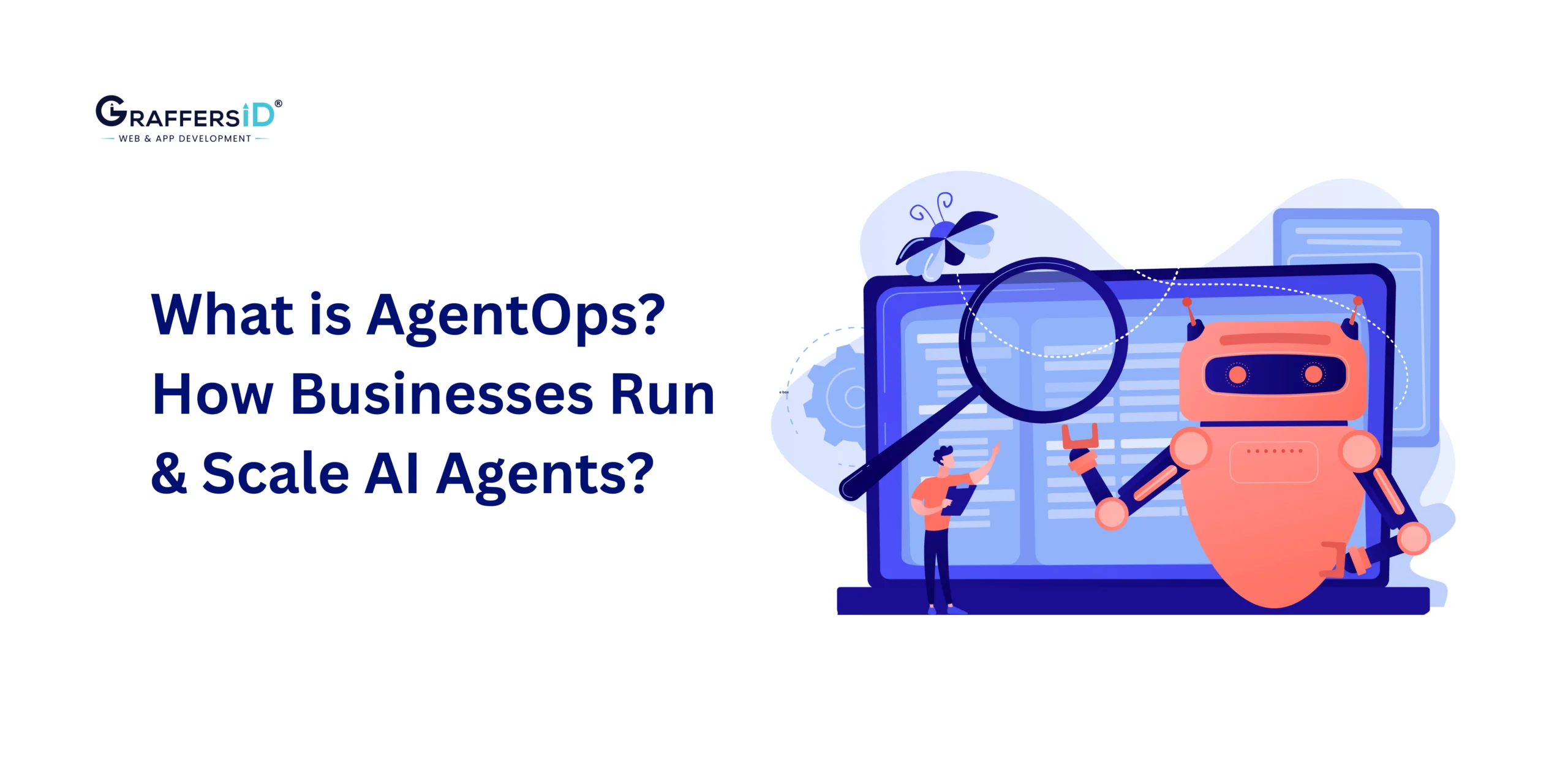
What is AgentOps?
AgentOps is the discipline of managing, monitoring, optimizing, and governing AI agents across their entire lifecycle.
Just like DevOps manages software releases and MLOps manages machine learning models, AgentOps ensures AI agents operate safely, reliably, and efficiently in real-world environments.
It focuses on how autonomous agents perform tasks such as:
-
Automated reasoning: interpreting context and making logical decisions.
-
Action planning & decision-making: choosing the next best step in multi-step workflows.
-
Tool use & API execution: interacting with databases, CRMs, browsers, or enterprise apps.
-
Workflow automation: completing tasks end-to-end without human involvement.
-
Multi-agent collaboration: coordinating with other agents to finish complex processes.
Read More: How to Build an AI Agent in 2026: A Strategic Guide for CTOs and Tech Leaders
In simple terms: AgentOps makes sure your AI agents behave predictably, stay safe, follow enterprise rules, and deliver consistent performance at scale.
Why Enterprises Need AgentOps in 2026?
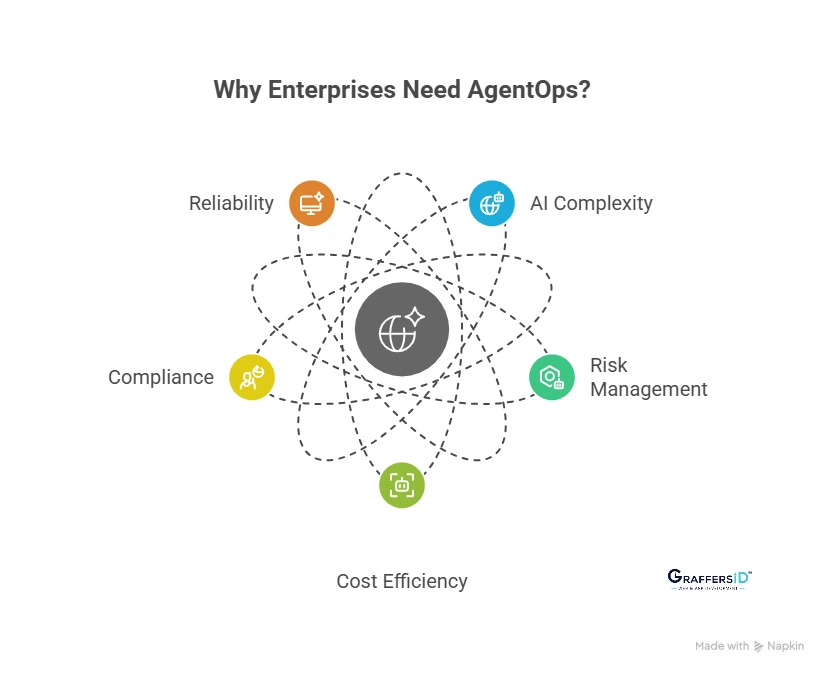
1. AI Agents Are Becoming More Complex: Modern agents now plan, reason, trigger APIs, and interact with enterprise tools, making their behavior harder to predict and monitor.
2. Higher Risks Without Proper Guardrails: Unsupervised agents may hallucinate actions, repeat tasks endlessly, leak sensitive data, or make unauthorized decisions.
3. Rising LLM and API Usage Costs: Poorly optimized agents can consume excessive tokens and API calls, dramatically increasing operational expenses.
4. Stronger Compliance and Audit Requirements: Sectors like finance, healthcare, and SaaS need transparent logs of agent decisions to meet 2026 audit and governance standards.
5. Demand for Reliable and Predictable AI Automation: Executives need AI systems that act consistently, safely, and within defined boundaries, not unpredictable black-box behaviors.
AgentOps provides a structured framework for monitoring, evaluating, and governing AI agents so enterprises can scale automation with confidence.
Key Components of AgentOps in 2026 (Core Features)
AgentOps offers the core capabilities enterprises need to monitor, evaluate, and scale AI agents safely. These core components ensure predictable, compliant, and high-performing agent behavior across production environments.
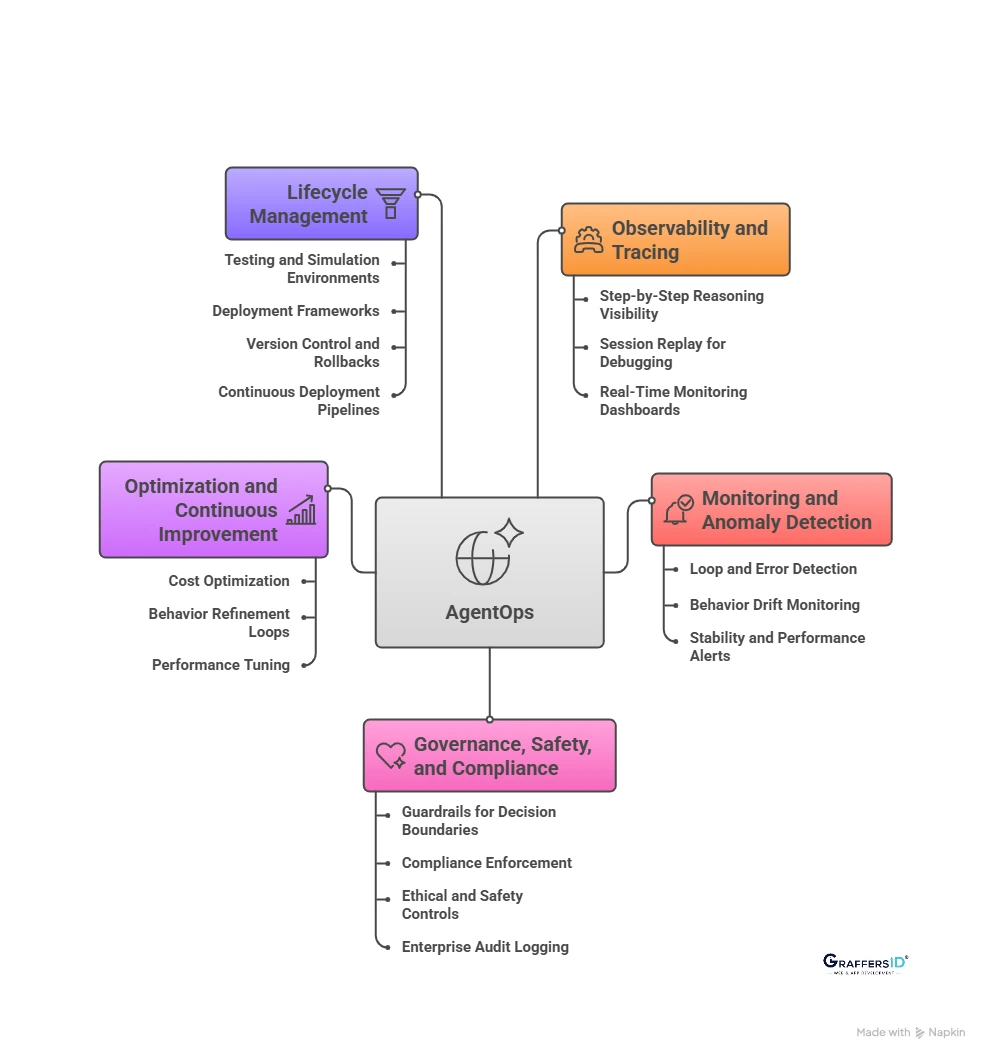
A: Observability and Tracing for AI Agents
Modern AI agents operate across multiple steps, tools, and decision paths. Observability helps teams understand exactly what the agent did, why it did it, and where things went wrong.
1. Step-by-Step Reasoning Visibility
Teams can inspect an agent’s reasoning patterns, chain-of-thought summaries, tool calls, and action sequences to understand why it made a specific decision. This clarity helps diagnose incorrect decisions quickly.
2. Session Replay for Debugging
Engineers can replay the agent’s entire workflow to see every step and interaction, making it easy to identify errors, bottlenecks, or unintended behaviors.
3. Real-Time Monitoring Dashboards
Live dashboards display latency spikes, throughput, decision accuracy, failure points, and downtime patterns, offering instant insight into system health.
Strong observability makes agent behavior transparent, traceable, and easier to optimize.
B: Monitoring and Anomaly Detection for AI Agents
AgentOps continuously analyzes agent behavior to detect problems or abnormalities before they impact production.
1. Loop and Error Detection
The platform flags infinite loops, repeated failures, or unexpected decision steps that signal unstable behavior.
2. Behavior Drift Monitoring
Teams can detect when an agent deviates from its usual reasoning style or expected workflow, producing unfamiliar outputs, preventing hallucinations and logic errors.
3. Stability and Performance Alerts
Real-time alerts notify teams about unusual latency, API error spikes, irregular tool usage, or anomalies in reasoning depth.
This proactive monitoring helps organizations prevent small issues from scaling into major outages, avoid costly downtime, and maintain agent reliability.
C: Governance, Safety, and Compliance Controls
As AI agents handle sensitive data and critical workflows, AgentOps ensures that AI agents operate within company policies, industry regulations, and ethical boundaries.
1. Guardrails for Decision Boundaries
Organizations can set strict rules around what an agent is allowed or restricted from doing, including data access, system actions, and tool usage.
2. Compliance Enforcement
Industries such as finance, insurance, healthcare, and legal benefit from built-in compliance checks to keep AI actions within regulatory standards.
3. Ethical and Safety Controls
Policies help prevent agents from executing harmful, biased, or unsafe actions, ensuring responsible AI usage.
4. Enterprise Audit Logging
Every decision, step, and action is logged with timestamps for complete auditability and governance visibility.
Read More: Agentic AI vs. AI Agents: Key Differences, Real-World Examples, and Business Use Cases (2026 Guide)
D: Optimization and Continuous Improvement for AI Agents
AgentOps uses real-time data to refine agent performance, reduce operational costs, and improve accuracy.
1. Cost Optimization
Teams can monitor LLM usage, token consumption, and API call patterns to prevent overspending on model operations.
2. Behavior Refinement Loops
Feedback loops help improve prompt structures, tool selection, and reasoning quality, making agents smarter over time.
3. Performance Tuning
AgentOps optimizes key metrics like latency, accuracy, throughput, and task success rate to deliver high-quality outcomes at scale.
E: Lifecycle Management for Enterprise AI Agents
AgentOps supports the full lifecycle, from testing and deployment to updates and scaling across enterprise environments.
1. Testing and Simulation Environments
Developers can validate agent behavior in sandbox environments before pushing changes to production.
2. Deployment Frameworks
Streamlined deployment flows allow teams to safely launch new agents or updated versions without disrupting workflows.
3. Version Control and Rollbacks
Enterprises can deploy new versions, so if a new update causes issues, teams can quickly revert to a stable agent version without downtime.
4. Continuous Deployment Pipelines
Automated pipelines support frequent, safe updates, ensuring agents stay up-to-date with the latest models, tools, and business rules.
Challenges Enterprises Face When Managing AI Agents Without AgentOps
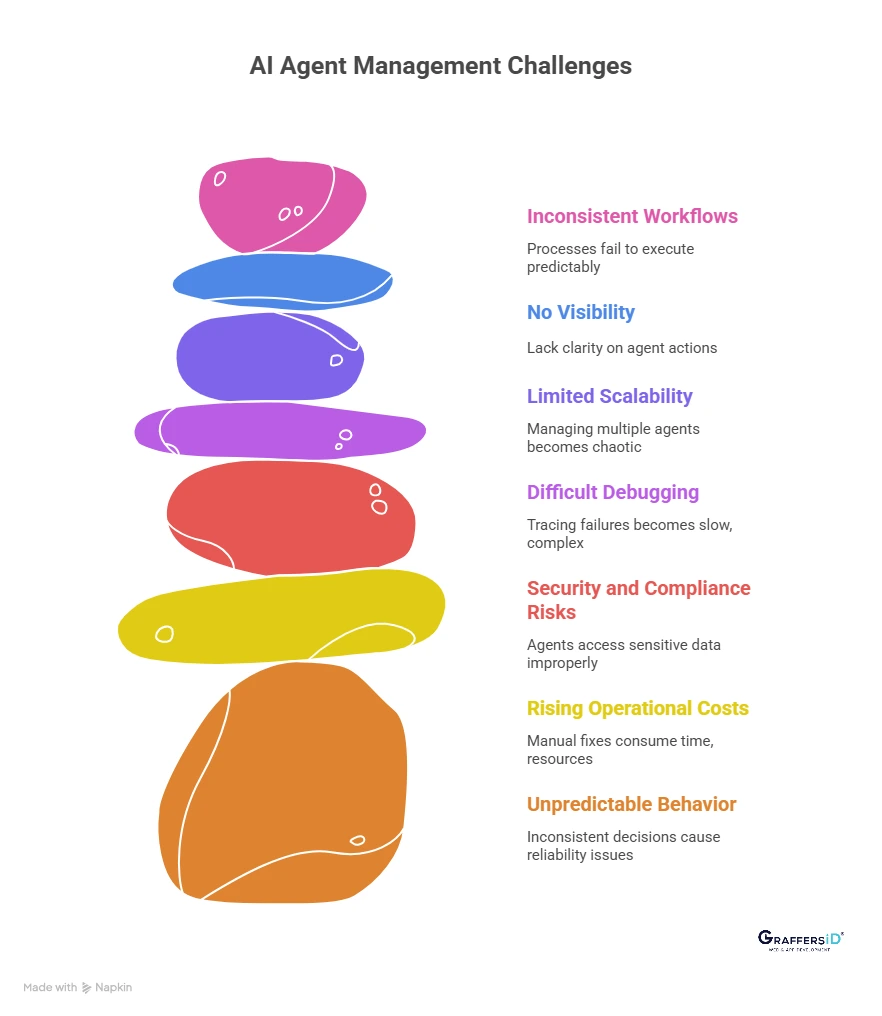
- Unpredictable Agent Behavior: AI agents often make inconsistent or incorrect decisions, creating reliability issues in real-world workflows.
- Rising Operational Costs: Teams spend significant time and resources manually fixing agent errors, re-running tasks, and monitoring performance.
- Security and Compliance Risks: Without structured oversight, agents may access sensitive data, violate policies, or produce outputs that fail compliance checks.
- Difficult Debugging and Troubleshooting: Tracing the root cause of failures becomes slow and complex because agent reasoning steps and actions are not logged properly.
- Limited Scalability for Multi-Agent Systems: Managing multiple agents or agentic workflows becomes chaotic, preventing organizations from scaling automation efficiently.
- No Visibility Into Agent Decision-Making: Teams lack clarity on why agents took certain actions, making it hard to evaluate reliability, accountability, or improvement paths.
- Inconsistent and Broken Workflows: Agentic processes fail to execute in a predictable sequence, leading to workflow disruptions and customer-facing errors.
Best Practices to Implement AgentOps Effectively in 2026
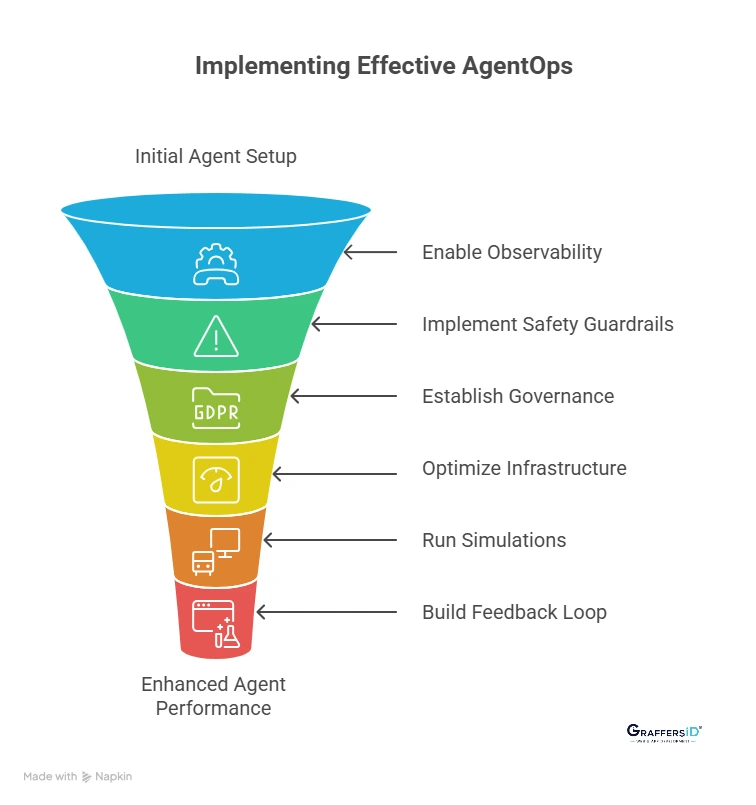
1. Enable Full Observability from the Start: Track every agent decision, tool call, workflow branch, and output so your team can quickly diagnose failures and optimize behavior.
2. Use Strong Multi-Layer Safety Guardrails: Set clear operational boundaries and safety rules to prevent unauthorized actions, hallucinations, and unintended agent behavior.
3. Create a Governance and Compliance Framework: Establish policies for data handling, audit trails, and model accountability, especially important for enterprises operating with sensitive or regulated data.
4. Optimize Infrastructure for Cost and Performance: Monitor compute usage, memory spikes, and tool-call frequency to manage cloud costs while keeping agents fast and reliable.
5. Run Regular Simulations and Stress Tests: Test agents in high-load, edge-case, and scenario-based environments before pushing changes to production to ensure stability.
6. Build a Continuous Feedback and Learning Loop: Collect user feedback, error patterns, and performance metrics to refine prompts, workflows, and reasoning over time.
7. Monitor Multi-Agent Collaboration Carefully: When multiple agents work together, track how they communicate, delegate tasks, and resolve conflicts to avoid cascading failures.
Read More: What Are Multi-Agent Systems in 2026? Architecture, Benefits, and Real-World Applications
How AgentOps Supports Multi-Agent Systems in 2026?
Multi-agent systems are now a core part of enterprise automation, where different agents handle specialized tasks and collaborate to complete workflows. AgentOps strengthens these systems by providing structure, stability, and predictable performance across all agents.
- Better Coordination Between Agents: AgentOps tracks interactions and handoffs between agents, ensuring tasks flow smoothly without overlaps or missing steps.
- Conflict-Free Decision-Making: It identifies conflicting actions or contradictory outputs in real time, preventing agents from working against each other.
- Smooth Task Delegation: AgentOps optimizes how tasks are assigned across agents, helping teams ensure the right agent handles the right job at the right time.
- Consistent Output Quality: It monitors variations in reasoning, accuracy, and reliability, helping maintain consistent performance even as task complexity grows.
- Reliable Agent-to-Agent Communication: AgentOps observes message exchanges and reasoning chains, ensuring agents share information clearly and follow the intended workflow structure.
- Predictable Multi-Agent Behavior: By enforcing rules, testing scenarios, and evaluating outcomes, AgentOps helps enterprises maintain stability across large, collaborative AI ecosystems.
Conclusion: AgentOps is Now Essential for Safe and Scalable AI Automation in 2026
AI agents have moved from experimental tools to mission-critical systems in 2026, and with that shift comes the need for stronger monitoring, governance, and operational control. AgentOps fills this gap by giving enterprises the visibility, evaluation, and optimization layers required to run AI agents safely at scale.
With the right AgentOps framework, businesses can build AI systems that are reliable, transparent, cost-efficient, compliant, and scalable. AgentOps is no longer optional; it’s the foundation of enterprise-grade AI automation.
If you want to build AI agents that perform consistently in real-world environments, investing in the right operational layer is the fastest way to stay ahead in 2026.
GraffersID helps companies design, develop, and scale AI automation systems with end-to-end reliability. Whether you need AI developers, custom AI solutions, or remote AI talent, our teams ensure your agents are production-ready and enterprise-safe.
Looking to hire AI developers or build advanced AI agents? Contact GraffersID to get started.