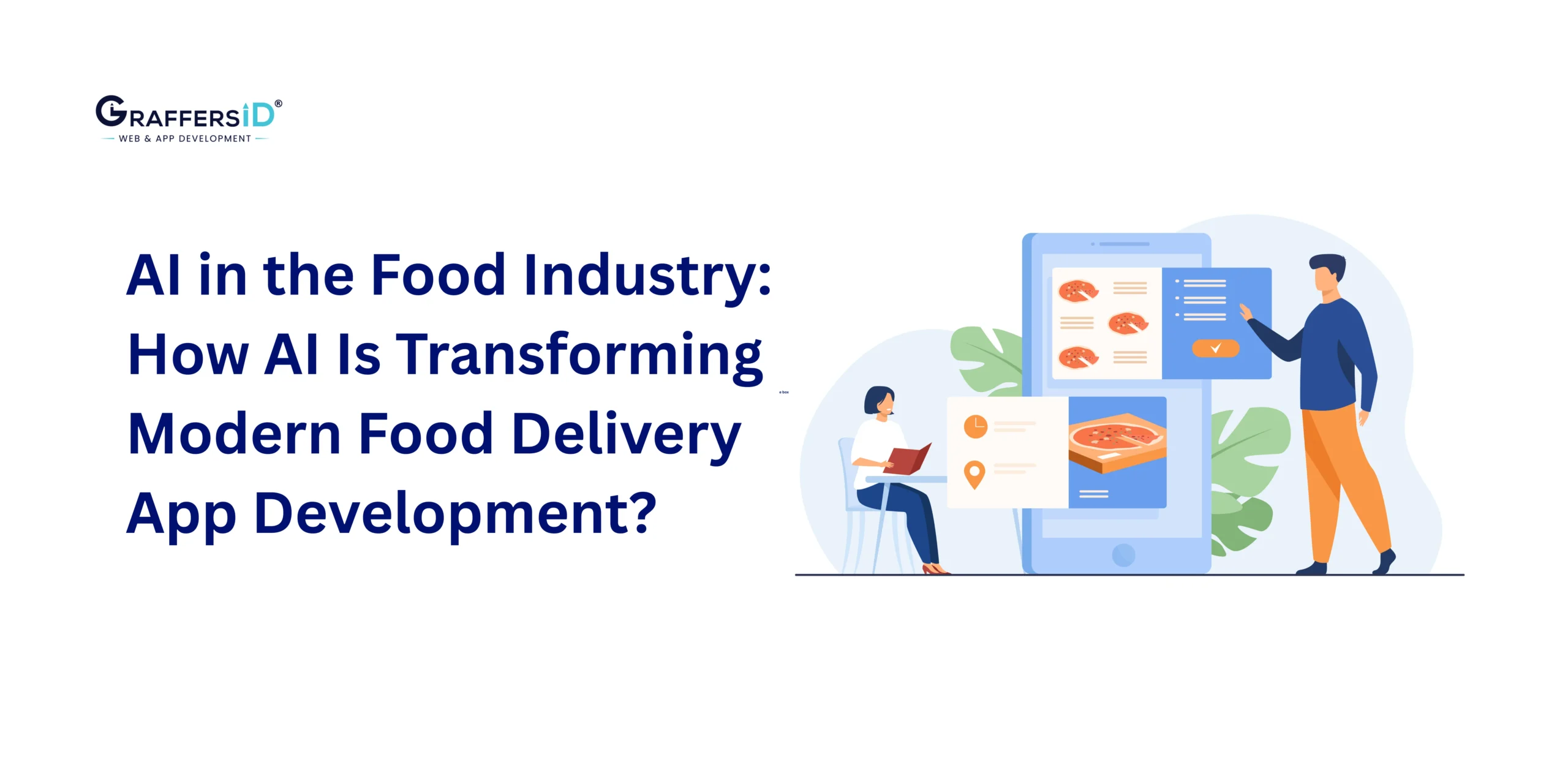
The food industry in 2026 is being reshaped by AI at every step, from how customers discover meals to how kitchens prepare and deliver orders. Food delivery apps have evolved far beyond simple ordering systems. Today’s users expect hyper-personalized recommendations, lightning-fast delivery, transparent food safety updates, accurate real-time tracking, and sustainable operations by default.
Behind these experiences is a new generation of AI systems powering demand forecasting, smart routing, automated kitchens, inventory prediction, driver optimization, and dynamic pricing. Restaurants, cloud kitchens, and food-tech startups that fail to adopt these AI capabilities are already falling behind.
For CTOs, CEOs, and product leaders, one question now determines competitive advantage:
How do you build an AI-powered food delivery app that can survive and scale in 2026 and beyond?
This blog gives you a complete, up-to-date roadmap, covering the latest AI innovations, essential 2026-ready features, architectural choices, and the technology stack you need to build (or upgrade) a future-proof food delivery platform.
Latest AI Trends Transforming the Food Industry in 2026
AI is reshaping how food brands operate, from customer experience to kitchen workflows. Here are the biggest trends defining the industry in 2026:
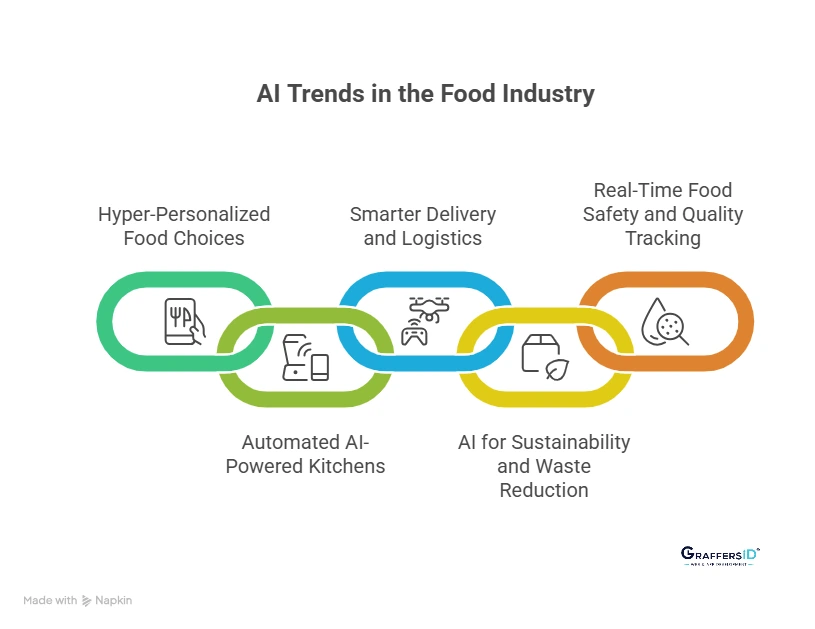
1. Hyper-Personalized Food Choices: Apps now use AI to recommend meals based on lifestyle, diet preferences, allergies, health goals, and even mood patterns.
2. Automated AI-Powered Kitchens: Restaurants and cloud kitchens rely on AI for demand forecasting, automated prep scheduling, ingredient planning, and efficient order management.
3. Smarter Delivery and Logistics: AI systems optimize delivery routes, reduce delays, and provide highly accurate real-time ETAs to enhance customer satisfaction.
4. AI for Sustainability and Waste Reduction: Predictive analytics help food businesses cut waste, optimize sourcing, and maintain sustainable operations demanded by modern consumers.
5. Real-Time Food Safety and Quality Tracking: AI enables transparent ingredient verification, contamination alerts, traceability, and compliance monitoring across the supply chain.
These trends show that food delivery apps in 2026 are no longer just ordering platforms; they are intelligent, end-to-end systems powering the entire food ecosystem.
Looking to build a high-performance food delivery app? Hire expert food delivery app developers from GraffersID.
AI Use Cases for Food Delivery Apps in 2026
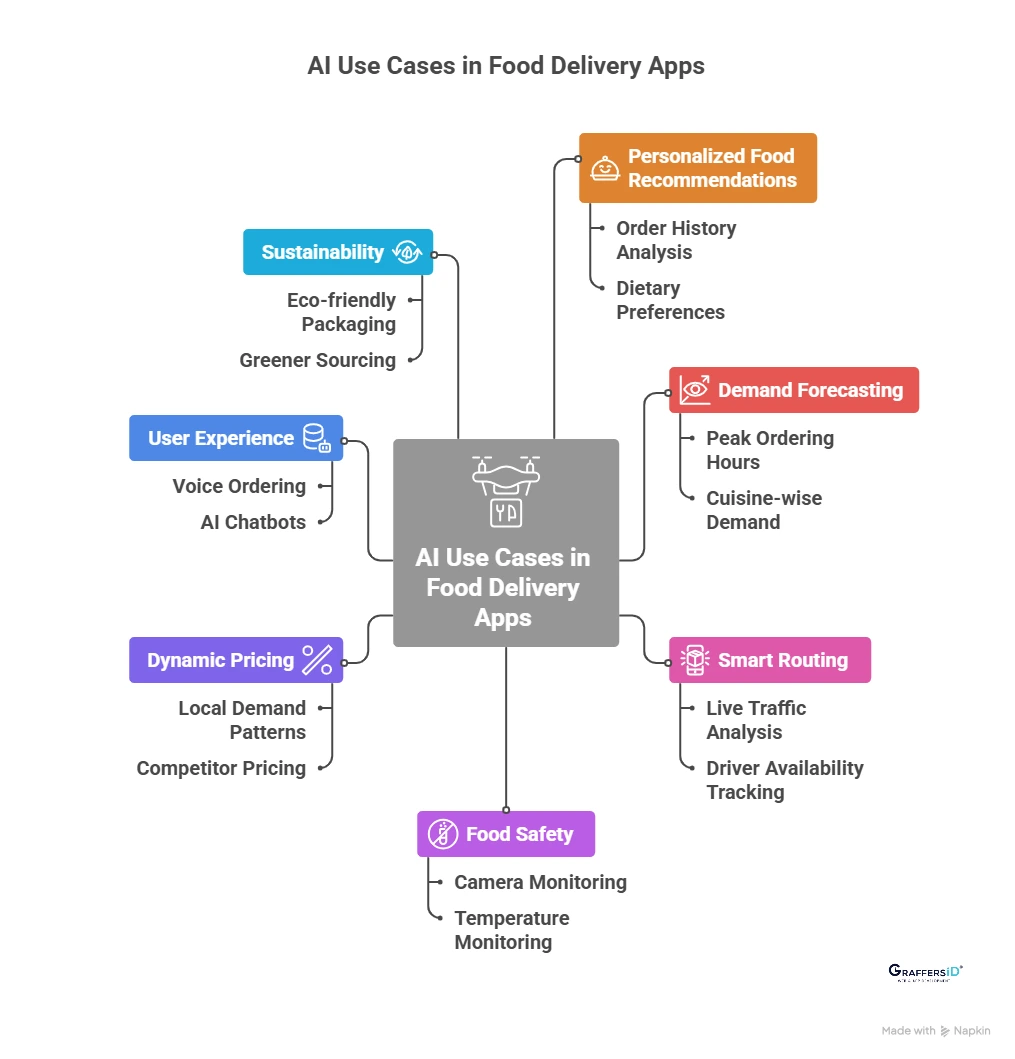
1. AI-Powered Personalized Food Recommendations
AI recommendation engines have become a core feature of every modern food delivery app. In 2026, these systems analyze multiple data points to deliver highly personalized meal choices and targeted offers.
How AI Personalizes Food Recommendations?
-
Order history analysis: Suggests dishes and restaurants based on past ordering patterns.
-
Dietary and cuisine preferences: Tailors recommendations for vegetarian, vegan, keto, high-protein, or cuisine-specific tastes.
-
Time-based behavior: Predicts cravings based on daily and weekly ordering habits (morning meals, late-night snacks, and weekend treats).
-
Weather-based suggestions: Recommends comfort foods, cold beverages, or hot meals based on local weather conditions.
-
Health and nutrition goals: Suggest calorie-conscious, macro-friendly, or diet-compliant meals.
-
Local food trends: Highlights trending dishes or popular restaurants in the user’s city.
-
Smart dynamic offers: Generates personalized combos, discounts, and upsell suggestions to increase average order value (AOV).
This level of personalization improves customer satisfaction, increases retention, and helps food delivery apps stay competitive in 2026.
2. AI Demand Forecasting and Smarter Inventory Planning
AI helps restaurants and cloud kitchens predict demand with high accuracy so they can plan inventory, reduce waste, and run operations more efficiently. In 2026, demand forecasting is essential for every food delivery platform.
What AI Predicts in Real Time?
-
Peak ordering hours: Identifies lunch/dinner rush and micro-surges throughout the day.
-
Cuisine-wise demand: Shows which cuisines will perform best in specific locations.
-
Location-based patterns: Maps ordering behavior area by area for better supply planning.
-
Event-driven spikes: Detects surges during festivals, sports events, holidays, or weather changes.
-
Ingredient usage trends: Predict raw material consumption to avoid overstocking or stockouts.
Example:
A cloud kitchen using AI may cut food waste by 18–25% by forecasting ingredient demand accurately.
This is also crucial for delivery platforms offering restaurant dashboards or B2B ecosystem tools.
3. Smart Routing Delivery and Real-Time ETA Accuracy
Smart route planning is one of the biggest factors that improve delivery speed and customer satisfaction. In 2026, food delivery apps use AI systems that analyze multiple data sources in real time to reduce delays and improve ETA accuracy.
Key AI Capabilities Used in Delivery Routing
-
Live traffic analysis: AI predicts congestion patterns and finds the fastest available route instantly.
-
Historical route behavior: Models learn from past delivery data to anticipate high-demand zones and recurring delays.
-
Weather-based route adjustments: AI modifies routes during rain, heatwaves, or storms to avoid slowdown areas.
-
Driver availability tracking: Dispatch systems assign the most suitable delivery partner based on proximity and performance.
-
Cluster-based order grouping: AI groups nearby orders to reduce travel distance and increase delivery efficiency.
-
Micro-route optimization: Hyperlocal insights help drivers take optimized shortcuts and street-level alternatives.
-
Predictive delay modelling: Systems forecast potential disruptions before they happen and adjust ETAs dynamically.
This allows apps to assign orders automatically, reduce delays, and deliver with remarkable accuracy.
4. AI for Food Safety, Quality Checks, and Traceability
In 2026, customers want complete transparency about how their food is prepared and delivered. AI now plays a critical role in ensuring safe, high-quality, and fully traceable meals across food delivery platforms.
How AI Improves Food Safety and Quality?
-
AI-powered camera monitoring: Detects hygiene issues, unsafe handling, or quality deviations inside kitchens in real time.
-
Ingredient traceability tracking: Maps every ingredient from supplier to kitchen, helping users verify food origin and safety.
-
Temperature monitoring automation: Uses sensors and vision AI to ensure food is stored and delivered at safe temperatures.
-
Hygiene compliance detection: Identifies whether staff are following safety standards, glove usage, cleanliness, handling protocols, etc.
-
Spoilage and contamination alerts: Flags expired, spoiled, or contaminated ingredients before they reach the cooking stage.
-
Restaurant compliance verification: Validates kitchen practices against local food safety regulations for safer user experiences.
AI-driven food safety builds stronger trust, especially in health-conscious regions like the US, UK, and Europe.
5. AI-Based Dynamic Pricing and Custom Promotions
AI-powered dynamic pricing has become one of the strongest revenue drivers for food delivery apps in 2026. Modern systems adjust prices in real time, helping platforms increase profitability while giving users relevant and timely deals.
How AI Decides the Best Price?
-
Local demand patterns: AI tracks real-time order demand across specific areas to adjust pricing accordingly.
-
Inventory levels: Surplus or shortage triggers automated discounts or premium pricing to balance stock.
-
Restaurant workload: If kitchens face backlogs, AI slows order inflow by adjusting price or wait-time incentives.
-
Historical purchase trends: Models analyze repeat behavior to predict what users are most likely to buy and at what price.
-
Weather and environmental factors: Rain, heatwaves, and seasonal shifts influence order spikes, enabling smarter surge pricing.
-
Competitor pricing signals: AI monitors nearby platforms to stay competitive without compromising margins.
-
Peak-hour prediction: Expected traffic patterns allow preemptive pricing changes before demand surges.
Apps can offer personalized discounts or surge pricing strategies that maximize both user value and platform profitability.
6. Better User Experience with AI Assistants and Voice Ordering
AI-powered assistants are transforming how users interact with food delivery apps in 2026. They make ordering faster, easier, and more personalized across mobile, web, smart devices, and in-car systems.
What AI Assistants Help Users Do?
-
Get personalized food recommendations based on taste, order history, mood, time of day, and diet goals.
-
Filter meals by calories, allergens, dietary needs, or ingredients for instant, accurate decision-making.
-
Track orders in real time with predictive updates powered by AI route optimization.
-
Resolve customer support queries instantly using AI chatbots integrated with live agent escalation.
-
Reorder favorite meals quickly with one-tap suggestions or automated reminders.
-
Place orders using voice commands, now widely used on smart speakers, cars, and IoT devices for hands-free ordering.
Voice-based ordering continues to grow rapidly in 2026 as users expect convenience on the go, making it a must-have feature for modern food delivery apps.
7. AI for Sustainability and Waste Reduction
AI-driven sustainability features are now essential for food delivery apps in 2026. Modern platforms use AI to cut waste, reduce costs, and meet rising consumer expectations for eco-friendly operations.
How AI Supports Sustainability in Food Delivery?
-
Predicts surplus food: AI forecasts excess production so restaurants can adjust prep volumes and avoid unnecessary waste.
-
Minimizes food waste: Smart inventory models identify slow-moving items and suggest timely promotions or redistribution options.
-
Recommends eco-friendly packaging: AI analyzes order patterns to suggest recyclable, compostable, or minimal packaging alternatives.
-
Optimizes delivery routes for fuel efficiency: Intelligent routing reduces delivery mileage, fuel consumption, and carbon emissions.
-
Promotes greener sourcing: AI flags sustainable suppliers and helps restaurants choose environmentally responsible ingredients.
-
Provides carbon footprint insights: Apps offer real-time data on CO₂ impact per order, improving transparency and regulatory compliance.
Food delivery platforms that prioritize sustainability not only win customer trust but also gain long-term regulatory benefits and brand differentiation.
Technology and Architecture Behind AI Delivery Apps in 2026
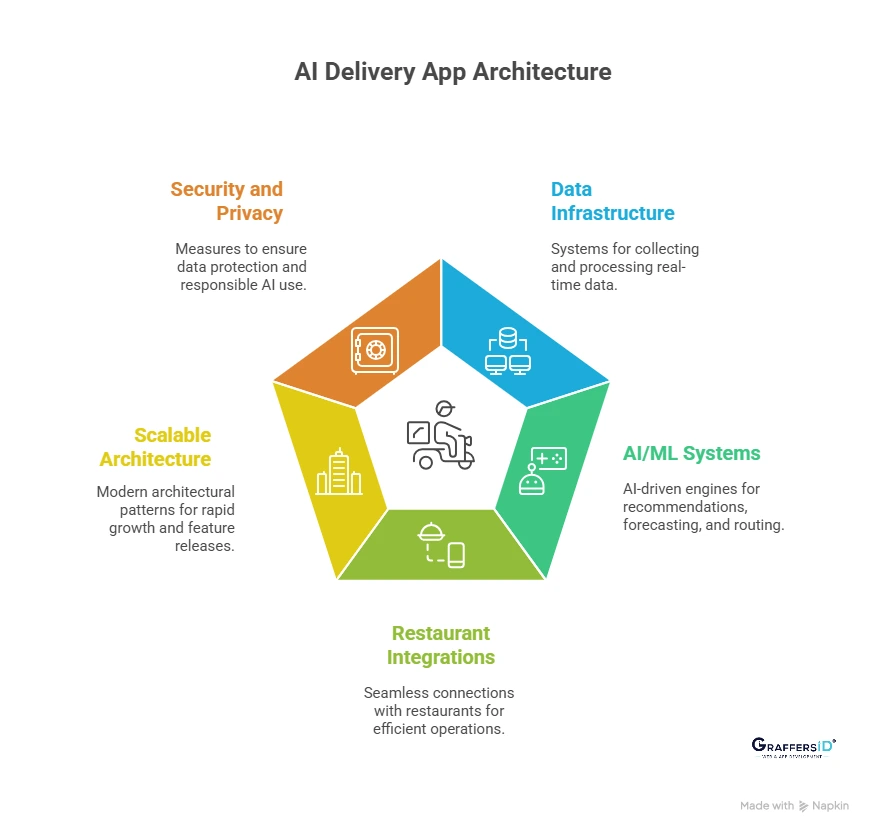
1. Data Infrastructure and Collection Systems
A scalable AI-driven food delivery app requires:
-
Real-time order data
-
Customer preference data
-
Inventory and supply insights
-
Delivery partner data
-
Restaurant operational metrics
-
Location intelligence
Data pipelines must be built for streaming, processing, cleaning, and modelling.
2. AI/ML Systems You Need to Build
A modern delivery app typically includes:
-
Recommendation Engine (ML-based)
-
Forecasting Models (time series, LLM-enhanced predictions)
-
Routing and Dispatch Engine
-
Dynamic Pricing System
-
Fraud Detection & Quality Monitoring Models
These systems often run on microservices, enabling real-time scalability.
3. Integrations With Restaurants and Cloud Kitchens
To offer restaurant partners powerful tools, your app needs:
-
POS integrations
-
Inventory management sync
-
Menu and pricing APIs
-
Kitchen automation dashboards
-
Real-time order management
These integrations enable a smooth ecosystem experience.
4. Scalable App Architecture for 2026
Modern architectures include:
-
Microservices
-
Modular AI services
-
Vector databases for personalization
-
Edge AI for smart kitchens
-
Serverless pipelines
-
Real-time event-driven systems
This supports rapid feature releases and multi-region scalability.
5. Security, Data Privacy, and Responsible AI
Critical requirements include:
-
Data encryption
-
GDPR/CCPA compliance
-
AI explainability
-
Audit logs
-
Human oversight for quality-sensitive decisions
-
Transparent disclaimers for AI recommendations
Trust is a major ranking factor in 2026.
Read More: What Is an AI Appointment Scheduling Agent? Benefits, Use Cases, and Setup (2026)
Key Challenges in Building AI-Powered Food Delivery Apps in 2026
Building an AI-enabled food delivery platform in 2026 comes with technical, regulatory, and operational challenges that businesses must be prepared to manage.
1. High AI Setup Costs and Unclear ROI: Implementing AI models, data pipelines, and automation systems requires significant upfront investment, and ROI timelines may vary based on scale.
2. Fragmented and Inconsistent Data: Data from users, restaurants, drivers, and kitchen systems is often unstructured, making AI training and decision-making less accurate.
3. Stricter Food Safety and Compliance Rules: New traceability, hygiene, and labeling regulations require apps to maintain transparent, AI-validated safety workflows.
4. Slow Adoption by Restaurants and Kitchens: Many partner kitchens still hesitate to use AI insights, automation suggestions, or predictive inventory systems.
5. Ethical, Safety, and Brand-Reputation Risks: Incorrect AI recommendations, delivery errors, or mislabeled safety alerts can damage customer trust and lead to regulatory penalties.
How to Build an AI-Powered Food Delivery App in 2026? Step-by-Step Guide
Building an AI-driven food delivery platform in 2026 requires a structured roadmap that ensures scalability, reliability, and fast market adoption.

1. Foundation Phase: Set Up the Core System
Establish the essential infrastructure and define how AI will power the platform.
-
Build the core app architecture: Develop user flows for ordering, payments, tracking, and restaurant onboarding.
-
Create data pipelines: Set up systems to collect customer, delivery, menu, and operational data.
-
Define AI use cases: Identify priority models such as recommendations, routing, demand forecasting, or pricing.
2. Pilot Phase: Test Early AI Models
Validate the performance of initial AI components with a controlled rollout.
-
Run recommendation engine tests: Evaluate the accuracy of personalized meal suggestions.
-
Launch limited routing experiments: Deploy AI-based delivery routing for select regions or partners.
3. Expansion Phase: Add Advanced AI Features
Enhance platform capability with deeper automation and restaurant-first features.
-
Enable dynamic pricing: Adjust delivery charges or offers based on real-time demand.
-
Add kitchen forecasting models: Predict prep times, order volume, and inventory usage.
-
Introduce partner dashboards: Give restaurants AI insights on sales, demand patterns, and performance metrics.
4. Scaling Phase: Expand to Multi-Region Operations
Ensure the platform performs reliably as operations grow.
-
Enable cross-city or multi-region delivery: Configure geo-based scaling and infrastructure expansion.
-
Optimize performance at scale: Improve latency, load balancing, and model accuracy for heavy traffic.
5. Sustainability and Compliance Phase
Integrate AI tools to meet regulatory requirements and reduce environmental impact.
-
Implement eco-routing models: Optimize delivery paths for lower fuel use and emissions.
-
Add waste prediction models: Help restaurants reduce surplus production and food waste.
6. Governance Phase: Ensure Responsible AI
Build trust with transparent and compliant AI operations.
-
Add audit trails: Track AI decisions for compliance and accountability.
-
Use explainable AI frameworks: Provide clarity on recommendations, pricing, and routing decisions.

Conclusion: AI Is the New Competitive Advantage in Food Delivery
AI is transforming the food delivery industry at a pace the market has never seen before. In 2026, the apps that lead the market aren’t just fast or convenient; they are intelligent, predictive, sustainable, and deeply personalized. Platforms using AI for recommendations, routing, kitchen automation, and waste reduction are outperforming competitors on every metric: delivery speed, customer satisfaction, retention, and operational efficiency.
AI is no longer an “add-on.” It is the core foundation of every successful platform in 2026 and beyond.
GraffersID helps startups and enterprises build AI-powered applications, custom food delivery platforms, automation systems, and high-performance mobile/web apps. We also provide dedicated remote AI developers and engineering teams to accelerate your product roadmap.
Ready to build a future-ready food delivery app?
Connect with GraffersID and scale faster with expert AI developers in 2026.