Large Language Models are no longer experimental add-ons. In 2026, they power core IT workflows, from software development and QA automation to internal tools, documentation systems, and AI-driven agents running in production.
For CTOs, CEOs, and product leaders, the conversation has moved past whether to adopt AI. The real challenge now is choosing the right LLM for your workflows, costs, and scale, without slowing teams down or inflating operational risk.
This guide breaks down Claude vs. Gemini for real-world IT workflows in 2026. Instead of focusing only on benchmarks, it compares how each model performs across coding, automation, reasoning, cost efficiency, and scalability, so you can make a clear, ROI-driven decision for your organization.
What is Anthropic Claude LLM?
Claude is Anthropic’s large language model built specifically for enterprise reasoning, safety, and explainability. As of early 2026, the latest widely adopted version is Claude 3.7 Sonnet.
Claude is designed for high-stakes IT workflows where accuracy, transparency, and instruction-following matter more than raw speed. This makes it a strong choice for organizations that rely on AI for architectural decisions, code reviews, and compliance-sensitive automation.
Key Strengths of Claude LLM in 2026
-
Strong performance on complex reasoning and planning tasks
-
Lower hallucination rates in real-world production systems
-
Reliable JSON and structured output generation for automation
-
Excellent comprehension of technical documentation and specifications
What is Google Gemini LLM?
Gemini is Google’s multimodal large language model designed for scale, speed, and high-volume execution. As of early 2026, the most commonly used enterprise variant is Gemini 2.5 Pro.
Gemini is optimized for organizations that need to process large amounts of data, code, and multimodal inputs efficiently, making it ideal for enterprise automation and large-scale IT operations.
Key Strengths of Gemini LLM in 2026
-
Exceptional long-context understanding
-
Native support for image, document, and video analysis
-
Competitive pricing for enterprise-scale usage
-
Deep integration with Google Cloud and Workspace tools
Claude vs. Gemini Architecture: How They Work and Why It Matters in 2026?
Understanding how Claude and Gemini are built helps explain why they behave differently in real production environments.
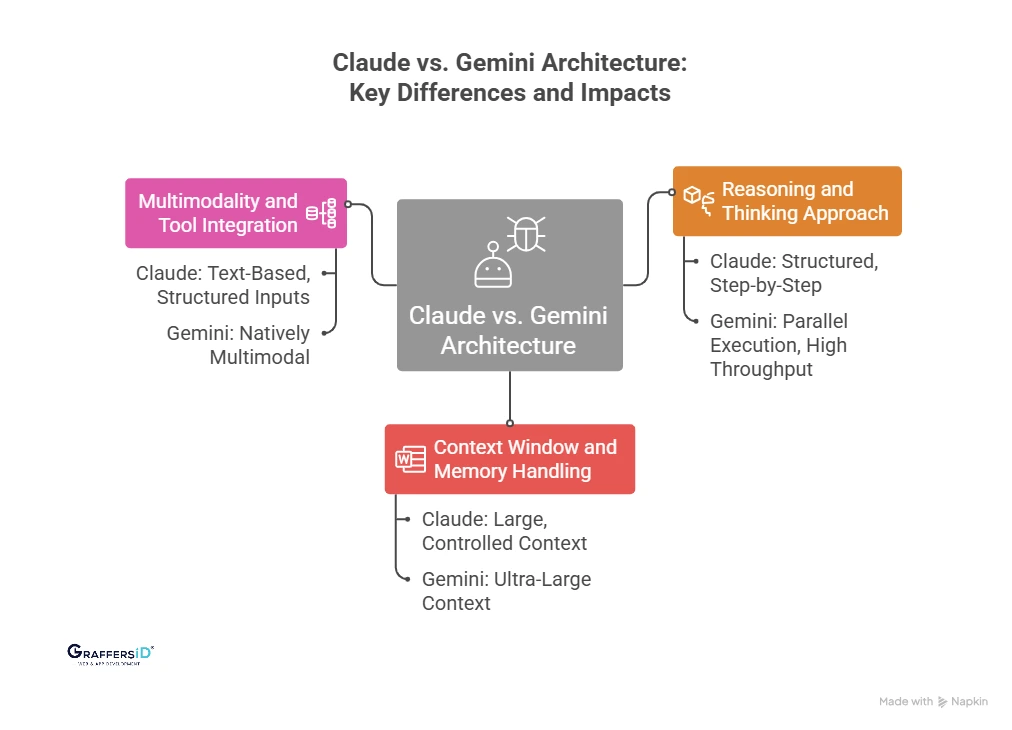
1. Reasoning and Thinking Approach
Claude is designed around structured, step-by-step reasoning. It focuses on accuracy, logical consistency, and explainable outputs, which makes it well-suited for tasks where decisions must be reviewed, validated, or audited.
Gemini uses a thinking-first architecture optimized for parallel execution and high throughput. This allows it to process large volumes of tasks quickly, making it effective for execution-heavy workflows.
Impact on real-world IT workflows
-
Claude performs better in decision-heavy workflows such as architecture planning, code reviews, and debugging
-
Gemini performs better in execution-heavy workflows such as large-scale code generation and automation pipelines
Read More: Claude vs. ChatGPT in 2026: Which AI Model Is Better for Business, Coding, and Automation?
2. Context Window and Memory Handling
Context window size determines how much information a model can process at once.
Claude supports large but controlled context windows, prioritizing precision and relevance over raw volume. This helps reduce errors when working with complex logic or critical business rules.
Gemini supports ultra-large context windows, often exceeding one million tokens, enabling it to ingest entire codebases, documentation sets, or datasets in a single pass.
Impact on real-world IT workflows
-
Gemini is ideal for analyzing large repositories, monorepos, and extensive documentation
-
Claude is better when accuracy, consistency, and reasoning depth are more important than volume
3. Multimodality and Tool Integration
Gemini is built as a natively multimodal LLM, meaning it can process text, images, diagrams, and structured data together. This makes it effective for workflows involving UI screenshots, architecture diagrams, or mixed-input automation.
Claude focuses primarily on text-based and structured inputs, which align well with documentation, code, specifications, and logic-driven workflows.
Impact on real-world IT workflows
-
Gemini fits multimodal IT workflows and data-rich automation
-
Claude fits structured, text-heavy, and compliance-sensitive workflows
Claude vs. Gemini Performance for IT Workflows in 2026
When comparing Claude vs. Gemini for IT workflows, both models deliver strong results, but they are optimized for different types of engineering and automation tasks. Understanding where each model performs best helps IT leaders design faster, more reliable AI-powered systems.
1. For Coding and Software Development
Both Claude and Gemini are widely used for software development in 2026, but their strengths vary based on the nature of the task.
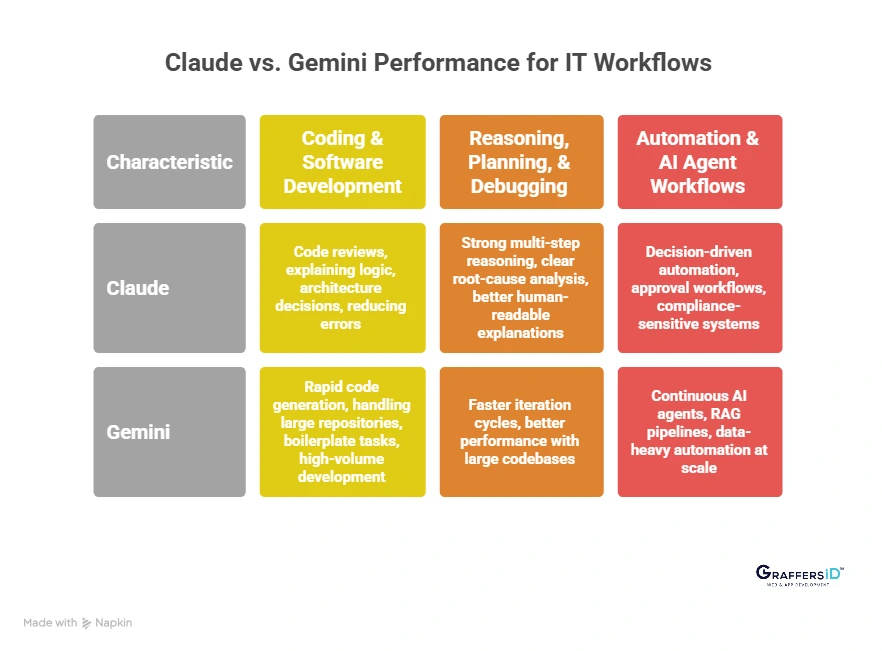
Claude performs better for
-
Code reviews and refactoring, especially in mature or legacy codebases
-
Explaining complex logic in existing applications, making it easier for teams to onboard and maintain systems
-
Architecture decisions and design reviews, where multi-step reasoning and trade-off analysis matter
-
Reducing logical errors in production code, thanks to more consistent reasoning and validation
Claude is often preferred when accuracy, clarity, and long-term maintainability are more important than raw speed.
Gemini performs better for
-
Rapid code generation, including features, components, and utilities
-
Handling large repositories and monorepos, where massive context windows provide an advantage
-
Boilerplate and repetitive coding tasks, such as API scaffolding and integrations
-
High-volume development environments, where throughput and speed are critical
Gemini excels in scenarios where scale and execution speed drive developer productivity.
2. For Reasoning, Planning, and Debugging
For teams evaluating Claude vs. Gemini for reasoning and debugging, Claude consistently shows stronger performance in logic-heavy workflows.
Claude advantages
-
Strong multi-step reasoning, making it reliable for complex problem-solving
-
Clear root-cause analysis for bugs, reducing time spent diagnosing issues
-
Better human-readable explanations, useful for product managers, QA leads, and non-technical stakeholders
These strengths make Claude particularly valuable in mission-critical systems where errors are costly.
Gemini advantages
-
Faster iteration cycles, especially during active development
-
Better performance when debugging very large codebases, thanks to extended context handling
Gemini’s speed makes it well-suited for teams working on fast-moving products with frequent releases.
3. For Automation and AI Agent Workflows
In 2026, LLMs are no longer limited to chat interfaces; they power long-running AI agents and automation workflows across enterprises.
Claude works best for
-
Decision-driven automation, where outputs influence business actions
-
Approval workflows, such as finance, HR, or compliance processes
-
Compliance-sensitive systems, where explainability and consistency are essential
Claude’s reasoning-first design reduces risk in workflows that require trust and accountability.
Gemini works best for
-
Continuous AI agents that run across systems and tools
-
Retrieval-Augmented Generation (RAG) pipelines, processing large volumes of data
-
Data-heavy automation at scale, such as analytics, reporting, and operational workflows
Gemini is ideal for organizations focused on automation throughput and system-wide scale.
Claude vs. Gemini Pricing, Costs, and ROI in 2026
In 2026, IT leaders evaluate the total ROI of using an LLM based on accuracy, reliability, and the operational effort required to maintain AI-driven workflows.
Key cost factors IT leaders must consider:
- Token Usage and Retry Costs: Frequent retries caused by unclear or incorrect outputs can significantly increase token consumption, especially in high-volume workflows and automated systems.
- Debugging and Hallucination Management: Time spent identifying, correcting, and preventing hallucinated responses adds hidden costs that directly impact engineering productivity and delivery timelines.
- Engineering Time for Output Validation: LLMs that require extensive human validation slow down teams and reduce the overall efficiency gains expected from AI adoption.
Claude vs. Gemini Pricing
- Claude typically has a higher per-token cost, but its stronger reasoning and accuracy reduce rework, making it more cost-effective for precision-driven and compliance-sensitive workflows.
- Gemini offers lower costs at scale and higher throughput, delivering better ROI for large workloads, continuous automation, and data-heavy IT operations.
Claude vs. Gemini: Best LLM for Common IT Use Cases in 2026
1. Best LLM for Product Engineering Teams
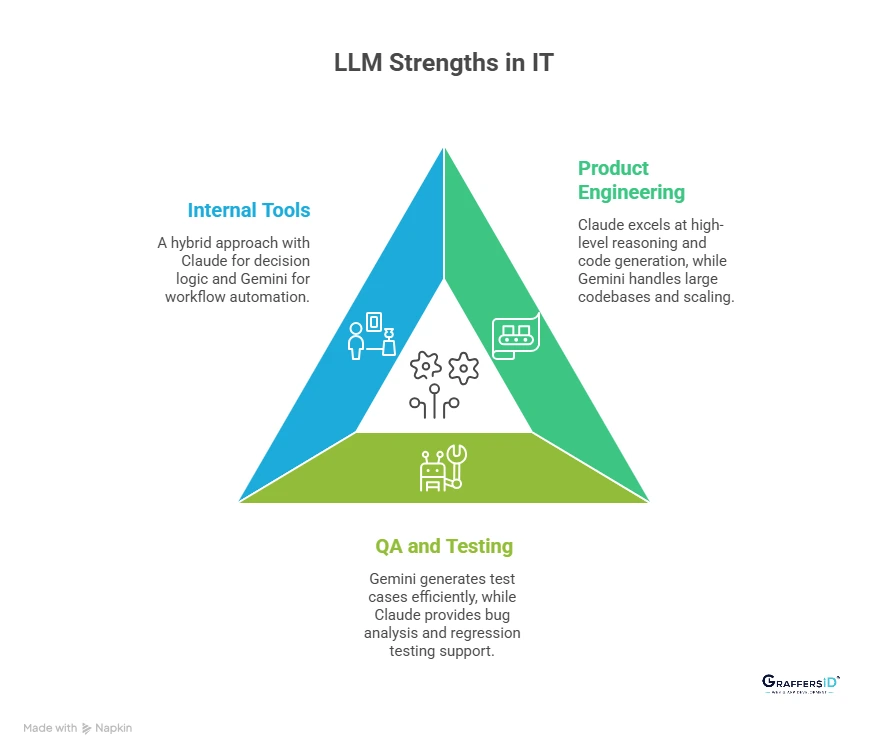
- Feature Planning and System Architecture: Claude excels at high-level reasoning, making it ideal for planning features, designing system architecture, and evaluating technical trade-offs before development begins.
- Code Generation and Engineering at Scale: Gemini handles large codebases efficiently, enabling faster code generation, framework setup, and scaling across distributed engineering teams.
- Code Reviews and Performance Optimization: Claude provides clearer explanations and more accurate logic checks, helping teams improve code quality, reduce technical debt, and optimize performance.
2. Best LLM for QA and Testing Automation
- Automated Test Case Generation: Gemini’s scale and speed make it well-suited for generating large volumes of test cases across applications, platforms, and environments.
- Bug Analysis and Root Cause Explanation: Claude performs better at explaining why issues occur, reproducing bugs logically, and supporting faster resolution during QA cycles.
- Regression Testing Pipelines: Gemini works efficiently in continuous testing environments, supporting automated regression testing within CI/CD and large QA pipelines.
3. Best LLM for Internal Tools and Business Process Automation
- CRM and ERP Workflow Automation: A hybrid approach works best, with Claude handling decision logic and Gemini executing large-scale workflow automation across systems.
- Document Processing and Knowledge Systems: Gemini’s large context window makes it ideal for processing long documents, internal knowledge bases, and enterprise documentation.
- Approval Flows and Decision-Based Automation: Claude’s reasoning accuracy makes it a stronger choice for approval workflows, compliance checks, and rule-based decision automation.
How to Choose the Best LLM for Your Business in 2026?
Selecting the right large language model in 2026 depends less on hype and more on how well the model aligns with your business workflows, scale, and risk tolerance. Below is a practical framework used by modern IT and product leaders.
When to Use Claude?
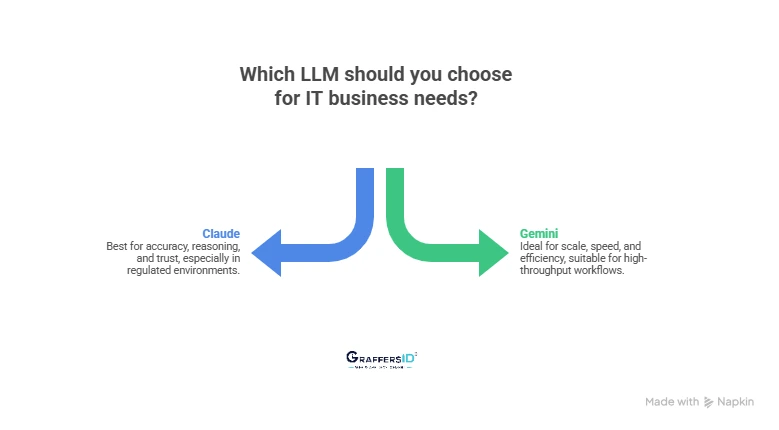
Choose Claude if you need accuracy, reasoning, and trust:
- High reasoning accuracy: Claude performs well in logic-heavy tasks such as architectural planning, complex debugging, and multi-step decision-making, where accuracy matters more than speed.
- Explainable AI outputs: Claude generates clear, human-readable explanations, making it easier for engineering leaders, auditors, and non-technical stakeholders to understand and trust AI-driven decisions.
- Enterprise compliance and reliability: Claude is often preferred in regulated or risk-sensitive environments due to its focus on safer outputs, reduced hallucinations, and predictable behavior in production workflows.
When to Use Google Gemini?
Choose Gemini if you need scale, speed, and efficiency:
- Large-scale automation: Gemini is optimized for high-throughput workflows, making it ideal for continuous automation, agent-based systems, and large development pipelines.
- Cost efficiency at volume: For organizations processing large token volumes, Gemini typically delivers better cost-to-performance efficiency, especially in execution-heavy use cases.
- Multimodal inputs and massive context: Gemini excels at handling large codebases, extensive documentation, and multimodal inputs like images, diagrams, and structured data in a single workflow.

Final Verdict: Claude vs. Gemini
There is no single “best” large language model in 2026. The right choice depends on how your business builds, scales, and operates its IT workflows.
Claude and Gemini each excel in different areas. Claude delivers stronger reasoning, explainability, and reliability for decision-critical tasks, while Gemini offers speed, scale, and efficiency for high-volume automation. The most successful organizations don’t treat this as an either-or decision; they match the right LLM to the right task.
The smart choice is to use a hybrid strategy; use Claude for reasoning and validation, and Gemini for execution and scale.
Build Production-Ready AI Workflows with GraffersID
At GraffersID, we help businesses move beyond AI pilots and into scalable, production-ready AI solutions. Our remote AI developers specialize in building AI-powered solutions, web and mobile applications.
Contact GraffersID to hire AI developers and build future-ready IT solutions for 2026 and beyond.