Every second, millions of financial transactions cross global networks. Fraud engines probe for gaps. Customers expect loan approvals in seconds. Regulators demand audit trails in real time. And somewhere in the middle of all this, your team is still running on rules written for a different era.
This is the defining tension of finance in 2026: complexity is outpacing the systems built to manage it. AI has moved decisively from pilot project to core infrastructure.
Across banks, NBFCs, fintech platforms, and enterprise finance teams, machine learning, generative AI, and predictive analytics are no longer optional upgrades; they are the operating model. The institutions pulling ahead aren’t asking whether to adopt AI. They’re asking how fast, how deep, and how responsibly.
This blog answers the questions decision-makers are actively searching for:
- What is artificial intelligence in finance, and how is it different from traditional automation?
- How is AI used in banking and financial services today?
- What are the real benefits and risks of AI in finance?
- How can CTOs, CEOs, and product leaders implement finance automation responsibly and at scale?
If you’re evaluating AI adoption for your banking platform, fintech product, or enterprise finance operations, this guide will help you move from experimentation to execution with clarity, strategy, and competitive advantage.
What is Artificial Intelligence in Finance?
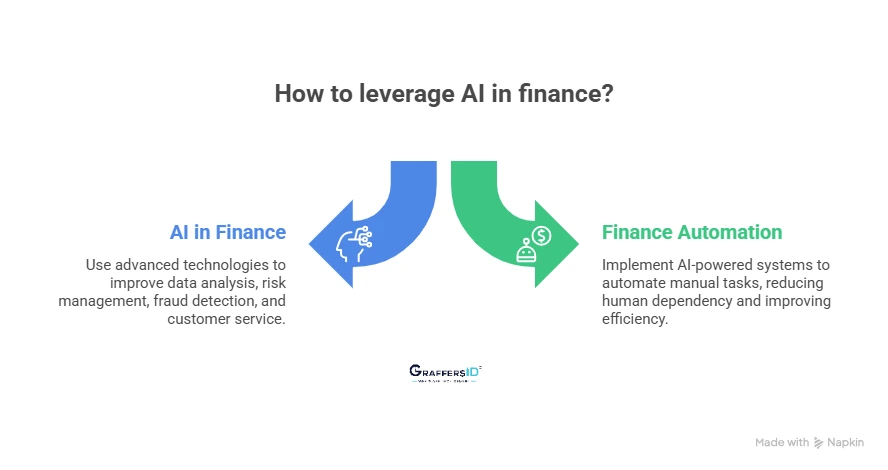
Artificial Intelligence (AI) in finance refers to the use of advanced technologies like machine learning, natural language processing (NLP), generative AI, and intelligent automation to improve how financial institutions analyze data, manage risk, detect fraud, and serve customers.
Unlike traditional rule-based systems, AI models continuously learn from new financial data, improving accuracy and decision-making over time.
What is Finance Automation?
Finance automation refers to the use of AI-powered systems and intelligent workflow tools to automate manual, time-consuming financial operations across banking, fintech, and enterprise finance teams.
It reduces human dependency on repetitive tasks while improving speed, compliance, and accuracy.
Common Finance Tasks Automated in 2026
- Accounts Payable and Accounts Receivable: Automated invoice matching, payment processing, and reminders reduce manual intervention. AI flags discrepancies and predicts delayed payments.
- Financial Reconciliation: AI compares transactional data across systems to detect mismatches instantly. This significantly reduces month-end closing time.
- Regulatory Reporting and Compliance Checks: Automation tools scan transactions against compliance rules in real time. AI-generated reports support faster audits and regulatory submissions.
- Data Entry and Financial Validation: Intelligent document processing extracts data from invoices, contracts, and forms. This eliminates manual data entry errors.
Key Drivers Accelerating AI Adoption in Banking and Finance
AI adoption is not just technology-driven; it is business-driven. The following factors are pushing decision-makers to invest aggressively in AI.
- Rapid Growth of Digital Transactions: Digital banking, UPI payments, mobile wallets, and online lending have increased transaction volumes exponentially. AI enables real-time monitoring, fraud detection, and scalable processing at this scale.
- Rising Cybersecurity Threats and Advanced Fraud: Fraud networks are now using AI themselves. Financial institutions must deploy machine learning-based fraud detection systems that evolve faster than attackers.
- Customer Demand for Real-Time and Personalized Services: Modern customers expect instant loan approvals, smart financial insights, and seamless digital experiences. AI helps deliver hyper-personalized recommendations and real-time service responses.
- Competition from AI-First Fintech Companies: AI-native fintech startups are built on automation, predictive analytics, and cloud scalability. Traditional banks must modernize their systems to compete with faster, leaner AI-driven platforms.
- Pressure to Reduce Operational Costs: Manual processes increase staffing costs and slow down decision-making. Finance automation powered by AI reduces repetitive workloads and improves operational efficiency.
What Technologies Power AI in Finance? (Core AI Technologies Used in Banking in 2026)
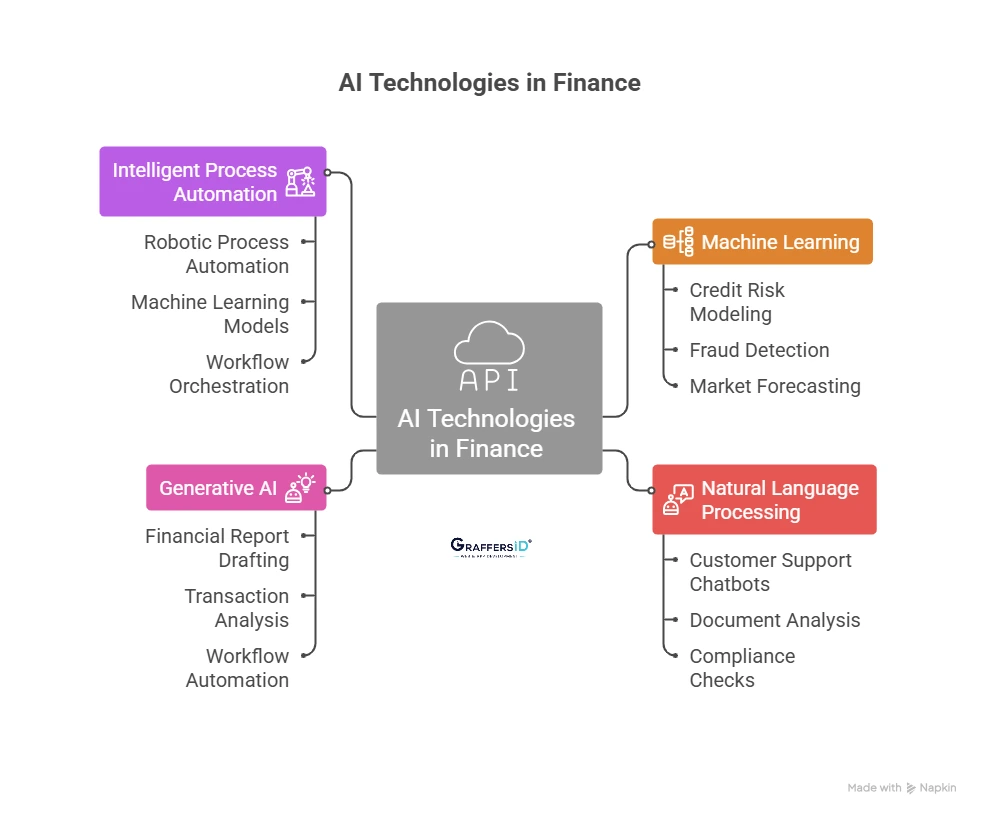
Artificial intelligence in finance is powered by a combination of machine learning, language intelligence, generative systems, and intelligent automation platforms. In 2026, these technologies work together to enable real-time decision-making, predictive risk control, and autonomous financial workflows.
Below are the core technologies driving AI adoption in banking and financial services.
1. Machine Learning and Predictive Analytics in Finance
Machine learning (ML) is the foundation of AI in finance. It enables systems to learn from historical and real-time financial data to predict outcomes and improve decisions continuously.
Used for:
- Credit risk modeling and dynamic underwriting
- Real-time fraud detection
- Market trend forecasting
- Portfolio optimization and asset allocation
In 2026, ML models rely on behavioral and transactional data streams rather than static credit scores, enabling more accurate and adaptive financial decision-making.
2. Natural Language Processing (NLP) in Banking and Compliance
Natural Language Processing allows AI systems to understand, interpret, and generate human language. In finance, NLP plays a critical role in automating communication and regulatory processes.
Key applications include:
- AI-powered customer support chatbots
- Automated analysis of contracts and financial documents
- Regulatory document scanning and compliance checks
- Sentiment analysis for market intelligence
NLP is especially valuable in compliance-heavy environments where large volumes of unstructured documents must be processed quickly and accurately.
3. Generative AI and AI Agents in Financial Services
Generative AI and AI agents represent the most significant advancement in finance automation in 2026. These systems go beyond task execution; they assist in contextual financial decision-making.
AI agents can:
- Draft and summarize financial reports
- Analyze transaction histories and flag anomalies
- Assist CFOs with forecasting and scenario planning
- Automate multi-step financial workflows across departments
Unlike traditional bots, AI agents understand context, adapt to new inputs, and make informed recommendations based on evolving financial data.
4. Intelligent Process Automation (IPA) in Finance Operations
Intelligent Process Automation combines automation tools with AI capabilities to manage high-volume financial processes more efficiently.
IPA integrates:
- Robotic Process Automation (RPA) for rule-based tasks
- Machine learning models for decision-making
- Workflow orchestration platforms for end-to-end automation
This technology is widely used for reconciliation, invoice processing, compliance checks, and reporting. In 2026, IPA systems are self-optimizing, meaning they improve performance as transaction volumes and rules change.
How is AI Used in Banking and Financial Services? (Top AI Use Cases in 2026)
Below are the most important AI use cases in banking and financial services in 2026:
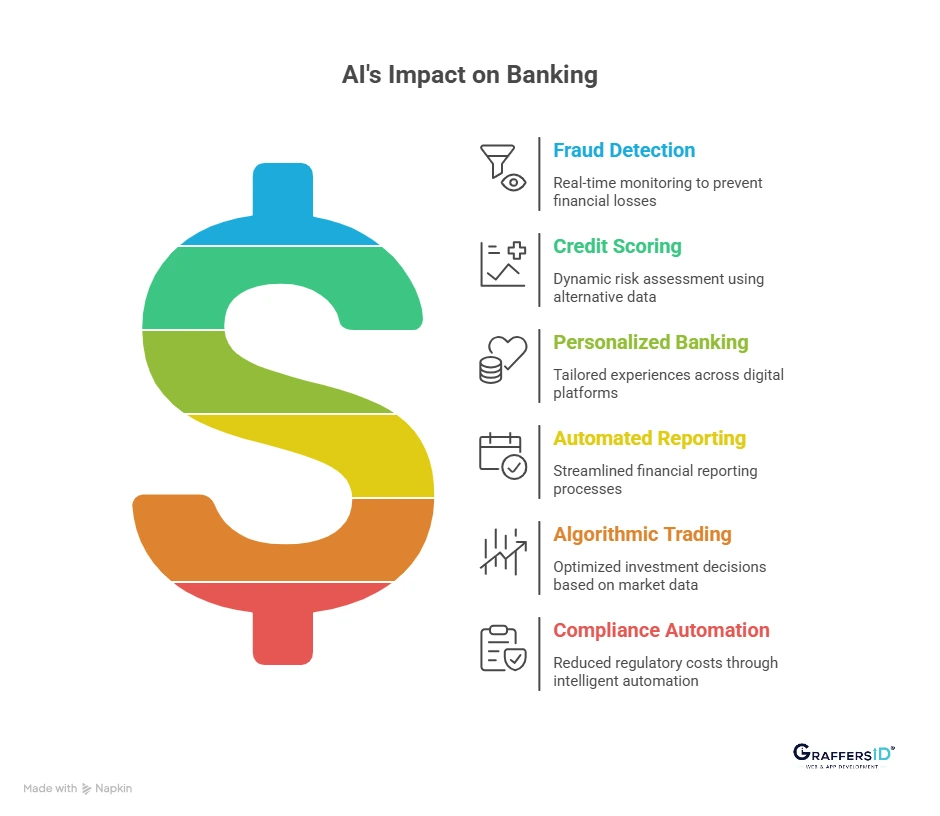
1. AI for Fraud Detection and Anti-Money Laundering (AML)
AI systems monitor financial activity in real time to detect suspicious behavior before losses occur. Unlike traditional rule-based systems, modern AI models analyze patterns, intent, and behavioral anomalies across millions of transactions.
AI monitors:
- Real-time transaction patterns
- Behavioral deviations from normal spending
- Suspicious cross-border transfers and layered transactions
2. AI in Credit Scoring and Loan Approval
AI-powered credit scoring models assess borrower risk using dynamic and alternative data sources, moving beyond traditional credit bureau metrics.
AI enables:
- Alternative data evaluation (digital payments, transaction behavior)
- Behavioral and transactional scoring models
- Real-time dynamic risk assessment
3. AI for Personalized Banking and Customer Experience
Banks use AI to deliver hyper-personalized financial experiences across mobile apps, web platforms, and digital assistants.
AI drives:
- Personalized product recommendations
- AI-powered financial assistants
- Spending pattern analysis
- Predictive budgeting and savings insights
4. AI for Automated Financial Reporting and CFO Dashboards
AI automates financial reporting processes, reducing month-end closing cycles and manual reconciliation tasks.
AI tools can:
- Generate automated financial summaries
- Detect anomalies in financial statements
- Assist with audit preparation and compliance documentation
5. AI in Algorithmic Trading and Wealth Management
AI-powered trading systems analyze large volumes of market data, news signals, and economic indicators to optimize investment decisions.
AI systems:
- Execute trades based on predictive market signals
- Dynamically rebalance portfolios
- Power robo-advisory platforms
6. AI for Compliance and Regulatory Automation
Regulatory compliance remains one of the highest operational costs in finance. AI reduces this burden through continuous monitoring and intelligent automation.
AI assists with:
- KYC (Know Your Customer) verification
- Automated regulatory document scanning
- Real-time compliance monitoring
- Audit trail generation and reporting
Benefits of AI in Finance in 2026
Below are the key benefits of AI in finance in 2026:
1. Higher Operational Efficiency in Financial Processes
AI reduces manual workload by automating repetitive tasks such as reconciliation, reporting, and transaction monitoring. Financial institutions now process approvals, settlements, and audits significantly faster, with many workflows running 24/7 through intelligent automation systems.
2. Stronger Risk Management and Fraud Prevention
AI models detect suspicious transactions, behavioral anomalies, and credit risks in real time. Predictive analytics allows banks and lenders to identify potential defaults or fraud patterns before losses occur, enabling proactive risk mitigation instead of reactive damage control.
3. Cost Reduction and Smarter Resource Allocation
Finance automation lowers administrative overhead by reducing dependency on manual processing teams. AI-driven fraud detection and compliance monitoring also minimize financial losses, penalties, and regulatory risks, improving overall cost efficiency.
4. Improved Customer Experience and Personalization
AI enables faster responses to customer queries through intelligent assistants and automated decision systems. By analyzing spending behavior and financial history, institutions deliver personalized product recommendations and seamless digital journeys that increase customer retention.
How to Implement AI in Finance: A Practical Step-by-Step Guide for Banks and Fintechs (2026)
Implementing AI in finance requires more than buying tools; it demands a structured, risk-aware strategy aligned with compliance, security, and business outcomes.
Below is a practical framework that CTOs, CIOs, and finance leaders can follow in 2026.
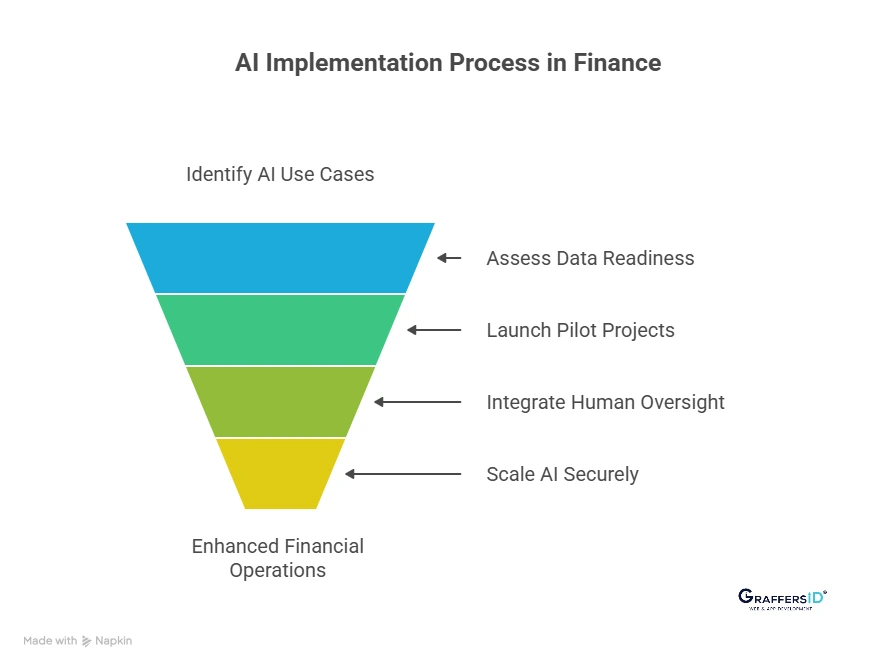
Step 1: Identify High-Impact AI Use Cases in Finance
Start with use cases that deliver measurable ROI and operational improvement. Focus on areas where large volumes of data and repetitive workflows exist.
Recommended starting points:
- Fraud Detection & AML Monitoring: AI models can analyze transaction behavior in real time and reduce false positives while improving detection accuracy.
- AI-Powered Loan Processing: Automate credit scoring, risk evaluation, and document verification to accelerate approval cycles.
- Financial Reporting Automation: Use AI to generate real-time dashboards, anomaly detection alerts, and predictive forecasts for CFOs.
Choosing the right first use case ensures faster adoption and stronger executive buy-in.
Step 2: Assess Data Readiness and Infrastructure
AI performance depends entirely on data quality. Before implementation, evaluate your data ecosystem. Ensure:
- Clean, structured, and centralized financial datasets
- Secure data storage with access controls
- Strong data governance and audit trails
- API-ready architecture for AI integration
Without data readiness, even advanced AI models will fail to deliver reliable outcomes.
Step 3: Launch Controlled AI Pilot Projects
Instead of enterprise-wide deployment, begin with controlled pilots. A successful AI pilot in finance should:
- Target a single department or workflow
- Define measurable KPIs (fraud reduction %, processing time, cost savings)
- Include clear success benchmarks
- Run parallel to existing systems for validation
Pilots reduce risk, demonstrate ROI, and build internal confidence before scaling.
Step 4: Integrate Human Oversight and AI Governance
AI in finance must remain accountable and explainable. Maintain:
- Explainable AI models for credit and risk decisions
- Compliance checkpoints within automated workflows
- Human review layers for high-risk approvals
- Risk and ethics review committees
In 2026, regulators increasingly expect transparency in AI-driven financial decisions.
Step 5: Scale AI Securely with Compliance-First Architecture
Once pilots succeed, scale using a secure, cloud-ready infrastructure designed for financial compliance. Adopt:
- Encryption-first architecture
- Role-based access controls
- Continuous AI model monitoring
- Bias detection and fairness audits
- Regulatory reporting automation
Secure scaling ensures AI adoption strengthens trust rather than increasing risk exposure.

Conclusion: Why AI in Finance is a Competitive Necessity in 2026
Artificial intelligence in finance is no longer an emerging trend; it is the foundation of modern banking, fintech, and enterprise financial operations.
In 2026, institutions using AI strategically are not just automating tasks. They are building intelligent, data-driven financial ecosystems. The future of banking and financial services belongs to organizations that treat AI not as a tool, but as a core strategic capability.
Ready to Build AI-Powered Finance Solutions?
At GraffersID, we help banks, fintech startups, and enterprise finance teams build AI-powered web and mobile platforms, implement finance automation systems, and develop intelligent dashboards and predictive analytics tools.
Hire skilled AI developers to build your AI-first finance ecosystem and start your AI transformation journey.