
The real estate world in 2026 has evolved far beyond listings and open houses; it’s now powered by artificial intelligence. Across the globe, PropTech companies are turning data into decisions, automating complex workflows, and reshaping how properties are priced, sold, and managed.
From AI-driven pricing engines that adapt to market shifts in real time to virtual agents that handle 24/7 buyer interactions and smart property management systems that predict maintenance needs before problems occur, AI has become the invisible infrastructure behind modern real estate success.
For CTOs, real estate founders, and investors, this shift isn’t optional; it’s a competitive advantage. AI enables faster deal closures, smarter investments, and more personalized customer journeys, transforming traditional property businesses into intelligent ecosystems.
In this 2026 guide, we’ll explore how PropTech is using AI to optimize pricing, accelerate sales, and simplify property management, and how forward-thinking companies are using these innovations to stay ahead in one of the world’s most competitive industries.
What is PropTech and How AI Powers It in 2026?
PropTech, short for Property Technology, refers to the use of digital tools and automation to simplify how properties are bought, sold, rented, and managed. In 2026, AI has become the driving force behind this transformation, enabling smarter, faster, and more data-driven decisions across the real estate ecosystem.
Here’s how different AI technologies are shaping PropTech today:
-
Machine Learning: Analyzes massive datasets for accurate pricing and investment forecasting.
-
Computer Vision: Enables property inspection and document verification from photos or video feeds.
-
Natural Language Processing (NLP): Powers chatbots and customer service automation.
-
Generative AI: Creates virtual tours, property renderings, and marketing visuals in seconds.
Read More: 7 Best Programming Languages for Real Estate & Property Management
How AI Improves Property Pricing and Valuation Accuracy?
Pricing a property accurately has always been one of real estate’s biggest challenges. In 2026, artificial intelligence (AI) is solving this by combining predictive analytics, machine learning, and real-time market data to deliver instant, reliable valuations.
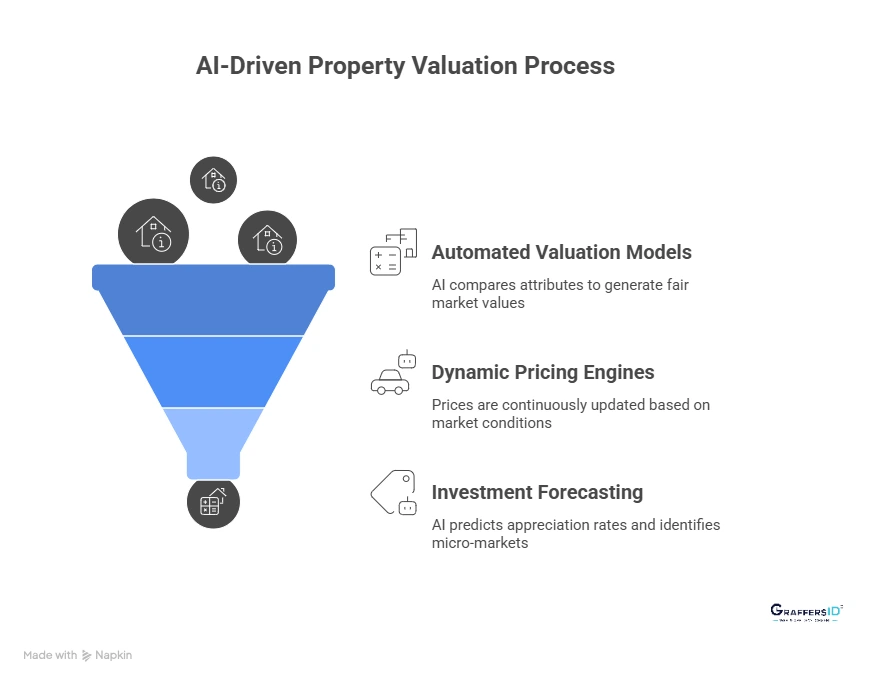
Here’s how leading PropTech platforms are using AI to make property pricing more accurate and transparent:
-
Automated Valuation Models (AVMs): AI compares thousands of property attributes, location, amenities, market trends, to generate fair market values in real time.
-
Dynamic Pricing Engines: Continuously update prices based on demand, interest rates, and seasonal fluctuations.
-
Investment Forecasting: AI models predict appreciation rates and help investors identify emerging micro-markets.
Example: Leading PropTech firms like Zillow in the U.S. and MagicBricks in India are using AI valuation engines to dynamically update property listings, improve pricing accuracy, and enhance investor trust.
AI for Real Estate Sales and Lead Conversion
By analyzing customer data and automating repetitive tasks, AI helps sales teams close deals faster and personalize the entire buyer journey.

Key AI Applications in Sales and Marketing (2026)
-
Predictive Lead Scoring: Machine learning ranks prospects based on engagement, location, and purchase likelihood.
-
Chatbots and Virtual Agents: Handle 80% of buyer queries, schedule visits, and offer instant recommendations.
-
Hyper-Personalized Property Suggestions: AI tailors property matches based on buyer intent and browsing history.
-
Automated Listing Descriptions: Generative AI tools craft SEO-friendly property descriptions with accurate emotional tone.
How AI Simplifies Property Management and Maintenance?
By integrating AI with IoT sensors and automation tools, real estate companies are reducing maintenance costs, improving tenant satisfaction, and running buildings more efficiently than ever.
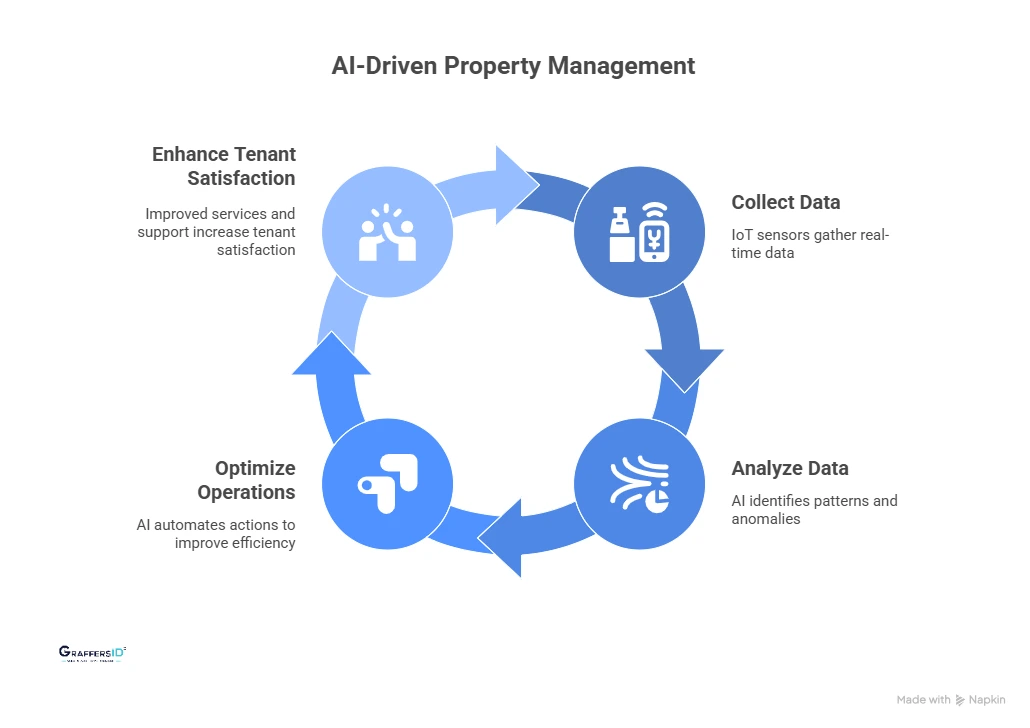
Key AI Functions in Property Management
-
Predictive Maintenance: IoT sensors + AI detect anomalies in HVAC, elevators, or plumbing before they fail.
-
Energy Optimization: AI monitors energy usage and automates power-saving actions.
-
Tenant Support Automation: Chatbots manage rent reminders, maintenance requests, and onboarding.
-
Smart Building Analytics: AI analyzes occupancy trends to optimize space utilization and maintenance costs.
Example: By 2026, leading property management firms are using AI-IoT dashboards to cut energy waste by 25% and maintenance costs by 30%, setting new benchmarks for operational efficiency in real estate.
Looking to integrate AI into your PropTech platform?
GraffersID helps enterprises build compliant, high-performance AI systems that accelerate growth and automate complex workflows smoothly.
How Generative AI and AR/VR Are Improving Real Estate Marketing?
In 2026, Generative AI combined with Augmented and Virtual Reality (AR/VR) is revolutionizing how buyers explore, visualize, and experience properties online.
-
AI-Generated Virtual Tours: 3D walkthroughs built from 2D floor plans.
-
Smart Interior Visualization: AI creates interior designs based on buyer preferences.
-
AR Property Previews: Users can visualize furniture layouts or renovations in real time.
-
Digital Twins: Real-time 3D replicas of buildings for construction and property management.
AI for Fraud Detection and Compliance in Real Estate
In 2026, as more real estate transactions move online, AI plays a crucial role in detecting fraud, verifying documents, and ensuring compliance across digital property deals.
-
AI Document Verification: Computer vision verifies IDs, ownership papers, and titles.
-
Fraud Detection Models: Machine learning detects anomalies in transaction patterns or property listings.
-
AI Credit and Risk Scoring: AI evaluates buyer profiles to mitigate financial risk.
Result: By 2026, AI-driven fraud detection systems have become essential for PropTech platforms. They minimize human error, ensure compliance with evolving regulations, and build trust through automated transparency in every transaction.
Read More: Top 15 Real Estate Technology & PropTech Trends in 2025 | AI Innovations in Real Estate
Key Challenges of Using AI in Real Estate in 2026
While AI is driving major efficiency in the real estate industry, it also introduces a new set of strategic, ethical, and operational challenges that decision-makers must navigate carefully. Here are the most pressing issues real estate businesses face when adopting AI in 2026:
1. Data Privacy and Security Risks
AI relies on massive volumes of buyer, seller, and property data. Without robust data governance and encryption, sensitive information can become vulnerable to breaches or misuse. Ensuring compliance with global data laws like GDPR and India’s DPDP Act is now a non-negotiable priority for PropTech platforms.
2. Bias in AI Predictions and Property Valuations
Machine learning algorithms can unintentionally reflect historical biases in datasets, leading to unfair pricing or property recommendations. PropTech leaders in 2026 are focusing on explainable AI (XAI) frameworks to maintain transparency and fairness in automated decision-making.
3. High Integration and Implementation Costs
Many real estate firms still operate on legacy systems that aren’t AI-ready. Integrating AI with CRMs, ERPs, and IoT systems requires upfront investment in infrastructure and developer expertise. However, the long-term ROI often outweighs these costs when done strategically.
4. Limited Human Oversight and Over-Automation
Relying solely on AI for pricing or client engagement can lead to errors and a poor user experience. Successful real estate businesses maintain a hybrid model, combining AI automation with expert human judgment to ensure quality and trust in every interaction.
Future Trends of AI in Real Estate: 2026 & Beyond
The next phase of PropTech innovation will merge AI, blockchain, and IoT to create a fully connected, data-driven real estate ecosystem. These technologies will make buying, managing, and investing in properties smarter, faster, and more transparent than ever before.
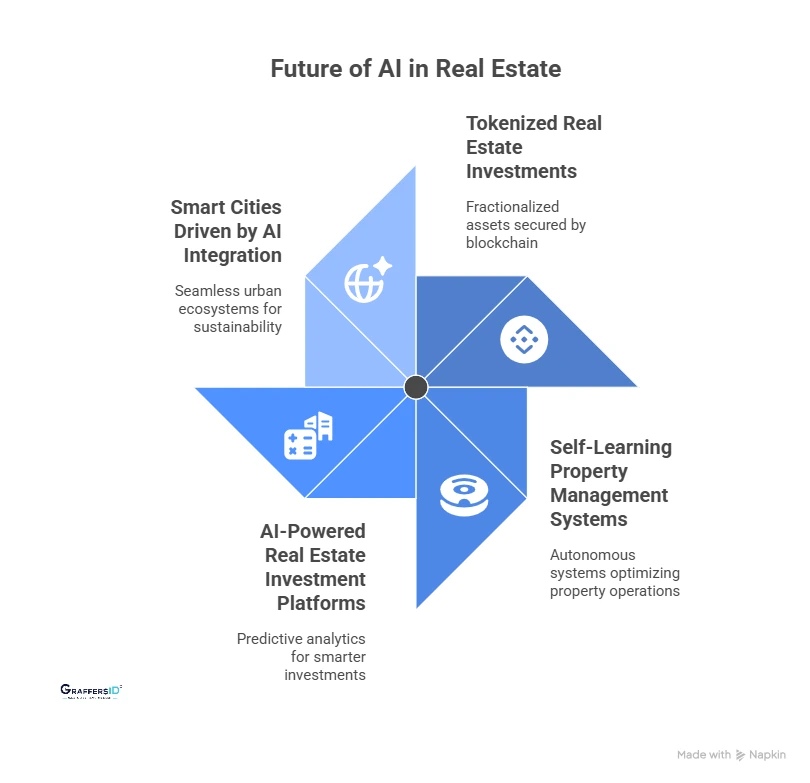
1. Tokenized Real Estate Investments with AI and Blockchain
In the coming years, real estate assets will be fractionalized into digital tokens, making property investment more accessible. AI algorithms will analyze market data, predict property value trends, and guide investors toward profitable, low-risk opportunities, all secured through blockchain transparency.
2. Self-Learning Property Management Systems
AI-powered systems will evolve into autonomous, self-learning platforms that optimize property maintenance, tenant management, and energy efficiency without manual oversight. These systems will continuously learn from data to make real-time operational decisions, improving performance over time.
3. AI-Powered Real Estate Investment Platforms
Next-generation PropTech platforms will use machine learning and predictive analytics to help investors assess market timing, property appreciation, and ROI potential. By combining big data and automation, these tools will enable smarter portfolio diversification and faster investment decisions.
4. Smart Cities Driven by AI Integration
AI will play a central role in developing smart city ecosystems where real estate, transportation, and infrastructure systems communicate seamlessly. This integration will lead to more sustainable urban environments, optimized resource use, and data-informed planning that improves both investor and resident experiences.

Conclusion: Future of Real Estate Belongs to AI-Powered PropTech
As we move beyond 2026, it’s clear that artificial intelligence is no longer just an enhancement, it’s the foundation of modern real estate.
From intelligent pricing engines and automated sales workflows to predictive property management, AI is transforming how developers, agents, and investors operate in a data-driven world.
The real estate leaders who embrace AI-powered PropTech today are setting the stage for a future defined by efficiency, transparency, and intelligent automation. They’re not just streamlining operations, they’re building the blueprint for smart living and sustainable urban innovation.
Looking to build your next PropTech platform or AI real estate app?
GraffersID helps enterprises to build AI-driven PropTech solutions, custom web and mobile apps, and automation systems.
Hire remote AI developers from GraffersID to transform your real estate business into an intelligent, scalable ecosystem.