AI adoption in 2026 has moved far beyond simple chatbots. Today’s businesses rely on AI decision engines, research copilots, and autonomous agents that directly influence revenue, efficiency, and competitive advantage.
For CTOs, CEOs, and product leaders, the priorities have completely shifted. Enterprises now demand:
-
Accuracy instead of creativity
-
Decision-support instead of generic text outputs
-
Automation instead of manual workflows
-
Security and governance instead of experimental tools
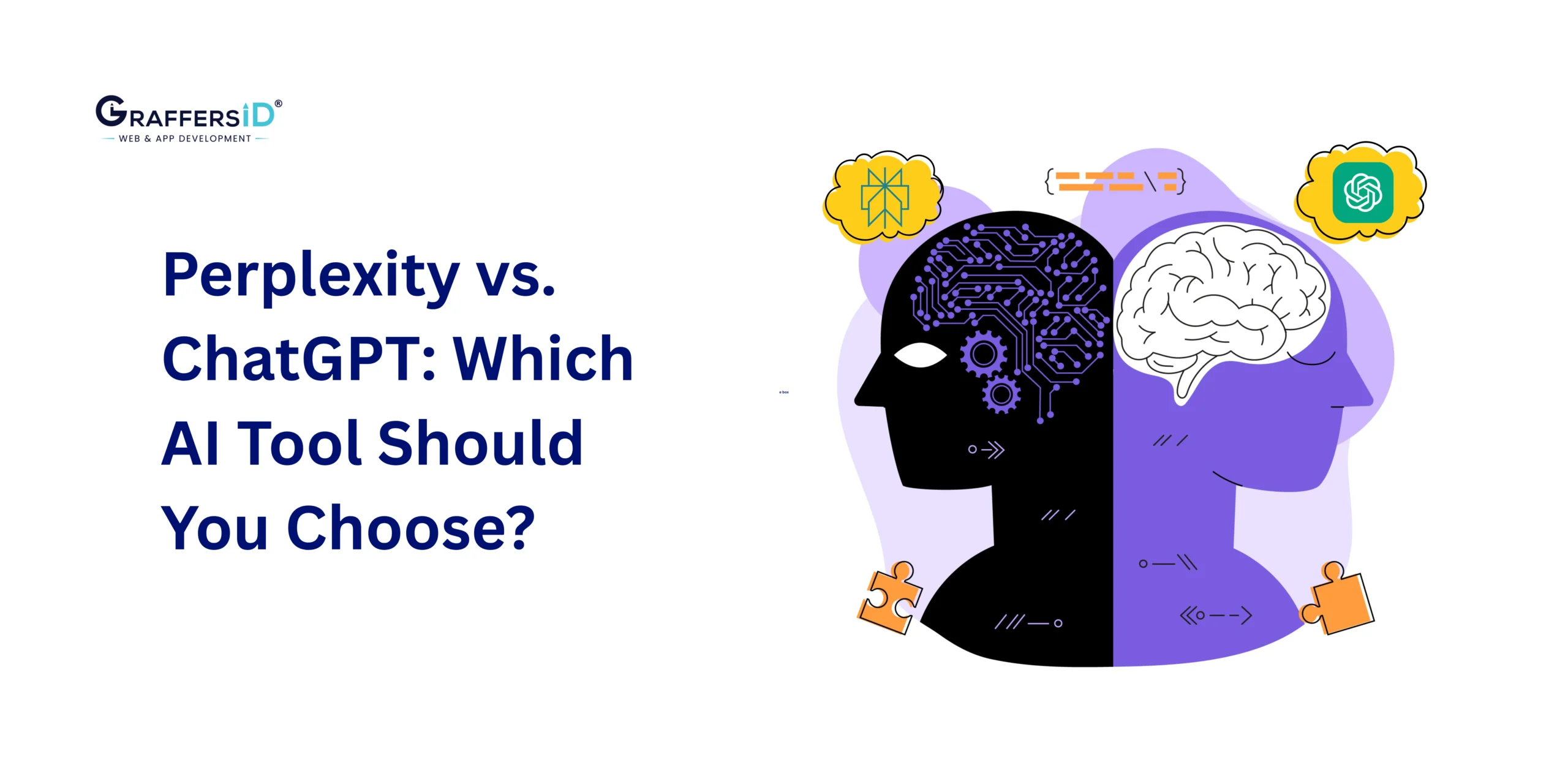
And among all AI platforms, two solutions consistently lead enterprise conversations: Perplexity AI and ChatGPT. Both are powerful but built for very different business needs.
In this blog, you’ll discover exactly how Perplexity and ChatGPT differ in 2026, what each tool is truly best at, and how to choose the right AI system for your organization’s goals.
What is Perplexity AI?
Perplexity AI in 2026 has matured into a real-time research platform designed for teams that need fast, accurate, and verifiable insights. Instead of generating generic text, it focuses on delivering evidence-backed answers powered by deep search, live data analysis, and intelligent research agents.
Key Features of Perplexity AI in 2026
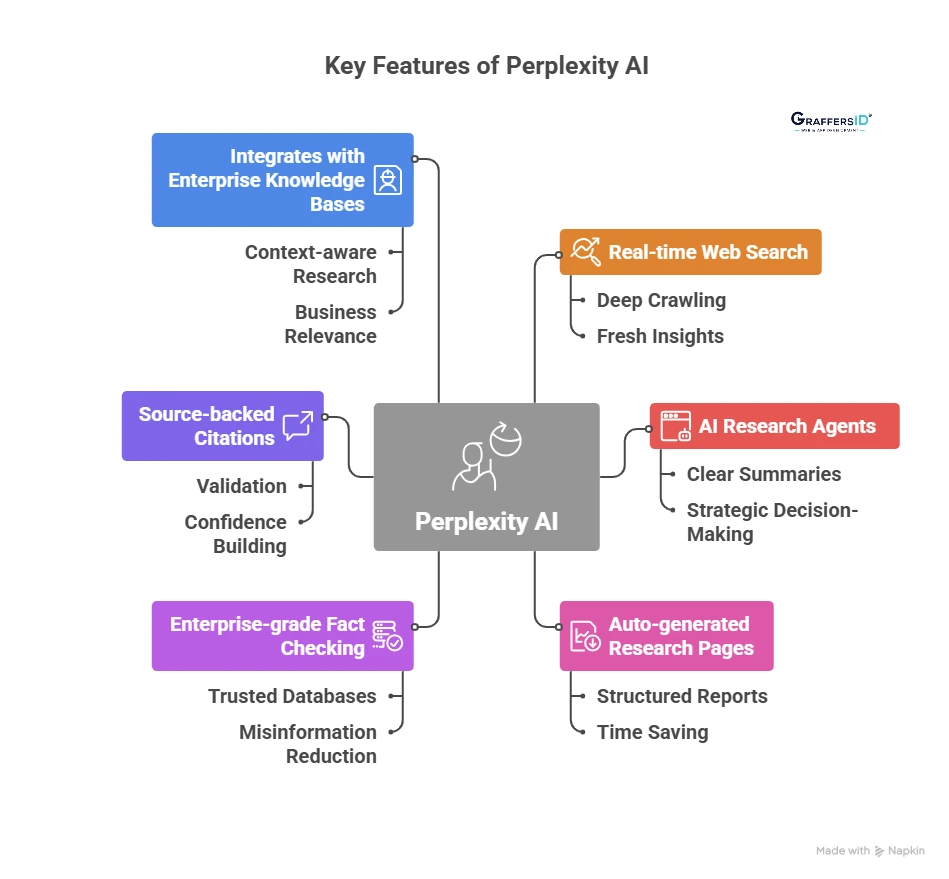
- Real-time web search with deep crawling: Perplexity scans the latest online data, news, and industry sources to deliver fresh, up-to-date insights.
- AI research agents for complex topics: It uses specialized agents that break down detailed subjects into clear summaries, ideal for strategic decision-making.
- Auto-generated research “Pages”: Perplexity creates structured research reports instantly, saving hours of manual work for analysts and leadership teams.
- Enterprise-grade fact checking: It verifies information across trusted academic, scientific, and market databases to minimize misinformation.
- Source-backed citations: Every answer includes direct citations, helping teams validate insights and build confidence in the data.
- Integrates with enterprise knowledge bases: Perplexity can connect with internal documents and knowledge hubs to deliver context-aware research for your business.
Read More: Which OpenAI ChatGPT Version Should You Use in 2025? (Complete Business Guide)
What is ChatGPT?
ChatGPT in 2026 has evolved far beyond a basic conversational tool. It is now a full enterprise AI platform designed to automate tasks, build workflows, assist developers, and integrate deeply with business systems. Companies use it as a reasoning engine, automation layer, and custom AI assistant across multiple departments.
Key Features of ChatGPT in 2026
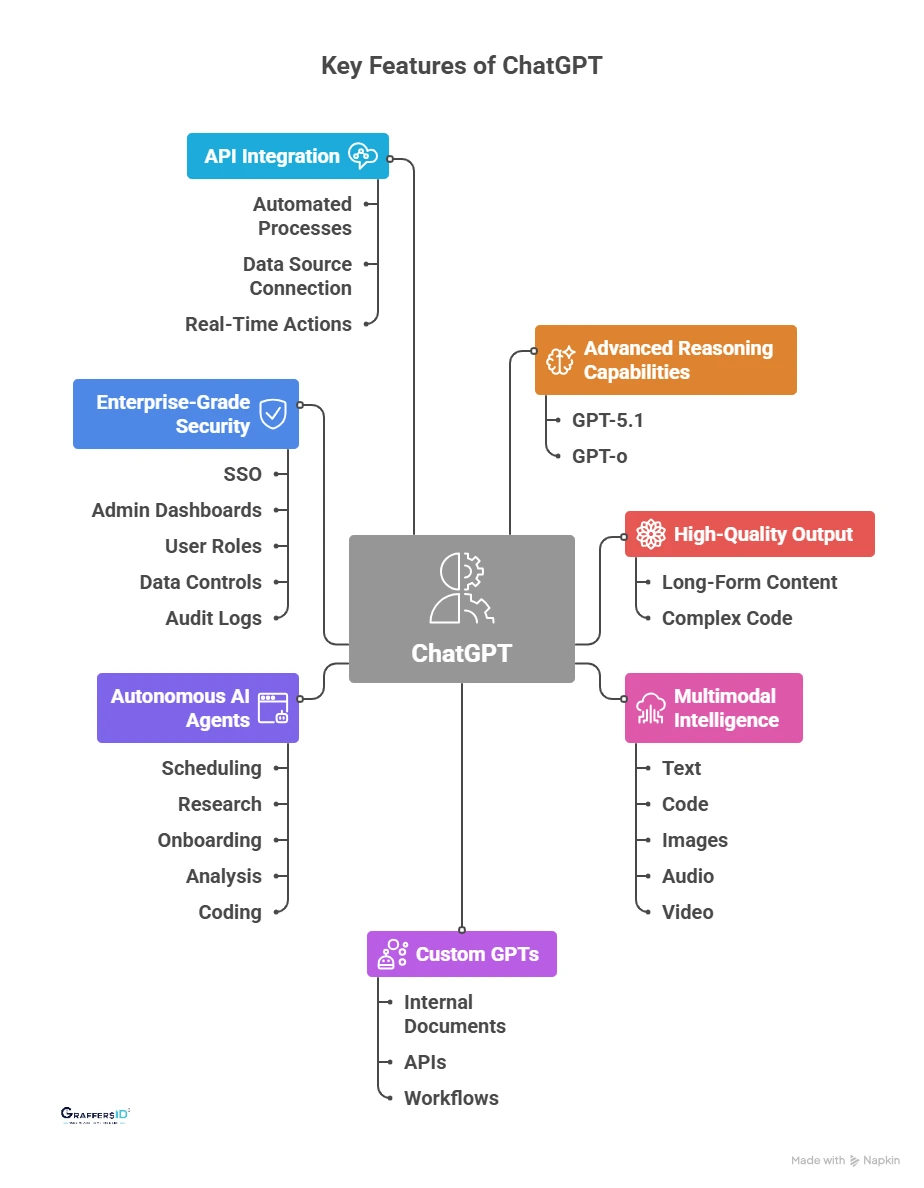
- Advanced Reasoning Capabilities: The latest GPT-5.1 and GPT-o models allow ChatGPT to understand complex business contexts, make multi-step decisions, and generate accurate, reliable outputs.
- High-Quality Creative and Technical Output: From long-form content to complex code, ChatGPT produces both creative and highly technical results with enterprise-grade precision.
- Multimodal Intelligence: ChatGPT can process and generate text, code, images, audio, and even video, making it useful for documentation, product design, prototyping, and analysis.
- Custom GPTs Trained on Business Data: Companies can build private, secure GPTs trained on internal documents, APIs, and workflows to create personalized AI assistants.
- Autonomous AI Agents for Task Execution: ChatGPT now runs end-to-end AI agents that can complete tasks like scheduling, research, onboarding, analysis, coding, and more without human intervention.
- Enterprise-Grade Security and Controls: With features like SSO, admin dashboards, user roles, data controls, and audit logs, ChatGPT meets modern enterprise compliance and governance requirements.
- Full API + Function Calling Workflows: ChatGPT integrates directly with software systems, allowing businesses to automate repetitive processes, connect data sources, and trigger real-time actions.
Perplexity vs. ChatGPT: Comparison Table 2026
| Factor | Perplexity AI | ChatGPT |
|---|---|---|
| Core Purpose | Real-time research, factual insights | Automation, execution, workflow generation |
| Data Freshness | Live web search + instant updates | Updated knowledge + optional browsing |
| Accuracy | Highly accurate, citation-backed answers | Strong reasoning accuracy but fewer live sources |
| Best For | Research teams, analysts, strategy units | Engineering, operations, support, product teams |
| Customization | Limited personalization | Highly customizable with Custom GPTs & APIs |
| Automation | Minimal automation | Advanced agent automation for end-to-end tasks |
| Enterprise Fit | Great for insights and competitive research | Ideal for automation, development, and internal copilots |
Best Use Cases of Perplexity in 2026
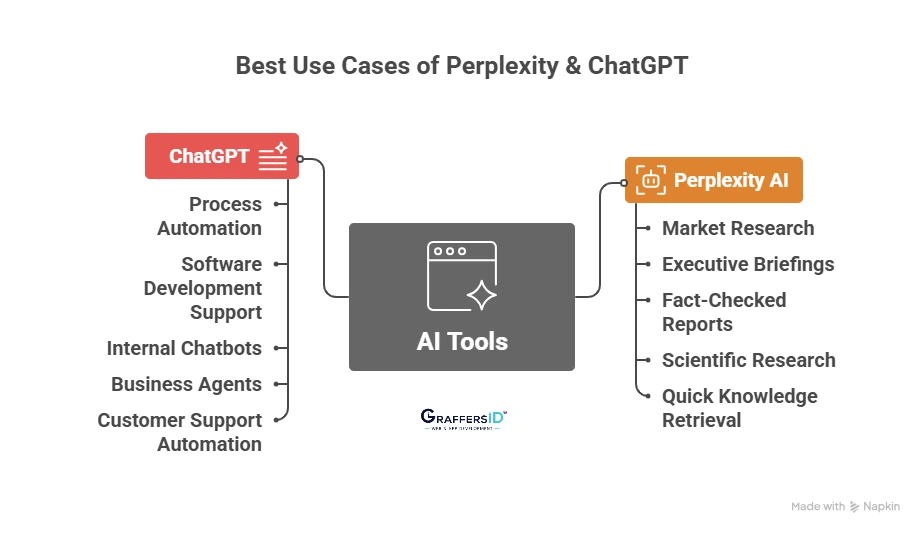
1. Market Research: Perplexity provides real-time competitive insights, industry trends, and customer intelligence, making it ideal for strategic planning and fast decision-making.
2. Executive Briefings: Leadership teams can receive daily, auto-generated summaries covering market updates, regulations, and industry shifts, saving hours of manual research.
3. Fact-Checked Reports: Perplexity specializes in producing reliable, citation-backed research outputs, perfect for analysts, consulting teams, and strategy departments.
4. Scientific or Technical Research: Its deep-crawl capabilities help businesses access evidence-heavy, niche information across scientific, engineering, and academic domains.
5. Quick Knowledge Retrieval: Teams can instantly get accurate answers with verified sources, which is especially useful when precision matters more than creative content.
In short: Perplexity is a research-first AI tool built for accuracy, insights, and decision support.
Best Use Cases of ChatGPT in 2026
1. Process Automation: ChatGPT automates repetitive tasks like emails, onboarding, workflow approvals, data entry, and operational processes, reducing manual workload.
2. Software Development Support: Engineers use ChatGPT for coding, debugging, code reviews, documentation, refactoring, and test generation, speeding up the entire development cycle.
3. Internal Chatbots or Team Copilots: Businesses can train ChatGPT on internal documents, SOPs, and knowledge bases to create intelligent copilots that support employees across teams.
4. Business Agents: With tool use and API integrations, ChatGPT agents can complete full workflows, generating reports, updating CRMs, triggering actions, and executing tasks end-to-end.
5. Customer Support Automation: ChatGPT delivers context-aware responses across support channels, helping teams resolve queries faster while maintaining high-quality customer interactions.
In short: ChatGPT is an automation and execution engine designed to streamline operations and accelerate development.
How to Choose the Right AI Tool for Your Business in 2026? Perplexity vs. ChatGPT
Choosing between Perplexity and ChatGPT depends on the type of work your business wants to optimize. Here is a clear, decision-focused comparison:
When Should You Use Perplexity?
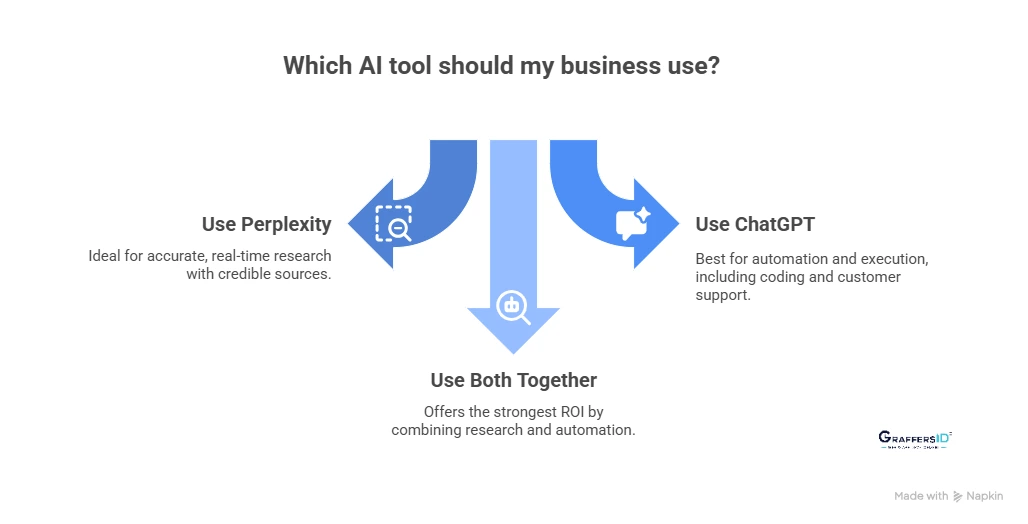
Perplexity is ideal for businesses that need accurate, real-time research supported by credible sources. It helps teams conduct market intelligence, competitor research, and trend analysis with verified data. Enterprises also use it for generating daily briefings, regulatory updates, and fact-checked insights for leadership.
When Should You Use ChatGPT?
ChatGPT is the better choice for businesses focused on automation and execution. It supports everything from coding and technical workflows to customer support automation and process optimization. Companies also rely on ChatGPT to build internal knowledge copilots and custom AI tools that integrate deeply with their systems.
Read More: OpenAI’s GPT vs. Google Gemini: Which AI Model is Better for Workflow Automation in 2025?
When Should You Use Both Together?
A combined approach offers the strongest ROI in 2026. Businesses use Perplexity for research and insight generation, then use ChatGPT to act on those insights through automation, development, and internal workflows. This hybrid model delivers both accuracy and execution, which is why most enterprises adopt it as their core AI strategy.

Conclusion: Which Is Better for Your Business: Perplexity or ChatGPT in 2026?
Perplexity and ChatGPT are both leading AI tools in 2026, but they deliver value in very different ways.
- Perplexity stands out when your business needs accurate research, real-time data, and reliable decision support backed by verified sources.
- ChatGPT, on the other hand, is unmatched for automation, software development support, internal copilots, and enterprise-level workflow optimization.
For most organizations, the highest ROI comes from using both tools together: Perplexity gathers the insights, and ChatGPT turns those insights into automated actions, tools, and business impact.
As AI becomes a core part of enterprise strategy in 2026, selecting the right tool is only the first step. What truly matters is how effectively you integrate, customize, and deploy these systems inside your business.
GraffersID helps global companies build AI-powered systems, automate workflows, accelerate development, and hire top remote AI developers who can accelerate your roadmap.
Ready to build with AI? Contact us to hire expert AI developers from GraffersID and transform your business today.