Generative AI has moved beyond experimentation in 2026; it’s a strategic game-changer for enterprises worldwide. From automating complex workflows to delivering hyper-personalized experiences, AI is reshaping how businesses operate, innovate, and compete.
For CTOs, CEOs, and product leaders, staying ahead means understanding the key generative AI trends that are defining the future of technology. In this blog, we break down the top 10 generative AI trends of 2026 influencing enterprise strategy, automation, infrastructure, and innovation.
Top 10 Generative AI Trends for Enterprises in 2026
Here’s a comprehensive look at the generative AI trends that are shaping the future of business and technology in 2026.
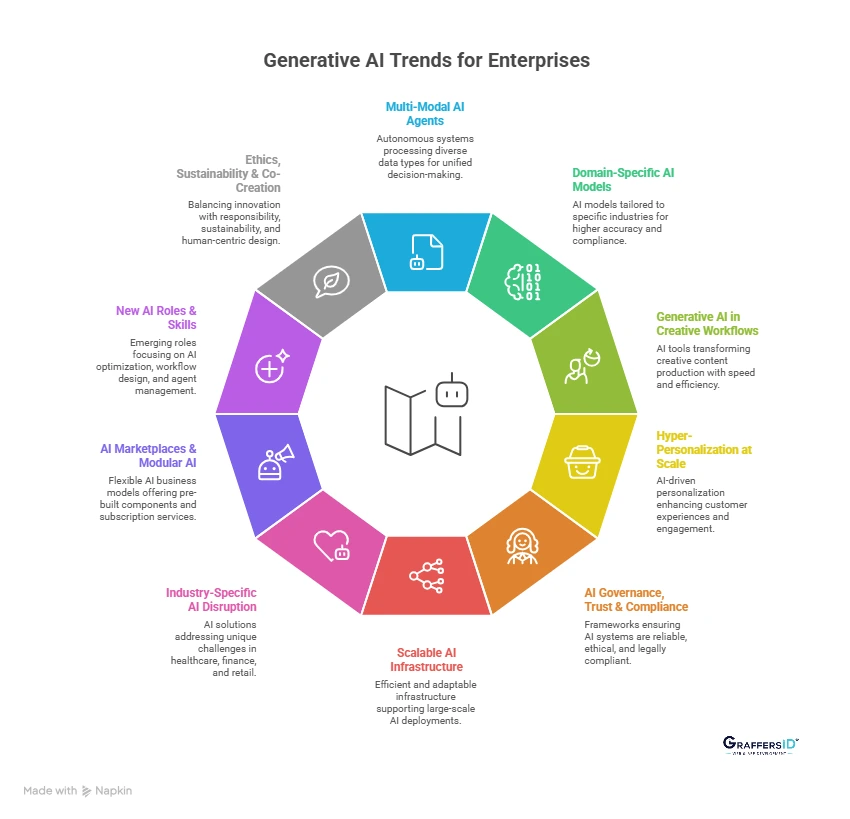
1. Multi-Modal AI Agents Transforming Enterprise Operations
What Are Multi-Modal AI Agents?
Multi-modal AI agents process and act on text, images, video, audio, documents, dashboards, structured data, and real-time signals, all at once. They’re autonomous systems capable of planning, reasoning, and executing multi-step tasks without human intervention.
Why Multi-Modal AI Agents Matter in 2026?
Multi-modal agents deliver:
-
Unified decision-making across diverse inputs, allowing businesses to merge multiple data types into one intelligent reasoning process.
-
Automation of complex workflows across operations, reporting, support, and sales, helping teams reduce manual effort and inefficiency.
-
Continuous monitoring of dashboards, emails, and KPIs, enabling real-time alerts and automatically generated actions.
-
Agentic reasoning that executes multi-step tasks, allowing AI agents to plan, verify, and complete tasks independently.
Enterprise Impact of Multi-Modal AI Agents
A multi-modal AI agent:
-
Reads daily analytics across tools, giving teams an automated performance overview.
-
Summarizes performance reports, turning raw data into quick executive insights.
-
Flags anomalies in KPIs, enabling early detection of issues or opportunities.
-
Generates email briefs automatically, saving leaders from manual status updates.
-
Schedules meetings intelligently, based on priority, availability, and workflow needs.
-
Creates tasks in project management tools, ensuring real-time operational alignment.
All without human involvement.
Read More: What Are Multi-Agent Systems in 2025? Architecture, Benefits, and Real-World Applications
2. Domain-Specific AI Models Delivering Higher Accuracy Than General LLMs
What Are Industry-Trained AI Models?
Domain-specific AI models are fine-tuned generative AI systems designed to handle tasks in specific industries, such as healthcare, finance, or manufacturing. Unlike generic large language models, they are trained on specialized datasets, delivering higher accuracy and relevance for industry-specific use cases.
Benefits of Domain-Specific AI Models
-
Higher Accuracy for Industry Tasks: Tailored to industry terminology and workflows, these models provide more precise insights and outputs.
-
Compliance and Data Privacy: Built with industry regulations in mind, they ensure sensitive data is handled securely, and outputs meet compliance standards.
-
Efficiency and Cost Savings: Optimized models reduce errors, streamline processes, and minimize the need for extensive manual intervention.
Use Cases of Domain-Specific AI Models Across Industries
-
Finance: AI-powered financial modeling, risk assessment, and fraud detection.
-
Healthcare: Assisting with medical diagnosis, treatment recommendations, and patient data analysis.
-
Manufacturing & Product Design: Generative AI for design simulations, predictive maintenance, and process optimization.
3. Generative AI Powering Enterprise Creative Workflows
Generative AI is transforming the way creative content is produced, spanning videos, music, graphics, and 3D designs. AI tools can now generate high-quality creative assets in minutes, enabling businesses to innovate faster and at lower cost.
How AI Is Transforming Creative Teams?
-
AI video generation produces professional-quality clips, saving time on filming and editing.
-
AI-based marketing campaign creation generates targeted content, reducing brainstorming cycles.
-
Automated graphic design tools create on-brand visuals, helping teams deliver assets consistently.
-
3D product modeling generates interactive prototypes, reducing reliance on expensive design software.
-
AI-driven website copy and UX content help brands maintain tone while producing fresh content on demand.
Business Impact of Generative AI
-
Reduced time-to-market for creative campaigns, helping brands respond quickly to trends.
-
Lower creative production costs, cutting down on agency or freelancer expenses.
-
Creation of personalized assets at scale, enabling brands to customize content for every segment.
-
Smaller teams achieving enterprise-level creative output, empowering lean marketing operations.
4. Hyper-Personalization at Scale With Generative AI
Generative AI is increasingly embedded in CRMs, ERPs, e-commerce platforms, and customer engagement tools to deliver real-time personalization. Businesses can now provide experiences that are uniquely tailored to each user, leveraging AI-generated content, recommendations, and insights.
Key Benefits of Hyper-Personalization
An AI engine:
-
Tracks user behavior across multiple touchpoints, building an evolving behavioral profile.
-
Predicts user preferences and intent, enabling smarter product and content recommendations.
-
Generates personalized email campaigns instantly, reducing manual work for marketing teams.
-
Sends tailored product suggestions, improving upsell and cross-sell outcomes.
-
Adjusts UI elements dynamically based on user interactions, improving user experience metrics.
All automatically, driving higher conversion rates and customer retention.
Enterprise Use Case of Hyper-Personalization
-
AI-generated emails, messages, and recommendations tailored to user behavior, improving engagement.
-
Personalized workflows that adapt based on user actions, ensuring a smoother and more relevant experience.
-
AI-suggested product bundles are created per customer profile, increasing average order value.
-
Real-time user journey optimization that adjusts content dynamically, maximizing conversion potential.
Read More: How to Build Generative AI Solutions That Actually Work and Drive Business Value in 2025?
5. AI Governance, Trust & Compliance
As enterprises adopt generative AI at scale, trust, transparency, and regulatory compliance have become non-negotiable. Organizations need robust governance frameworks to ensure AI systems are reliable, ethical, and legally compliant.
Key Governance Focus Areas in 2026:
A. Explainable AI (XAI) for Model Decisions
Enterprises must understand how AI reaches decisions so stakeholders can trust the reasoning and auditors can verify compliance.
B. Bias Detection and Intellectual Property Protection
Automated frameworks scan for harmful bias in LLMs and enterprise datasets, ensuring fair and ethical outcomes. Secure AI pipelines prevent data leakage, enforce permissions, and maintain strict internal confidentiality.
C: Regulatory Alignment Across Industries
Different sectors have specific compliance requirements; ensuring AI models meet these regulations is critical to prevent fines, reputational damage, and operational risks.
Compliance with:
-
HIPAA ensures data protection in healthcare workflows, maintaining patient privacy.
-
GDPR mandates responsible data handling, preventing unauthorized processing.
-
CPRA expands privacy rights, requiring transparent AI decision policies.
-
FINRA ensures financial model transparency, especially in automated decision tools.
-
PCI DSS strengthens payment security, protecting financial transactions.
-
ISO 42001 provides an AI management framework, guiding enterprises on responsible AI operations.
6. Scalable AI Infrastructure and Cost Efficiency
In 2026, deploying generative AI at scale requires not just powerful models but also efficient, adaptable infrastructure. Enterprises are increasingly leveraging energy-efficient compute, cloud-native platforms, and edge AI to deliver high-performance AI solutions without breaking the budget.
Infrastructure Trends of Scalable AI
-
Edge + Cloud hybrid deployments improve performance, balancing speed, security, and cost.
-
Energy-efficient LLM inference reduces compute usage, lowering operational expenses.
-
On-device AI provides instant processing, enabling privacy-first operations.
-
Model compression and distillation reduce model size, making AI cheaper to deploy.
-
Serverless AI architectures support dynamic scaling, optimizing resource allocation.
Enterprise Benefits of AI Infrastructure
-
Reduced compute costs across departments, enabling broader AI adoption.
-
Greater scalability as teams expand their AI usage, supporting enterprise growth.
-
Faster inference speeds enhance real-time decision-making, improving business agility.
-
Low-latency decision systems create instant insights, helping companies respond quickly.
7. Industry-Specific AI Disruption
Generative AI is no longer a one-size-fits-all solution. In 2026, enterprises are leveraging AI to solve industry-specific challenges, drive efficiency, and unlock new business value. Here’s how AI is transforming key verticals:
A: Healthcare: Accelerating Drug Discovery and Synthetic Data Generation
-
AI-powered diagnostics analyze complex medical data, helping doctors detect conditions earlier.
-
Drug discovery simulations reduce R&D time, accelerating scientific breakthroughs.
-
Synthetic datasets support research without privacy risks, enabling high-quality training data.
-
Clinical workflow automation reduces admin load, letting healthcare professionals focus on care.
B: Finance: Risk Simulation and Fraud Detection
-
Real-time fraud detection identifies suspicious activity instantly, preventing financial losses.
-
AI-generated risk simulations analyze market volatility, helping institutions prepare better.
-
Automated compliance documentation reduces regulatory workload, improving efficiency.
C: Retail: Personalized Shopping Experiences
-
Personalized shopping enhances user experience, recommending products that match preferences.
-
Dynamic pricing adjusts cost based on demand, maximizing revenue.
-
AI-generated product descriptions improve SEO, helping brands scale content creation.
-
Automated visual merchandising updates layouts, increasing product visibility.
8. Rise of AI Marketplaces, MaaS & Modular Enterprise AI
By 2026, AI marketplaces, Model-as-a-Service (MaaS), and modular AI workflows are becoming standard for enterprises seeking flexibility and scalability. Businesses are no longer limited to building models in-house; they can leverage pre-built components and subscription-based services to accelerate AI adoption.
Benefits of Modern AI Business Models
-
Model-as-a-Service (MaaS) offers ready-to-use AI models, reducing upfront development.
-
AI component marketplaces provide plug-and-play tools, simplifying integration.
-
Pre-built AI workflow modules accelerate deployment, especially for repetitive tasks.
-
Composability with drag-and-drop AI blocks empowers non-technical teams, making AI accessible.
Why Enterprises Prefer Modular AI
-
Faster deployment reduces implementation cycles, helping businesses launch solutions sooner.
-
Lower engineering cost decreases dependency on large dev teams, making AI affordable.
-
Easy experimentation allows rapid prototyping, supporting an innovation culture.
-
Flexible subscription or usage-based pricing makes scaling cost-efficient, supporting agile budgeting.
Read More: Agentic AI vs. Generative AI: Key Differences CTOs Must Know in 2025
9. New AI Roles & Organizational Transformation
The rapid adoption of generative AI is creating specialized roles in several verticals. These roles focus on optimizing AI outputs, designing autonomous workflows, and managing AI agents effectively across business operations.
Emerging Roles in 2026
-
AI Workflow Designers map automated workflows, ensuring smooth human-AI collaboration.
-
Prompt Engineers optimize model instructions, improving AI accuracy and output quality.
-
AgentOps Specialists manage AI agents at scale, ensuring reliability and performance.
-
AI Trainers (Data + Behavioral) fine-tune models, teaching AI how to respond responsibly.
-
AI QA Analysts validate AI outputs, ensuring alignment with business logic.
-
AI Product Strategists define AI-driven roadmaps, helping teams identify strategic opportunities.
Enterprise Impact of New AI Roles & Skills
-
Higher AI literacy across teams, enabling better adoption and fewer workflow bottlenecks.
-
Faster adoption of AI across departments, boosting operational efficiency.
-
Stronger human-AI collaboration enhances productivity, improving team outcomes.
-
Better AI output quality ensures reliability, increasing trust in automated systems.
10. Ethics, Sustainability & Human-AI Co-Creation
As generative AI adoption accelerates in 2026, enterprises must balance rapid innovation with responsibility, sustainability, and human-centric design. Here’s how the trend is shaping the industry:
Key Focus Areas in 2026
A: Sustainable Compute
-
Energy-efficient inference reduces environmental impact, making AI greener.
-
Low-carbon AI frameworks minimize compute waste, supporting sustainability goals.
-
Optimization for cost and environment balances performance, reducing overhead.
B: Ethical AI
-
Bias-free decision models support fairness, improving societal impact.
-
Transparent model reasoning increases trust, helping stakeholders understand outputs.
-
Verified data sourcing ensures dataset quality, preventing unethical training practices.
C: Human-AI Co-Creation
-
AI co-creates outputs such as content, designs, and workflows, enhancing human creativity.
-
Humans guide strategy, quality, and judgment, ensuring that AI aligns with business goals.
-
Collaborative systems enable augmented decision-making, combining human expertise with AI speed.
Strategic Recommendations for Enterprises Adopting AI in 2026
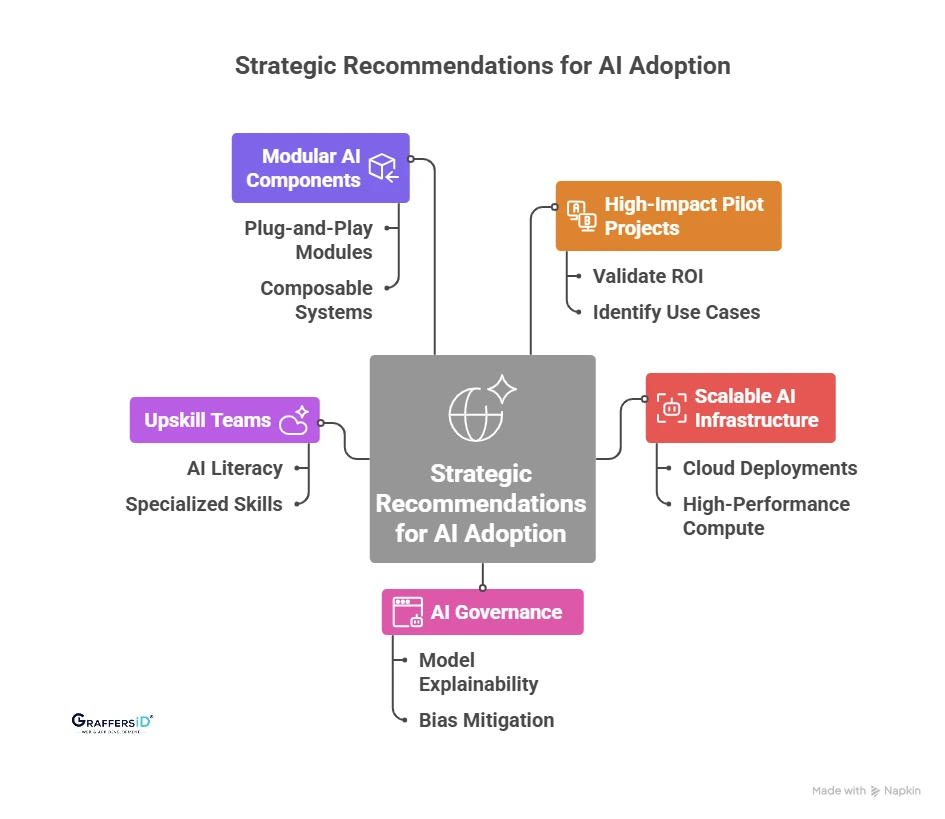
1. Start With High-Impact Pilot Projects
Begin with small, high-impact AI initiatives to validate ROI before scaling. Pilot projects help identify practical use cases, measure effectiveness, and reduce risk while demonstrating business value quickly.
2. Build Scalable AI Infrastructure
Ensure your AI systems are built on scalable and efficient infrastructure. Optimized cloud or edge deployments, along with high-performance compute, allow enterprises to handle growing AI workloads cost-effectively.
3. Implement AI Governance Early
Implement trust, compliance, and ethical frameworks from the start. Governance ensures model explainability, bias mitigation, data privacy, and alignment with emerging AI regulations in 2026.
4. Upskill Teams for AI Collaboration
Develop internal AI literacy and specialized skills for teams. Upskilling enables employees to collaborate effectively with AI, optimize workflows, and create innovative solutions that leverage generative AI fully.
5. Use Modular AI Components
Adopt plug-and-play AI modules or composable AI systems for faster deployment. Modular approaches allow enterprises to integrate advanced AI capabilities without building everything from scratch, reducing time-to-market and operational complexity.

Conclusion: Embrace the Generative AI Revolution in 2026
Generative AI in 2026 is far more than automation; it’s a strategic enabler that drives hyper-personalization, intelligent decision-making, and end-to-end enterprise transformation. By understanding and adopting the latest AI trends, CTOs, CEOs, and decision-makers can position their organizations at the forefront of innovation and gain a competitive edge in their industry.
With GraffersID’s expertise in AI development, enterprise AI integration, and remote developer solutions, businesses can confidently deploy scalable, ethical, and high-impact generative AI systems.
Ready to lead with AI in 2026? Partner with GraffersID today to build custom AI solutions, hire top AI developers, and transform your enterprise operations. Book Your Consultation!