Over the past two years, most companies followed the same playbook when adopting AI: pick a powerful large language model, build a chatbot or copilot on top of it, and launch.
At the time, it made sense. Large language models unlocked capabilities that were previously difficult or expensive to build. For many teams, integrating a single model felt like the fastest way to bring AI into their product or workflow.
But as those early AI experiments moved into real production environments, a clear gap started to appear. The difference between AI demos and AI systems that actually drive revenue.
A single model, no matter how advanced, struggles when it meets real business complexity. Modern products require AI to handle multi-step workflows, access live data, integrate with internal tools, follow compliance rules, and make context-aware decisions across different systems.
In other words, the problem is rarely the model.
It is the architecture around it.
The companies pulling ahead in AI today are not necessarily using better models. They are building better AI systems. This is where Compound AI Systems come in.
Instead of relying on one model to do everything, compound AI systems combine multiple models, retrieval layers, external tools, APIs, and orchestration logic into a coordinated system designed to solve complex tasks reliably. This approach is quickly becoming the standard architecture behind modern AI products.
In this guide, we break down:
- what compound AI systems are
- how their architecture works in real-world applications
- where businesses are seeing measurable ROI
- practical examples and use cases across industries
- best practices for building compound AI solutions that scale
If you are a founder, CTO, or product leader exploring how to move from AI experiments to production-grade AI systems, understanding compound AI architecture is an important place to start.
What is a Compound AI System?
A compound AI system is an AI architecture where multiple models, tools, and data systems work together in a coordinated workflow to solve complex tasks.
Instead of depending on a single AI model to handle everything, compound systems divide the problem into smaller steps and assign each step to the most suitable component.
This approach allows AI applications to access external data, interact with software tools, reason across multiple stages, and generate more reliable outcomes. As a result, compound AI systems are increasingly used in enterprise AI products, automation platforms, and intelligent assistants.
A typical compound AI system combines several components that collaborate to produce the final output, like:
- Large language models (LLMs)
- Retrieval systems
- Knowledge bases
- AI agents
- External APIs
- Memory systems
- Rule-based logic
- Orchestration engines
To understand this in practice, imagine a modern AI assistant handling a business query. The system may first interpret the request using an LLM, retrieve relevant company data from a knowledge base, fetch live information through APIs, summarize the results, and then generate a final response.
By distributing tasks across specialized components, compound AI systems create more reliable, scalable, and adaptable AI applications for real-world business environments.
Read More: What Are Multi-Agent Systems in 2026? Architecture, Benefits, and Real-World Applications
Key Advantages of Compound AI Systems in 2026
- Better accuracy: Different components handle specific tasks such as retrieval, reasoning, or summarization.
- Lower infrastructure costs: Smaller models and tools can perform targeted functions instead of relying on a single expensive model.
- Real-time knowledge access: Systems can retrieve information from databases, documents, and APIs dynamically.
- Improved reliability: Validation layers, guardrails, and rule engines reduce hallucinations.
- Flexible system design: Individual components can be upgraded or replaced without rebuilding the entire system.
This modular design is one reason many modern AI platforms now resemble software systems more than standalone AI models.
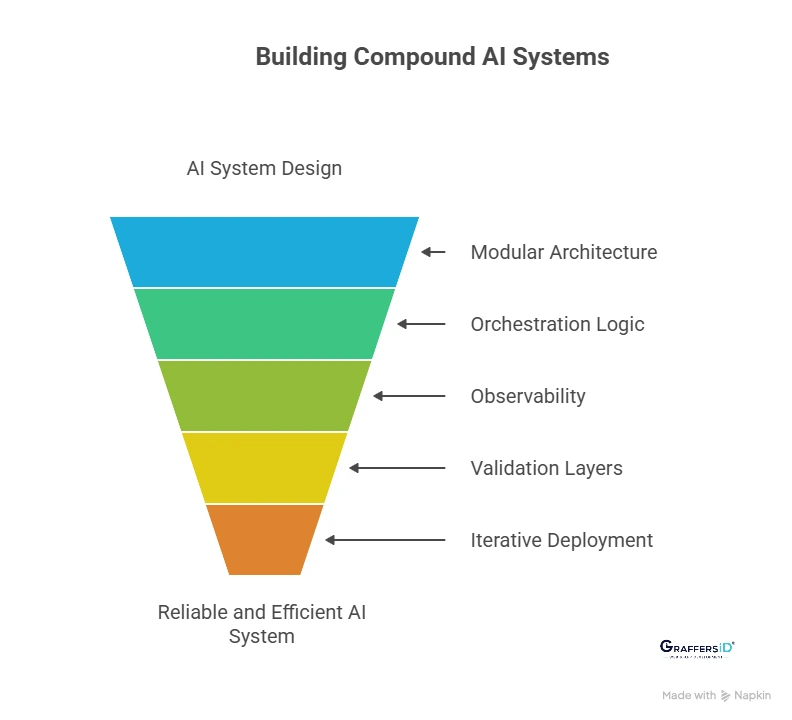
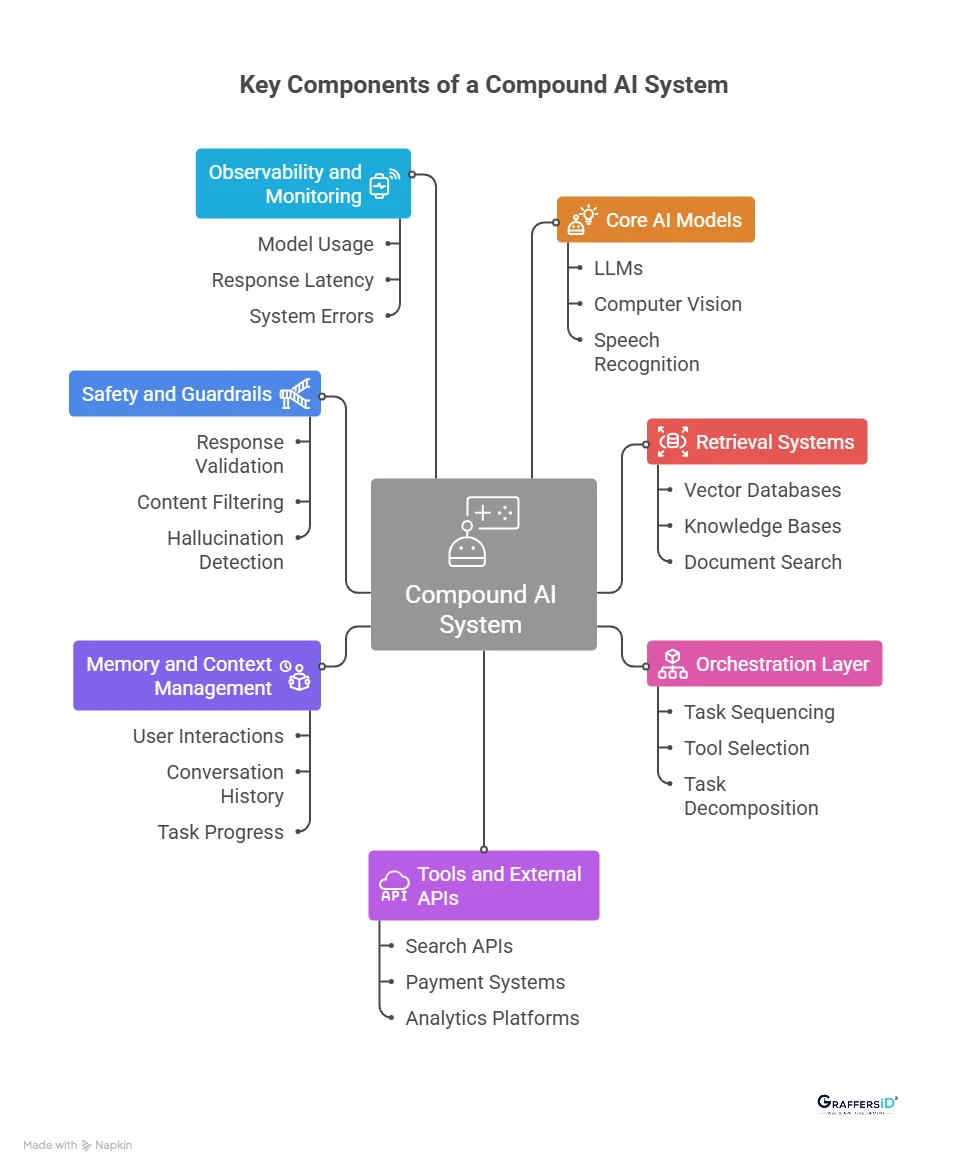
Key Components of a Compound AI System in 2026
Most compound AI systems follow a similar architectural pattern. While the exact setup may vary depending on the product or industry, the core idea remains the same: multiple specialized components work together to solve complex tasks.
Understanding these components helps founders, CTOs, and product leaders design AI systems that scale beyond simple chatbots or one-model experiments.
1. Core AI Models
Core AI models act as the reasoning or generation engines inside the system. Instead of doing everything, each model typically handles a specific task within the workflow. Common examples include:
- Large language models (LLMs) for reasoning, summarization, and text generation
- Computer vision models for image or video analysis
- Speech recognition models for voice interfaces and audio processing
In compound systems, models are used for specialized capabilities, making the overall architecture more efficient and reliable.
2. Retrieval Systems
Retrieval systems connect AI models to external knowledge sources so they can access accurate and up-to-date information before generating responses. Typical retrieval components include:
- Vector databases that store embeddings for semantic search
- Enterprise knowledge bases containing internal documentation
- Document search systems for structured or unstructured data
This layer powers retrieval-augmented generation (RAG), which allows AI applications to reference real data instead of relying only on model training.
3. Orchestration Layer
The orchestration layer coordinates how all components in the AI system interact. It decides the order of operations and manages the flow of tasks across models and tools. This layer typically controls:
- which component should run next
- what tools the AI should use
- how tasks should be broken into smaller steps
Without orchestration, complex AI systems quickly become difficult to control, debug, or scale.
4. Tools and External APIs
Many AI workflows require access to external systems in order to perform real-world tasks. Common integrations include:
- search APIs
- payment or billing systems
- analytics platforms
- scheduling tools
- CRM or customer data systems
For example, an AI sales assistant might retrieve lead data from a CRM, analyze past interactions, and automatically draft a follow-up message.
5. Memory and Context Management
Advanced AI applications often require persistent memory so the system can retain context across interactions or long workflows. Memory layers typically store:
- user interactions and preferences
- conversation history
- retrieved documents or knowledge
- task progress across multiple steps
This capability enables AI systems to support longer processes, personalized experiences, and multi-step reasoning.
6. Safety and Guardrails
When AI systems are used in real products or enterprise workflows, reliability and compliance become critical. Guardrail mechanisms often include:
- response validation layers
- content filtering systems
- policy enforcement rules
- hallucination detection mechanisms
These safeguards ensure that AI outputs remain accurate, appropriate, and aligned with business requirements.
Read More: AI Assistants vs. AI Agents (2026): Key Differences, Features, and Use Cases Explained
7. Observability and Monitoring
Production AI systems require strong monitoring and observability to ensure reliability and performance. Teams typically track metrics such as:
- model usage and performance
- response latency
- system error rates
- token consumption and cost
- system failures or workflow interruptions
Without proper observability, diagnosing issues in compound AI systems can quickly become difficult, especially as the architecture grows more complex.
How Do Compound AI Systems Work in Real Applications in 2026?
Below is a simplified workflow of how Compound AI is commonly used in production AI systems:
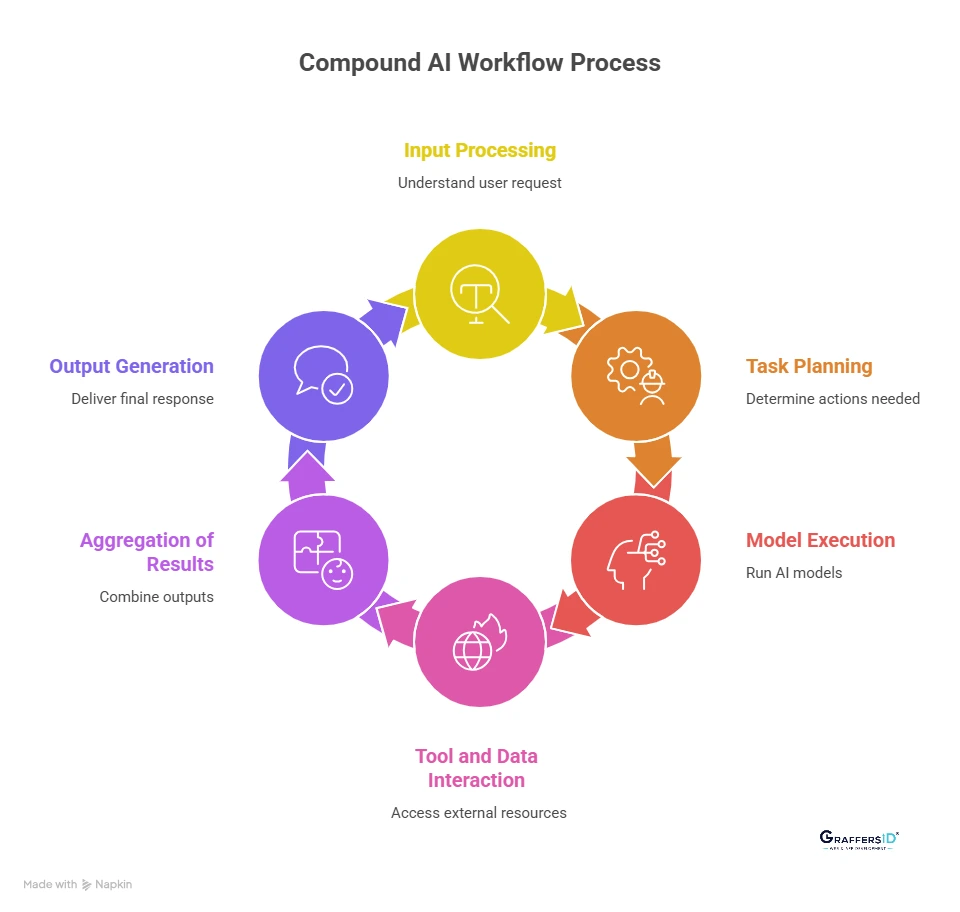
1. Input Processing
- Every compound AI workflow begins with understanding the user’s request.
- The system first analyzes the input to identify the context, intent, and important entities within the query. This may include classifying the request type, detecting user intent, and extracting key data points such as names, dates, or product information.
- This step ensures the system clearly understands what the user is asking before any AI reasoning begins.
2. Task Planning
- Once the request is understood, the system decides how to solve it.
- At this stage, the AI determines the sequence of actions required to complete the task. This may involve selecting specific models, identifying external tools to call, or determining whether additional data needs to be retrieved.
- More advanced implementations use AI planning agents that dynamically design workflows based on the complexity of the request.
3. Model Execution
- After the plan is created, the system executes the required AI models.
- Different models may perform specialized tasks such as reasoning, summarizing information, classifying data, or extracting structured insights from documents. Using multiple models allows the system to handle complex problems more efficiently.
- This stage typically performs the core AI computation within the workflow.
4. Tool and Data Interaction
- In most real-world applications, AI systems need access to external information or services.
- During this stage, the system retrieves data or executes actions using tools such as APIs, enterprise databases, internal software platforms, or third-party services. For example, an AI assistant might pull customer data from a CRM or retrieve product details from a knowledge base.
- This ensures the system works with real-time, reliable information instead of relying only on model knowledge.
5. Aggregation of Results
- Once data and model outputs are collected, the system combines them into a unified result.
- This step involves synthesizing different inputs such as retrieved documents, API responses, and model predictions. The system organizes these outputs into a structured format that can be easily interpreted by the final model or application layer.
- Effective aggregation ensures the final response is accurate, contextual, and coherent.
6. Output Generation
- In the final stage, the system generates the response or executes the action requested by the user.
- Depending on the application, this output may include natural language responses, summarized reports, recommendations, automated actions, or triggers for business workflows.
- By coordinating multiple components through this layered process, compound AI systems can reliably handle complex, real-world tasks that single-model systems struggle to manage.
Real-World Examples of Compound AI Systems in 2026
Many AI products used by businesses today are already built using compound AI architectures. Below are some common examples where compound AI systems are already delivering real business value.
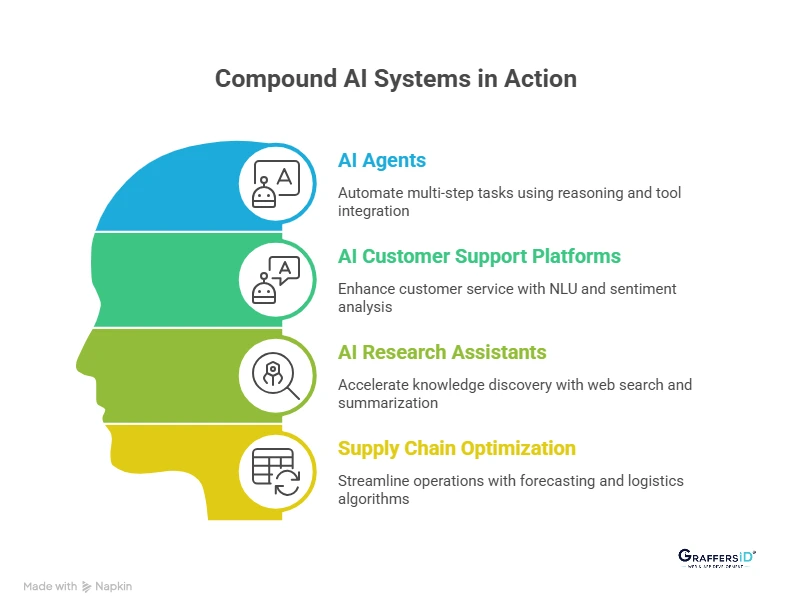
1. AI Agents
AI agents are one of the clearest examples of compound AI systems in action. They combine multiple AI capabilities to complete multi-step tasks autonomously. Common components in AI agents include:
- reasoning models to understand and plan tasks
- tool integrations for interacting with software and APIs
- planning systems that break tasks into smaller steps
- memory layers that retain context across interactions
These systems are increasingly used for tasks such as research automation, coding assistance, data analysis, and workflow scheduling, helping teams reduce manual work.
2. AI Customer Support Platforms
Modern AI-powered customer support platforms rarely rely on a single model. Instead, they combine multiple AI systems to deliver accurate and context-aware responses. Typical components include:
- natural language understanding for interpreting user queries
- sentiment analysis to detect customer intent and urgency
- knowledge retrieval systems that pull answers from documentation
- recommendation engines that suggest relevant solutions
This architecture allows businesses to automate common customer queries while routing complex issues to human support teams, improving both response time and customer experience.
Read More: Agentic AI vs. AI Agents: Key Differences, Real-World Examples, and Business Use Cases (2026 Guide)
3. AI Research and Knowledge Assistants
AI research assistants are designed to analyze large volumes of information quickly by combining multiple AI capabilities. These systems often integrate:
- web search tools for discovering relevant information
- language models for reasoning and analysis
- document retrieval systems for accessing internal knowledge bases
- summarization models that condense large documents into key insights
This enables faster market research, competitive analysis, and knowledge discovery, especially for teams working with large datasets or documentation libraries.
4. Supply Chain and Operations Optimization
Compound AI systems are also widely used in operational environments where multiple data sources and predictive models must work together. These systems typically combine:
- forecasting models to predict demand and supply patterns
- logistics optimization algorithms for routing and delivery planning
- real-time data streams from inventory and operational systems
- automation workflows that trigger operational actions
By coordinating these components, businesses can optimize inventory management, delivery routes, and supply chain decisions in real time, improving efficiency and reducing operational costs.