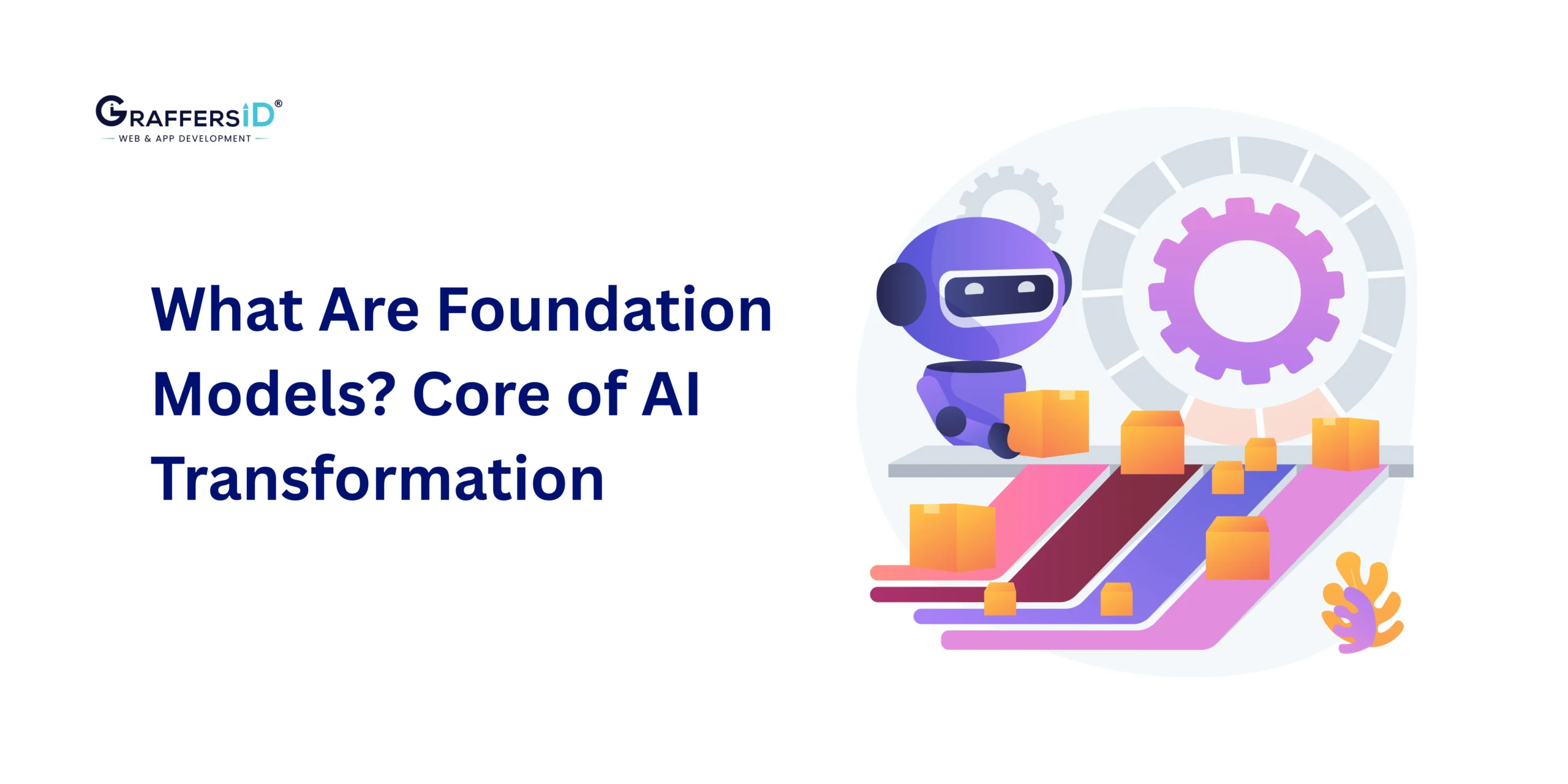
In 2026, foundation models have become the invisible infrastructure powering enterprise intelligence. They are the core intelligence infrastructure behind modern enterprise software, automation platforms, and AI-driven products.
From internal copilots to autonomous workflow agents, enterprise AI systems are built on large multimodal models developed by leaders such as OpenAI (GPT-5), Google DeepMind (Gemini 2), Meta (LLaMA 3), and Anthropic (Claude 3). These models can understand text, images, code, and voice in a unified architecture, enabling businesses to automate decisions, personalize experiences, and scale intelligence across departments.
For CTOs, CEOs, and technology leaders, this is not just another wave of digital transformation. It is a structural shift in how software is built and how competitive advantage is created. The organizations that understand foundation models and implement them strategically are accelerating innovation cycles, reducing operational costs, and redefining productivity.
In this 2026 guide, we’ll explore what are foundation models, how they work, why transformer architectures matter, how they differ from generative AI & agentic AI, enterprise use cases across industries, and how to build, fine-tune, & deploy them in 2026.
What is a Foundation Model in AI?
A foundation model is a large-scale, pre-trained artificial intelligence model trained on massive and diverse datasets, including text, code, images, audio, video, and structured enterprise data.
It serves as a general-purpose intelligence system that can be adapted to perform many different tasks without being built from scratch each time.
Unlike traditional machine learning models that are designed for one specific task, foundation models provide a reusable AI base that organizations can customize for multiple business applications.
In simpler terms, think of it as an “AI Operating System” for your enterprise. A foundation model acts as a universal intelligence layer inside your organization.
Just as cloud infrastructure powers multiple applications, a foundation model powers multiple AI-driven workflows, from automating customer support to analyzing financial risk and processing enterprise documents. Instead of rebuilding AI every time, you build on top of the same intelligent foundation.
Key Characteristics of Foundation Models in 2026
To understand why foundation models are transforming enterprise AI, it’s important to look at their core capabilities. Below are the key features that differentiate foundation models from traditional AI systems in 2026.
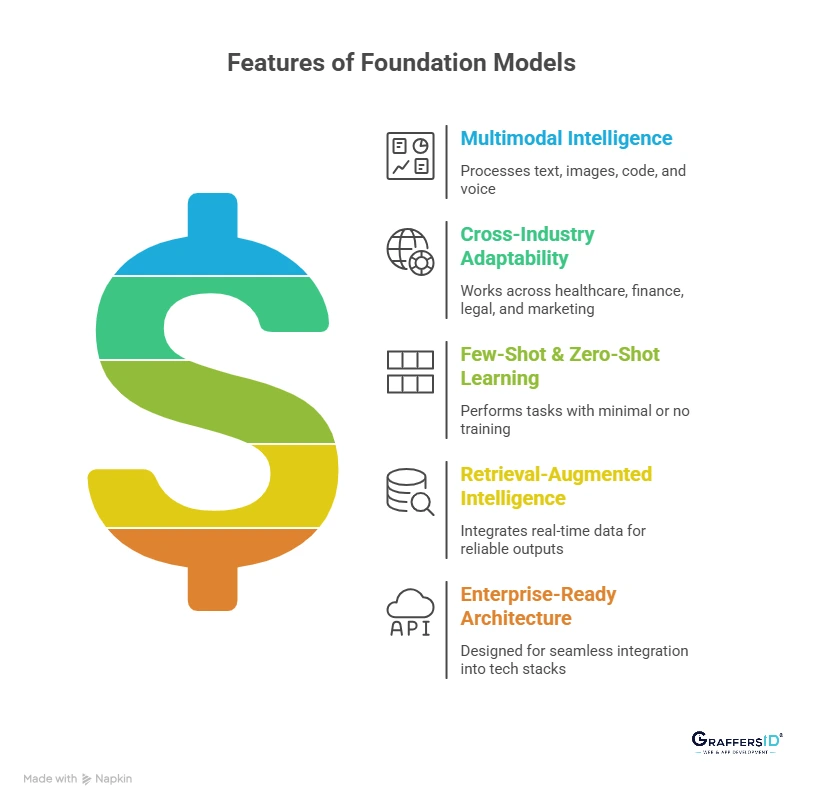
1. Multimodal Intelligence (Text, Images, Code & Voice in One Model)
Modern foundation models can process and connect multiple data types within a single architecture.
- Understand text and generate human-like responses
- Analyze images and visual documents
- Write, debug, and explain code
- Interpret audio or voice inputs
This unified capability enables seamless automation across customer support, product development, analytics, and operations.
2. Cross-Industry and Cross-Task Adaptability
A single foundation model can be adapted for multiple industries and use cases without rebuilding from scratch.
- Healthcare: clinical documentation and diagnostics
- Finance: fraud detection and risk modeling
- Legal: contract analysis and compliance review
- Marketing: personalization and content automation
This reduces infrastructure complexity and standardizes AI intelligence across departments.
3. Few-Shot & Zero-Shot Learning
Foundation models can perform new tasks with little to no additional training data.
- Few-shot learning: Works with just a handful of examples
- Zero-shot learning: Performs tasks based purely on instructions
This dramatically lowers development time, labeling costs, and AI deployment cycles.
4. Retrieval-Augmented Intelligence (RAG Integration)
In 2026, foundation models are enhanced with Retrieval-Augmented Generation (RAG) pipelines to access real-time enterprise data securely.
- Connect to internal databases and knowledge bases
- Pull updated information during inference
- Reduce hallucinations by grounding outputs in factual data
This makes enterprise AI systems more reliable and context-aware.
5. Enterprise-Ready & API-First Architecture
Foundation models are designed for integration into modern tech stacks.
- Accessible via secure APIs and SDKs
- Deployable on cloud, hybrid, or private infrastructure
- Scalable across global enterprise systems
This allows organizations to embed AI directly into CRMs, ERPs, analytics tools, and internal platforms.
How Do Foundation Models Work? Simplified Architecture in 2026
Most foundation models are built on transformer-based neural networks, a deep learning architecture designed to understand relationships across long sequences of data. This allows models to interpret context across paragraphs, images, code blocks, and even multimodal inputs in a single system.
Below is a simplified, enterprise-focused breakdown of how foundation models work in practice:
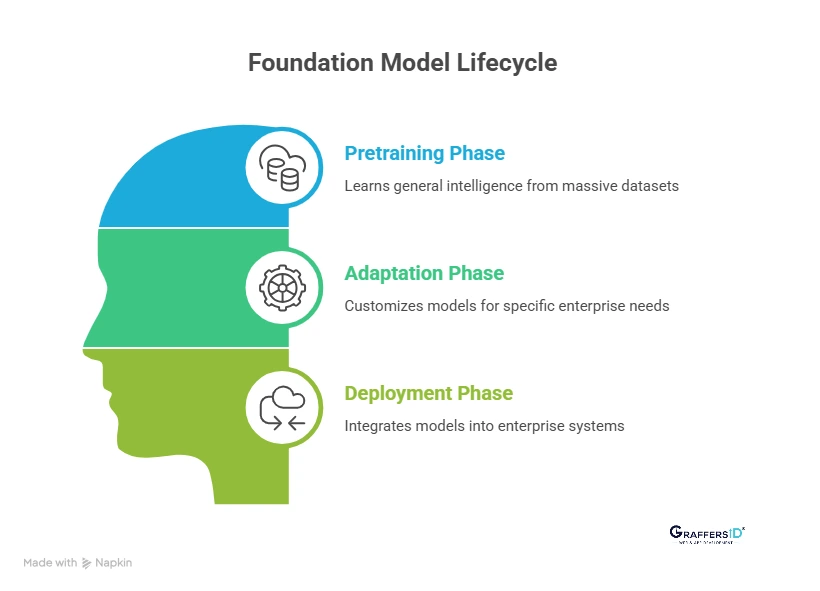
1. Pretraining Phase: How Foundation Models Learn General Intelligence
In the pretraining stage, the model is trained on massive datasets containing text, code, images, audio, and structured data. This process uses self-supervised learning, meaning the model learns patterns without manual labeling. During this phase, the model:
- Processes trillions of tokens from diverse sources
- Learns grammar, reasoning patterns, logic, and world knowledge
- Builds contextual understanding across formats (multimodal learning)
The goal here is not to teach a single task but to develop broad, transferable intelligence that can later be adapted for enterprise use.
2. Adaptation Phase: How Businesses Customize Foundation Models
Enterprises typically do not train foundation models from scratch. Instead, they adapt existing base models using lightweight fine-tuning and data augmentation techniques. Common customization methods include:
- LoRA (Low-Rank Adaptation): Efficient parameter tuning without retraining the full model
- Adapter layers: Add-on modules that adjust model behavior for specific domains
- Prompt engineering: Structuring inputs to guide model output
- Retrieval-Augmented Generation (RAG): Connecting the model to private enterprise data
- Domain fine-tuning: Training on industry-specific datasets
This enables organizations to align the model with:
- Internal documentation and knowledge bases
- Industry terminology and compliance rules
- Brand voice and communication standards
- Operational workflows and automation logic
3. Deployment Phase: How Foundation Models Are Integrated into Enterprise Systems
After customization, foundation models are deployed through secure and scalable infrastructure. Common deployment environments include:
- Cloud AI platforms such as Amazon Bedrock and Azure AI Studio
- Private cloud environments for enhanced control
- On-premise infrastructure for regulated industries
- Embedded AI within enterprise applications
Once deployed, foundation models integrate directly into:
- CRM and ERP systems
- Business intelligence dashboards
- Internal AI copilots
- Customer-facing chatbots
- AI workflow automation agents
This stage transforms the model from a research system into a production-grade enterprise intelligence layer.
Foundation Models vs. Generative AI vs. Agentic AI: What’s the Difference in 2026?
Many decision-makers use these terms interchangeably, but they represent three different layers of the enterprise AI stack. Understanding the difference helps CTOs design scalable, future-ready AI architectures instead of fragmented experiments.
| AI Layer | Role in AI Stack | What It Does | Examples |
|---|---|---|---|
| Foundation Models | Core Intelligence Layer | Understands and processes text, code, images, audio, and structured data | GPT-5, LLaMA 3 |
| Generative AI | Content Creation Layer | Generates new content such as reports, emails, images, code, and summaries | DALL·E 3, Midjourney |
| Agentic AI | Autonomous Execution Layer | Plans, reasons, makes decisions, and executes multi-step tasks toward goals | AutoGPT, Devin AI |
In short:
- Foundation models provide intelligence: They are the underlying large-scale models trained on massive datasets that power understanding and reasoning.
- Generative AI creates outputs: It uses foundation models to produce text, visuals, code, and other content for business use.
- Agentic AI takes action: It builds on foundation models and generative capabilities to autonomously plan and execute workflows.
Read More: Agentic AI vs. Generative AI: Key Differences CTOs Must Know in 2025
How do Foundation Models, Generative AI & Agentic AI work together in Enterprise AI Systems in 2026?
Modern enterprise AI solutions combine all three layers:
1. A foundation model interprets data and context.
2. Generative AI produces relevant outputs (reports, responses, code).
3. Agentic AI triggers actions (sending emails, updating CRM records, executing workflows).
In 2026, competitive enterprises are not choosing between these technologies; they are strategically layering them to create end-to-end intelligent systems.
Key Benefits of Foundation Models for Modern Enterprises in 2026
Foundation models have become the fastest way for enterprises to adopt advanced AI without building complex systems from scratch. Instead of investing years in model development, organizations can leverage pre-trained, enterprise-ready intelligence and focus on solving real business problems.
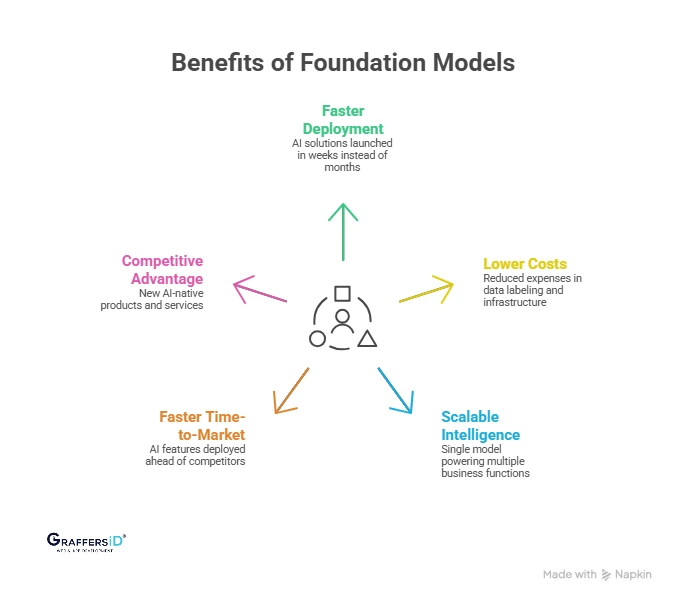
Below are the key reasons foundation models matter for businesses in 2026:
1. Faster AI Deployment Across the Organization
Foundation models come pre-trained on massive datasets, allowing enterprises to launch AI solutions quickly using APIs or fine-tuning techniques.
- Businesses can deploy AI copilots, automation tools, or analytics assistants in weeks instead of months.
- Teams focus on integration and outcomes rather than core model training.
2. Lower AI Development Costs
Building a large AI model from scratch requires massive compute, data engineering, and ML expertise. Foundation models eliminate that overhead.
- Reduced need for extensive data labeling and retraining
- Lower infrastructure and model engineering expenses
- Higher return on AI investment (ROI)
3. Scalable Intelligence Across Departments
A single foundation model can power multiple business functions simultaneously.
- Customer support automation
- Marketing content generation
- Financial forecasting
- Internal knowledge assistants
This creates a standardized intelligence layer across global operations.
4. Faster Time-to-Market for AI Features
With API-first architectures and modular fine-tuning methods (such as LoRA and RAG), enterprises can rapidly prototype and deploy AI-driven features.
- Launch AI-powered products ahead of competitors
- Reduce experimentation cycles
- Adapt quickly to market demands
5. Competitive Advantage Through AI-Native Innovation
Foundation models enable entirely new categories of products and services.
- AI-powered SaaS platforms
- Intelligent automation workflows
- Personalized digital experiences at scale
Organizations that integrate foundation models strategically are not just improving efficiency; they are building AI-native business models.
Read More: What is Multimodal AI in 2026? Definition, Examples, Benefits & Real-World Applications
How Are Foundation Models Used in Real Businesses? 2026 Industry Use Cases
Foundation models are no longer theoretical AI systems; they are actively transforming how major industries operate. Below are real-world business use cases in 2026 that show how enterprises apply foundation models to improve efficiency, accuracy, and decision-making.
1. Finance
In financial services, foundation models analyze structured and unstructured data to detect fraud patterns, monitor regulatory compliance, and assess real-time risk exposure. They also power AI-driven portfolio analysis by processing market signals, news sentiment, and historical data to support faster, data-backed investment decisions.
2. Healthcare
Healthcare organizations use foundation models for diagnostic assistance by interpreting medical images and patient records together. They also automate medical transcription and clinical document summarization, reducing administrative burden and allowing healthcare professionals to focus more on patient care.
3. Retail and E-commerce
Retailers leverage foundation models to generate personalized product recommendations based on behavioral and transactional data. These models also enable dynamic pricing strategies and demand forecasting by analyzing purchasing trends, seasonality, and external market signals in real time.
4. Legal and Human Resources (HR)
In legal and HR departments, foundation models accelerate contract analysis by identifying risks, clauses, and inconsistencies across large document volumes. They also automate policy summarization and enhance intelligent candidate screening by matching resumes with job descriptions using contextual understanding rather than keyword-based filtering.
Most Popular Foundation Models for Enterprises in 2026 (Top AI Models Companies Use Today)
Below are the leading foundation models powering enterprise AI systems in 2026. These models are widely adopted for automation, copilots, analytics, and domain-specific AI applications.
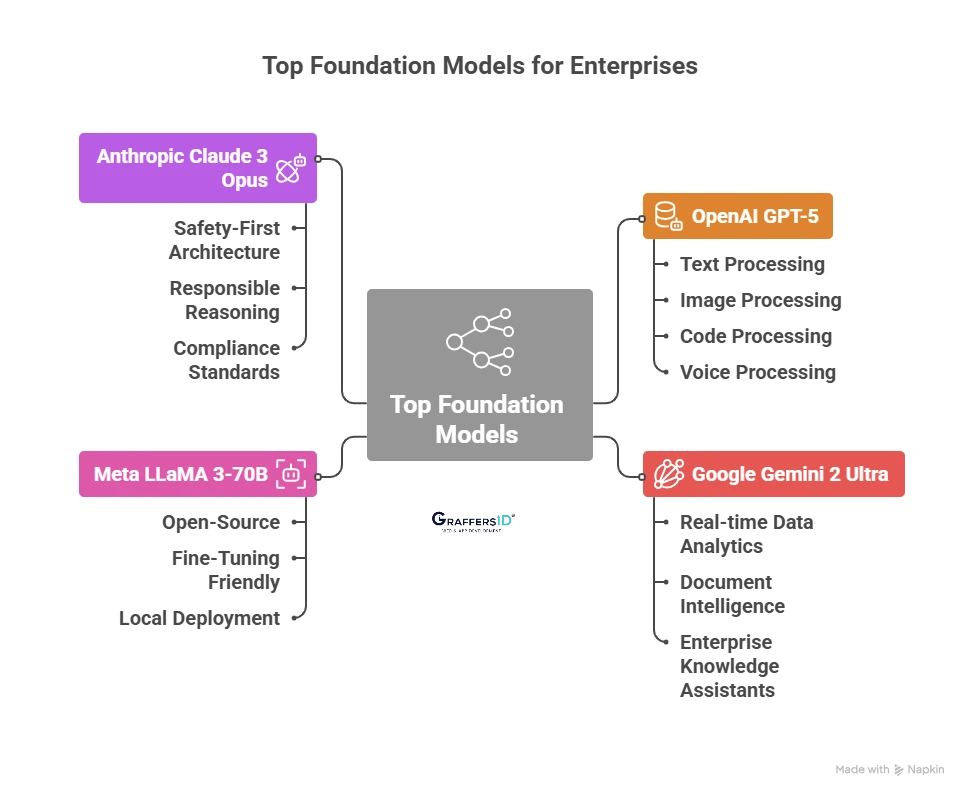
1. GPT-5 (by OpenAI)
GPT-5 is a multimodal foundation model designed for advanced reasoning across text, code, images, and structured enterprise data. It is commonly used to build internal AI copilots, customer-facing assistants, and intelligent automation systems. Enterprises choose GPT-5 for:
- Strong coding and workflow automation capabilities
- Long-context reasoning for complex documents
- API-first deployment for scalable enterprise integration
2. Gemini 2 Ultra (by Google DeepMind)
Gemini 2 Ultra is a natively multimodal AI model optimized for deep integration with the Google ecosystem. It is widely used for document intelligence, data analytics, and enterprise knowledge management. Organizations leverage Gemini 2 Ultra for:
- Seamless integration with Google Workspace and BigQuery
- Real-time enterprise data analysis
- Advanced document summarization and insight extraction
3. LLaMA 3-70B (by Meta)
LLaMA 3-70B is an open-weight foundation model known for flexibility and cost-efficient fine-tuning. It is popular among startups and mid-sized enterprises that prefer greater control over deployment. It is often selected for:
- Private or on-premise deployments
- Custom domain fine-tuning
- Reduced licensing costs compared to proprietary APIs
4. Claude 3 Opus (by Anthropic)
Claude 3 Opus is built with a safety-first architecture, making it suitable for highly regulated industries. It is known for structured reasoning and responsible AI alignment. Enterprises use Claude 3 Opus for:
- Compliance-sensitive workflows (finance, healthcare, legal)
- Policy analysis and contract review
- Long-form reasoning with strong guardrails
How Businesses Build, Customize & Implement Foundation Models in 2026?
In 2026, most enterprises do not build foundation models from scratch. Instead, they select a powerful base model and customize it to fit their industry, workflows, and compliance requirements. The key to success is combining technical fine-tuning with a phased adoption strategy. Here’s how leading companies do it:
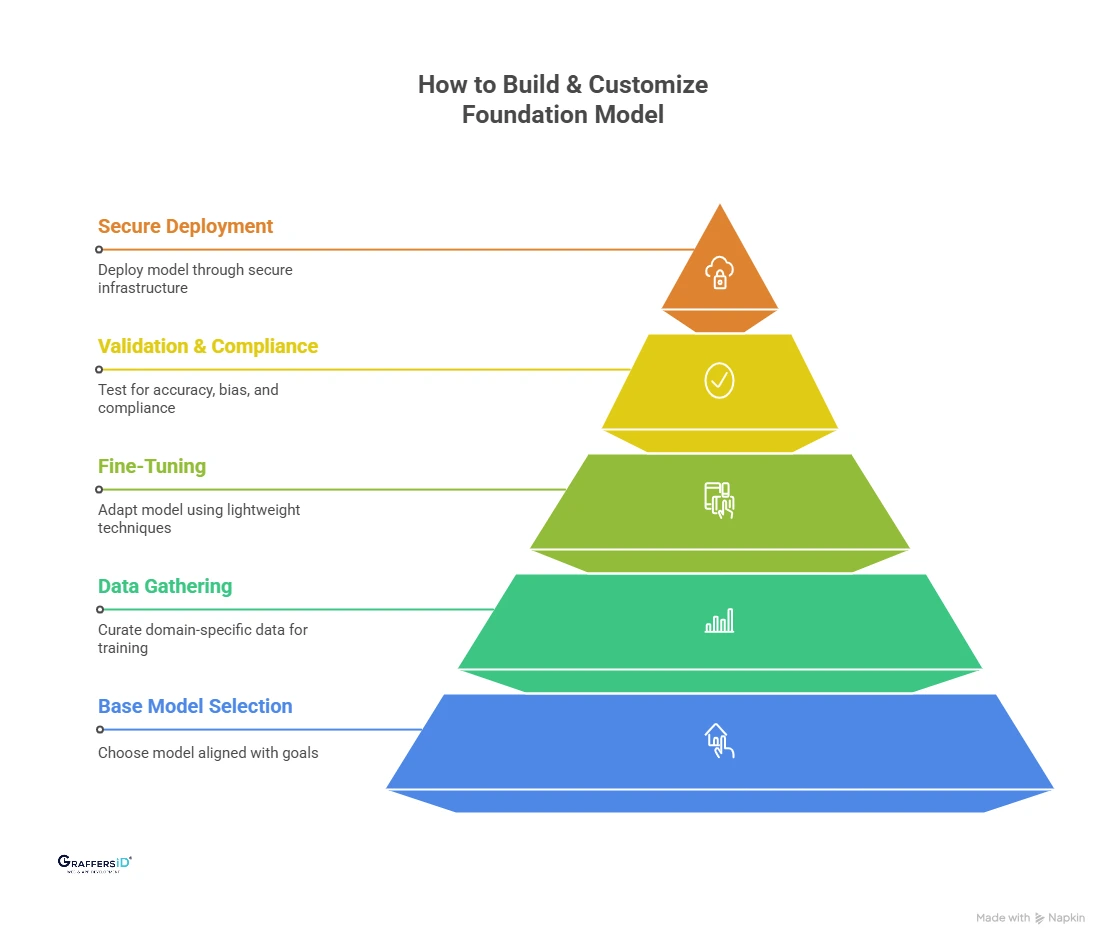
Step 1: Choose the Right Foundation Model
Enterprises start by selecting a base model that matches their technical and business goals. This decision depends on reasoning capability, cost structure, deployment flexibility, and compliance needs. Popular choices include:
- GPT-5 by OpenAI for advanced reasoning and enterprise automation
- LLaMA 3 by Meta for open-weight flexibility and private deployments
- Models from Mistral AI for cost-efficient performance
The right model depends on use case maturity and infrastructure readiness.
Step 2: Collect and Prepare Domain-Specific Data
Customization requires high-quality, relevant data. Companies curate:
- Internal documents and SOPs
- Customer support conversations
- Industry-specific terminology
- Structured enterprise datasets
All sensitive information is anonymized and secured before training or retrieval integration.
Step 3: Fine-Tune or Use Retrieval-Based Customization
Instead of retraining large models, enterprises apply lightweight adaptation methods such as:
- LoRA (Low-Rank Adaptation)
- Adapter layers
- Retrieval-Augmented Generation (RAG)
This allows rapid customization while reducing compute costs and maintaining model stability.
Step 4: Validate, Test, and Ensure Compliance
Before deployment, enterprises rigorously evaluate models for:
- Accuracy and hallucination risks
- Bias and fairness
- Security vulnerabilities
- Regulatory alignment
Compliance frameworks often include:
- EU AI Act
- ISO/IEC 42001
- Industry-specific governance standards
This step is critical for the finance, healthcare, and legal sectors.
Step 5: Deploy Securely and Integrate into Business Systems
Once validated, models are deployed through:
- Secure APIs
- Private cloud infrastructure
- On-premise servers
- Enterprise AI platforms
Integration typically connects models with CRM systems, ERP platforms, analytics tools, and workflow automation engines.

Conclusion: Foundation Models Are Powering the Future of Enterprise AI
In 2026, foundation models are no longer experimental technologies; they are the core infrastructure behind modern enterprise AI systems. From intelligent copilots to workflow automation and autonomous agents, these models now power how businesses analyze data, make decisions, and scale operations efficiently.
When implemented correctly, foundation models provide a reusable intelligence layer that supports multiple business functions. Organizations that invest in structured AI adoption frameworks today will define their industries tomorrow. Those who delay risk falling behind AI-native competitors building smarter, faster, and more adaptive systems.
At GraffersID, we help enterprises & companies design and deploy AI-powered automation systems, intelligent copilots, and scalable AI workflows tailored to their industry needs.
Hire expert AI developers from GraffersID today and build a secure, scalable, and future-ready AI ecosystem.