Voice is no longer just a way to interact with technology; it has become a strategic channel for AI-first businesses. In 2026, customers expect instant, natural, and context-aware conversations across support, sales, and operations. Long hold times, rigid IVR menus, and repetitive explanations are now a thing of the past.
This is where AI voicebots step in: intelligent, conversational systems powered by advanced AI that can understand intent, retain context, and respond in natural language. Unlike traditional call flows, these voicebots can manage complex business interactions at scale, from answering customer queries and qualifying leads to automating internal workflows and voice-enabled operations.
In this guide, we’ll explore what a voicebot is, how AI voicebots work, their real-world applications, and the tangible benefits for modern businesses in 2026.
What is a Voicebot?
A voicebot is an AI-powered virtual assistant that interacts with users through natural spoken language, enabling businesses to automate conversations at scale. Unlike traditional IVR systems, which rely on rigid menus and scripted responses, modern voicebots can understand intent, maintain context, and carry on conversational dialogues in real time.
Voicebots use advanced AI and speech technologies to process user requests, respond naturally, and deliver personalized, human-like experiences. They can handle complex queries, remember context across multiple interactions, and operate 24/7, ensuring consistent customer engagement.
In 2026, voicebots are more than just automated call systems; they are strategic AI tools that drive operational efficiency, enhance customer satisfaction, and support enterprise-level digital transformation.
How AI Voicebots Work in 2026? Technologies, Architecture, & Integrations
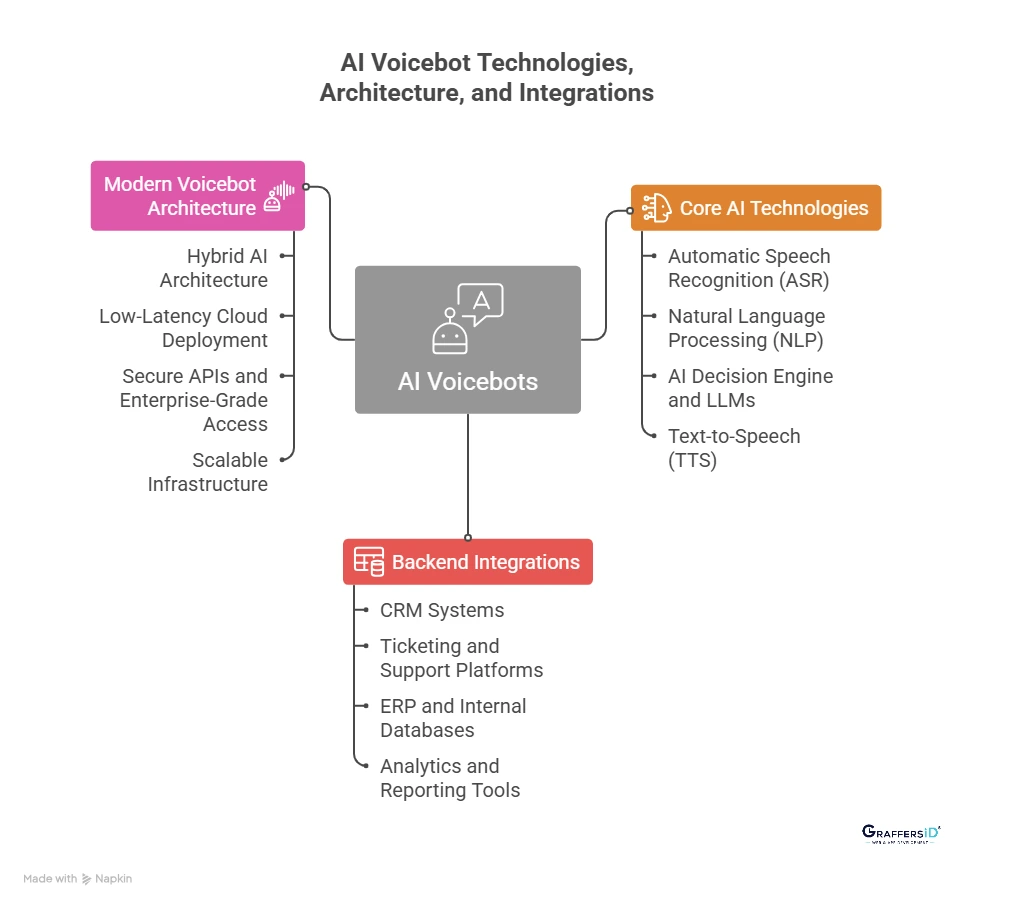
AI voicebots are powered by a layered AI technology stack that allows them to understand human speech, process meaning, make decisions, and respond naturally, all in real time. Here’s a detailed look at how they work:
Core AI Technologies Behind Voicebots
1. Automatic Speech Recognition (ASR)
- Converts spoken words into text in real time.
- Handles variations in accents, background noise, and speaking styles.
- Ensures the system accurately “hears” the user, even in complex environments.
2. Natural Language Processing (NLP)
- Analyzes the transcribed text to understand intent, context, and meaning.
- Identifies what the user actually wants, rather than just keywords.
- Supports multilingual processing for global applications.
3. AI Decision Engine and Large Language Models (LLMs)
- Determines the best response using a combination of predefined workflows and generative AI.
- Maintains conversation context for multi-turn dialogues, creating a human-like interaction.
- Learns from previous interactions to continuously improve responses.
4. Text-to-Speech (TTS)
- Converts AI-generated responses into natural-sounding speech.
- Supports multiple languages, tones, and voice styles for personalized experiences.
- Ensures responses sound human and engaging, not robotic.
Together, these components allow AI voicebots to listen, understand, decide, and respond instantly, making conversations seamless and scalable.
Read More: What is Text-to-Speech (TTS)? How It Works, Benefits, Applications & AI Trends in 2026
Backend Integrations That Make Voicebots Enterprise-Ready
An AI voicebot becomes truly powerful when connected to enterprise systems, enabling it to not just converse but also take action. Key integrations include:
-
CRM systems for real-time customer data and history.
-
Ticketing and support platforms to automate case handling.
-
ERP and internal databases for access to operational or product information.
-
Analytics and reporting tools to track conversation insights and measure performance.
With these integrations, voicebots can fetch data, update records, and complete tasks automatically, turning conversations into actionable business outcomes.
Modern Voicebot Architecture in 2026
AI voicebots today are built for speed, security, and scalability:
-
Hybrid AI architecture: Combines rule-based workflows with generative AI for predictability and flexibility.
-
Low-latency cloud deployment: Ensures real-time responses even under high traffic.
-
Secure APIs and enterprise-grade access: Protects sensitive customer data while integrating with core systems.
-
Scalable infrastructure: Handles thousands of simultaneous interactions without performance drops.
This modern architecture ensures AI voicebots deliver consistent, reliable, and intelligent conversations across any business environment.
Top AI Voicebot Applications for Businesses in 2026
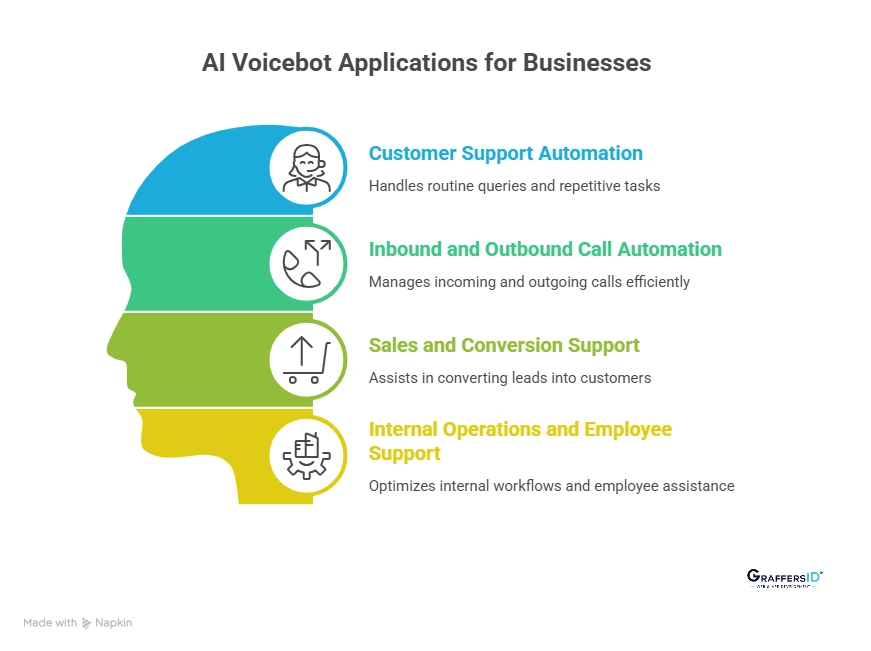
1. Customer Support Automation
AI voicebots are revolutionizing customer support by handling routine queries and repetitive tasks efficiently. They can:
-
Answer FAQs and provide instant responses to common questions
-
Check order statuses or service updates without human intervention
-
Book appointments and resolve standard tickets
By automating these tasks, voicebots reduce wait times, improve first-contact resolution, and free human agents to focus on complex or high-value interactions, enhancing overall customer satisfaction.
2. Inbound and Outbound Call Automation
Voicebots excel in both incoming and outgoing calls, helping businesses maintain consistent communication at scale. Use cases include:
-
Lead qualification by engaging prospects and capturing key details
-
Follow-up calls to ensure timely responses and nurture leads
-
Payment reminders, notifications, and surveys
This ensures businesses reach the right audience efficiently, improve response rates, and maintain high engagement without overburdening human teams.
Read More: How to Build an AI Voice Agent in 2026: Step-by-Step Guide, Tools, and Future Trends
3. Sales and Conversion Support
AI voicebots act as the first point of contact for sales interactions, helping convert leads into customers. They can:
-
Handle inbound sales inquiries promptly
-
Explain product features and offerings clearly
-
Route qualified leads to the right sales representative or department
By managing initial engagement, voicebots accelerate the sales funnel, improve conversion rates, and provide a seamless customer experience.
4. Internal Operations and Employee Support
Beyond customer-facing functions, voicebots also optimize internal business workflows. They can:
-
Automate IT helpdesk requests and troubleshoot basic issues
-
Answer HR policy queries for employees instantly
-
Handle leave requests, approvals, and internal workflows efficiently
This reduces operational overhead, ensures quick issue resolution, and allows internal teams to focus on strategic initiatives rather than repetitive tasks.
How AI Voicebots Are Used in Different Industries in 2026?
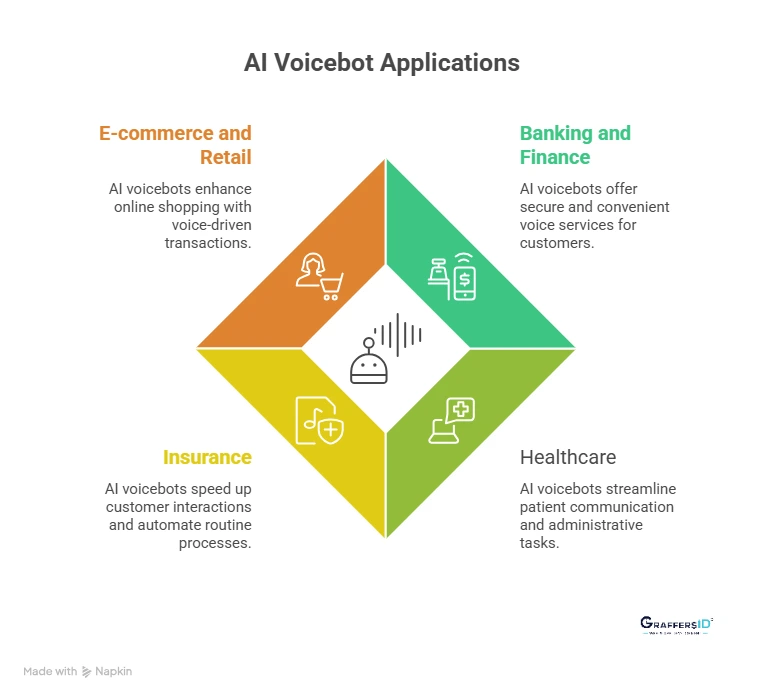
1. Banking and Finance
AI voicebots help banks and financial institutions offer secure, convenient, and real-time voice services for customers. They can:
-
Check account balances and recent transactions instantly via voice
-
Authenticate users securely using voice biometrics
-
Provide loan, credit, and product information without human intervention
This improves customer experience, reduces call center load, and enhances security.
2. Healthcare
In healthcare, AI voicebots streamline patient communication and administrative tasks, reducing wait times and improving operational efficiency. They can:
-
Schedule or reschedule appointments automatically
-
Send reminders for consultations or medication
-
Answer common medical or insurance-related queries
This ensures patients stay informed and clinics operate efficiently.
3. Insurance
Insurance providers leverage voicebots to speed up customer interactions and automate routine processes. They can:
-
Provide real-time claim status updates
-
Assist with First Notice of Loss (FNOL) reporting
-
Answer policy or coverage questions quickly and accurately
Voicebots help enhance customer satisfaction while reducing manual support efforts.
4. E-commerce and Retail
AI voicebots transform online shopping by enabling voice-driven transactions and personalized experiences. They can:
-
Track orders and provide delivery updates instantly
-
Assist with voice-based product searches and recommendations
-
Guide users through checkout or return processes
This improves customer engagement, boosts sales, and reduces friction in online shopping journeys.
Read More: What is Conversational AI in 2026? Top Tools, Business Use Cases, and Enterprise Adoption
Benefits of Using AI Voicebots in 2026
AI voicebots deliver measurable business value. Key benefits include:
- 24/7 Customer Support: AI voicebots provide round-the-clock assistance, helping businesses serve customers anytime without increasing staff.
- Faster Response and Resolution: Voicebots handle queries instantly, reducing wait times and improving first-contact resolution rates.
- Lower Operational Costs: Automating routine tasks with AI voicebots reduces the need for large support teams and lowers operational expenses.
- Consistent Customer Experience: AI voicebots deliver uniform responses and service quality, ensuring a reliable experience across all interactions.
- Enhanced Accessibility: Voicebots support multiple languages and adapt to different accents, making services accessible to diverse audiences.
- Improved Business Efficiency: By handling repetitive tasks, voicebots allow human agents to focus on high-value work, boosting overall productivity and scalability.
Best Practices for Implementing AI Voicebots in 2026
Implementing an AI voicebot goes beyond technology; it’s about creating seamless, human-like interactions that deliver measurable business value. Following best practices ensures your voicebot improves customer experience, drives efficiency, and scales across operations.
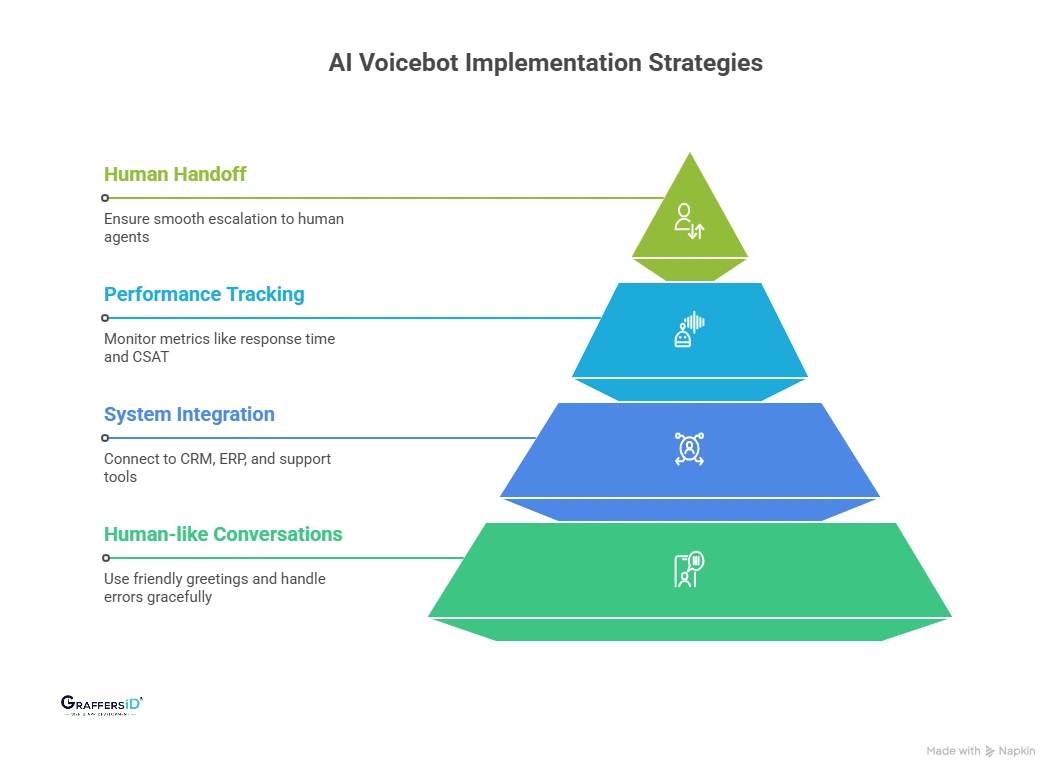
1. Design Conversations That Feel Human
To engage users effectively, AI voicebots should simulate natural conversations:
-
Use friendly greetings and confirmations: Start interactions with a warm welcome and confirm user requests to build trust and clarity.
-
Handle errors gracefully: When the bot cannot understand a query, provide helpful suggestions or guide users back to the right path without frustration.
-
Keep conversations concise and goal-oriented: Avoid unnecessary dialogue. Focus on completing tasks quickly while maintaining a human-like tone.
2. Integrate Voicebots with Your Business Systems
A voicebot is most powerful when connected to enterprise systems:
-
Connect to CRM, ERP, and support tools: Pull real-time customer data to personalize responses and streamline workflows.
-
Enable accurate, real-time actions: Whether checking an order, updating a ticket, or providing account information, integrations ensure accurate and timely responses.
3. Track Performance and Continuously Improve
Monitoring your voicebot ensures it stays effective and evolves with user needs:
-
First response time: Measure how quickly the bot acknowledges and begins handling queries.
-
Call completion rate: Track the percentage of interactions resolved fully by the bot.
-
Customer satisfaction score (CSAT): Collect feedback to evaluate user experience and identify improvement areas.
4. Enable Seamless Human Handoff
Even the most advanced AI cannot handle every scenario. Ensure smooth escalation:
-
Allow easy transfer to human agents: Maintain context so customers don’t have to repeat information.
-
Preserve conversation history: A context-aware handoff ensures consistent, professional interactions, improving overall customer satisfaction.
By following these practices, businesses can maximize ROI from AI voicebots, improve user engagement, and achieve a scalable, future-ready voice automation strategy in 2026.
Conclusion: Why AI Voicebots Are a Strategic Advantage in 2026?
AI voicebots have moved far beyond basic call automation. Today, they are intelligent, conversational systems that can handle complex interactions, deliver personalized experiences, and drive measurable business outcomes at scale.
In 2026, companies leveraging AI voicebots gain a clear competitive edge through faster customer engagement, lower operational costs, and scalable, AI-driven communication.
For CTOs, CEOs, and product leaders, AI voicebots are no longer just a support tool; they are strategic assets that enable digital transformation and AI-first business operations.
At GraffersID, we help enterprises design and deploy custom AI voicebots, conversational agents, and intelligent automation tailored to your business needs.
Contact GraffersID today to hire expert AI developers and build scalable AI voice solutions for your web, app, or enterprise operations.