If you’re still opening a browser, typing a query, and stitching together answers from ten blue links. You’re operating on a 2018 workflow in a 2026 world. Search has evolved.
Today, the tools winning the attention of CTOs, product leaders, and engineering teams aren’t traditional search engines. They’re AI answer engines, systems designed to deliver verified, contextual, decision-ready insights in seconds. And Perplexity AI is leading that shift.
In 2026, Perplexity is rapidly becoming a default research assistant for engineering and product teams worldwide. In this guide, you’ll learn:
- What Perplexity AI is and how it works
- How its real-time retrieval model differs from traditional LLMs
- Key features, pricing, and enterprise considerations
- Practical use cases for CTOs and tech teams
- A clear comparison with ChatGPT, Claude, and Gemini
If your decisions depend on fast, accurate, and verifiable information, this is the breakdown you need before choosing your AI research stack in 2026.
What is Perplexity AI?
Perplexity AI is a real-time AI search engine that delivers conversational answers backed by live web citations. Instead of simply generating responses from pre-trained data, it retrieves current information from the internet before producing an answer.
Founded in 2022 by Aravind Srinivas, a former OpenAI researcher, Perplexity was built for research-driven and decision-critical workflows. It is widely used by developers, CTOs, product leaders, and enterprise teams that require accurate, verifiable, and up-to-date information.
Unlike traditional AI chatbots, Perplexity attaches inline citations to every response, allowing users to instantly verify claims and reduce the risk of AI hallucinations. This makes it particularly useful for technical research, architecture planning, compliance validation, and competitive analysis.
At its core, Perplexity combines four key technologies:
- Live Web Search: Performs real-time retrieval from the internet to ensure answers reflect the latest updates, documentation, and benchmarks.
- Large Language Models (LLMs): Uses advanced models to generate structured, conversational, and context-aware responses.
- Retrieval-Augmented Generation (RAG): Injects verified web data into the AI model’s context before generating answers, improving accuracy and freshness.
- Citation Mapping: Links each claim to its original source, making responses transparent and traceable.
In simple terms, Perplexity functions like Google Search + ChatGPT + a research analyst, all in one interface, optimized for fast, reliable decision-making in 2026.
Advantages of Perplexity AI to Tech Teams in 2026
Here’s why Perplexity AI is gaining adoption among modern technical teams in 2026.
- Reduces AI Hallucination Risk: Unlike traditional chatbots that rely heavily on pre-trained data, Perplexity retrieves live information and attaches citations. This significantly lowers the risk of hallucinated answers in technical, compliance, or architecture-related decisions.
- Cuts Through SEO-Driven Noise: Search engines prioritize engagement and ranking signals, not always accuracy. Perplexity focuses on surfacing high-signal, authoritative sources, helping teams avoid misleading or overly optimized content.
- Speeds Up Technical Research: Engineering leaders often spend hours validating tools, frameworks, and benchmarks. Perplexity compresses that workflow into minutes by delivering summarized, citation-backed answers in a single interface.
- Supports Iterative, Context-Aware Exploration: Perplexity maintains session context, allowing leaders to refine queries, run comparisons, and explore trade-offs without restarting research from scratch.
Key Features of Perplexity AI in 2026
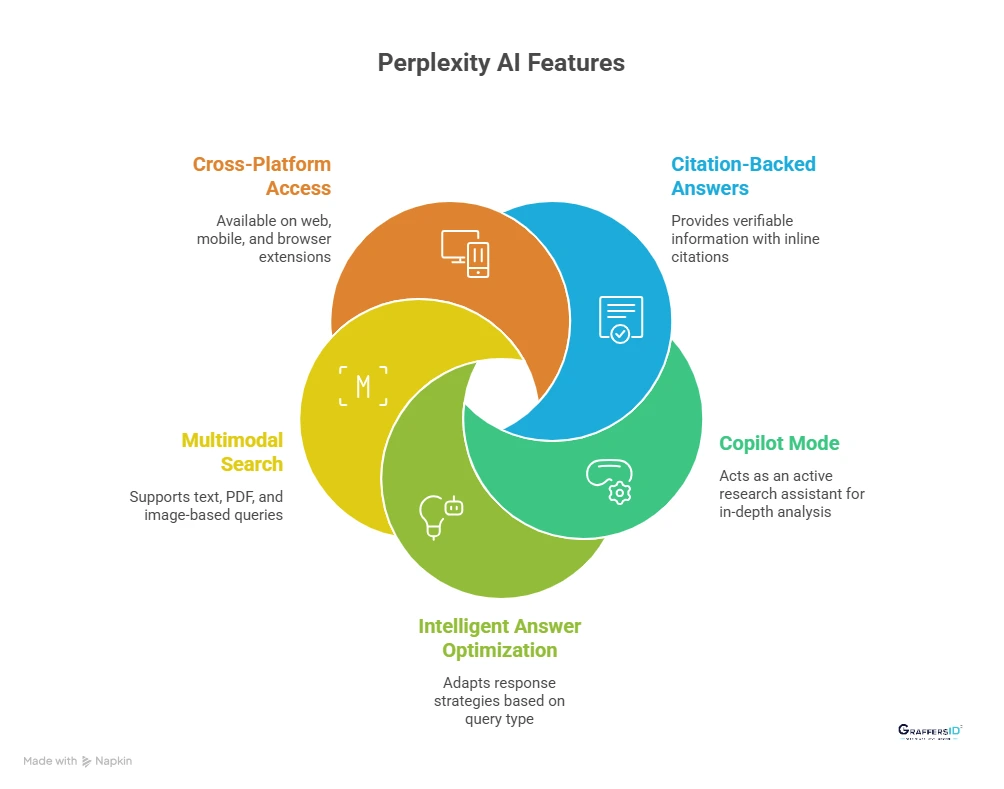
Below are the most important features that make Perplexity AI one of the leading AI search and research tools for CTOs, developers, and product teams in 2026:
1. Citation-Backed Answers with Live Sources
Perplexity provides conversational answers with inline citations from live web sources. Every major claim is traceable, making it easier to validate technical benchmarks, pricing data, or compliance information.
Every response includes clickable, real-time web citations, allowing users to:
- Instantly verify facts and technical claims
- Reduce the risk of misinformation or hallucinated answers
- Use AI outputs confidently in enterprise, technical, and business workflows
2. Copilot Mode for In-Depth Research
Copilot Mode turns Perplexity into an active research assistant rather than a simple search tool. Instead of searching in isolation, Copilot can:
- Analyze live web pages in real time
- Summarize long technical blogs or documentation
- Extract insights from GitHub repositories
- Answer questions based on the exact content of a page
3. Intelligent Answer Optimization (Performance Layer)
Perplexity adapts its response strategy based on the type of question being asked. Instead of treating every query the same, it adjusts output style, reasoning depth, and structure depending on whether the user needs:
- Technical analysis
- A quick factual answer
- A comparison breakdown
- A structured summary
4. Multimodal Search and Document Analysis
In 2026, Perplexity supports more than just text-based queries. It can handle:
- PDF uploads and document Q&A
- Research paper summarization
- Structured data extraction
- Early-stage image-based queries
5. Cross-Platform Access and Expanding API Support
Perplexity is designed for seamless research across workflows and devices. It is available via:
- Web application
- iOS and Android apps
- Browser extensions (with Copilot integration)
- Expanding API access for enterprise automation in 2026
How Does Perplexity AI Work in 2026? (Technical Architecture Explained)
Perplexity AI works by combining live web search with advanced large language models to generate accurate, citation-backed answers. Here’s how the system works in 2026:
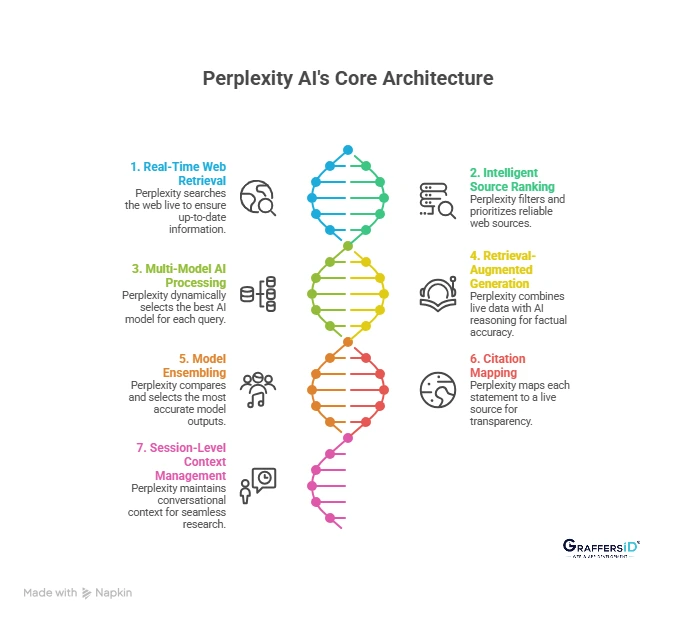
1. Real-Time Web Retrieval (Search-First Architecture)
When a user submits a query, Perplexity performs a live web search before generating an answer.
Instead of depending only on training data, it retrieves up-to-date content from publicly available sources. This ensures responses reflect current frameworks, pricing, APIs, and industry changes.
2. Intelligent Source Ranking & Quality Filtering
After retrieval, Perplexity evaluates and prioritizes:
- Authoritative domains
- High-signal technical sources
- Recent and relevant updates
Low-quality or low-relevance content is filtered out. This improves reliability and reduces exposure to SEO-manipulated or outdated pages.
3. Multi-Model AI Processing (Dynamic Model Selection)
Perplexity does not rely on a single model. It dynamically selects from advanced LLMs such as:
- GPT-4 Turbo
- Claude 3
- Mixtral
- Proprietary Perplexity-optimized research models (2026)
Model selection is automatic and based on query complexity, domain type, and reasoning depth. This ensures that technical queries, summaries, and analytical questions are handled by the most suitable AI engine.
4. Retrieval-Augmented Generation (RAG) Engine
Perplexity uses a Retrieval-Augmented Generation (RAG) framework to combine live data with AI reasoning. How RAG works:
- Query is submitted
- Relevant live sources are retrieved
- Verified content is injected into the model’s context
- The response is generated using grounded information
- Inline citations are attached to key claims
This significantly reduces hallucinations and improves factual accuracy compared to static LLM-only systems.
5. Model Ensembling & Dynamic Selection for Higher Precision
In many cases, multiple AI models evaluate the same query. Perplexity compares outputs and selects the most accurate or relevant version. This model ensembling approach improves answer quality, especially for technical, legal, or high-risk domains.
6. Citation Mapping & Traceable Reasoning
Each major statement in the final response is mapped to a live source. This creates:
- Transparent attribution
- Faster fact verification
- Audit-friendly research trails
For CTOs and enterprise teams, this traceability is critical for architecture validation, compliance research, and vendor comparisons.
7. Session-Level Context Management & Research Continuity
Perplexity maintains conversational context within a session. Users can:
- Ask follow-up questions
- Conduct multi-step research
- Refine comparisons without repeating prompts
Context is session-based rather than permanently stored, making it suitable for exploratory research. However, it is not designed for handling sensitive or proprietary enterprise data.
Practical Use Cases of Perplexity AI for Tech Teams in 2026
Below are the most common, high-impact ways tech teams are using Perplexity AI across the software development lifecycle.
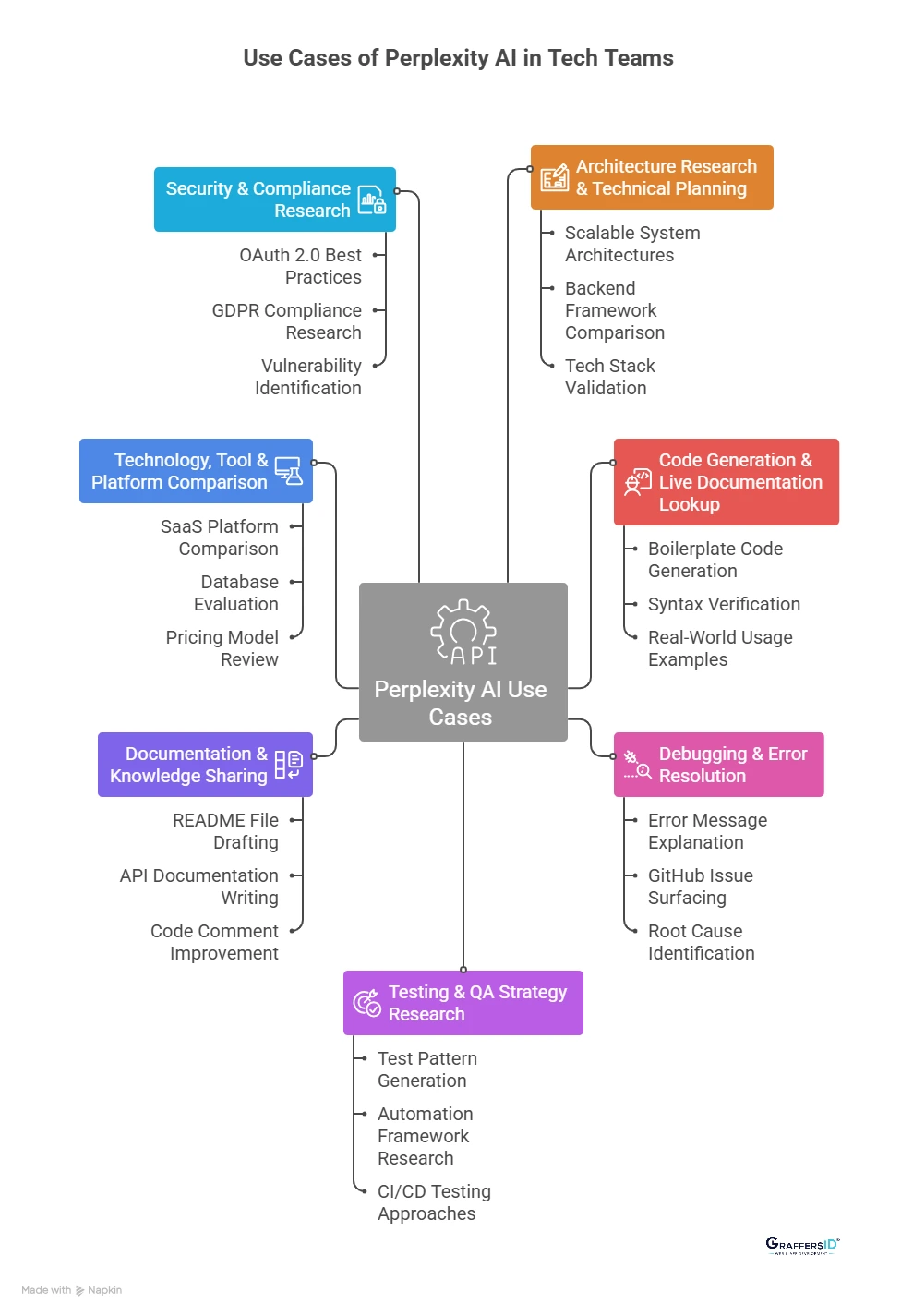
1. Architecture Research & Technical Planning
Tech teams use Perplexity AI during early-stage planning and system design to reduce research time and avoid outdated assumptions.
Common use cases:
- Researching scalable system architectures with real-world references
- Comparing backend frameworks (Node.js vs. Bun, Django vs. FastAPI, etc.)
- Validating tech stack decisions using up-to-date benchmarks and sources
- Understanding how similar products are built, with cited examples
This is especially valuable for CTOs and architects who need quick, verified insights before committing to long-term technical decisions.
2. Code Generation & Live Documentation Lookup
Perplexity AI supports developers by combining code generation with real-time documentation access.
Common use cases:
- Generating boilerplate code and utility functions
- Verifying syntax against the latest official documentation
- Finding real-world usage examples from open-source repositories
- Exploring best-practice implementation patterns
Because responses are grounded in live sources, developers can trust that examples reflect current standards, not outdated tutorials.
3. Debugging & Error Resolution
One of the most practical uses of Perplexity AI is speeding up debugging and issue resolution.
Common use cases:
- Explaining error messages in simple, human-readable terms
- Surfacing relevant GitHub issues, discussions, or Stack Overflow threads
- Identifying likely root causes and proven fixes
- Troubleshooting build, dependency, and deployment failures
This helps engineering teams resolve issues faster without jumping across multiple forums and search results.
Read More: Claude vs. Gemini: Which LLM is Better for IT Workflows Like Coding and Automation in 2026?
4. Testing & QA Strategy Research
Perplexity AI is widely used by QA engineers and developers to improve testing workflows.
Common use cases:
- Generating unit, integration, and end-to-end test patterns
- Researching test automation frameworks and tools
- Learning CI/CD testing approaches used by modern teams
- Understanding edge cases and common failure scenarios
This enables teams to build more reliable testing strategies without excessive trial and error.
5. Documentation & Knowledge Sharing
Clear documentation is critical for scaling teams, and Perplexity AI significantly reduces the effort required.
Common use cases:
- Drafting README files and onboarding documentation
- Writing API documentation and endpoint descriptions
- Improving code comments and docstrings
- Aligning documentation with industry standards
This is particularly useful for distributed or remote teams that rely heavily on written knowledge sharing.
6. Technology, Tool & Platform Comparison
When teams need to choose between tools, Perplexity AI provides fast, side-by-side comparisons with cited sources.
Common use cases:
- Comparing SaaS platforms and developer tools
- Evaluating databases, messaging queues, or logging tools
- Understanding pricing models, licensing terms, and scalability limits
- Reviewing real-world pros and cons from multiple sources
These insights help decision-makers make confident, data-backed choices.
7. Security & Compliance Research
Perplexity AI supports secure development practices by surfacing reliable, up-to-date security information.
Common use cases:
- Learning OAuth 2.0 and JWT implementation best practices
- Researching GDPR, HIPAA, and other compliance requirements
- Identifying common vulnerabilities and mitigation techniques
- Referencing secure coding standards and guidelines
While not a replacement for security audits, Perplexity helps teams stay informed and compliant during development.
How Perplexity Differs from Other AI Models in 2026? Perplexity AI vs. ChatGPT vs. Claude vs. LLaMA
Tech teams often ask a simple question in search engines and AI tools:
“How is Perplexity AI different from ChatGPT or Claude?”
The answer depends on what you want the AI to do: real-time research, reasoning, safety-focused conversations, or custom model development. Below is a clear comparison of Perplexity AI and other leading AI models in 2026.
| Feature | Perplexity AI | OpenAI ChatGPT | Claude (Anthropic) | Meta’s LLaMA |
| Primary Purpose | Real-time AI search engine | General-purpose AI assistant | Safe, helpful conversational AI | Open-source base LLM |
| Live Web Access | Native (RAG + crawling) | Limited(via tools/plugins) | Limited | No |
| Model Switching | Uses multiple LLMs | Single model per session | Claude only | Self-managed |
| Citations | Built-in, inline sources | Not default | Limited | No |
| Custom Integration | Planned/API in development | API ready | Limited | Full control (self-hosted) |
| Research Speed | Very High | Medium | Medium | Low |
Quick Takeaway: Perplexity vs. ChatGPT vs. Claude vs. LLaMA
- Perplexity: Best for real-time research
- ChatGPT: Best for creative + structured reasoning
- Claude: Best for safety-focused writing
- LLaMA: Best for custom AI infrastructure
How to Use Perplexity AI in 2026? Step-by-Step Setup Guide
Getting started with Perplexity AI is simple and requires no technical setup. Follow this practical step-by-step guide to start using it for research, product decisions, and technical workflows:
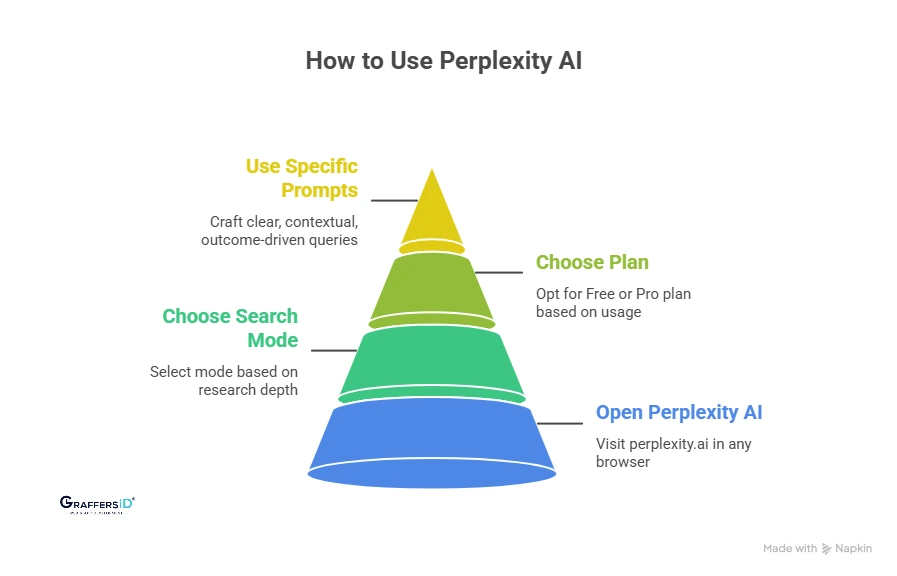
Step 1: Open Perplexity AI
Visit perplexity.ai in any browser. You can begin using it immediately without creating an account for basic queries. For advanced research workflows, you can:
- Install the Chrome or Firefox extension for Copilot-assisted browsing
- Download the iOS or Android app for mobile research
- Sign in to save history and unlock advanced features
This flexibility supports cross-device research, which aligns with how teams work in 2026.
Step 2: Choose the Right Search Mode for Your Task
Perplexity offers different research modes depending on the depth of analysis you need.
- Default Search Mode: Best for quick answers, definitions, comparisons, and fact-checking. It generates conversational responses with live citations, making it ideal for fast validation.
- Copilot Mode: Designed for deeper research and multi-step exploration. It analyzes live web sources, summarizes long-form content, and supports structured follow-up questions. This mode works well for architecture decisions, competitive research, and documentation review.
Choosing the correct mode improves output quality and reduces unnecessary back-and-forth.
Step 3: Choose a Plan (Free vs. Pro)
Perplexity offers flexible plans based on usage intensity.
- Free Plan: Suitable for individuals testing the platform. It includes citation-backed answers and limited Copilot access, making it useful for light research and quick lookups.
- Pro Plan ($20/month): Built for research-heavy users. It provides extended context memory, unlimited Copilot usage, and access to advanced models like GPT-4-class and Claude-class systems. This plan is ideal for engineering teams, founders, and decision-makers who rely on continuous, high-accuracy research.
Selecting the right plan ensures better performance and deeper context retention for complex queries.
Step 4: Use High-Intent, Specific Prompts for Better Results
Perplexity performs best when queries are clear, contextual, and outcome-driven. In 2026, AI answer engines prioritize structured intent over vague keywords.
Instead of asking: “Best backend framework?”
Ask: “Best backend frameworks for scalable SaaS applications in 2026 with performance comparisons.”
For stronger results:
- Specify the year, version, or technology stack
- Mention your goal (comparison, implementation, analysis)
- Use follow-up questions to refine depth
- Avoid one-word or overly broad queries
High-intent prompts improve accuracy, citation quality, and relevance, which is essential when using AI for technical or business-critical decisions.

Conclusion: Is Perplexity AI Worth Using in 2026?
Search has evolved, and so have expectations. In a world where AI-generated content is everywhere, the real advantage is no longer speed alone. It’s speed with verification. The ability to ask a complex question and receive a structured, citation-backed answer sourced from live web data is quickly becoming the new standard.
That’s the space Perplexity AI is defining. For technical teams making infrastructure decisions, evaluating vendors, validating benchmarks, or tracking market shifts, that transparency changes the risk equation.
If your workflow depends on real-time research, verifiable sources, and live citations, or on faster product or architecture decisions, then yes, Perplexity is worth integrating into your 2026 AI stack.
At GraffersID, we help startups and enterprises move beyond experimentation to implementation. Our AI experts build LLM-powered answer engines, AI automation platforms, intelligent agents, and scalable AI-driven web and mobile products.
Hire AI experts from GraffersID to turn AI strategy into production-ready solutions.