Instant delivery, better known as quick commerce (q-commerce), is no longer a “nice to have.” In 2026, it’s a baseline expectation for urban consumers. Platforms like Blinkit and Zepto have reshaped buying behavior by making essentials available in 10-30 minutes, raising the bar for speed, accuracy, and experience across retail, grocery, and hyperlocal services.
This shift signals far more than changing consumer habits. It represents a scalable, high-margin digital business model, one that runs on hyperlocal logistics, real-time inventory visibility, AI-powered demand forecasting, and automation-first operations. When executed right, instant delivery apps don’t just move products faster; they create defensible moats through data, technology, and operational efficiency.
In this guide, we break down how to build an instant delivery app like Blinkit or Zepto in 2026, from must-have features and modern tech architecture to AI integrations, development costs, and go-to-market strategies.
What is an Instant Delivery App?
An instant delivery app, also known as a quick commerce (q-commerce) app, is a hyperlocal, on-demand digital platform that allows users to order groceries, daily essentials, or high-frequency products and receive them within 10-30 minutes instead of waiting days, as with traditional eCommerce.
Unlike conventional online shopping platforms, instant delivery apps are built for speed and locality. Orders are fulfilled from nearby dark stores or local partner stores, ensuring products are always close to the end customer. This proximity enables faster delivery times while reducing logistics complexity.
How Instant Delivery Apps Work?
-
Customers place an order through a mobile app or website
-
The system checks real-time inventory at the nearest dark store or partner location
-
Orders are instantly assigned to available delivery partners
-
AI-powered routing selects the fastest and most efficient delivery path
-
Customers track the order live from checkout to the doorstep
This fully synchronized flow ensures consistent delivery timelines, even during peak demand.
Instant Delivery Apps vs. Traditional eCommerce Platforms
-
Delivery speed: Minutes vs. several hours or days
-
Fulfillment model: Local inventory and micro-warehouses vs. centralized warehouses
-
Decision-making: Real-time AI and automation vs. static, rule-based logistics
-
Customer experience: Immediate gratification vs. scheduled delivery
This model demands speed, precision, and automation, making technology a core differentiator.
Quick Commerce Market Landscape in 2026
The quick commerce (instant delivery) market is growing rapidly in 2026, driven by changing consumer behavior, technology adoption, and improvements in hyperlocal logistics. For founders and decision-makers, understanding these drivers is critical to building a scalable and competitive instant delivery platform.
- Urban Lifestyle Shift Toward Instant Convenience: Urban consumers increasingly prefer speed over bulk purchasing. Busy work schedules and on-demand habits have made instant delivery apps a daily-use utility rather than an occasional service.
- Rise of Small and Frequent Purchases: Instead of weekly grocery runs, users now place multiple small orders throughout the week. This behavior increases order frequency, lifetime value, and retention for quick commerce platforms.
- High Smartphone and UPI Adoption: Widespread smartphone usage combined with seamless UPI payments has removed friction from checkout. One-tap payments significantly improve conversion rates and repeat usage.
- Stronger Last-Mile Delivery Infrastructure: Better road connectivity, mapping accuracy, and delivery partner availability have made 10-30 minute deliveries operationally viable across more cities.
Read More: Best E-Commerce Development Companies in 2026 for Scalable, AI-Driven Online Stores
Key Features Every Instant Delivery App Must-Have in 2026
To compete with platforms like Blinkit and Zepto in 2026, the customer-facing app must be built for speed, accuracy, and scalability.
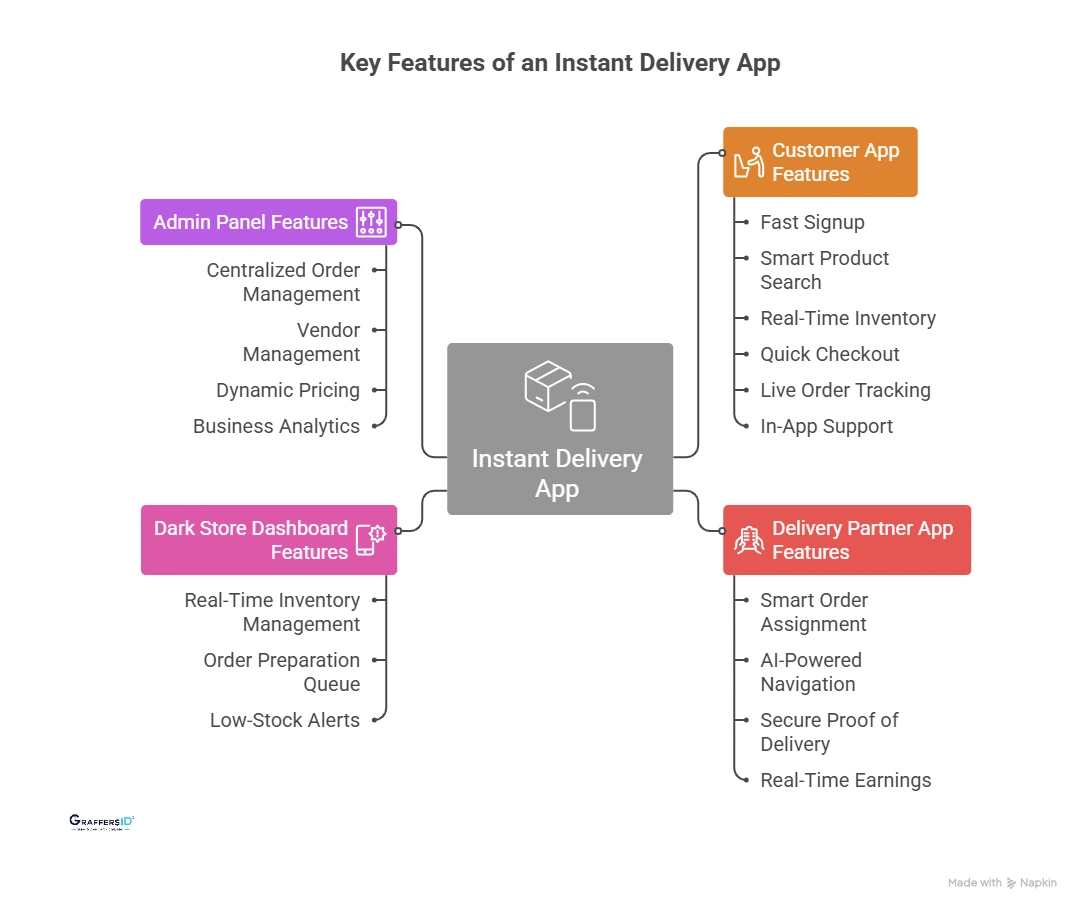
A: Customer App Features (User-Facing Experience)
1. Fast Signup with Mobile and UPI Authentication
A one-tap signup using mobile numbers and UPI-linked verification reduces friction during onboarding. This ensures users can place their first order within seconds, improving activation and lowering drop-offs.
2. Smart Product Search with Filters and AI Recommendations
Advanced search allows users to quickly find products using categories, filters, and auto-suggestions. AI-driven recommendations personalize results based on location, browsing patterns, and previous purchases, increasing cart value.
3. Real-Time Inventory and Price Visibility
Displaying live stock availability prevents failed orders and builds trust. Real-time inventory syncing ensures users only see products that are actually available at nearby stores or dark warehouses.
4. Quick Checkout with Multiple Payment Options
A frictionless checkout experience supports UPI, wallets, cards, and Buy Now Pay Later (BNPL). Faster payments directly improve order completion rates, especially for high-frequency, low-value purchases.
5. Live Order Tracking with Accurate ETA
Real-time order tracking shows each delivery stage, from packing to dispatch to doorstep. Dynamic ETAs powered by AI routing improve transparency and reduce customer anxiety.
6. In-App Support, Ratings, and Order History
Integrated customer support, order history, and rating systems help resolve issues quickly. These features also generate feedback loops that improve service quality and operational decisions.
AI-Powered Personalization Advantage: AI analyzes user behavior, location, time of day, and purchase history to recommend relevant products. This personalization increases repeat orders, boosts average order value, and strengthens user loyalty.
B: Delivery Partner App Features
1. Smart Order Assignment
Orders are automatically assigned to delivery partners based on real-time location, availability, and current workload. This ensures faster pickups, reduces idle time, and maintains consistent delivery timelines during peak demand.
2. AI-Powered Navigation and Route Optimization
The app uses AI-driven routing algorithms combined with live traffic data to select the fastest delivery routes. This helps delivery partners avoid congestion, meet strict delivery SLAs, and handle multiple orders efficiently.
3. Secure Proof of Delivery
Built-in OTP verification, image capture, or digital signatures confirm successful delivery. These verification methods reduce fraud, prevent disputes, and improve trust between customers, delivery partners, and the platform.
4. Real-Time Earnings and Performance Dashboard
Delivery partners can view earnings, incentives, completed orders, and performance metrics in real time. Transparent reporting improves partner satisfaction, boosts motivation, and supports long-term retention.
AI Advantage for Delivery Operations: Advanced instant delivery apps use dynamic order batching and traffic-aware routing to increase deliveries per hour. AI continuously learns from delivery patterns to optimize rider utilization while maintaining fast delivery promises.
C: Dark Store Dashboard Features
1. Real-Time Inventory and Stock Management
Store managers can track stock levels for every SKU in real time across one or multiple dark stores. Accurate inventory data minimizes stockouts, prevents order cancellations, and ensures customers only see available products, improving trust and fulfillment speed.
2. Order Preparation and Packing Queue Management
Structured picking and packing queues help store staff process orders in the correct priority sequence. This reduces manual coordination, shortens preparation time, and directly impacts how quickly orders move from confirmation to dispatch.
3. Low-Stock Alerts and Demand Notifications
Automated alerts notify teams when stock levels fall below defined thresholds or when sudden demand spikes occur. This enables faster restocking decisions and smoother operations during peak hours.
Automation advantage: AI-driven predictive restocking uses historical consumption patterns and sales velocity to maintain optimal inventory levels without overstocking.
D: Admin Panel Features for Managing an Instant Delivery App
1. Centralized Order and User Management
Admins can manage all orders, customers, vendors, and delivery partners from a single unified dashboard. This central control ensures faster issue resolution, smoother order processing, and consistent service quality across locations.
2. Vendor and Delivery Partner Management
The admin panel allows businesses to onboard vendors and delivery partners, manage availability, set commissions, and track performance metrics. Effective partner management helps maintain delivery speed, reliability, and operational efficiency at scale.
3. Dynamic Pricing, Surge Fees, and Offer Management
Admins can configure dynamic pricing rules, apply surge fees during peak demand, and launch targeted discounts or offers. AI-assisted pricing strategies help protect margins while maximizing conversions and customer retention.
4. Business Analytics and City-Wise Performance Insights
The admin dashboard provides real-time analytics on order volume, delivery times, customer retention, and revenue by city or zone. These insights support data-driven decisions for expansion, optimization, and long-term growth in 2026.
Technology Stack for Building an Instant Delivery App in 2026
In 2026, successful instant delivery platforms are built on flexible, cloud-native architectures designed for speed, reliability, and automation.
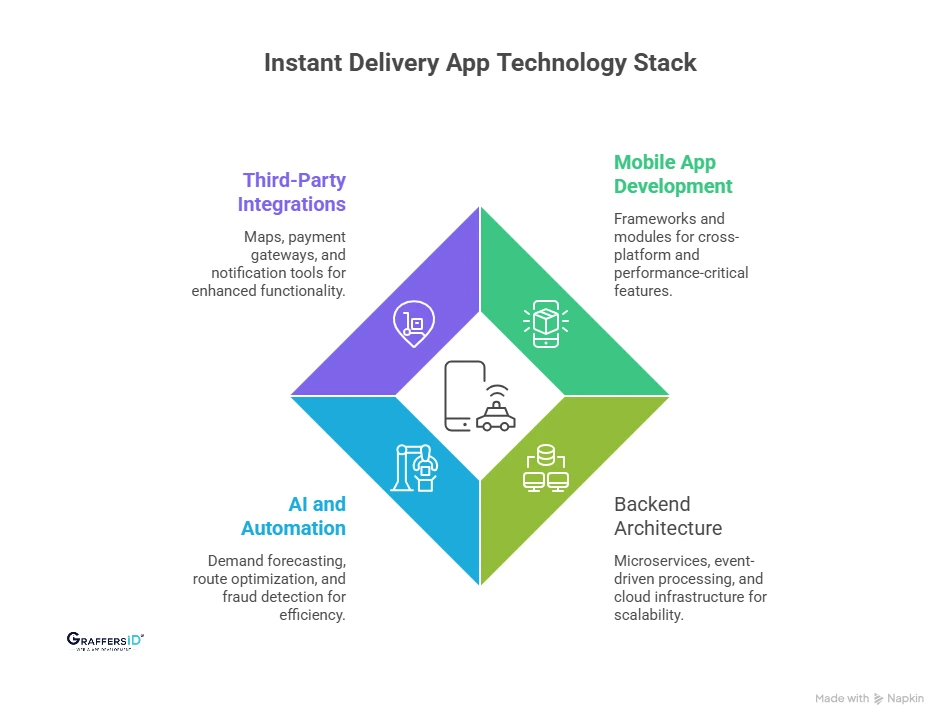
1. Mobile App Development Frameworks
-
Flutter or React Native: Enables faster cross-platform development while maintaining consistent performance across Android and iOS devices.
-
Native Modules: Used for performance-critical features such as real-time tracking, push notifications, and device-level optimizations.
2. Backend Architecture
-
Microservices-Based Architecture: Breaks the system into independent services for orders, inventory, payments, and delivery, allowing faster updates and easier scaling.
-
Event-Driven Real-Time Processing: Ensures instant updates for order status, inventory changes, and delivery tracking across the platform.
-
Scalable Cloud Infrastructure: Supports high traffic volumes, peak-hour demand, and city-level expansion without downtime.
3. AI and Automation Layer
-
Demand Forecasting and SKU Optimization: Uses historical and real-time data to predict demand, reduce stockouts, and improve inventory efficiency.
-
Route Optimization and Delivery Batching: Applies AI models to assign riders efficiently, minimize delivery time, and lower operational costs.
-
Fraud Detection and Anomaly Monitoring: Identifies suspicious transactions, fake orders, and delivery inconsistencies in real time.
4. Third-Party Integrations
-
Maps and Geolocation Services: Enable accurate location tracking, distance calculation, and ETA predictions for faster deliveries.
-
Payment Gateways and UPI Integration: Support instant, secure payments with high success rates and minimal friction.
-
Notifications and CRM Tools: Power real-time order updates, promotions, customer communication, and retention campaigns.
How to Build an Instant Delivery App? 2026 Step-by-Step Guide
Here’s a detailed, step-by-step roadmap to develop a scalable, AI-enabled quick commerce platform.
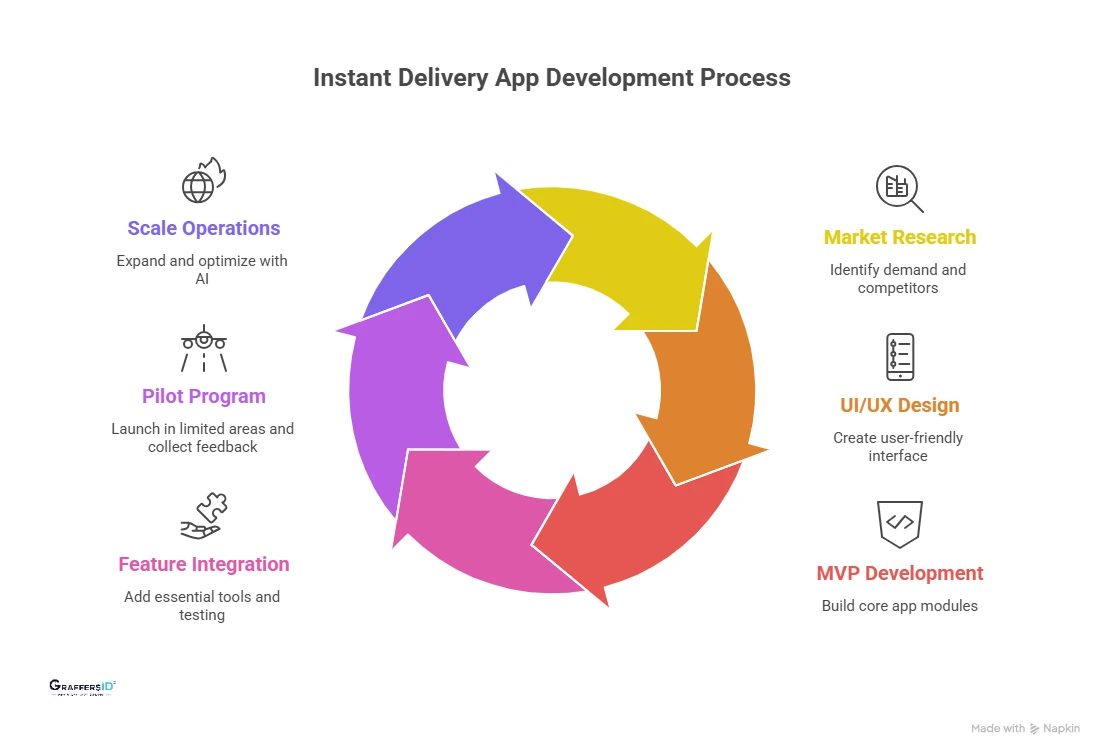
1. Conduct Market Research and Validation
-
Identify city-level demand: Analyze urban areas to understand buying patterns, peak order times, and high-demand product categories.
-
Competitor analysis and differentiation: Study existing players’ offerings, delivery speed, and pricing to define your unique value proposition.
2. Design User-Friendly UI/UX for Speed and Conversion
-
Optimize checkout flow: Reduce steps from product search to payment for faster conversions.
-
Mobile-first, thumb-friendly design: Ensure all app interactions are intuitive and optimized for one-handed use on smartphones.
3. Develop an MVP (Minimum Viable Product)
-
Core app development: Build essential modules for customers, delivery partners, and admins.
-
Inventory and order lifecycle integration: Sync real-time stock availability with order management to ensure accurate fulfillment.
4. Integrate Features and Conduct Testing
-
Essential integrations: Add payment gateways, maps, push notifications, and analytics tools for smooth operations.
-
Performance and load testing: Test the system under peak traffic to prevent crashes and delays during high-demand periods.
5. Launch a Pilot Program
-
Limited zone rollout: Start with select neighborhoods or cities to manage operations efficiently.
-
Feedback collection: Gather insights from users and delivery partners to refine workflows and app functionality.
6. Scale the Platform and Optimize Operations
-
Expand product categories and service areas: Gradually increase offerings and geographic coverage based on demand data.
-
AI-driven automation and insights: Implement predictive inventory, route optimization, and personalized recommendations to maximize efficiency and customer satisfaction.
Read More: E-commerce Automation Trends 2026: How Retailers Are Using AI and Automation to Scale
How Much Does It Cost to Build an Instant Delivery App Like Blinkit or Zepto?
Building an instant delivery app in 2026 requires careful planning around time, technology, and investment, especially if you aim to include AI-driven automation, real-time logistics, and scalable infrastructure. Here’s a clear breakdown:
Estimated Development Timeline
-
MVP Development: Developing a functional MVP typically takes 12-16 weeks to launch a functional version with core features for customers, riders, and admins.
-
Full-Scale Platform: Scaling the platform with advanced AI-driven logistics, automated inventory, and multi-address feature sets usually takes 6-9 months, including testing, integrations, and pilot launches.
Key Factors Influencing the Cost of Development
-
Number of Apps: Developing separate apps for customers, delivery partners, and admin dashboards increases complexity and cost.
-
AI & Automation Integration: Advanced features like route optimization, demand forecasting, and predictive inventory add to the development effort.
-
Third-Party Integrations & Scalability: Connecting to payment gateways, maps, and analytics platforms, plus designing for future growth, impacts investment.
Conclusion: How to Build a Successful Instant Delivery App in 2026?
Building a successful instant delivery app like Blinkit or Zepto is about far more than speed. In 2026, success comes from combining intelligent AI systems, scalable technology architecture, and automation-driven operations that can handle real-time demand at scale.
For CEOs, CTOs, and product leaders, the winning formula is:
-
Start lean with a validated MVP to test demand and refine operations
-
Invest early in AI, predictive inventory, and real-time infrastructure for efficiency and reliability
-
Scale strategically city-by-city, using data and operational insights to optimize delivery and user experience
By following this approach, you not only meet customer expectations for ultra-fast delivery but also create a defensible, high-margin business model powered by data and automation.
At GraffersID, our experienced AI developers help startups and enterprises build custom delivery and quick commerce solutions.
Contact GraffersID today to build your instant delivery app for 2026 and beyond.