Every board deck in 2025 promised AI. Most of them delivered a chatbot.
That gap, between what was sold to the C-suite and what actually shipped, is now one of the most expensive mistakes in enterprise technology. When organizations conflate chatbots, AI assistants, and AI agents, they don’t just waste budget. They build the wrong foundation, lock themselves into architectures that can’t scale, and ship demos that quietly die in production.
Here’s the question that should be on every technology leader’s desk right now: Does your team actually know which type of AI system you’re building and whether it’s the right one?
The distinction is no longer academic. Chatbots handle conversations. AI assistants augment decisions. AI agents take action autonomously across systems at scale. Choosing the wrong architecture is the difference between an AI feature and an AI capability.
This guide gives decision-makers a clear framework for understanding how these three systems differ, where each belongs in a modern tech stack, and how to evaluate them before your next investment cycle.
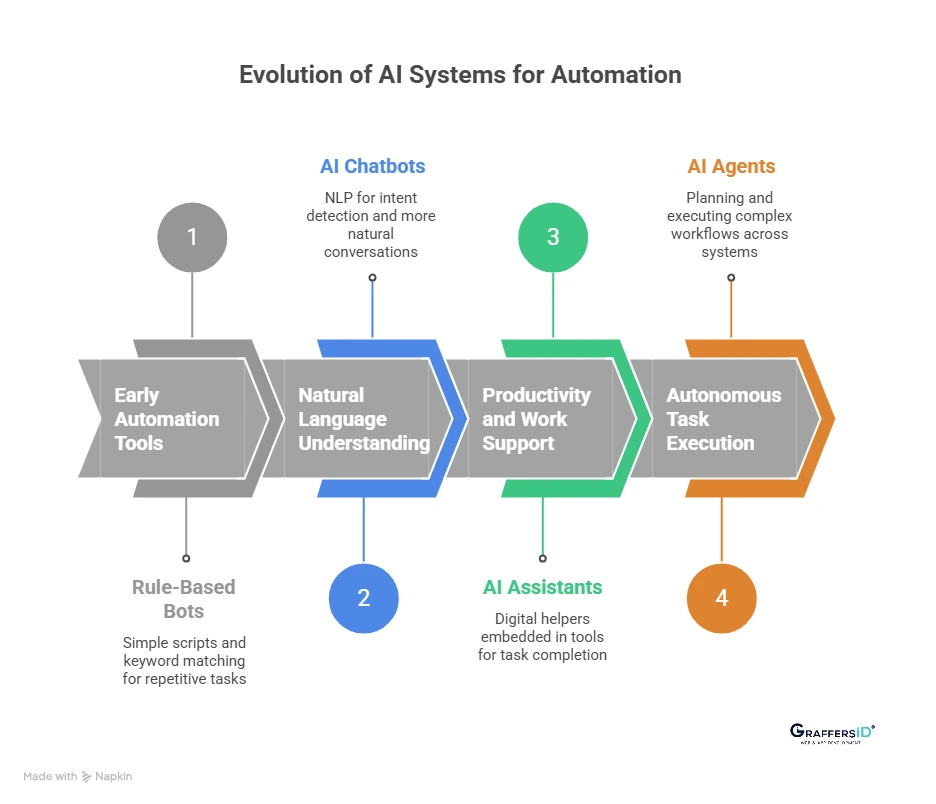
How AI Systems Evolved: From Rule-Based Bots to Autonomous AI Agents
AI systems used for conversations and automation did not emerge all at once. They evolved gradually as technologies like natural language processing, machine learning, and large language models matured.
Each stage solved a different problem for businesses. Early tools focused on basic automation, later systems improved human productivity, and the newest generation aims to automate entire workflows.
Understanding this evolution helps decision-makers choose the right AI architecture when building products or automation systems.

1. Rule-Based Bots (Early Automation Tools)
The earliest automated interaction systems were rule-based bots. These tools followed predefined scripts or decision trees to respond to specific user inputs.
They typically worked using a simple logic pattern:
User input → keyword detection → predefined response.
Common examples included:
- FAQ bots on company websites
- IVR (interactive voice response) phone systems
- basic automated support chat widgets
These bots were useful for handling repetitive questions and reducing manual workload. However, they had significant limitations. They could not understand context, adapt to new queries, or learn from conversations.
As a result, they often failed when users asked questions outside the scripted flow.
2. AI Chatbots (Natural Language Understanding Systems)
The introduction of natural language processing (NLP) significantly improved chatbot capabilities. Instead of matching keywords, AI chatbots started identifying the intent behind a user’s message.
A simplified chatbot architecture typically looks like this:
User Query → NLP Model → Intent Detection → Response Engine → Reply
This allowed chatbots to respond to more natural conversations rather than rigid scripts.
Businesses commonly use AI chatbots for:
- customer support automation
- website product guidance
- lead qualification
- appointment scheduling
Despite these improvements, most chatbots still focus on conversation rather than execution. They can answer questions effectively but rarely complete complex business workflows.
3. AI Assistants (Productivity and Work Support Tools)
AI assistants represent the next stage in conversational AI evolution. Instead of focusing only on customer interactions, these systems are designed to help individuals complete tasks faster.
AI assistants typically work through prompts or requests from users. They act as digital helpers embedded within productivity tools, collaboration platforms, or enterprise software.
Common tasks handled by AI assistants include:
- writing emails or documents
- summarizing reports or meetings
- researching information
- generating content or insights
- scheduling meetings or reminders
In many modern workplaces, AI assistants function as copilots that support human decision-making and productivity.
However, they still depend on user input. Assistants help people work faster, but usually do not automate full operational workflows on their own.
4. AI Agents (Autonomous AI Systems for Task Execution)
AI agents represent the newest and most advanced stage of AI automation.
Unlike chatbots or assistants, AI agents are designed to achieve specific goals by planning and executing tasks across multiple systems.
A well-designed AI agent can:
- understand an objective
- plan the steps needed to complete it
- interact with software tools and APIs
- execute actions across systems
- evaluate results and adjust its approach
For example, consider a customer requesting a refund. A chatbot might simply explain the refund policy. An AI agent, however, could:
- verify the order details
- check refund eligibility
- process the refund in the system
- update the customer record in the CRM
- notify the customer automatically
This shift, from answering questions to completing tasks, is why AI agents are becoming central to enterprise automation and AI-driven operations in 2026.
Many modern AI platforms now combine assistants for user interaction and agents for task execution, creating systems that can both communicate and take action.
What is a Chatbot?
A chatbot is a software system designed to simulate human conversation and respond to user queries through text or voice interfaces. It interacts with users using predefined rules, natural language processing, or limited AI models to provide information and guide basic tasks.
Most chatbots focus on answering questions and assisting users through conversations, rather than executing complex operations or completing multi-step workflows.
For many businesses, chatbots serve as the first layer of automation for handling customer interactions at scale.
Read More: Voicebot vs. Chatbot in 2026: Key Differences, Use Cases, and Choosing the Right Conversational AI for Your Business
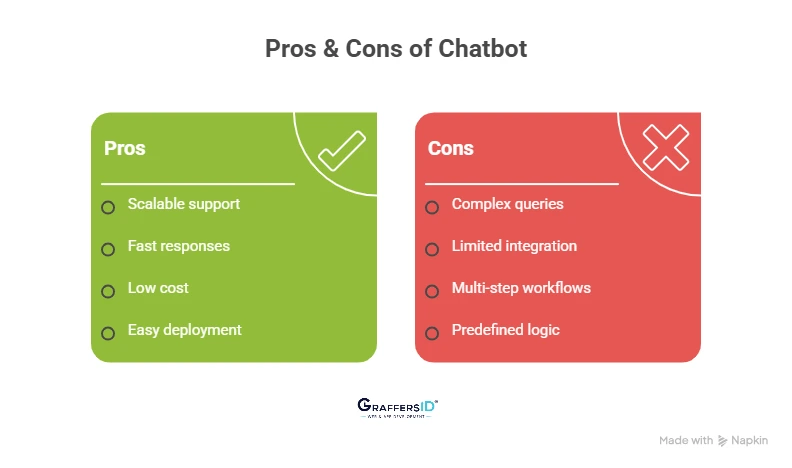
Key Strengths of Chatbots
Chatbots remain widely used because they provide quick and scalable automation for repetitive communication tasks.
- Scalable customer support: Chatbots can handle thousands of conversations simultaneously, helping companies manage high volumes of customer queries without expanding support teams.
- Fast response times: Users receive instant responses to common questions, reducing wait times and improving the overall customer experience.
- Lower implementation cost: Compared to full AI automation systems, chatbots are relatively inexpensive to build and maintain, making them accessible for startups and growing companies.
- Easy deployment across digital channels: Businesses can integrate chatbots into websites, mobile apps, messaging platforms, and customer portals with minimal infrastructure changes.
For many organizations, chatbots act as the starting point for customer service automation and digital support systems.

Limitations of Chatbots
While chatbots are useful for simple interactions, they often struggle when conversations become complex or require deeper system integration.
- Limited ability to handle complex queries: Chatbots typically perform best with predefined topics and may fail when users ask nuanced or multi-layered questions.
- Restricted integration with internal systems: Many chatbot implementations operate separately from backend systems, limiting their ability to access customer data or perform actions.
- Inability to complete multi-step workflows: Chatbots usually guide users through information rather than executing processes such as refunds, account updates, or approvals.
- Heavy reliance on predefined logic: Even AI-powered chatbots often depend on structured conversation flows, which can limit flexibility when conversations deviate from expected patterns.
Because of these limitations, chatbots often function more as information providers than problem-resolution systems.
What is an AI Assistant?
An AI assistant is a software system designed to help people complete tasks faster by understanding prompts, generating information, and supporting everyday work activities.
Instead of replacing employees or running entire workflows independently, AI assistants act as collaborative digital tools that help individuals and teams work more efficiently.
They are commonly embedded in productivity tools, workplace software, and enterprise platforms to assist with writing, research, analysis, and decision support.
Read More: AI Agent vs. Chatbot: Key Differences, Use Cases & Future of Intelligent CX (2026)
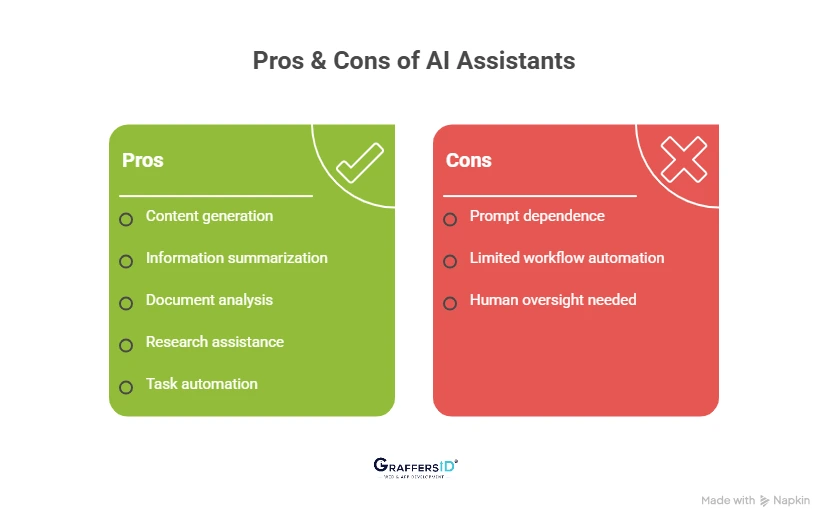
Key Strengths of AI Assistants
Modern AI assistants are designed to handle knowledge-based tasks that typically consume a significant portion of a professional’s workday. Key capabilities include:
- Content generation: AI assistants can generate emails, reports, documentation, and other written materials, helping teams produce content faster while maintaining consistency.
- Information summarization: They can summarize long documents, research reports, meeting notes, or knowledge bases into concise insights that are easier to review.
- Document and data analysis: Assistants can analyze documents, identify key insights, and highlight important patterns or findings to support faster decision-making.
- Research assistance: They help users quickly gather information, answer questions, and compile insights from multiple sources.
- Task-level automation: AI assistants can automate small personal tasks such as drafting responses, organizing notes, or preparing structured outputs from unstructured information.
These capabilities make AI assistants especially valuable for professionals working in research, product management, marketing, software development, and operations.

Limitations of AI Assistants
While AI assistants significantly improve productivity, they are not designed to fully automate business operations. Key limitations include:
- Dependence on user prompts: Assistants typically require clear instructions from users and do not proactively initiate tasks without input.
- Limited workflow automation: They support individual tasks but rarely execute complete multi-step processes across multiple business systems.
- Human oversight is still required: Users must review outputs, validate decisions, and guide the assistant when dealing with complex or sensitive tasks.
For most organizations, AI assistants work best as productivity multipliers rather than autonomous systems.
What is an AI Agent?
An AI agent is a software system designed to understand a goal, plan actions, and execute tasks automatically by interacting with different digital tools, databases, and software systems.
Unlike chatbots or AI assistants that mainly respond to prompts or questions, AI agents focus on task completion and workflow automation.
Instead of guiding users step-by-step, they can analyze requests, make decisions, and perform multi-step operations across connected systems.
Read More: AI Assistants vs. AI Agents (2026): Key Differences, Features, and Use Cases Explained
Key Strengths of AI Agents
AI agents provide several advantages that make them valuable for modern businesses and automation workflows. These strengths are:
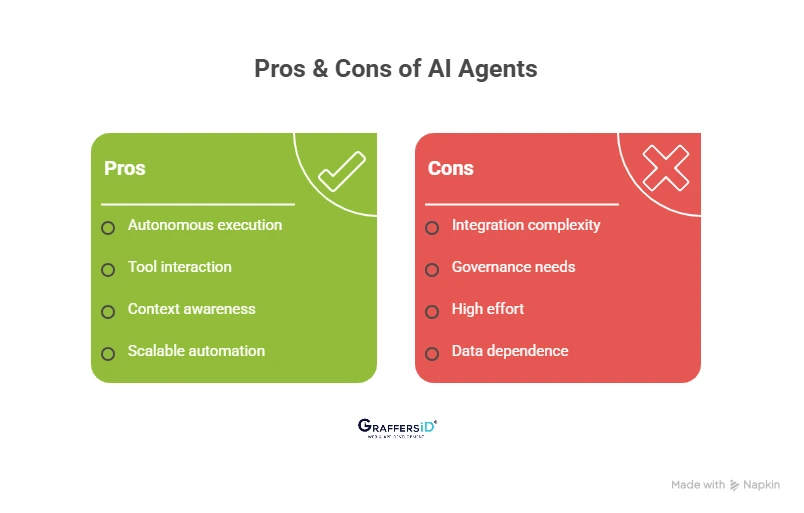
- Autonomous task execution: AI agents can complete multi-step processes without constant human input, reducing manual work across operations.
- Ability to interact with tools and systems: They can connect with APIs, CRMs, databases, and internal software to perform real actions rather than just generate responses.
- Context awareness through memory: Many AI agents use memory systems to retain context, helping them make better decisions during longer workflows.
- Scalable automation for complex processes: AI agents can manage repetitive or operational tasks across multiple systems, enabling organizations to automate workflows at scale.

Limitations of AI Agents
While AI agents offer powerful capabilities, they also come with certain technical and operational challenges that organizations must address.
- Complex system integration requirements: Building effective AI agents requires connecting multiple systems, APIs, and data sources, which can be technically demanding.
- Need for governance and safety controls: Because agents can perform real actions, organizations must implement guardrails to prevent errors or unintended outcomes.
- Higher development and implementation effort: Compared with simple chatbots or assistants, AI agents require more advanced architecture and engineering.
- Dependence on high-quality data and system access: Agents perform best when they have reliable access to structured data and well-integrated business systems.
AI agents represent the next step in intelligent automation, moving beyond simple AI responses to autonomous task execution and workflow management. As technology advances, they are expected to play a major role in transforming how businesses operate and automate complex processes.
Chatbots vs. AI Assistants vs. AI Agents: Key Differences
| Feature |
Chatbots |
AI Assistants |
AI Agents |
| Primary role |
Conversation |
Productivity support |
Task execution |
| Autonomy |
Low |
Low–Medium |
High |
| Decision-making |
Rule-based or limited AI |
Prompt-driven |
Goal-driven |
| Workflow automation |
Minimal |
Limited |
End-to-end |
| System integrations |
Few |
Moderate |
Extensive |
| Best suited for |
Customer queries |
Employee productivity |
Operational automation |
A useful way to think about it:
- Chatbots answer questions
- Assistants help people work
- Agents complete tasks
When Should Businesses Use Chatbots, AI Assistants, or AI Agents?
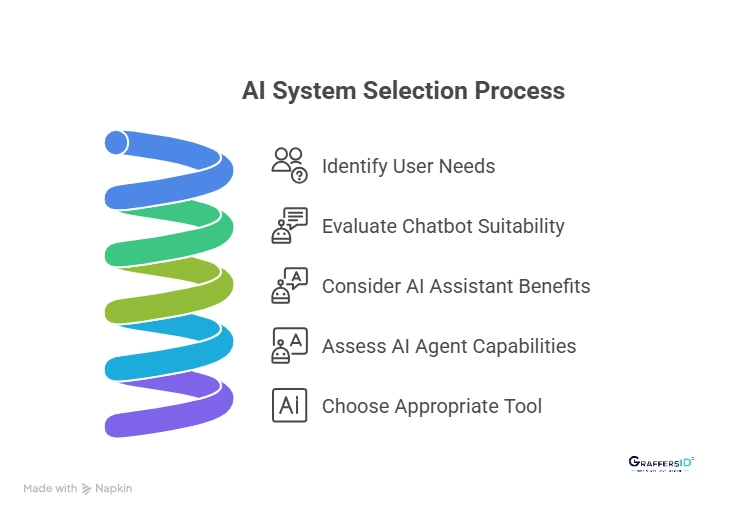
For most companies exploring AI, the real challenge is not whether to use AI, but which type of AI system solves the problem best. The right choice depends on what you want the system to do: answer questions, assist employees, or automate entire workflows.
Below is a simple framework technology leaders can use when evaluating AI solutions.

When Should Businesses Use Chatbots?
Chatbots are best suited for situations where users frequently ask repetitive and predictable questions. They help businesses handle large volumes of customer queries without increasing the support team’s workload.
Best use cases include:
- Customer FAQs: Chatbots can instantly answer common questions about products, services, pricing, or policies.
- Appointment or booking management: Businesses can automate scheduling, confirmations, and reminders through conversational interfaces.
- Website customer support: Chatbots can guide visitors, provide quick product information, and route complex issues to human agents.
- Basic service inquiries: Tasks like checking order status, store hours, or account information can be handled quickly.
For many organizations, chatbots provide the fastest and most cost-effective entry point into AI-powered automation.
When Should Businesses Use AI Assistants?
AI assistants are ideal when the goal is to help employees work faster and reduce time spent on repetitive knowledge tasks. Instead of replacing workflows, assistants improve productivity inside existing tools.
Read More: What is Conversational AI in 2026? Top Tools, Business Use Cases, and Enterprise Adoption
Common applications include:
- Internal knowledge support: Employees can quickly find policies, documentation, or company knowledge without searching multiple systems.
- Document summarization and analysis: Assistants can review long reports, contracts, or research papers and extract key insights.
- Research and information gathering: Teams can use assistants to quickly collect and organize data from multiple sources.
- Meeting preparation and summaries: AI assistants can generate agendas, summarize discussions, and create follow-up action items.
These systems act as AI copilots for teams, helping employees focus more on strategic work rather than manual tasks.
When Should Businesses Use AI Agents?
AI agents are the best choice when organizations want to automate multi-step workflows that normally require human intervention. Unlike chatbots or assistants, AI agents can execute tasks across multiple systems and complete processes independently.
Key business scenarios include:
- Enterprise workflow automation: Agents can manage processes like onboarding, ticket resolution, or financial approvals across different systems.
- Complex system integrations: AI agents can interact with CRMs, databases, APIs, and internal tools to complete operational tasks.
- Multi-step operational processes: Tasks such as processing refunds, handling support tickets, or verifying transactions can be executed end-to-end.
- Large-scale customer service automation: AI agents can resolve customer issues instead of only providing information.
For companies building AI-native platforms or intelligent automation systems, AI agents are quickly becoming a core architectural layer.

Conclusion: How Businesses Should Choose Between Chatbots, AI Assistants, and AI Agents
The difference between chatbots, AI assistants, and AI agents ultimately comes down to how much work the system can perform independently. A simple way to understand it:
- Chatbots handle conversations and answer user questions.
- AI assistants support human productivity by helping teams complete tasks faster.
- AI agents execute workflows by planning actions, interacting with tools, and completing multi-step processes.
Each of these systems plays a different role in a modern AI stack. In practice, many successful companies combine all three:
- Chatbots serve as customer-facing interfaces for support and engagement.
- AI assistants improve employee productivity and knowledge access.
- AI agents automate complex operational workflows behind the scenes.
For startups and growing enterprises, the biggest opportunity is not simply adding AI features to products. The real advantage comes from designing AI systems that integrate directly with business processes, data systems, and operational tools.
At GraffersID, we help companies build intelligent automation systems by combining experienced developers with practical AI implementation strategies tailored to your product and business goals.
Hire expert AI developers from GraffersID to design and build scalable AI-powered systems.