In 2026, open-source developer tools aren’t “budget-friendly alternatives.” They are the default infrastructure for AI-native software development. Engineering teams no longer debate whether to adopt open source. Instead, they’re asking smarter, higher-impact questions:
-
Which open-source tools accelerate AI-assisted development?
-
How do we integrate coding agents without compromising security?
-
Which tools are enterprise-ready for compliance and DevSecOps automation?
The shift is dramatic. The modern developer stack looks radically different from what it did even two years ago. For CTOs, founders, and product leaders building in an AI-first world, tool selection directly impacts development speed, costs, security, scalability, and AI integration readiness.
This guide breaks down the top open-source developer tools in 2026, curated for decision-makers who need clarity, not hype. Inside, you’ll discover:
-
The best open-source code editors for AI-native workflows
-
AI coding assistants and open models shaping repository-level automation
-
Low-code frameworks for internal tooling and ops efficiency
Let’s explore the tools defining modern software development.
A: Best Open-Source Code Editors in 2026
Choosing the right open-source code editor in 2026 is no longer about syntax highlighting or themes. It’s about AI integration, performance, collaboration, and cloud-native development support.
Below are the top open-source editors that developers and CTOs are actively choosing for AI-native workflows.
1. Visual Studio Code (VS Code)
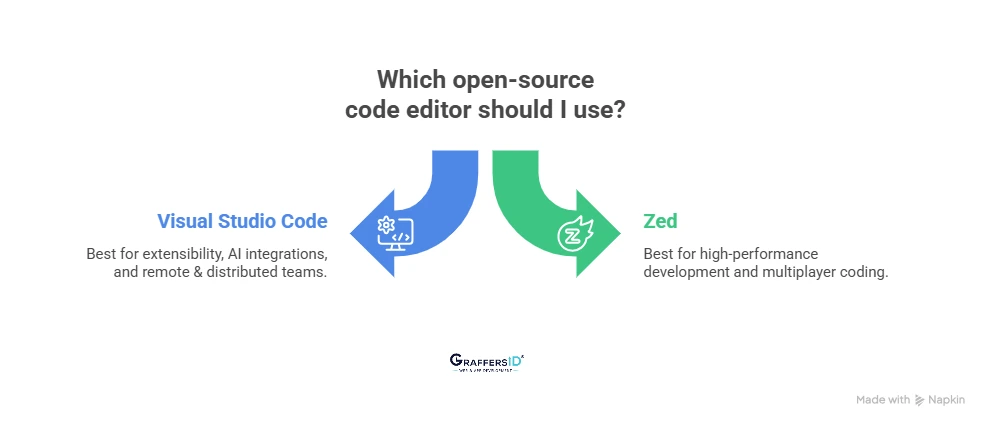
Visual Studio Code (VS Code) remains the most widely adopted open-source code editor in 2026, developed by Microsoft for Windows, macOS, and Linux. It supports numerous programming languages and features intelligent code completion (IntelliSense), debugging, built-in Git control, and extensive extension customization.
Key Features of VS Code
-
Massive Extension Ecosystem: Thousands of community-built extensions support every major language, framework, and DevOps workflow. This reduces tooling friction and accelerates onboarding.
-
Seamless AI Coding Assistant Integrations: Native support for AI agents, autocomplete engines, and repository-aware coding tools makes it ideal for AI-driven development pipelines.
-
Dev Containers & Cloud-Native Workflows: Built-in dev container support enables consistent environments across local machines and cloud infrastructure, reducing “it works on my machine” issues.
-
Remote SSH & Container Development: Developers can securely code inside remote servers, Docker containers, or Kubernetes clusters without leaving the editor.
-
Cross-Platform Stability: Reliable performance across macOS, Windows, and Linux ensures smooth collaboration in distributed engineering teams.
Best for: Extensibility, AI integrations, and remote & distributed teams.
2. Zed
Zed is a high-performance, open-source code editor written in Rust, designed for speed and AI-native collaboration. It is rapidly gaining traction among performance-focused engineering teams building AI-native and Rust-based systems.
Key Features of Zed
-
Built in Rust for Speed: Designed with performance at its core, Zed offers low latency and efficient memory usage, even in large codebases.
-
Real-Time Collaborative Editing: Multiplayer-first architecture allows multiple developers to edit the same codebase simultaneously, improving pairing and distributed teamwork.
-
Lightweight Memory Footprint: Compared to heavier editors, Zed runs lean, making it suitable for resource-constrained environments.
-
Designed for Modern AI Workflows: Built with extensibility and automation in mind, it aligns well with AI-assisted coding and fast iteration cycles.
Best for: High-performance development and multiplayer coding.
B: Best Open-Source AI Assistants & LLMs in 2026
AI coding assistants are no longer “nice-to-have” plugins. In 2026, they function as core development infrastructure, enabling repository-level reasoning, automated refactoring, and AI-driven task execution across the software lifecycle.
Below are the top open-source AI coding tools developers and CTOs are actively adopting.
1. Aider (Open-Source AI Pair Programming for Git Repositories)
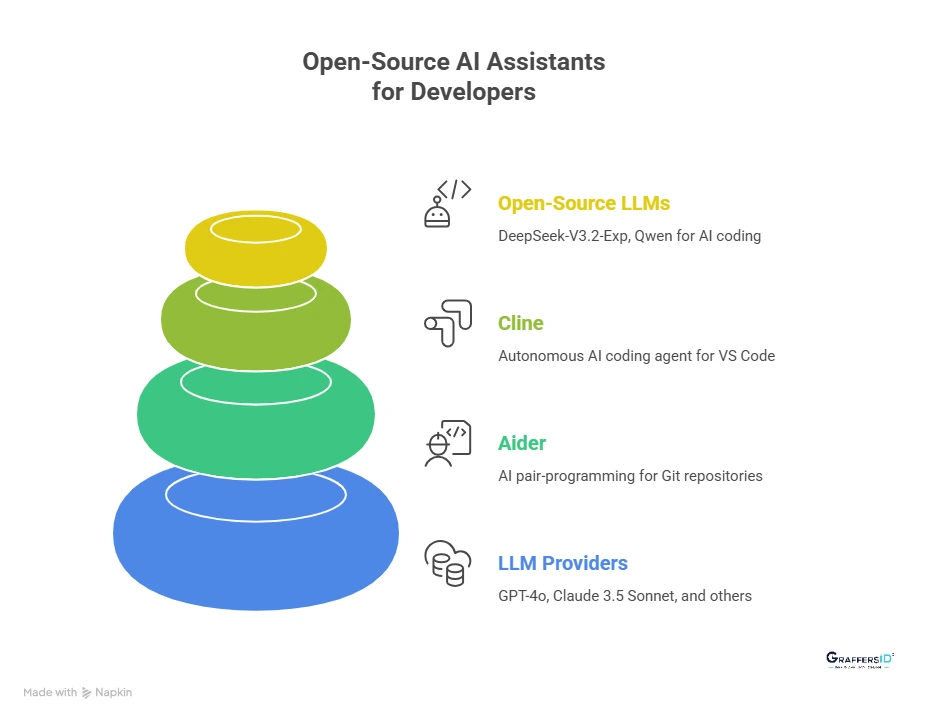
Aider is an open-source, terminal-based AI pair-programming tool that allows developers to edit code in local Git repositories using Large Language Models (LLMs) like GPT-4o, Claude 3.5 Sonnet, and others. It works directly inside your local Git repository, enabling repository-wide reasoning instead of single-file suggestions.
Key Features of Aider
-
Understands full repository context for safer large-scale refactoring
-
Works with multiple LLM providers and open-weight models
-
Git-aware changes with clean commit workflows
Best for: Senior engineers, backend teams, and developers managing complex or legacy codebases.
2. Cline (Autonomous AI Coding Agent for VS Code)
Cline is an open-source AI coding agent extension integrated into VS Code that automates & executes multi-step development tasks with minimal manual prompting.
Key Features of Cline
-
Context-aware code generation across multiple files
-
Autonomous task execution (feature building, refactoring, debugging)
-
Designed for agentic workflows beyond autocomplete
Best for: Teams adopting AI-native workflows inside modern IDE environments.
3. Best Open-Source LLMs for AI Code Generation (Self-Hosted & Enterprise-Ready)
Modern engineering teams increasingly deploy open-weight large language models for secure, cost-efficient AI coding. Some popular open-source models in 2026 are:
- DeepSeek-V3.2-Exp: DeepSeek-V3.2-Exp is an experimental open-source large language model designed to be highly efficient, especially for long-context processing. It introduces a sparse attention mechanism that significantly reduces the computation and memory needed to handle long input sequences, making it both faster and more cost-effective.
- Qwen: Qwen is a family of large language models developed by Alibaba Cloud that are widely used in everything from text generation to code assistance and multimodal AI tasks (text, image, audio). These models are designed to be open-source and accessible for developers, making them popular in AI coding workflows and multilingual applications.
Why Enterprises Prefer Open-source Models?
- Self-hosting for regulatory compliance and data sovereignty
- Lower long-term inference costs at scale
- Custom fine-tuning for domain-specific codebases
- Greater privacy and infrastructure control
C: Best Open-Source Git & DevOps Platforms in 2026
1. Gitea
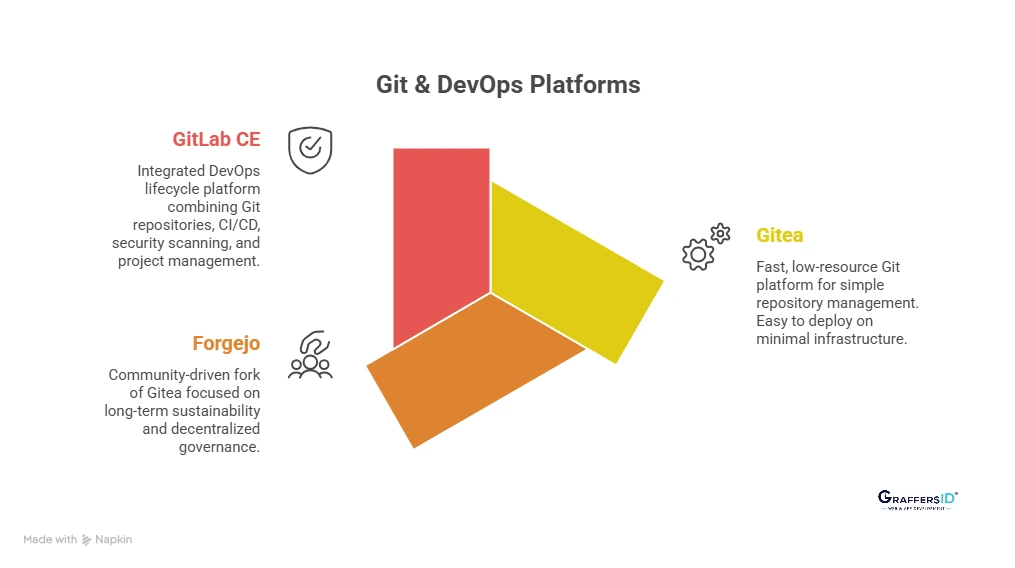
Gitea is a fast, low-resource Git platform designed for teams that want simple repository management without enterprise overhead. It’s easy to deploy on minimal infrastructure and works well for startups, optimizing cloud costs.
Key Features of Gitea
-
Lightweight and efficient (runs on small VPS instances)
-
Simple UI for repository and issue management
-
Self-hosted control for data privacy
-
Ideal for early-stage SaaS teams
Best for: Small teams, startups, and lightweight self-hosted Git workflows.
2. Forgejo
Forgejo is a community-driven fork of Gitea focused on long-term sustainability and decentralized governance. In 2026, many engineering leaders evaluate not just features but also project governance and vendor independence.
Key Features of Forgejo
-
Fully open governance model
-
Community-led development roadmap
-
Strong alignment with open-source principles
-
Reduced risk of corporate control shifts
Best for: Teams that prioritize transparency and open governance.
Read More: Top 5 AI Coding Assistants in 2026 Every CTO Should Know About
3. GitLab Community Edition
GitLab Community Edition provides an integrated DevOps lifecycle platform, combining Git repositories, CI/CD, security scanning, and project management in one system.
Key Features of GitLab CE
-
Built-in CI/CD pipeline automation
-
Integrated security and dependency scanning
-
DevSecOps-ready workflows
-
End-to-end project lifecycle management
Best for: Scaling teams (10–100+ developers) needing full DevOps automation.
D: Best Open-Source Low-Code Tools in 2026
Open-source low-code developer tools help teams build internal dashboards, admin panels, and automation workflows faster, without compromising flexibility or control. In 2026, they’re widely used for operational efficiency, rapid prototyping, and internal product support.
Below are the top open-source low-code platforms optimized for modern engineering teams.
1. Appsmith
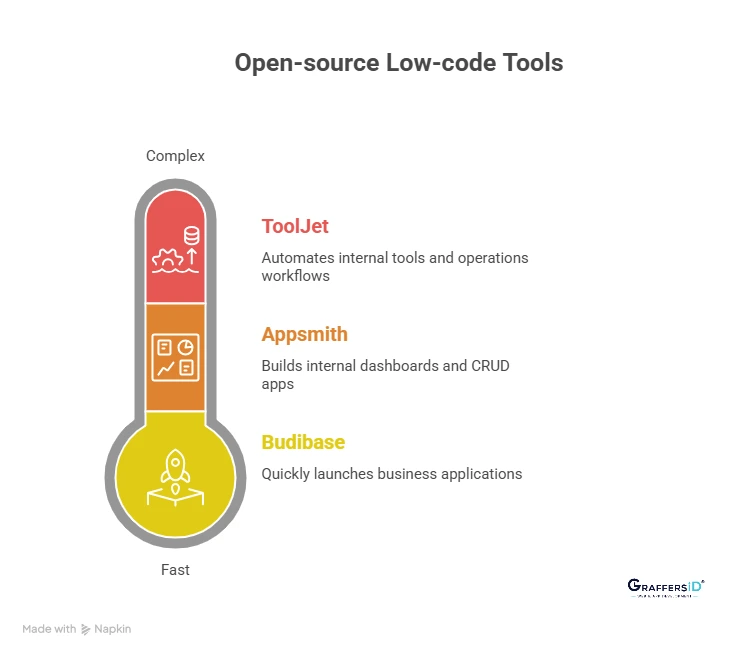
Appsmith is an open-source low-code platform designed for developers who need to ship internal tools fast while maintaining full control over APIs and databases.
Key Features of Appsmith
-
Rapid CRUD app development with drag-and-drop UI components
-
Native integrations with REST APIs, GraphQL, PostgreSQL, MongoDB, and more
-
Self-hosted deployment options for compliance-sensitive teams
-
Ideal for internal dashboards, admin panels, and support tools
Best for: Building internal dashboards and CRUD apps quickly.
2. ToolJet
ToolJet is an open-source, AI-native low-code framework designed to rapidly build and deploy custom internal tools, dashboards, and business applications. It focuses on connecting multiple data sources and enabling operational efficiency across teams.
Key Features of ToolJet
-
Multi-database and API connectors (SQL, NoSQL, third-party services)
-
Workflow automation features for repetitive operational tasks
-
Role-based access control for secure internal deployments
-
Strong use cases in finance, operations, and customer support teams
Best for: Automation-driven internal tools and operations workflows.
3. Budibase
Budibase is an open-source, low-code platform designed for building, automating, and deploying internal tools, forms, and business applications rapidly. It is optimized for quickly launching internal business apps with built-in logic and workflows.
Key Features of Budibase
-
Pre-built components for forms, tables, and approval flows
-
Built-in workflow automation and business logic handling
-
SaaS-friendly integrations and cloud/self-hosted options
-
Suitable for HR tools, inventory systems, and lightweight business apps
Best for: Fast deployment of business applications.
E: Best Open-Source Backend Tools in 2026
1. Prisma (Open-Source ORM for Node.js & TypeScript)
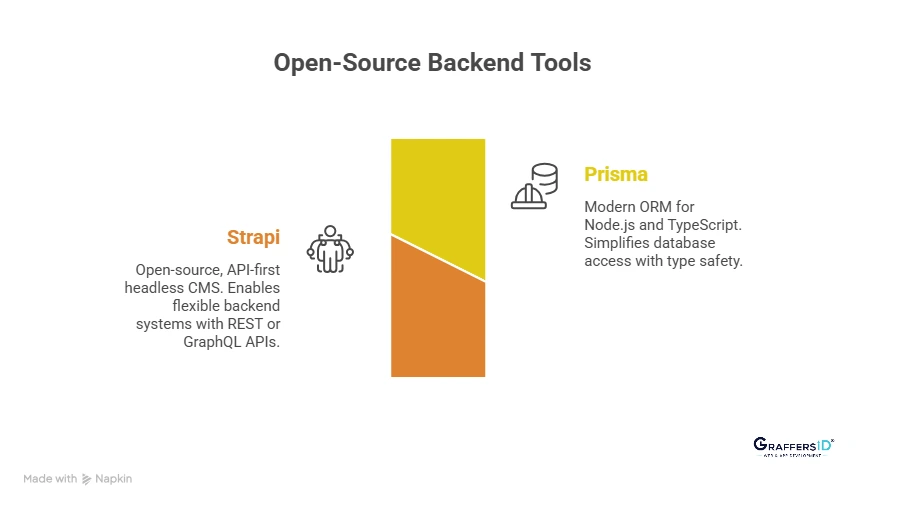
Prisma is a modern open-source ORM designed for Node.js and TypeScript applications. It simplifies database access while maintaining strict type safety, making it a top choice for AI-native and SaaS backends in 2026.
Key Features of Prisma
- Type-safe database queries that reduce runtime errors and improve code reliability.
- Auto-generated client APIs based on your schema for faster development.
- Excellent developer experience (DX) with clear schema modeling and migration tools.
- Microservice-ready architecture that works well with scalable, distributed systems.
Best for: Startups and scaling SaaS platforms building TypeScript-first applications, microservices, and AI-driven backend systems.
2. Strapi (Open-Source Headless CMS for API-First Backends)
Strapi is an open-source, API-first headless CMS that enables teams to build flexible backend systems with REST or GraphQL APIs. It’s widely adopted for content-heavy and marketplace platforms.
Key Features of Strapi
- API-first architecture that integrates easily with web, mobile, and AI-powered frontends.
- Customizable content models for dynamic SaaS and e-commerce platforms.
- Role-based access control (RBAC) for secure enterprise deployments.
- Extensible plugin ecosystem for payments, authentication, and automation.
Best for: SaaS products, e-commerce systems, marketplaces, and content-driven applications requiring structured content management with scalable API delivery.
Read More: Best AI Code Generators to Use in 2026 for Faster and Smarter Development
How to Choose the Best Open-Source Developer Stack in 2026?
Selecting the right open-source developer stack in 2026 isn’t about picking popular tools; it’s about aligning your engineering infrastructure with your product stage, AI roadmap, and security requirements. Use the framework below to make a scalable, AI-ready decision.
Step 1: Define Your Product Stage
Your product maturity directly impacts your tooling complexity. MVP-stage startups need speed, flexibility, and minimal DevOps overhead, while growth-stage SaaS companies require structured CI/CD and collaboration workflows. Enterprise systems demand reliability, auditability, and long-term scalability across distributed teams.
Step 2: Evaluate Your AI Strategy
AI is now core infrastructure, not an experimental feature. If AI-driven features are part of your roadmap, your stack must support AI coding assistants, automation agents, and model integration. Teams building AI-native products may also require self-hosted LLM deployment for cost control, customization, and compliance.
Step 3: Assess Security and Compliance Requirements
Security-first development is mandatory in 2026. Consider data sensitivity, industry regulations, and global compliance standards before finalizing your stack. Enterprises and regulated industries should prioritize DevSecOps automation, repository-level security scanning, and AI tools that support self-hosted deployment.

Final Thoughts: Open-Source Developer Tools Power Modern Software Development in 2026
In 2026, open-source developer tools are no longer optional components of a tech stack; they are the foundation of AI-native software development, providing cost-efficiency, security, and scalability.
For CTOs and founders, the real competitive advantage is not just “using open source.” It’s building a strategically aligned open-source developer stack that supports AI automation, faster releases, stronger security, and long-term product evolution.
At GraffersID, we help startups and enterprises hire AI developers, experts in building scalable web and mobile applications, and integrating AI-driven development workflows
Contact us today and build a scalable & secure developer ecosystem designed for long-term growth.