AI is no longer a developer assistant. In 2026, it is core engineering infrastructure. The best engineering teams in 2026 aren’t using AI to autocomplete functions; they’re using it to debug distributed systems at 2 AM, generate cloud architecture proposals before the morning standup, and orchestrate multi-agent pipelines that would have required entire platform teams two years ago.
In 2026, AI models like ChatGPT, Google Gemini, and DeepSeek can be embedded directly into the software development lifecycle (SDLC). Teams adopting AI-first development workflows are shipping features 5–10× faster, with fewer production issues and lower engineering overhead.
The question isn’t whether to integrate AI into your development lifecycle; it’s which model can actually handle production-grade pressure without breaking down when it matters most.
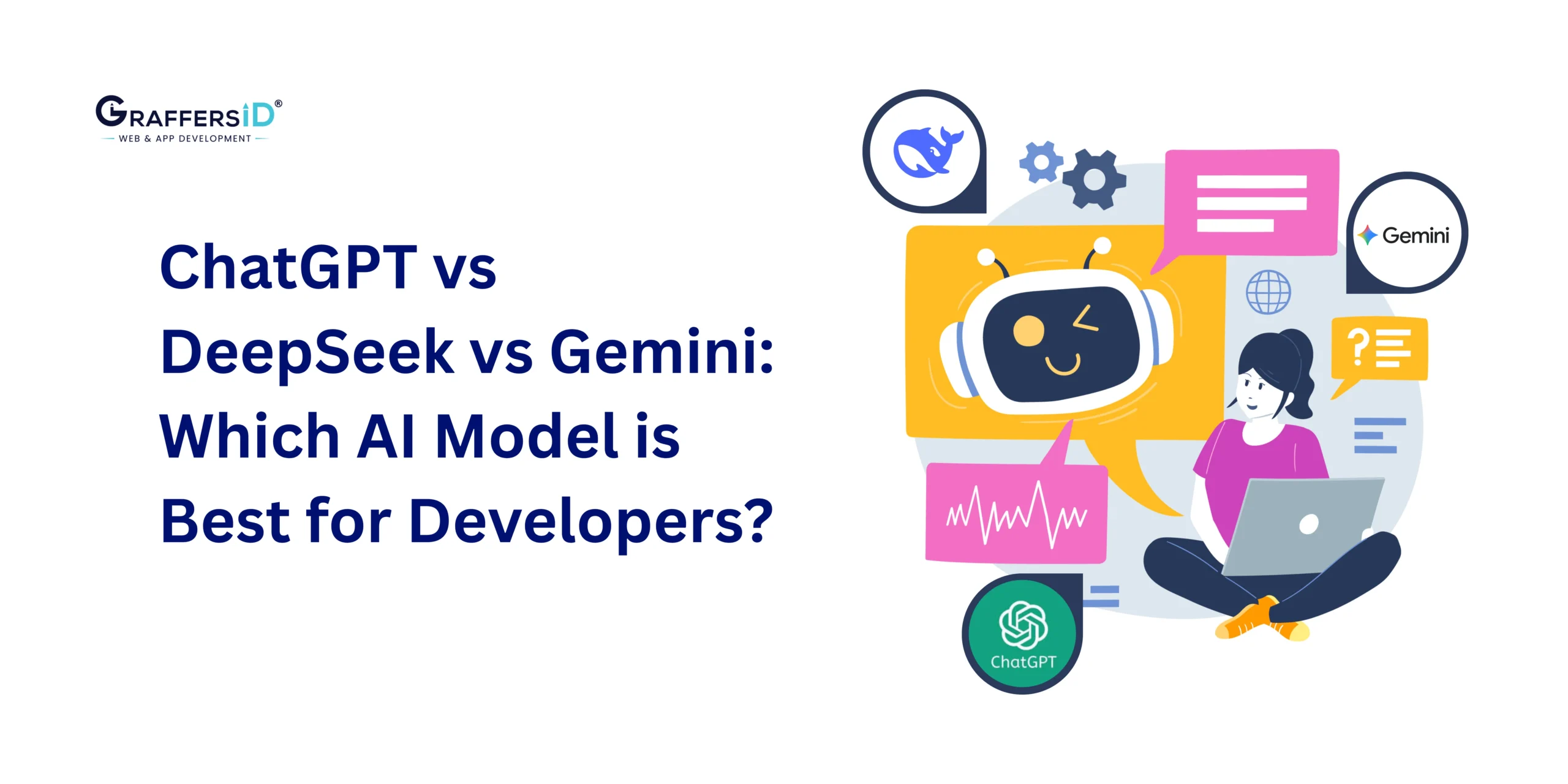
This guide delivers a clear comparison of ChatGPT, Google Gemini, and DeepSeek across the workflows your team actually cares about:
- Production code generation across Python, JavaScript, Java, Go, and Rust
- Root-cause debugging in distributed and microservices architectures
- Cloud-native development on AWS, Google Cloud, and Azure
- DevOps, CI/CD, and security automation
- AI agent orchestration and RAG pipeline design
By the end of this breakdown, you’ll have a clear answer not just which AI model is “best,” but which one is best for your stack, your cloud, and your team’s scale.
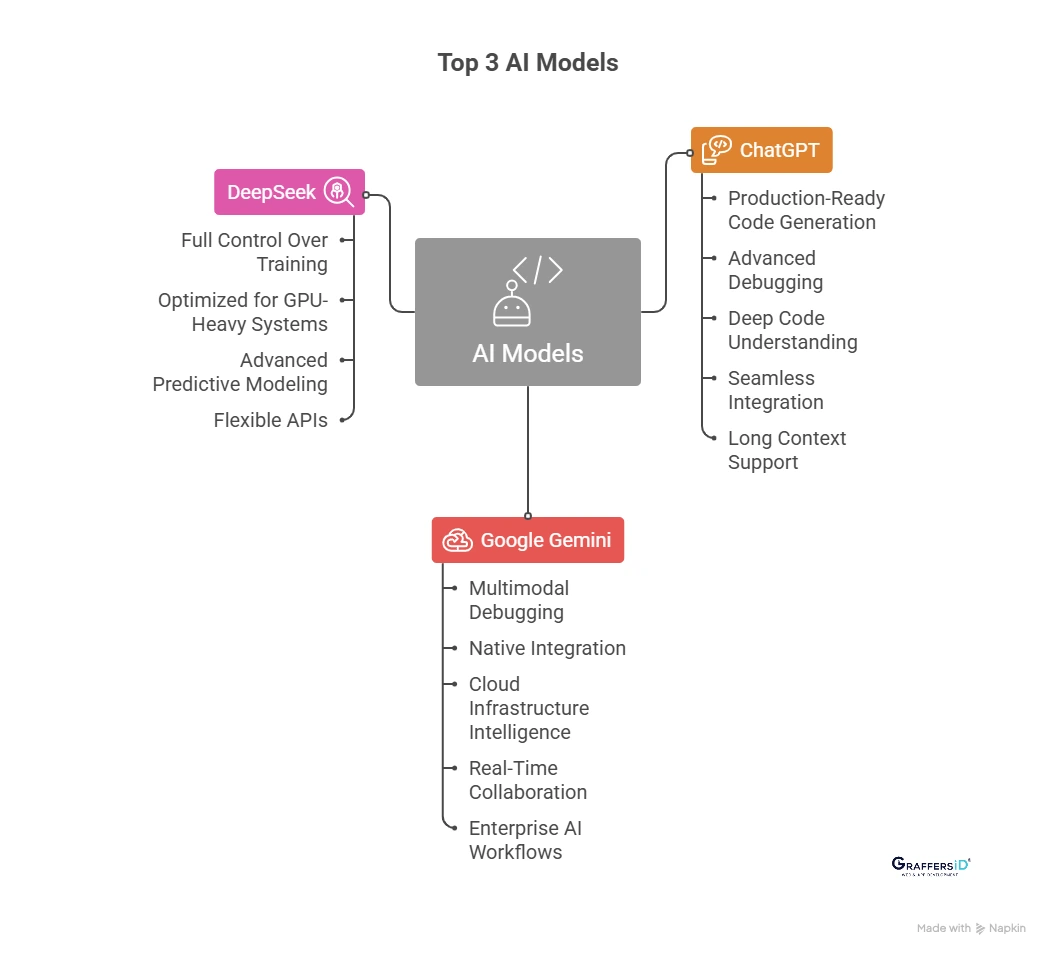
A: ChatGPT by OpenAI: Best AI Tool for Coding, Debugging, and Full-Stack Software Development
ChatGPT, created by OpenAI, is the most trusted and widely adopted AI model for software development in 2026. It stands out for its ability to understand complex codebases, debug real production issues, and support developers across the entire software development lifecycle (SDLC).
From early-stage product builds to large enterprise platforms, ChatGPT acts as a reliable engineering copilot, helping teams write better code, ship faster, and reduce costly errors in production.
Key Features of ChatGPT
1. Advanced Code Generation Across Modern Stacks
ChatGPT generates clean, scalable, and maintainable code for modern development environments, including:
-
Python, JavaScript, TypeScript, Java, Go, Swift, Rust, PHP
-
Code aligned with current frameworks, libraries, and best practices
-
Output suitable for real-world production systems, not just demos or snippets
This makes ChatGPT ideal for full-stack development, API design, backend logic, and frontend components.
2. Superior Debugging & Root-Cause Analysis for Production Systems
ChatGPT excels at identifying and resolving complex software issues, including:
-
Logical bugs, race conditions, API mismatches, and configuration errors
-
Clear explanations of why an issue occurred, not just how to fix it
-
Strong performance with async workflows, microservices, and event-driven systems
Developers benefit from faster debugging cycles and fewer recurring issues.
3. Long Context Handling & System Architecture Reasoning
ChatGPT understands modern system architectures at a high level, including:
-
Monolithic, microservices, and hybrid architectures
-
Design pattern evaluation and architectural trade-offs
-
Suggestions for refactoring, performance tuning, and scalability improvements
It is especially valuable during system design reviews and technical decision-making.
4. Enterprise-Grade Integrations & Developer Ecosystem
ChatGPT integrates smoothly into existing engineering workflows through:
-
GitHub, VS Code, JetBrains IDEs
-
CI/CD pipelines, testing frameworks, and automation tools
-
Robust APIs for building internal developer tools and AI-powered workflows
This makes it easy to embed ChatGPT into daily development and DevOps operations.
5. Long Context Support for Large Codebases
ChatGPT can process and reason over:
-
Multi-file repositories and cross-module dependencies
-
Large prompts with extensive business logic
-
Long-running development cycles that require sustained context
This capability is critical for enterprise applications and large product teams.
Why ChatGPT is the Top Choice for Developers in 2026?
-
Best debugging accuracy across real-world codebases
-
Strongest contextual understanding for large and complex projects
-
End-to-end SDLC support: coding, testing, documentation, automation, and planning
Best suited for: SaaS products, enterprise platforms, full-stack development teams, and fast-scaling tech companies.
Read More: Which OpenAI ChatGPT Version Should You Use in 2026? (Complete Business Guide)
B: Google Gemini: Best AI Model for Google Cloud, Firebase, & Android Development
Google Gemini is Google’s latest AI model, designed for teams building inside the Google ecosystem. Its biggest advantage in 2026 is its multimodal intelligence combined with deep, native Google Cloud integration.
Gemini is particularly effective for cloud-native applications, mobile development, and teams running production workloads on Google Cloud Platform (GCP).
Key Features of Google Gemini
1. Multimodal Debugging: Code + Logs + UI Analysis
Gemini can analyze multiple input types at once, including:
-
Code, logs, stack traces, diagrams, screenshots, and UI flows
-
Faster issue identification across mobile and cloud applications
This makes it especially useful for debugging Android apps and cloud services.
2. Native Integration with Google Cloud, Firebase & Android Tools
Gemini works directly inside:
-
Google Cloud Console
-
Firebase
-
Android Studio
It assists with deployment, configuration, refactoring, and environment setup without leaving the Google ecosystem.
3. Kubernetes, GKE & Cloud Infrastructure Optimization
Gemini provides guidance for:
-
Kubernetes and GKE configurations
-
Autoscaling and load balancing strategies
-
Cloud cost optimization and performance tuning
This helps teams design efficient, cloud-native architectures.
4. Real-Time Collaboration for Engineering Teams
Engineering teams can collaborate using:
-
Shared prompts, logs, configs, and debugging sessions
-
Faster cross-team troubleshooting and reviews
Ideal for distributed or remote development teams.
5. Enterprise AI Workflows via Vertex AI and BigQuery
Gemini integrates tightly with:
-
Vertex AI pipelines
-
BigQuery analytics
-
Google’s enterprise AI services
This makes it suitable for production-scale AI and data-driven applications on GCP.
Why Developers Choose Google Gemini in 2026?
-
Best AI model for Google Cloud-first organizations
-
Excellent support for Android, Flutter, and Firebase development
-
Strong multimodal debugging for logs, screenshots, and mobile UI issues
Best suited for: GCP-native teams, Android app developers, Firebase startups, and cloud-first enterprises.
C: DeepSeek: Best AI Model for Research, Custom Training & High-Compute Workloads
DeepSeek is built for teams that need full control over AI model behavior and performance. Unlike general-purpose coding assistants, DeepSeek focuses on custom AI training, research, and compute-heavy workloads.
Key Features of DeepSeek
1. Custom AI Model Training & Fine-Tuning
DeepSeek enables teams to:
-
Train AI models from scratch or fine-tune existing ones
-
Customize datasets, architectures, and evaluation metrics
-
Optimize models for highly specific domains and use cases
2. GPU Optimization & Distributed AI Training
DeepSeek is well-suited for:
-
Large neural networks and simulation-based systems
-
Distributed training across GPU clusters
-
Low-latency inference at scale
3. Advanced Predictive Modeling & Simulation Systems
It excels in:
-
Forecasting and anomaly detection
-
Risk modeling and simulations
-
Data-intensive analytics for enterprise and research environments
Common use cases include finance, healthcare, robotics, and scientific research.
4. Flexible APIs for Custom AI Pipelines
DeepSeek integrates easily with:
-
Internal research tools
-
Custom ML stacks and workflows
-
Open-source ecosystems with strong community adoption
Why Developers Choose DeepSeek in 2026?
-
Maximum flexibility for AI research and experimentation
-
Best option for domain-specific and experimental AI models
-
Strong performance for data-heavy prediction systems
Best suited for: AI research labs, data science teams, deep learning engineers, and R&D-focused organizations.
Feature-by-Feature Comparison of AI Models: Gemini vs. ChatGPT vs. DeepSeek (2026)
Let’s compare the AI models using the following key factors to decide which is better for developers:
1. Coding & Debugging Performance
How well does each AI model generate, debug, and maintain real-world production code?
| Feature | ChatGPT | Google Gemini | DeepSeek |
|---|---|---|---|
| Code Generation | Advanced | Advanced | Advanced |
| Debugging Support | Excellent | Intermediate | Excellent |
| Language Support | Multi-language | Multi-language | Specialized |
| Code Refactoring | Yes | Yes | Yes |
| AI Code Completion | Yes | Yes | Yes |
Key Insights:
-
ChatGPT excels at full-stack debugging, logic tracing, and explaining failures in production-grade systems.
-
DeepSeek performs equally well for AI-heavy, data-intensive, and ML-driven codebases.
-
Gemini handles standard debugging well, but is less effective with very large or non-Google-centric repositories.
2. Context Awareness & Code Reasoning
How well can each model understand system design, APIs, and long-term project context?
| Feature | ChatGPT | Google Gemini | DeepSeek |
|---|---|---|---|
| Conversational AI | Yes | Yes | Yes |
| Code Context Understanding | Best | Good | Good |
| Documentation Summarization | Yes | Yes | Yes |
| API Documentation Search | Advanced | Intermediate | Advanced |
Key Insights:
-
ChatGPT has the strongest ability to reason across multiple services, architecture layers, and long-running conversations and repos.
-
DeepSeek performs well for technical documentation, research APIs, and custom ML workflows.
-
Gemini is effective for cloud configs but weaker for deep cross-system reasoning.
3. Ecosystem & Developer Tool Integration
Which AI model fits best with your existing tools, cloud stack, and workflows?
| Feature | ChatGPT | Google Gemini | DeepSeek |
|---|---|---|---|
| GitHub Integration | Deep | Yes | Yes |
| Google Cloud Support | No | Native | No |
| Open-Source Libraries | Strong | Limited | Strong |
| API & Plugin Support | Advanced | Intermediate | Advanced |
Key Insights:
-
Gemini is tightly embedded into Google Cloud, Firebase, Android Studio, and Vertex AI.
-
ChatGPT offers the most flexible integrations across GitHub, CI/CD, IDEs, APIs, and third-party tools.
-
DeepSeek is optimized for custom research pipelines, GPU clusters, and experimental AI systems.
Which AI Model Has the Strongest Developer Community & Enterprise Adoption in 2026?
In 2026, adoption patterns differ across ChatGPT, Google Gemini, and DeepSeek based on how developers and enterprises use these models, and understanding these trends helps CTOs and engineering leaders choose the right AI stack.
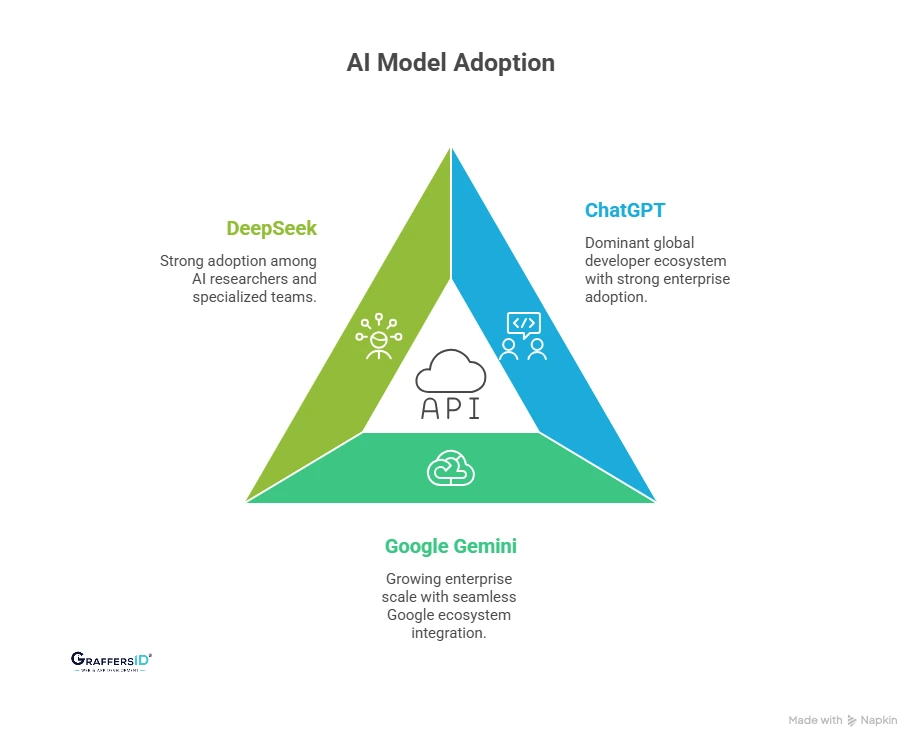
1. ChatGPT: Largest Global Developer Ecosystem & Enterprise Footprint
ChatGPT continues to lead in community support and enterprise adoption:
-
Massive global usage: Millions of developers across web, mobile, DevOps, and data science use ChatGPT daily for coding, debugging, design reviews, and automation workflows.
-
Enterprise trust: Fortune 500 and mid-market firms embed ChatGPT into internal dev tools, CI/CD pipelines, support workflows, and custom integrations.
-
Open ecosystem: A rich library of plugins, community examples, tutorials, and third-party tools makes it easy to integrate ChatGPT into existing development lifecycles.
This broad adoption makes ChatGPT a default choice for development teams that want ecosystem support and enterprise reliability.
2. Google Gemini: Growing Enterprise Scale with Google Ecosystem Integration
Google Gemini is gaining strong traction among teams building on Google Cloud, Firebase, and Android:
-
Google-backed growth: Gemini benefits from direct integration with Google’s cloud, data, and AI platforms, making it a natural choice for enterprises committed to the Google ecosystem.
-
Enterprise deployment: Large organizations use Gemini for automated deployments, cloud optimization, and real-time team collaboration on logs, code, and error insights.
-
Collaborative adoption: Shared sessions and multimodal intelligence help cross-functional teams (dev, QA, ops) solve issues faster.
Gemini’s growth is driven by enterprise cloud use cases rather than general community size, making it ideal for teams heavily invested in Google technologies.
3. DeepSeek: Strong Adoption Among AI Researchers & Specialized Teams
DeepSeek has carved out a niche where custom AI workloads and research innovation are priorities:
-
R&D momentum: Academic labs, AI research centers, and innovation teams prefer DeepSeek for training custom models and experimenting with new algorithms.
-
Asia-centric growth: Adoption is especially strong in regions focused on AI research and government-led technology initiatives.
-
Specialized use cases: Teams working on predictive analytics, domain-specific modeling, and GPU-optimized workloads choose DeepSeek for flexibility and performance control.
While DeepSeek’s community is smaller than ChatGPT’s, its targeted adoption makes it an important contender in high-compute, research-driven environments.
Which AI Model is Best for Developers in 2026? Gemini vs. ChatGPT vs. DeepSeek
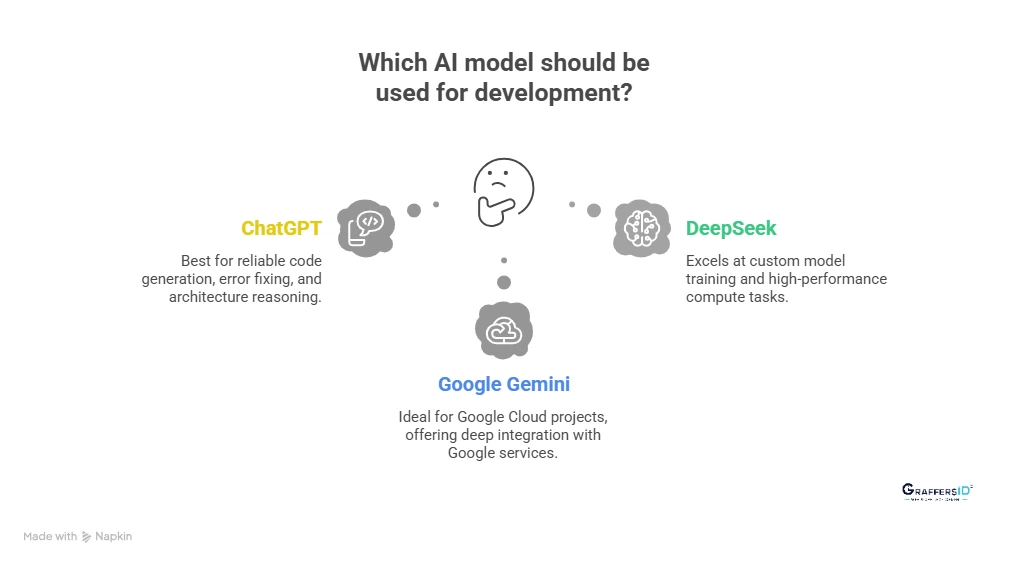
Here’s how leading developers and CTOs are choosing AI models today:
-
For coding and debugging: ChatGPT offers the most reliable code generation, error fixing, and architecture reasoning for real-world software projects.
-
For Google Cloud projects: Google Gemini delivers deep integration with Google Cloud, Firebase, and Android tooling for cloud-native and mobile development.
-
For AI research and custom models: DeepSeek excels at custom model training, high-performance compute tasks, and research-driven AI workflows.

Conclusion: Gemini vs. ChatGPT vs. DeepSeek- Choosing the Right AI Model in 2026
In 2026, AI models are no longer optional productivity tools; they are core engineering infrastructure that directly impacts development speed, code quality, system reliability, and long-term scalability.
There is no single “best” AI model for every development team. The most effective engineering organizations choose AI models based on specific use cases, cloud environments, and workflow maturity, not market hype.
-
ChatGPT is the most reliable all-round AI for coding, debugging, refactoring, and end-to-end software development workflows.
-
Google Gemini is the strongest choice for teams building on Google Cloud, Firebase, and Android, with deep cloud-native and multimodal capabilities.
-
DeepSeek is ideal for AI research, custom model training, and GPU-intensive, domain-specific AI systems.
The highest-performing teams in 2026 don’t rely on just one AI model. Instead, they combine multiple AI systems, aligning each model to the task it performs best. This approach leads to faster releases, fewer production issues, and a stronger competitive advantage.
At GraffersID, we help companies hire experienced AI developers who specialize in building intelligent web and mobile applications, custom AI agents, and automation-driven workflows tailored to modern engineering needs.
Hire top AI developers from GraffersID and take your development to the next level.