In 2026, training an AI model has evolved from a technical experiment into a core business growth strategy. Forward-thinking companies are no longer settling for generic, off-the-shelf AI tools; they’re building custom-trained AI models that understand their unique data, customers, and workflows.
For CTOs, CEOs, and product heads, this shift marks a new era of competitive advantage. A model trained on your organization’s real-world data can automate decision-making, personalize user experiences, and predict market shifts with precision, something no plug-and-play AI can offer.
In this comprehensive blog, we’ll break down how to train an AI model step-by-step, explore the latest tools, frameworks, and trends shaping AI development, and reveal how enterprises can leverage custom-trained AI to drive scalability, innovation, and long-term business impact.
What is AI Model Training and How Does It Work?
AI model training is the process of teaching a machine learning algorithm to identify patterns, understand data, and make decisions without human intervention; essentially, it’s how you make an AI “learn.”
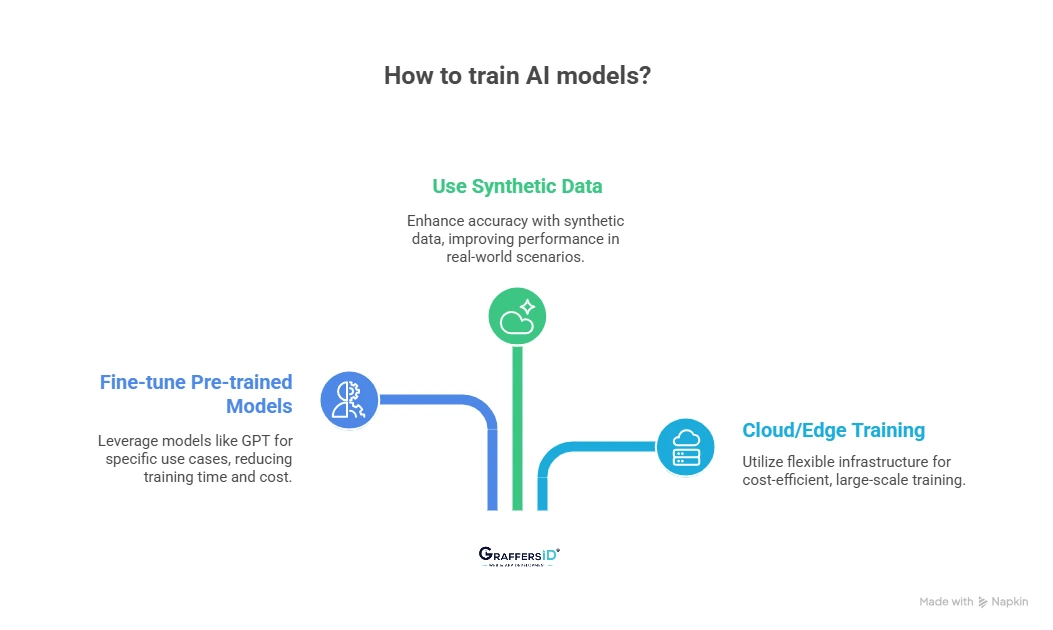
In 2026, AI model training has become faster, more affordable, and more adaptable for enterprises of all sizes. Here’s why:
-
Pre-trained foundation models like GPT, LLaMA, and Mistral make it easy to fine-tune powerful AI systems for your specific use case.
-
Synthetic and multimodal data enhance accuracy and help AI systems perform better across varied real-world scenarios.
-
Cloud and edge training environments offer flexible, cost-efficient infrastructure for large-scale or on-device AI model training.
By training AI models customized to their business data, companies in 2026 achieve higher accuracy, stronger data compliance, and full control over AI performance, giving them a decisive competitive edge.
Key Steps to Take Before Training Your AI Model in 2026
Before jumping into training, enterprises must ensure three key foundations: clear goals, strong data, and the right infrastructure.
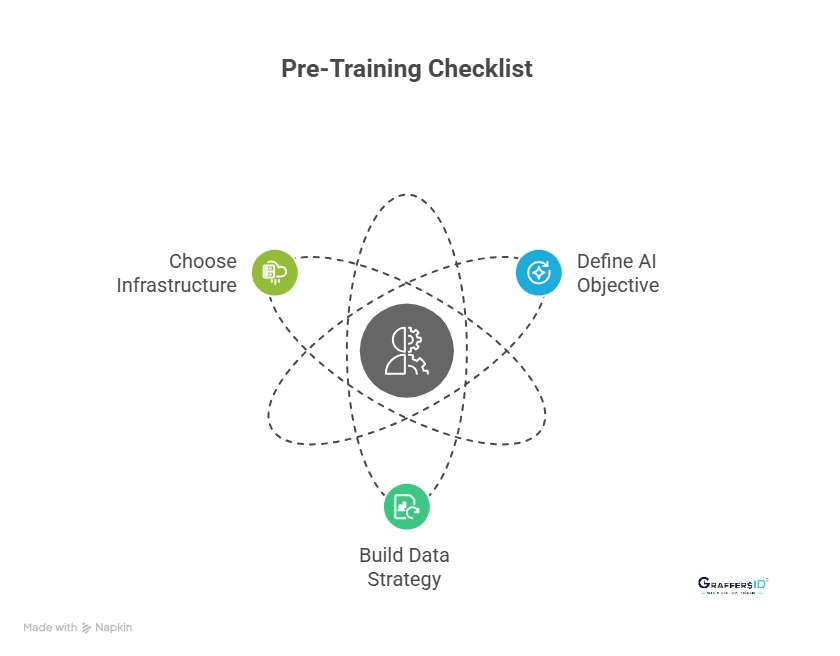
1. Define Your AI Objective: Start with a clear problem statement, whether it’s automating customer service, predicting demand, or generating personalized insights.
Ask: “What problem do you want AI to solve?” A defined goal shapes your data, model choice, and evaluation metrics.
2. Build a Solid Data Strategy: Data is the fuel of AI training. Focus on collecting clean, diverse, and high-quality data. Use synthetic data to fill gaps, remove bias, and ensure accuracy while complying with global privacy regulations like GDPR and India’s DPDP Act.
3. Choose the Right Infrastructure: Modern AI training requires scalable infrastructure. Use scalable infrastructure such as NVIDIA H100 GPUs or Google Cloud TPUs for high-performance training. In 2026, many enterprises also adopt federated learning and serverless MLOps for secure, automated model training.
How to Train an AI Model in 2026? Step-by-Step Process
Training an AI model in 2026 is no longer limited to research labs; it’s an essential process for businesses aiming to build intelligent, data-driven solutions.
Here’s a step-by-step guide that breaks down how modern enterprises and developers train, deploy, and optimize AI models using the latest tools and technologies.
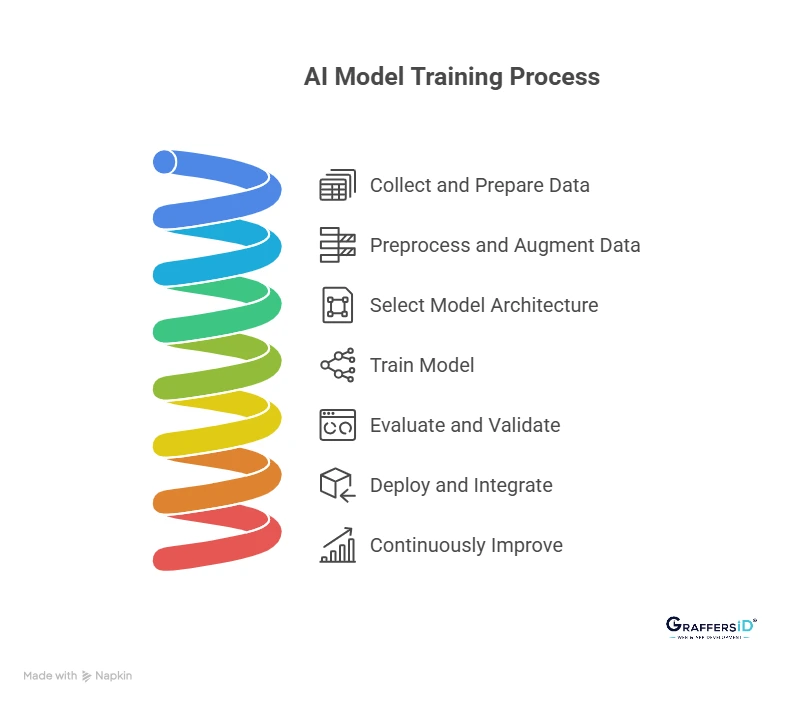
Step 1: Collect and Prepare High-Quality Data
The foundation of every AI model is clean, reliable, and labeled data. Start by gathering data from trusted sources like internal systems, APIs, customer interactions, or open datasets.
Key Actions in 2026
-
Use AI-based data cleaning tools to remove inconsistencies and duplicates.
-
Label data efficiently using tools such as Label Studio, Snorkel, or automated annotation systems powered by AI.
-
Ensure data diversity to minimize bias and improve model fairness.
Tip: The better your data, the smarter your AI model will perform.
Step 2: Preprocess and Augment Your Dataset
Once your data is collected, convert it into a model-ready format. This process ensures your model learns effectively without noise or inconsistencies.
Common Preprocessing Techniques
-
Normalize numerical values for consistent scaling.
-
Tokenize text data for NLP tasks.
-
Resize, crop, or enhance images for computer vision models.
-
Use AI-driven augmentation tools (like AugLy or Roboflow) to expand dataset variety and accuracy.
In 2026, many teams rely on generative AI for synthetic data augmentation, improving accuracy without collecting new real-world data.
Read More: OpenAI’s GPT vs. Google Gemini: Which AI Model is Better for Workflow Automation in 2025?
Step 3: Select the Right Model Architecture
Choosing the correct model type depends on your project’s goal and data type.
Popular AI Architectures in 2026
-
Transformers: for text, speech, and multimodal tasks.
-
CNNs / Vision Transformers (ViTs): for image recognition and object detection.
-
RNNs / Temporal Models: for time-series forecasting and financial modeling.
By 2026, most teams fine-tune pre-trained foundation models like GPT, LLaMA, or Claude instead of training from scratch, saving time, cost, and compute power.
Step 4: Train Your Model Using Modern Frameworks
Now, the model training begins, where your data and architecture meet computation.
Top AI Frameworks in 2026
-
PyTorch 2.x, TensorFlow 3.0, and JAX are standard for training deep learning models.
-
AutoML and AI agents handle hyperparameter tuning, reducing manual effort.
-
Distributed training using cloud platforms (AWS Sagemaker, Google Vertex AI, Azure ML) speeds up large-scale training.
Key Configurations
-
Define learning rate, batch size, and optimization strategy.
-
Implement early stopping and checkpoint saving for efficiency.
Pro tip: Hybrid-cloud and GPU-optimized training pipelines are now standard for scaling enterprise AI.
Step 5: Evaluate and Validate Model Performance
After training, test your model to ensure it performs accurately in real-world conditions.
Use Task-specific Metrics
-
Classification: Precision, Recall, F1-score
-
Regression: RMSE, MAE
-
Language: BLEU, ROUGE, or Perplexity
Validation Techniques in 2026
-
Test with live or unseen production data.
-
Use AI evaluation tools like Weights & Biases, MLflow, or TruLens for automated validation.
Continuous evaluation ensures your model adapts well to dynamic business environments.
Step 6: Deploy and Integrate the AI Model
Once validated, it’s time to deploy your AI model into real-world applications.
Best Deployment Practices in 2026
-
Containerize models using Docker or Kubernetes for scalability.
-
Deploy via APIs using platforms like Hugging Face Inference API or AWS Bedrock.
-
Monitor model drift and performance with AI observability tools like Arize AI or Fiddler AI.
Integrate smoothly with CRMs, apps, or analytics systems to turn predictions into business impact.
Step 7: Continuously Improve Through Retraining
AI models must evolve with changing data, trends, and customer behavior.
Modern Techniques for Continuous Improvement
-
Reinforcement Learning from Human Feedback (RLHF) for smarter adaptability.
-
Automated retraining loops powered by AI agents for real-time updates.
-
Performance dashboards for tracking drift, latency, and model bias.
In 2026, continuous learning pipelines are not optional; they’re the secret to staying competitive.
Read More: 5 Best AI Frameworks and Libraries in 2025 Trusted by Leading Tech Companies
Practical Use Cases of AI Model Training
1. Retail and E-commerce: Brands are training AI models on customer behavior and sentiment data to create personalized recommendations, boosting retention and average order value.
2. Finance: Financial institutions use trained AI models on transaction logs to detect fraud, predict credit risks, and improve real-time decision accuracy.
3. Healthcare: Hospitals train diagnostic AI systems on medical imaging data to enhance early disease detection while ensuring data security and compliance.
4. Customer Support: Companies fine-tune large language models (LLMs) on internal documents and FAQs to automate customer interactions with brand-specific accuracy and tone.
Top Tools and Frameworks for AI Model Training in 2026
| Category | Tools & Platforms |
|---|---|
| Frameworks | PyTorch 2.x, TensorFlow 3.0, JAX, FastAI |
| Platforms | AWS SageMaker Studio, Google Vertex AI, Azure ML Studio |
| Libraries | Hugging Face Transformers, LangChain, AutoKeras |
| MLOps & Monitoring | MLflow, Weights & Biases, Neptune.ai |
| Governance | Explainable AI Toolkits, Bias Detection APIs, Privacy Dashboards |
These tools make AI model training faster, scalable, and compliant with 2026’s evolving AI governance standards.
Common AI Training Challenges and How to Fix Them in 2026
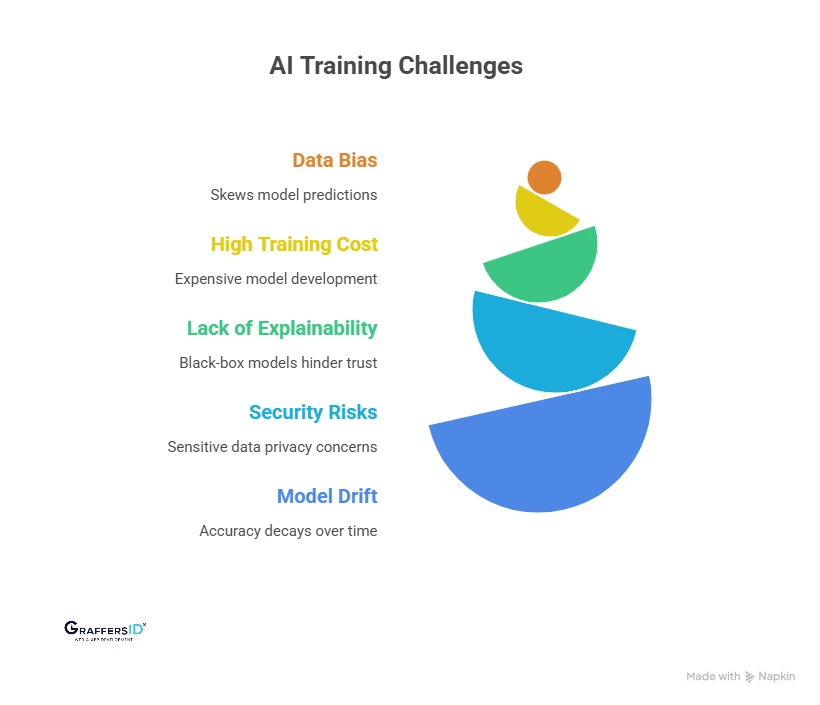
1. Data Bias and Quality Problems: Poor or biased data leads to inaccurate predictions. In 2026, regular data audits, diverse sourcing, and synthetic data generation help ensure fair and reliable model outcomes.
2. High Cost of Model Training: Full-scale model training can be expensive. Businesses now reduce costs by using fine-tuning methods, pre-trained models, and serverless AI infrastructure for scalable training.
3. Lack of Model Explainability: Black-box models hinder trust. Modern Explainable AI (XAI) dashboards and transparency layers make decision-making clearer and easier to audit for compliance.
4. Security and Data Privacy Risks: Training models on sensitive data raises privacy concerns. The 2026 best practice is to use encrypted, privacy-preserving training methods to ensure compliance with AI governance standards.
5. Model Drift and Performance Decay: AI models lose accuracy as data changes. Continuous learning loops, feedback mechanisms, and retraining pipelines keep models accurate and aligned with evolving business data.

Conclusion: Build Future-Ready AI Models for Your Business Growth
In 2026, training an AI model isn’t just about innovation; it’s about staying relevant. As industries evolve toward automation and intelligence-driven ecosystems, custom-trained AI models have become the foundation for smarter decisions, faster scaling, and stronger competitive edges.
Whether you’re a startup optimizing operations or an enterprise transforming customer experiences, success depends on how effectively you train, deploy, and maintain AI systems tailored to your data and business logic. The future belongs to organizations that treat AI as a strategic asset, not a one-time experiment.
At GraffersID, we empower companies to build custom AI solutions and intelligent automation systems designed for performance, scalability, and business impact.
Partner with GraffersID to hire top AI developers and build intelligent systems that scale your business in 2026 and beyond.