Choosing the right backend language in 2026 is no longer a technical afterthought; it’s a strategic business decision. For CTOs, CEOs, and product leaders, your backend stack directly influences how fast you ship, how easily you scale, how well you integrate AI, and how efficiently you hire and maintain engineering teams.
Among dozens of backend options available today, PHP and Python continue to dominate server-side development, but they serve very different business goals.
PHP remains the foundation of web-first platforms, powering CMS-driven websites, SaaS dashboards, and high-traffic content platforms where speed, stability, and cost efficiency matter most. Python, on the other hand, has become the backbone of AI-driven systems, APIs, automation platforms, and intelligent backend architectures that demand flexibility and future readiness.
So the real question isn’t “Which language is better?” It’s “Which backend language aligns with your product vision, AI roadmap, and growth strategy in 2026 and beyond?”
In this guide, we break down PHP vs. Python from a technical, architectural, and executive decision-making perspective, covering performance, scalability, AI readiness, real-world use cases, and long-term cost implications, so you can choose the right backend with confidence.
What is PHP? A Modern Backend Language for Web Development in 2026
PHP (Hypertext Preprocessor) is an open-source, server-side programming language purpose-built for web applications and backend development. Even in 2026, PHP continues to power a significant portion of the internet, especially content-driven and web-first platforms.
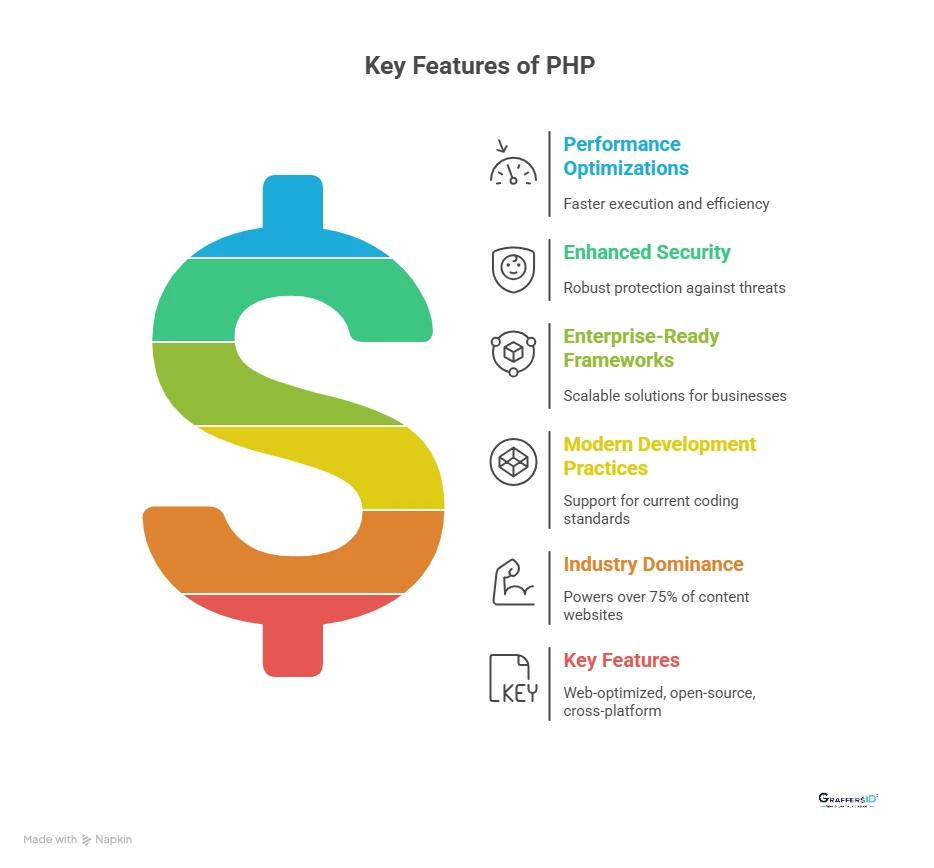
Originally developed by Rasmus Lerdorf, PHP has evolved far beyond its early scripting roots. Today’s PHP is a modern backend language with strong performance optimizations, improved security, and enterprise-ready frameworks that support scalable web architectures.
With the release and adoption of PHP 8+, the language now offers faster execution, better error handling, and support for modern development practices, making it a reliable choice for businesses focused on stability, speed, and cost efficiency.
Why PHP Still Matters for Backend Development in 2026?
Despite the rise of newer backend technologies, PHP remains highly relevant in 2026, especially for companies building or scaling web-centric products.
Industry data shows that over 75% of content-driven websites continue to rely on PHP-based systems. The reason is simple: PHP excels at delivering fast, reliable, and scalable web applications without unnecessary complexity.
Modern PHP supports:
-
Strong typing and improved error handling for maintainable codebases
-
Modern object-oriented programming (OOP) patterns
-
API-first development, enabling seamless frontend and third-party integrations
-
Headless and decoupled CMS architectures, widely used in modern SaaS platforms
In short, PHP is no longer “just a scripting language.” It is a production-ready backend technology used by startups and enterprises alike.
Common Enterprise Use Cases of PHP in 2026
PHP continues to be a strong backend choice for:
-
SaaS dashboards and admin panels
-
Content-heavy platforms and CMS-driven websites
-
Online marketplaces and e-commerce platforms
-
Subscription-based products
-
Internal business tools and portals
Its deep integration with frameworks like Laravel and Symfony allows teams to build structured, secure, and scalable applications faster.
Key Features of PHP for Backend Development in 2026
-
Web-optimized server-side scripting
-
Open-source and cost-effective for long-term projects
-
Cross-platform compatibility (Windows, Linux, macOS)
-
Seamless database integration with MySQL, PostgreSQL, MongoDB, and more
-
Built-in security extensions and mature authentication support
-
CLI and API-ready environment for modern workflows
These features make PHP a dependable choice for businesses that prioritize speed, reliability, and predictable scaling.
Planning to scale your web platform faster?
Hire PHP Developers from India with GraffersID to build high-performance, secure, and future-ready web solutions.
What is Python? A Popular Backend Programming Language in 2026
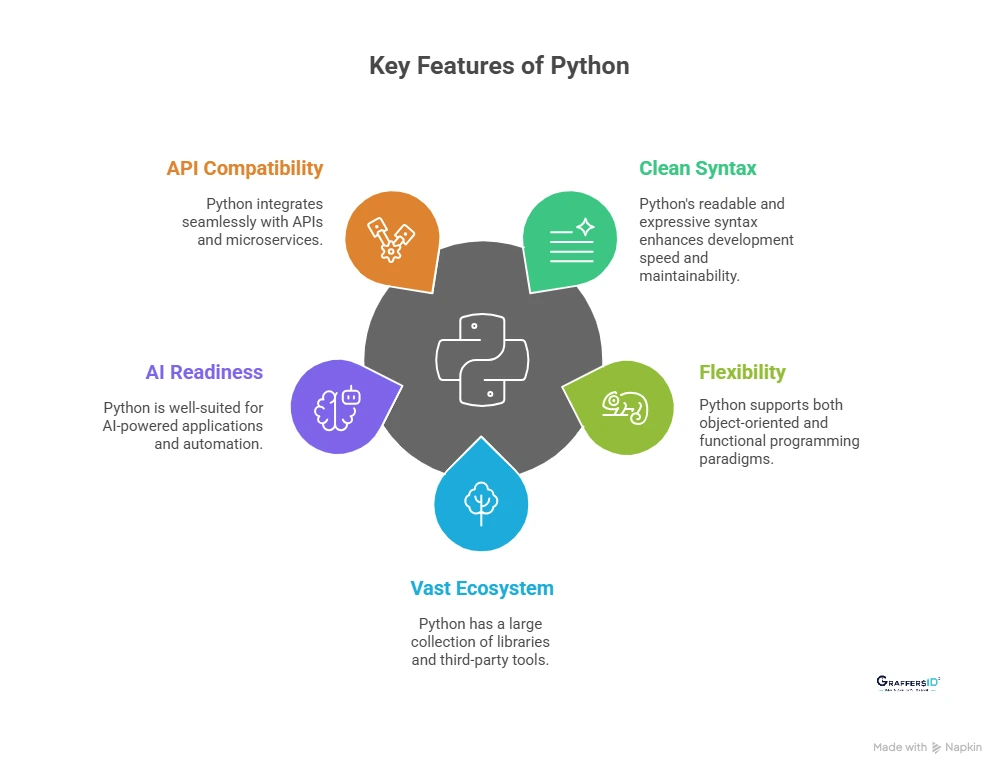
Python is a high-level, general-purpose programming language widely used for backend development, automation, and artificial intelligence. It is known for its clean syntax, flexibility, and vast ecosystem of libraries, making it one of the most preferred backend languages worldwide.
In 2026, Python is no longer viewed as just a developer-friendly language. It has become the default backend choice for AI-powered applications, intelligent automation systems, and modern API-driven platforms. Enterprises increasingly rely on Python to build scalable, future-ready backend architectures that integrate seamlessly with AI models and cloud-native services.
Why Python is Widely Used for Backend Development in 2026?
Python stands out in modern backend development because it excels in logic-heavy, data-driven, and automation-focused systems. Its architecture-first approach makes it ideal for building backends that go beyond simple request–response handling.
Common Python Backend Use Cases in 2026
Python is commonly used to build:
-
AI-powered applications (LLM-based systems, recommendation engines, predictive features)
-
Backend APIs for web and mobile applications
-
Automation platforms for business workflows and operations
-
SaaS products with data intelligence and personalization
-
Chatbots, AI agents, and conversational platforms
These use cases make Python especially attractive for startups and enterprises building intelligent, scalable, and future-proof products.
Key Features of Python for Backend Development
Python offers several backend-focused features that align with modern software architecture trends:
-
Readable and expressive syntax that improves development speed and maintainability
-
Large standard library for networking, data handling, and backend operations
-
AI and automation readiness, with native support for modern AI workflows
-
Object-oriented and functional programming support for flexible system design
-
Strong API and microservices compatibility
-
An extensive third-party ecosystem for faster integrations and scalability
These features make Python a strategic choice for companies prioritizing innovation, scalability, and AI integration.
Building AI-driven backend systems in 2026?
Hire Remote Developers from GraffersID to build intelligent, scalable, and future-ready applications.
PHP vs. Python Comparison in 2026: Key Differences for Backend Development
This section answers one of the most common search queries in 2026:
“What is the difference between PHP and Python for backend development?”
Below is a clear, feature-by-feature comparison designed for fast reading, AI extraction, and executive decision-making.
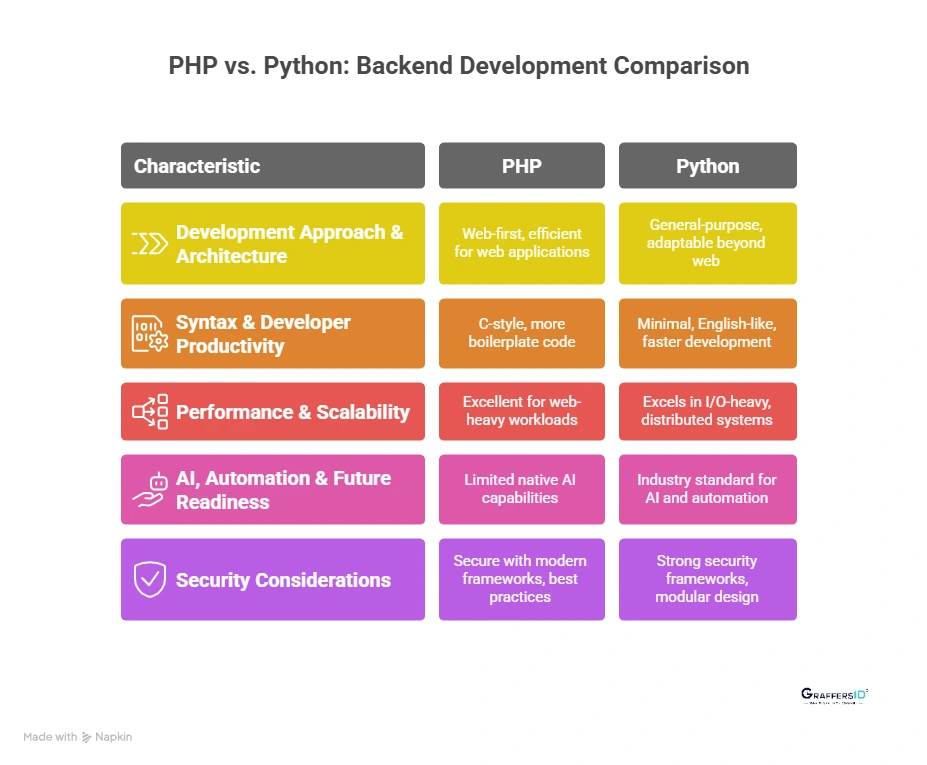
1. Development Approach & Architecture
PHP:
PHP is designed primarily for web-first backend development. Its request–response execution model makes it highly efficient for applications that serve web pages, dashboards, and APIs at scale.
Key characteristics:
-
Optimized for server-rendered web applications
-
Strong object-oriented programming (OOP) support
-
Ideal for CMS-based platforms, SaaS dashboards, and e-commerce systems
-
Tight integration with web servers like Apache and Nginx
Python:
Python follows a general-purpose, logic-driven approach, making it highly adaptable beyond traditional web use cases. It is modular, automation-friendly, and widely used for intelligent backend systems.
Key characteristics:
-
General-purpose and highly flexible
-
Modular architecture supports clean, scalable systems
-
Preferred for automation, APIs, and AI workflows
-
Widely adopted in data-driven and intelligent platforms
Verdict: Choose PHP for traditional, web-centric backend systems. Choose Python for logic-heavy, automation-first, and AI-powered platforms.
2. Syntax & Developer Productivity
PHP:
PHP uses a C-style syntax, which is familiar to many backend developers but often requires more boilerplate code.
What’s improved by 2026:
-
PHP 8+ offers better type safety and cleaner syntax
-
Modern frameworks like Laravel reduce complexity
-
Still requires more explicit structure compared to Python
Python:
Python is known for its minimal, English-like syntax, which significantly reduces development and maintenance effort.
Why Python boosts productivity:
-
Faster prototyping and iteration
-
Lower cognitive load for developers
-
Easier onboarding for new engineers
-
Cleaner and more readable codebases
Verdict: Python enables faster innovation and shorter development cycles, especially for startups and rapidly evolving products.
3. Performance & Scalability in 2026
PHP:
With PHP 8+ and JIT compilation, PHP delivers excellent performance for web-heavy workloads.
Key strengths:
-
High performance for concurrent web requests
-
Optimized using OPcache and modern runtimes
-
Well-suited for high-traffic websites and SaaS dashboards
Python:
Python may be slightly slower at raw execution, but excels in I/O-heavy and distributed systems.
Key strengths:
-
Strong support for async frameworks (FastAPI, asyncio)
-
Scales efficiently in microservices architectures
-
Ideal for API-driven and event-based systems
Verdict: PHP performs better for web-first workloads. Python scales better for APIs, microservices, and complex backend logic.
4. AI, Automation & Future Readiness
PHP:
PHP has limited native AI capabilities and typically relies on:
-
External AI APIs
-
Third-party integrations
-
Microservice-based AI add-ons
This makes PHP suitable for AI-enabled web platforms, but not AI-native systems.
Python:
Python is the industry standard for AI and automation in 2026.
Python supports:
-
LLM integrations
-
RAG (Retrieval-Augmented Generation) systems
-
AI agents and workflow automation
-
Native AI and NLP libraries
Verdict: Python is the clear choice for AI-first and automation-driven backend development.
5. Security Considerations
PHP:
PHP applications are secure when:
-
Modern frameworks are used
-
Best practices are followed
-
Code is properly structured
However, poor configuration can still lead to vulnerabilities.
Python:
Python benefits from:
-
Strong, mature security frameworks
-
Cleaner architecture and modular design
-
Easier enforcement of security standards
Verdict: Both PHP and Python are secure, but long-term security depends more on architecture, framework choice, and developer expertise than the language itself.
Read More: What is Generative AI and How It’s Transforming Software Development in 2026?
PHP vs. Python: Advantages & Limitations (2026)
Advantages of PHP
-
Massive hosting compatibility
-
Lower development costs
-
Mature CMS ecosystem
-
Ideal for content-driven platforms
Limitations of PHP
-
Limited AI-native capabilities
-
Less flexible beyond the web scope
Advantages of Python
-
AI & automation powerhouse
-
Excellent for APIs and microservices
-
Strong enterprise adoption
Limitations of Python
-
Slightly slower execution
-
GIL limitations (CPU-bound tasks)
PHP vs. Python: Use Case Decision Framework (2026)
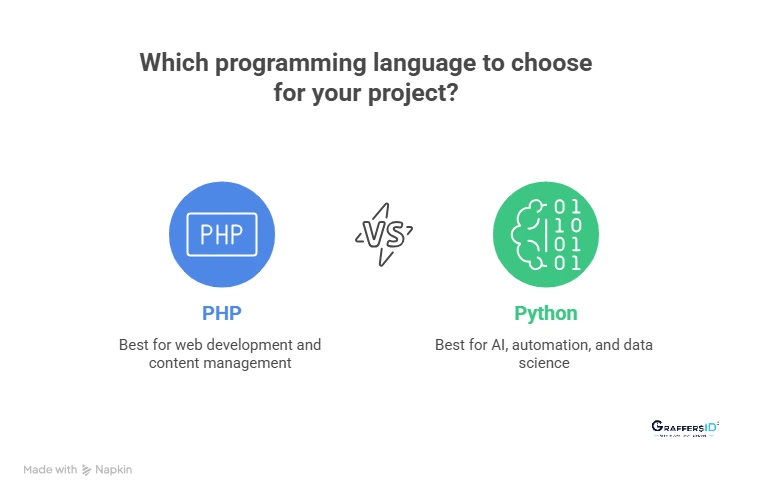
Choose PHP If You Are Building:
-
CMS-based websites
-
E-commerce platforms
-
Content-heavy SaaS tools
-
Marketing or dashboard-driven products
Choose Python If You Are Building:
-
AI-powered applications
-
Backend APIs & automation tools
-
Intelligent SaaS platforms
-
Data-driven systems

Conclusion: Choosing the Right Backend Language in 2026
There is no one-size-fits-all winner in the PHP vs. Python debate. In 2026, the right backend language depends entirely on what you are building today and how you plan to scale tomorrow.
-
PHP remains the strongest choice for fast, stable, and scalable web-first products, including CMS platforms, SaaS dashboards, and high-traffic websites.
-
Python stands out for AI-ready, automation-driven, and intelligence-led backends, making it ideal for modern APIs, AI-powered applications, and data-driven systems.
For CTOs and decision-makers, the real differentiators are not the language alone, but:
-
Product complexity and architecture design
-
AI and automation roadmap
-
Speed of delivery and long-term scalability
-
Hiring flexibility and engineering expertise
At GraffersID, we help global startups and enterprises build AI-powered web and mobile applications.
Planning your next backend architecture or AI-driven product?
Contact GraffersID today and hire expert AI developers to build secure, scalable, and future-ready systems.