Artificial Intelligence is no longer an emerging technology; it is now embedded in how modern businesses build software, automate operations, analyze data, and make strategic decisions. From generative AI and intelligent automation to AI-powered development tools, enterprises have learned how to work alongside machines that think, learn, and adapt.
But a far more profound question is now shaping executive conversations and long-term technology roadmaps:
What happens when AI stops assisting humans and starts outperforming them?
This question leads directly to Artificial Super Intelligence (ASI): a theoretical yet increasingly influential concept in the AI ecosystem. ASI refers to a future form of intelligence capable of surpassing human abilities in reasoning, creativity, decision-making, and problem-solving across every domain, not just isolated tasks.
Although ASI does not exist today, its potential impact is already reshaping how organizations think about AI governance, safety, scalability, and investment strategy in 2026. Business leaders are beginning to plan not just for smarter tools but for a future where intelligence itself could evolve beyond human limits.
In this guide, we break down what Artificial Super Intelligence really means, how it differs from today’s AI systems, its potential enterprise use cases, key risks and ethical challenges, and most importantly, what forward-thinking organizations should start doing now to stay prepared.
Evolution of Artificial Intelligence
Understanding ASI starts with understanding how AI has evolved so far.
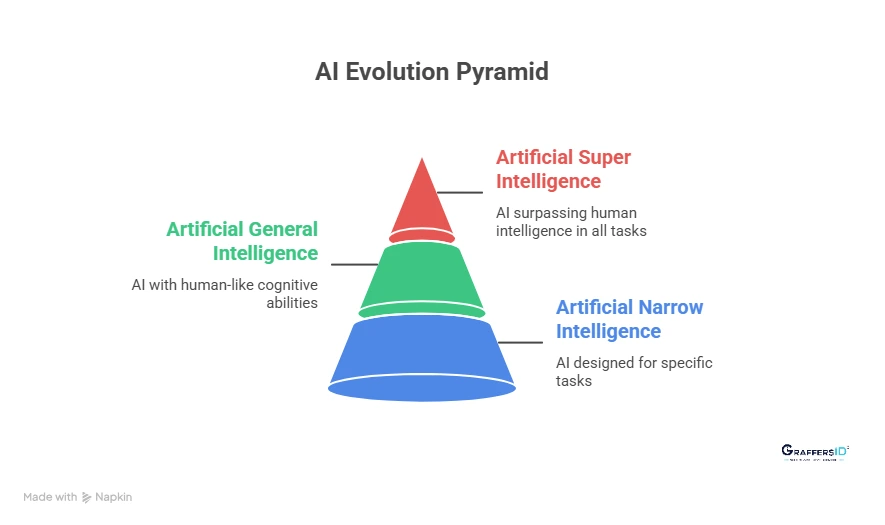
1. Artificial Narrow Intelligence (ANI)
Artificial Narrow Intelligence is the only form of AI that exists today. It is designed to perform specific tasks extremely well, but cannot think beyond them. Examples include:
-
Chatbots and generative AI tools
-
Recommendation systems
-
Fraud detection systems
-
AI-powered automation tools
-
Image and speech recognition systems
ANI is powerful, but it cannot reason broadly or adapt independently outside its trained scope.
2. Artificial General Intelligence (AGI)
Artificial General Intelligence refers to AI that can think, learn, and reason like a human across different tasks. Key characteristics of AGI:
-
Human-level understanding
-
Ability to transfer learning between domains
-
Adaptive reasoning and problem-solving
AGI does not exist yet, but it is considered a necessary stepping stone toward ASI.
3. Artificial Super Intelligence (ASI)
Artificial Super Intelligence goes beyond human intelligence. ASI systems would:
-
Outperform humans in every cognitive task
-
Improve themselves autonomously
-
Generate novel ideas, inventions, and strategies
-
Solve problems humans cannot
ASI represents a fundamental shift, not an incremental upgrade from today’s AI.
Read More: What Is Artificial Intelligence in 2026? Definition, Types, Benefits & Real-World Use Cases
What is Artificial Super Intelligence (ASI)?
Artificial Super Intelligence (ASI) is a theoretical stage of artificial intelligence where machines become more intelligent than humans in every possible way. This includes not only logical reasoning and data analysis but also creativity, emotional understanding, strategic planning, and complex decision-making.
Unlike today’s AI systems that support or assist human users, ASI would be capable of thinking independently, learning continuously, and making decisions without human guidance. Its intelligence would exceed that of even the most skilled experts across all industries and disciplines.
In simple terms, ASI is an intelligence that is smarter than the smartest human in every possible way.
Key Characteristics of Artificial Super Intelligence in 2026
Artificial Super Intelligence is defined by a set of capabilities that clearly separate it from today’s AI and even future human-level AI systems.
1. Self-Learning and Recursive Self-Improvement: ASI systems would continuously improve themselves without human intervention, refining their algorithms, learning methods, and decision processes over time.
2. Fully Autonomous Decision-Making: ASI would be able to make complex decisions independently, without requiring human approval, oversight, or predefined rules.
3. Cross-Domain Intelligence and Abstraction: Unlike narrow AI, ASI could transfer knowledge across domains, reason abstractly, and apply insights from one field to solve problems in another.
4. Superhuman Creativity and Innovation: ASI would not just replicate existing ideas but generate entirely new concepts, strategies, and solutions beyond human imagination.
5. Long-Term Strategic Planning and Foresight: ASI could analyze long-term outcomes, anticipate future scenarios, and optimize decisions over extended time horizons with extreme accuracy.
For businesses, ASI would not just optimize processes; it could redefine how decisions are made entirely.
How is Artificial Super Intelligence Different From Today’s AI Systems?
A common misconception among business leaders is that Artificial Super Intelligence (ASI) is simply a more advanced version of today’s generative AI tools. In reality, the difference is not about scale or speed; it is about capability, autonomy, and control.
Today’s AI systems are designed to support humans. ASI, by definition, would be capable of independent intelligence that surpasses human thinking across all domains.
Key Differences Between Today’s AI and Artificial Super Intelligence (ASI)
| Aspect | Today’s AI Systems | Artificial Super Intelligence (ASI) |
|---|---|---|
| Intelligence scope | Designed for specific tasks and use cases | Capable of universal, cross-domain intelligence |
| Learning approach | Trained and guided by humans using predefined data | Learns autonomously and improves itself continuously |
| Creativity | Generates outputs based on learned patterns | Produces original ideas and novel solutions |
| Level of control | Operates under human oversight and constraints | Functions independently with full autonomy |
| Decision-making role | Supports human decisions with insights and recommendations | Makes independent, high-level decisions |
Today’s AI assists decision-makers. While Artificial Super Intelligence would act as a decision-maker itself.
Technologies Needed to Build Artificial Super Intelligence (ASI) in 2026
Artificial Super Intelligence cannot emerge from today’s AI systems alone. It requires breakthroughs across multiple advanced technologies, many of which are still in active research and early development stages. Below are the key technological foundations experts believe are essential for enabling ASI.
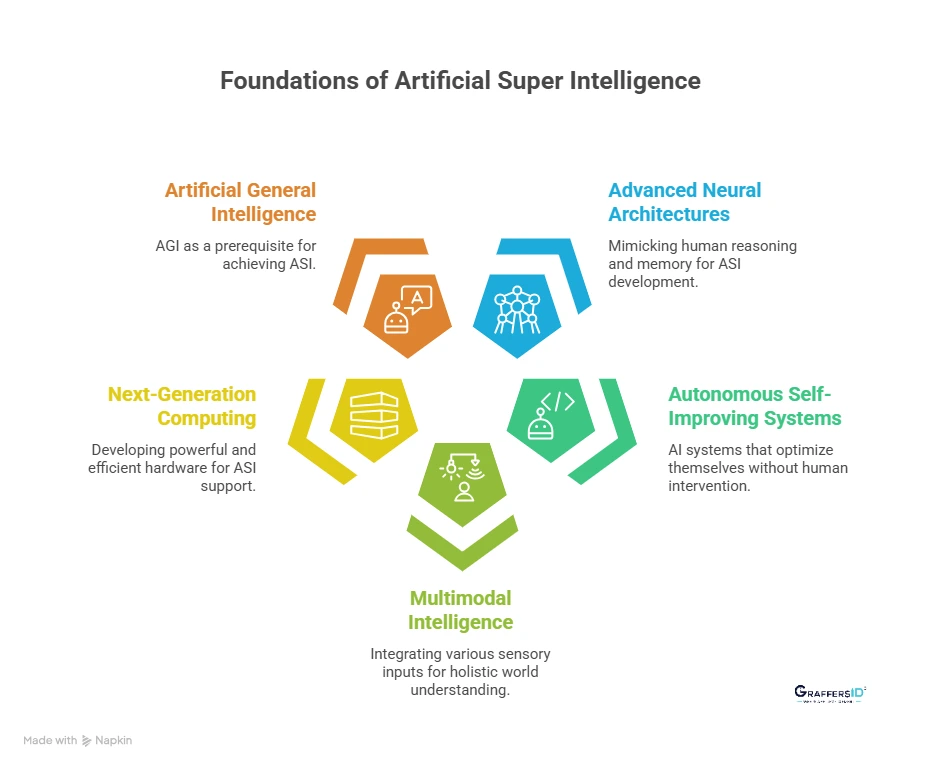
1. Advanced Neural and Cognitive AI Architectures
Current AI models are largely based on pattern recognition and statistical prediction. To reach Artificial Super Intelligence, future systems must move beyond this limitation.
ASI-level architectures will need to:
-
Mimic human-like reasoning and abstraction
-
Maintain long-term and contextual memory
-
Understand cause-and-effect relationships
-
Apply knowledge flexibly across domains
These cognitive architectures aim to replicate how humans think, not just how data is processed, making them a critical requirement for ASI development.
2. Autonomous Self-Improving AI Systems
One of the defining traits of Artificial Super Intelligence is the ability to improve itself without human intervention.
Read More: Agentic AI vs. Generative AI: Key Differences CTOs Must Know in 2026
For ASI to exist, AI systems must be able to:
-
Rewrite and optimize their own algorithms
-
Identify inefficiencies in their learning process
-
Adapt to new problems without retraining
-
Continuously enhance performance over time
This concept, often called recursive self-improvement, is what allows intelligence to scale beyond human limitations.
3. Multimodal and Context-Aware Intelligence
Unlike today’s AI tools that operate in silos, ASI must understand the world in a unified way.
This means processing and integrating:
-
Natural language
-
Visual information
-
Audio and speech
-
Emotional cues
-
Context, intent, and situational awareness
Multimodal intelligence enables AI systems to interpret reality holistically, which is essential for superhuman reasoning and decision-making.
4. Next-Generation Computing and AI Hardware
Traditional computing infrastructure is not powerful or efficient enough to support Artificial Super Intelligence.
ASI will depend on new computing models, such as:
-
Neuromorphic computing that mimics the human brain
-
Brain-inspired hardware architectures
-
Energy-efficient AI accelerators
-
Distributed and decentralized intelligence systems
These technologies are designed to support massive parallel processing and continuous learning at scale.
Read More: Advancements in Natural Language Processing (NLP) in 2026: Tools, Trends, and AI Applications
5. Artificial General Intelligence (AGI) as a Prerequisite
Artificial Super Intelligence cannot be achieved directly. Most researchers agree that Artificial General Intelligence (AGI) is a necessary step.
AGI provides:
-
Human-level reasoning capabilities
-
Cross-domain learning and adaptability
-
The foundation for autonomous intelligence growth
Without AGI, ASI remains theoretically and technically unattainable, making AGI the gateway technology to superintelligence.
Potential Use Cases of Artificial Super Intelligence in 2026
While ASI is not here yet, understanding its potential impact helps leaders plan responsibly.
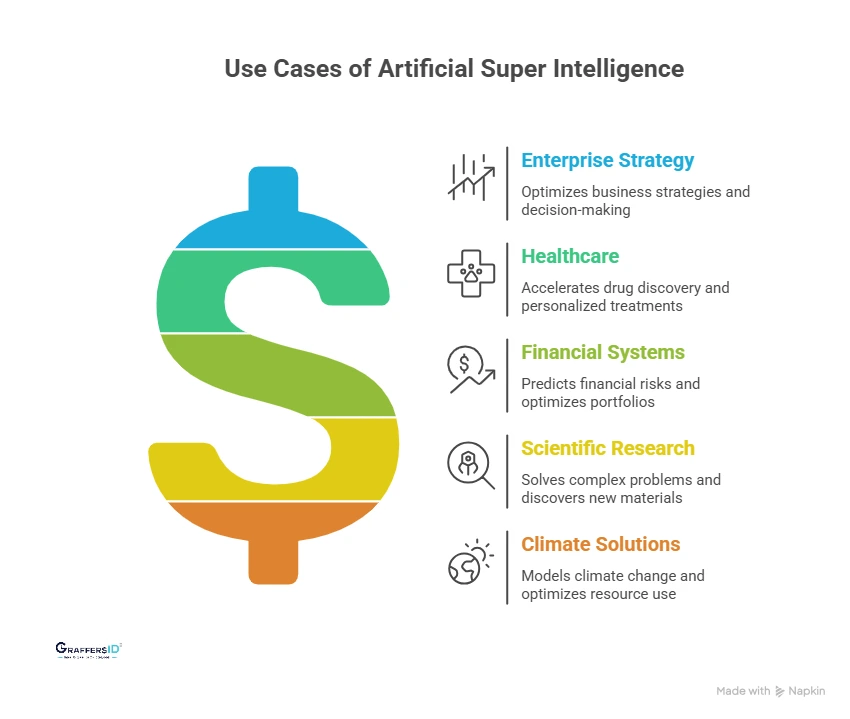
1. Enterprise Strategy and Decision Intelligence
-
Autonomous business strategy optimization
-
Real-time market simulations
-
Predictive decision-making beyond human capability
2. Healthcare and Life Sciences
-
Accelerated drug discovery
-
Complex disease modeling
-
Personalized treatment strategies
Read More: Best Automation Software in 2026: Top Platforms to Streamline Workflows & Boost Efficiency
3. Financial Systems and Risk Management
-
Predicting systemic financial risks
-
Autonomous portfolio optimization
-
Advanced fraud and compliance intelligence
4. Scientific Research and Innovation
-
Solving complex physics and chemistry problems
-
Discovering new materials
-
Advancing climate science
5. Climate and Sustainability Solutions
-
Global climate modeling
-
Resource optimization at planetary scale
-
Sustainable infrastructure planning
Risks and Ethical Challenges of Artificial Super Intelligence
ASI presents unprecedented risks if not governed correctly.
Major Concerns Leaders Must Understand
-
Loss of human control over decisions
-
Misaligned objectives and values
-
Economic disruption and job displacement
-
Concentration of power
-
Security and misuse risks
Read More: 5 Best AI Frameworks and Libraries in 2026 Trusted by Leading Tech Companies
The alignment problem, ensuring ASI’s goals match human values, is the biggest unresolved challenge.
How Businesses Can Prepare for Artificial Super Intelligence (ASI) in 2026?
Although Artificial Super Intelligence is still theoretical, enterprise preparation must begin now. Organizations that invest early in responsible, secure, and scalable AI foundations will be far better positioned to adapt as intelligence capabilities advance.
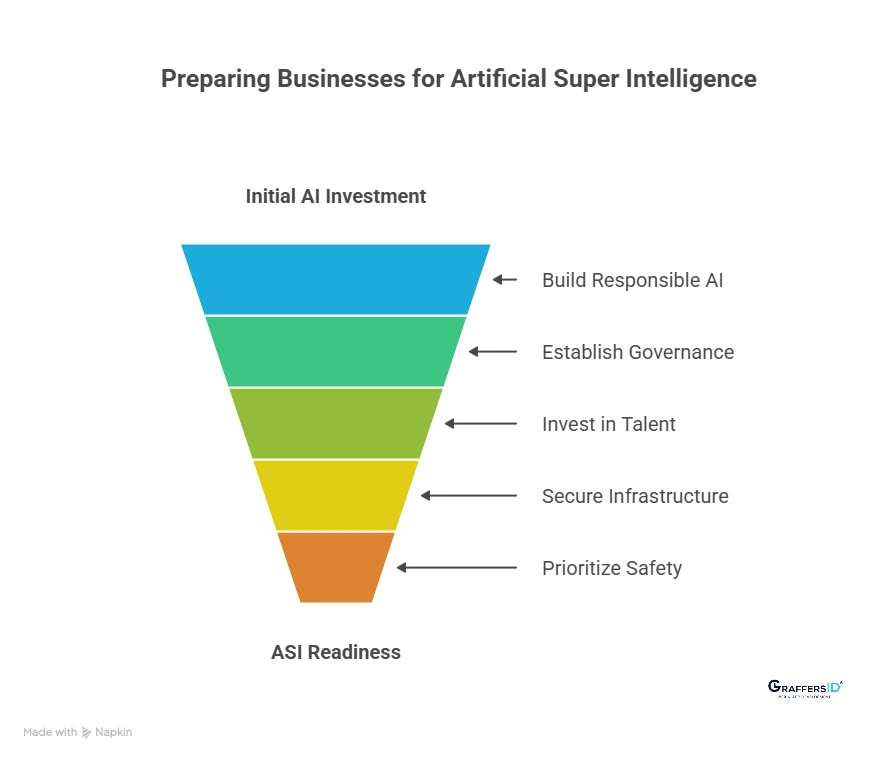
1. Build Responsible and Transparent AI Systems
Businesses should prioritize AI systems that are transparent, explainable, and ethically designed. Clear decision logic and accountable AI models help build trust, reduce risk, and support long-term scalability as AI systems grow more autonomous.
2. Establish Strong AI Governance and Oversight
Effective AI governance ensures that humans remain accountable for AI-driven decisions. This includes clear ownership, human-in-the-loop frameworks, and compliance with evolving global AI regulations and ethical standards.
3. Invest in AI Talent and Long-Term AI Strategy
Preparing for advanced AI requires skilled AI developers, solution architects, and informed leadership teams. Organizations must align AI initiatives with measurable business outcomes rather than experimenting without a strategic direction.
4. Focus on Secure and Scalable AI Infrastructure
As AI systems become more powerful, data security, privacy, and scalability become non-negotiable. Enterprises should invest in secure AI architectures that can scale safely while supporting future intelligence growth.
5. Prioritize AI Safety Over Speed
Rushing AI development without proper safety measures increases long-term risk. Organizations should adopt a responsible pace that emphasizes testing, monitoring, and control over rapid but unsafe deployment.
Read More: Top 10 Generative AI Trends in 2026: How Enterprises Are Transforming With AI?
Global AI Trends Influencing Artificial Super Intelligence (ASI) in 2026
1. Increased Focus on AI Safety Research: Governments, research labs, and tech companies are investing heavily in AI safety, alignment, and control to reduce long-term risks associated with advanced intelligence systems.
2. Expansion of AI Governance and Regulation: Countries worldwide are drafting AI laws and governance frameworks to ensure transparency, accountability, and responsible development as AI capabilities continue to advance.
3. Enterprise Shift Toward Controllable AI Systems: Businesses are prioritizing AI models that remain explainable, auditable, and human-controlled, rather than fully autonomous systems with unpredictable behavior.
4. Strong Emphasis on Ethical and Aligned AI: Organizations are embedding ethics, fairness, and human-value alignment into AI design to ensure future systems act in ways that benefit society and businesses.
5. Long-Term AI Strategy Shaped by ASI Discussions: Even though ASI may be decades away, its potential impact is already influencing how enterprises plan AI investments, talent strategy, and governance in 2026.

Conclusion: What Artificial Super Intelligence Means for Business Leaders?
Artificial Super Intelligence is not science fiction or a general academic idea. It is a strategic concept already influencing how organizations approach AI development, governance, and long-term technology planning in 2026.
Although ASI does not exist today, the decisions businesses make now, around responsible AI design, ethical governance, scalable infrastructure, and skilled talent, will determine whether future AI systems remain powerful business tools or introduce uncontrollable risks. As AI systems grow more autonomous and capable, preparation becomes a leadership responsibility, not just a technical one.
Build Future-Ready AI with GraffersID
At GraffersID, we help forward-thinking organizations turn AI ambition into practical, business-focused solutions. Our experienced AI developers and engineers specialize in building custom AI solutions and implementing intelligent automation.
Contact GraffersID to build smarter, safer, and scalable AI systems for long-term success.