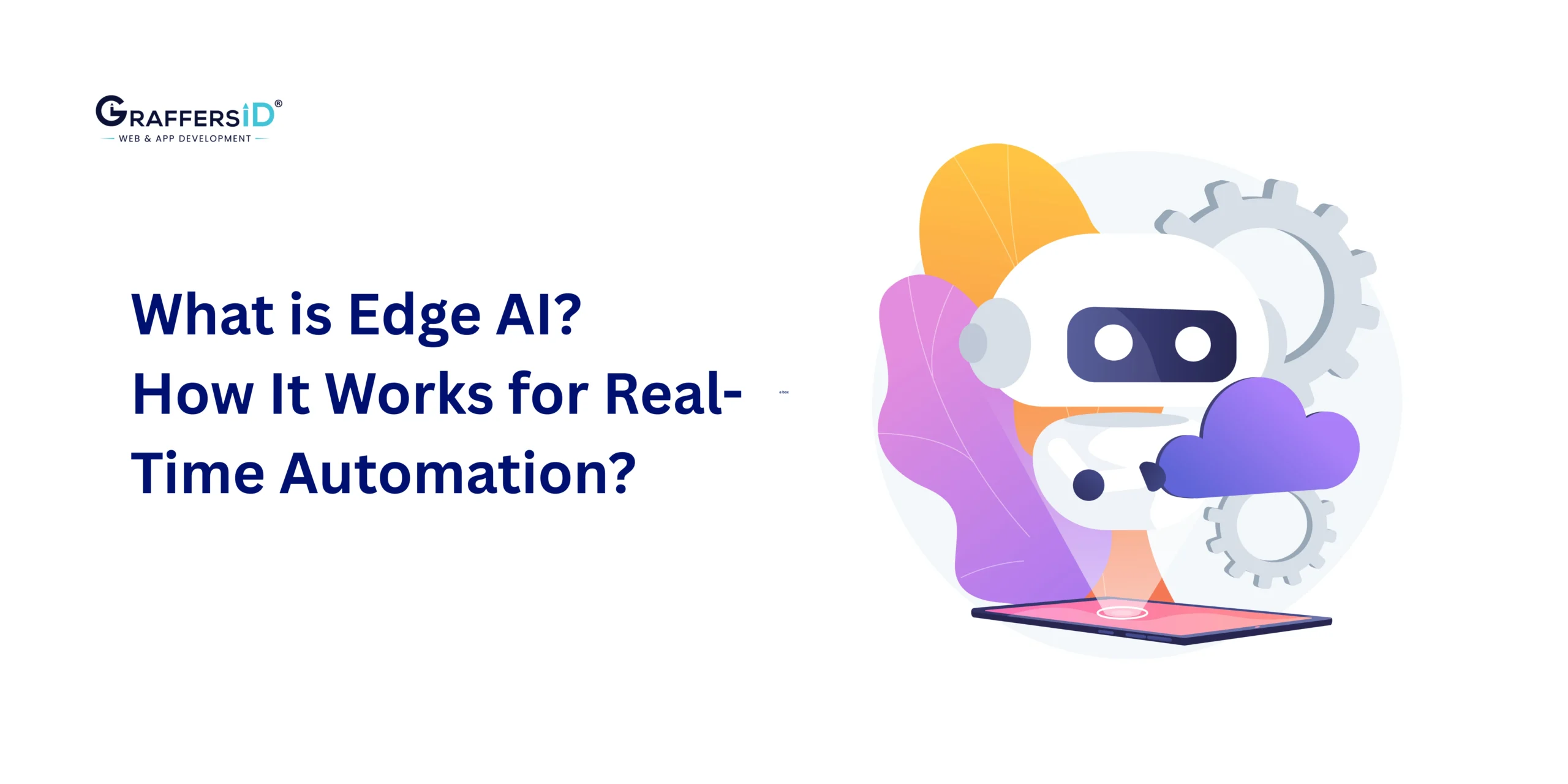
Edge AI in 2026 isn’t just a tech trend; it’s a competitive advantage. As enterprises push for faster decision-making, real-time analytics, and intelligent automation, relying only on cloud-based AI is no longer enough. Leaders across industries are now shifting to Edge AI, where data is processed instantly, right where it’s generated.
With global Edge AI adoption projected to surpass $66.47 million by 2026, driven by 5G networks, IoT growth, and the demand for ultra-low-latency intelligence, CTOs and CEOs are treating it as a board-level priority. Industries like healthcare, manufacturing, retail, logistics, and smart mobility are already replacing slow cloud round-trips with on-device, real-time AI decisions that improve performance, reduce costs, and unlock new automation opportunities.
This guide breaks down Edge AI in simple, decision-maker-friendly language, what it is, why it matters now, where it delivers the strongest ROI, and how your enterprise can prepare for successful adoption in 2026.
What is Edge AI?
Edge AI means running artificial intelligence directly on local devices, without always sending data back to the cloud. These “edge devices” can include:
-
IoT sensors and gateways
-
Factory and industrial machines
-
Smart cameras and surveillance systems
-
Retail checkout or POS systems
-
Connected cars, drones, and robots
-
Smartphones, wearables, and home assistants
Instead of relying on cloud servers for every decision, the AI model processes data immediately at the source, enabling faster responses, reduced bandwidth usage, and improved privacy.
How Edge AI Works in 2026 (Step-by-Step)?

- Model Training Happens in the Cloud: Enterprises use powerful cloud GPUs to train large AI models using historical data.
- The Trained Model Is Optimized for Edge Devices: Using techniques like model compression, quantization, and distillation, the model is made smaller and energy-efficient.
- The Optimized Model Is Deployed to Edge Hardware: Devices receive the AI model through secure OTA (over-the-air) updates or edge orchestration platforms.
- Real-Time Inference Happens Locally on the Device: The device analyzes data instantly, whether it’s detecting defects, identifying objects, or predicting maintenance needs.
- Only Important Insights Are Sent Back to the Cloud: Instead of raw data, the cloud receives processed insights for monitoring, long-term storage, or retraining updated models.
This edge–cloud combination allows enterprises to achieve speed, accuracy, reliability, and cost efficiency.
Why Edge AI is Growing Fast in 2026: Key Trends Driving Adoption
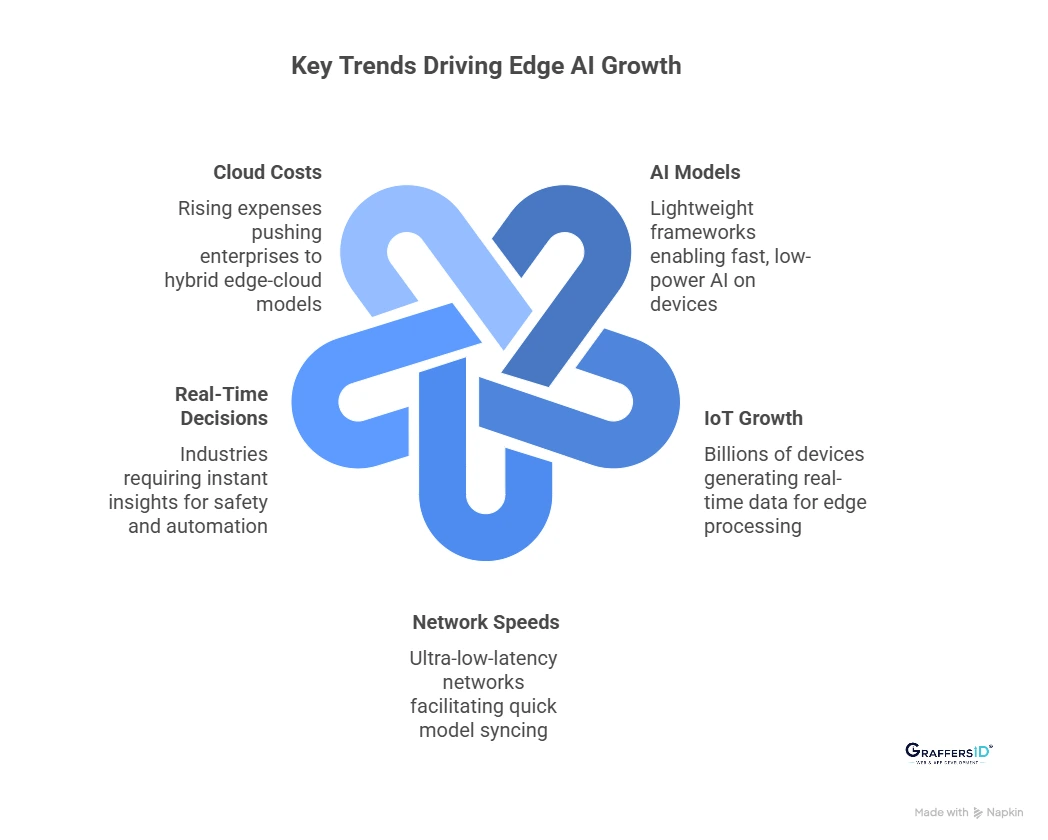
Edge AI adoption is accelerating in 2026 due to major shifts in AI models, IoT growth, network speeds, business demands, and rising cloud costs.
1. AI Models Are Smaller and Faster:
Lightweight frameworks like ONNX Runtime Mobile, TensorFlow Lite, and compact LLaMA variants allow advanced AI to run directly on edge devices with low power and high speed.
2. Massive Growth of IoT Devices:
Billions of sensors and IoT devices now generate real-time data, pushing enterprises to process information on-device instead of relying on slow, expensive cloud round-trips.
3. 5G and Early 6G Enable Distributed AI:
Ultra-low-latency networks make it possible for edge devices to sync models quickly and deliver real-time intelligence in high-demand environments.
4. Real-Time Decisions Are Now Mandatory:
Industries require instant insights for safety, automation, and competitive advantage, making edge-based processing essential for millisecond-level decisions.
5. Cloud Costs Are Increasing Rapidly:
Rising data transfer and inference expenses are pushing enterprises toward hybrid Edge+Cloud models that reduce costs while improving performance.
Top Business Benefits of Edge AI for Enterprises in 2026
Edge AI gives companies a clear competitive advantage by improving speed, reducing costs, strengthening data security, and boosting operational resilience.
1. Real-Time AI Decisions With Ultra-Low Latency:
Edge AI enables millisecond-level decision-making where delays directly impact revenue, safety, or customer experience.
Examples: autonomous vehicles, industrial robots, fraud detection, smart grids.
2. Significant Cost Reduction and Lower Cloud Dependency:
By processing data locally, enterprises cut cloud compute, storage, and bandwidth usage, reducing operating costs by 40–60% with an ROI in 12–18 months.
3. Better Data Privacy and Easy Compliance:
Sensitive data stays on-device, helping companies meet regulations like HIPAA, GDPR, and CCPA while reducing breach risks and building stronger customer trust.
4. High Reliability and Business Continuity:
Edge AI works offline or in low-connectivity environments, ensuring uninterrupted operations across factories, hospitals, logistics fleets, and remote locations.
5. More Efficient and Optimized Network Usage:
Only processed insights, not raw data, are sent to the cloud, reducing network congestion and enabling faster, cost-effective scaling.
Top Edge AI Use Cases in 2026
Edge AI adoption is growing fastest in sectors where real-time decisions directly affect revenue, safety, or user experience. Below are the most impactful enterprise use cases in 2026.

1. Edge AI in Education
-
AI-enabled smart classrooms deliver real-time personalization without sending sensitive student data to the cloud.
-
On-device learning analytics track progress instantly and support teachers with real-time insights.
Impact: Better learning outcomes + improved data privacy.
2. Edge AI in Healthcare
-
Smart medical devices and wearables analyze vitals on-device, enabling continuous, real-time monitoring.
-
Point-of-care diagnostics deliver instant detection for emergencies and critical care.
Impact: Faster diagnosis, reduced errors, and improved patient outcomes.
3. Edge AI in Fintech
-
Real-time fraud detection at the edge blocks suspicious transactions instantly.
-
On-device biometric verification improves security without latency.
Impact: Lower fraud losses + instant, smooth user experience.
4. Edge AI in Marketing
-
In-store digital signage shows personalized ads based on real-time customer behavior.
-
On-device user analytics deliver hyper-personalized experiences without exposing private data.
Impact: Higher engagement + better ROI from targeted campaigns.
5. Edge AI in Retail
-
Autonomous checkout systems enable “walk-in, walk-out” shopping with on-device vision.
-
Smart shelves and sensors track inventory instantly and prevent stockouts.
Impact: 15–25% higher conversions + reduced operational costs.
Edge AI vs Cloud AI in 2026: Why Enterprises Need a Hybrid Approach
In 2026, high-performing enterprise AI systems no longer rely on Edge or Cloud alone. The most scalable architectures use a hybrid Edge-Cloud model, combining instant on-device intelligence with powerful cloud computing for training and optimization.
What Edge AI Handles (On-Device Intelligence)
-
Real-time decisions: Edge devices process data instantly without waiting for cloud response.
-
Local inference: AI models run directly on devices for ultra-low latency and uninterrupted performance.
-
Privacy-first processing: Sensitive data stays on the device, reducing risk and ensuring compliance.
What Cloud AI Handles (Centralized Intelligence)
-
Model training: The cloud provides the computing power needed to train large, complex models.
-
Long-term analytics: Centralized platforms store and analyze historical data for deeper insights.
-
Scalable storage: Enterprises can easily manage large datasets and maintain full data history.
Edge AI vs Cloud AI: Key Differences Explained (2026)
| Cloud AI | Edge AI |
|---|---|
| Centralized, high-performance compute in the cloud | Local, distributed compute on devices |
| Requires constant internet connectivity | Works offline or with intermittent connectivity |
| Higher latency due to data traveling to the cloud | Ultra-low latency (milliseconds) with on-device processing |
| Higher ongoing cloud usage and bandwidth costs | Lower long-term cost due to reduced cloud dependency |
How the Hybrid Edge-Cloud Workflow Operates?
-
Train models in the cloud: High-compute GPUs train advanced, high-accuracy AI models.
-
Deploy lightweight versions to the edge: Optimized, compressed models are pushed to edge devices.
-
Edge performs real-time inference: Devices process data instantly for immediate actions.
-
Cloud receives refined insights: Aggregated outputs sync back to the cloud for analysis.
-
Continuous updates pushed to edge: The cloud keeps edge models updated with the latest improvements.
This hybrid model ensures speed, accuracy, security, and enterprise-wide scalability, making it the default architecture for AI-driven businesses in 2026.
Common Challenges in Edge AI Deployment in 2026 & How Enterprises Overcome Them?
As more companies adopt real-time, on-device intelligence, leaders face technical, organizational, and security hurdles that can slow down Edge AI deployment. Here are the most common challenges and how modern teams navigate them:
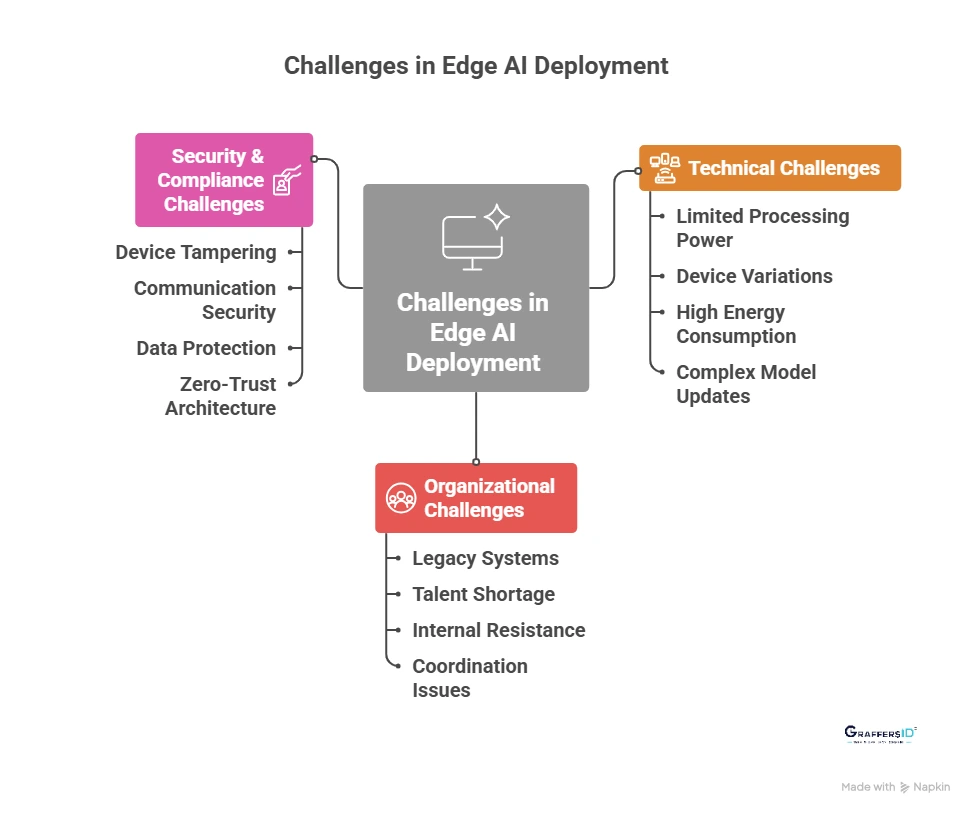
1. Technical Challenges
-
Limited processing power on edge devices: Many devices cannot run large AI models, forcing companies to use model compression and lightweight architectures.
-
Device and hardware variations: Different chips, OS versions, and capabilities make it hard to maintain consistent AI performance across all endpoints.
-
High energy consumption: Running continuous AI inference drains batteries quickly, making energy-efficient model design essential.
-
Complex distributed model updates: Updating and synchronizing AI models across thousands of edge devices requires automated, secure rollout systems.
2. Organizational Challenges
-
Legacy systems that slow adoption: Older infrastructure often lacks support for real-time AI processing, requiring phased modernization or hybrid architecture.
-
Shortage of Edge AI-skilled talent: Most teams lack specialists who can build, optimize, and deploy AI models on edge hardware.
-
Internal resistance to AI-driven workflows: Shifting from cloud-first to edge-first operations requires structured change management and stakeholder alignment.
-
Lack of cross-functional coordination: Engineering, security, and operations teams must work closely, which can be difficult without clear ownership.
3. Security & Compliance Challenges
-
Risk of physical device tampering: Edge devices deployed in the field are vulnerable to physical attacks, requiring tamper-resistant hardware.
-
Securing edge-to-cloud communication: Companies must encrypt all data transfers to prevent exposure during model updates or sync operations.
-
Managing local data protection: Since data stays on-device, enterprises must enforce strict local storage, access, and retention policies.
-
Implementing zero-trust architecture: A zero-trust framework is crucial to authenticate every device and connection in a distributed Edge AI environment.

Conclusion: Why Edge AI Is a Must-Have for Enterprises in 2026
Edge AI has officially moved from experimental to essential. In 2026, enterprises that process data where it is created gain faster decisions, lower cloud dependency, stronger data privacy, and operational resilience that cloud-only systems cannot match. With industries shifting toward distributed, real-time AI architectures, the organizations that adopt Edge AI early will secure a lasting competitive advantage.
Whether you are modernizing legacy systems, scaling intelligent devices, or building industry-specific AI solutions, the path forward is clear: Edge AI is a strategic priority for every CTO, CEO, and product leader aiming to stay ahead in 2026 and beyond.
GraffersID helps enterprises build, deploy, and scale production-ready AI, covering expert engineering, custom AI development, product integration, and dedicated remote AI teams.
Looking to hire top AI developers or build powerful AI solutions? Connect with GraffersID today and accelerate your AI journey.