In 2026, the most successful businesses don’t just analyze data; they anticipate what’s coming next.
Markets shift faster, customer behavior changes in real time, and operational risks emerge without warning. In this environment, relying on intuition or backward-looking reports is no longer enough. This is where predictive AI becomes a critical advantage.
By analyzing historical and real-time data, predictive AI helps organizations forecast demand, predict system failures, identify high-value customers, and uncover risks before they impact the business. As a result, CTOs, CEOs, and product leaders are using predictive AI to answer one essential question:
What is most likely to happen next, and how can we act on it today?
Unlike traditional analytics that focus on past performance, predictive AI enables forward-looking, data-driven decision-making. It allows teams to move from reactive problem-solving to proactive planning, improving efficiency, reducing uncertainty, and driving sustainable growth.
In this guide, you’ll learn:
-
What Predictive AI is and how it works in simple terms
-
How modern businesses use Predictive AI across industries
-
Key benefits of Predictive AI for decision-makers
-
How organizations implement and scale Predictive AI systems in 2026
What is Predictive AI? Meaning and Definition Explained
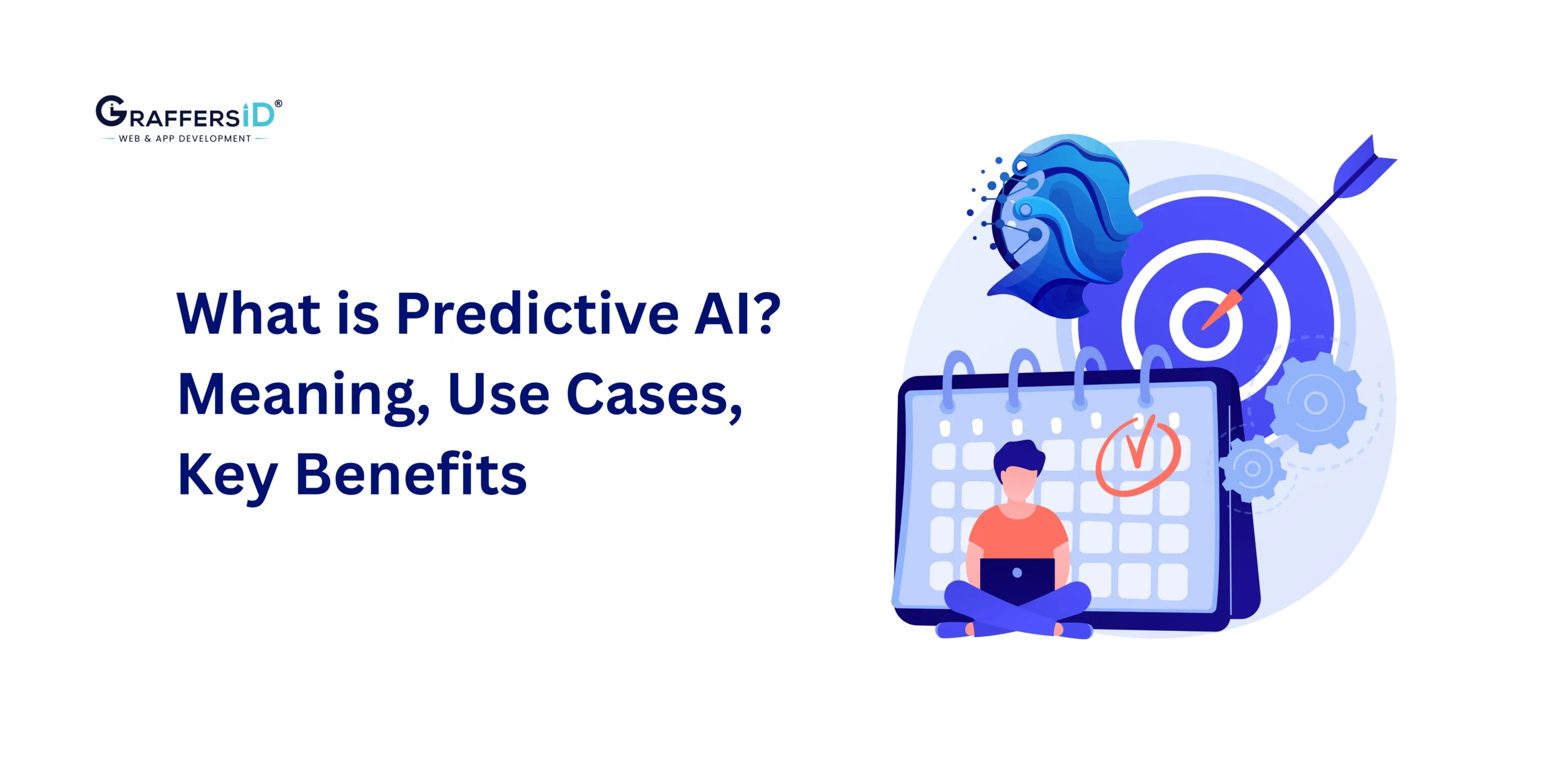
Predictive AI is a form of artificial intelligence that analyzes historical and real-time data to predict future outcomes with a high level of accuracy.
Instead of only reporting what has already happened, predictive AI focuses on identifying patterns, trends, and signals within data to forecast what is most likely to happen next.
It works by combining:
-
Machine learning algorithms that learn from past data
-
Statistical models that measure probabilities and trends
-
Pattern recognition techniques that detect hidden relationships in large datasets
In simple terms, predictive AI helps businesses move from reactive analysis to proactive decision-making, enabling leaders to plan ahead, reduce uncertainty, and make faster, data-backed decisions in an increasingly data-driven world.
Read More: What Is Artificial Intelligence in 2026? Definition, Types, Benefits & Real-World Use Cases
How Does Predictive AI Work? Step-by-Step Process in 2026
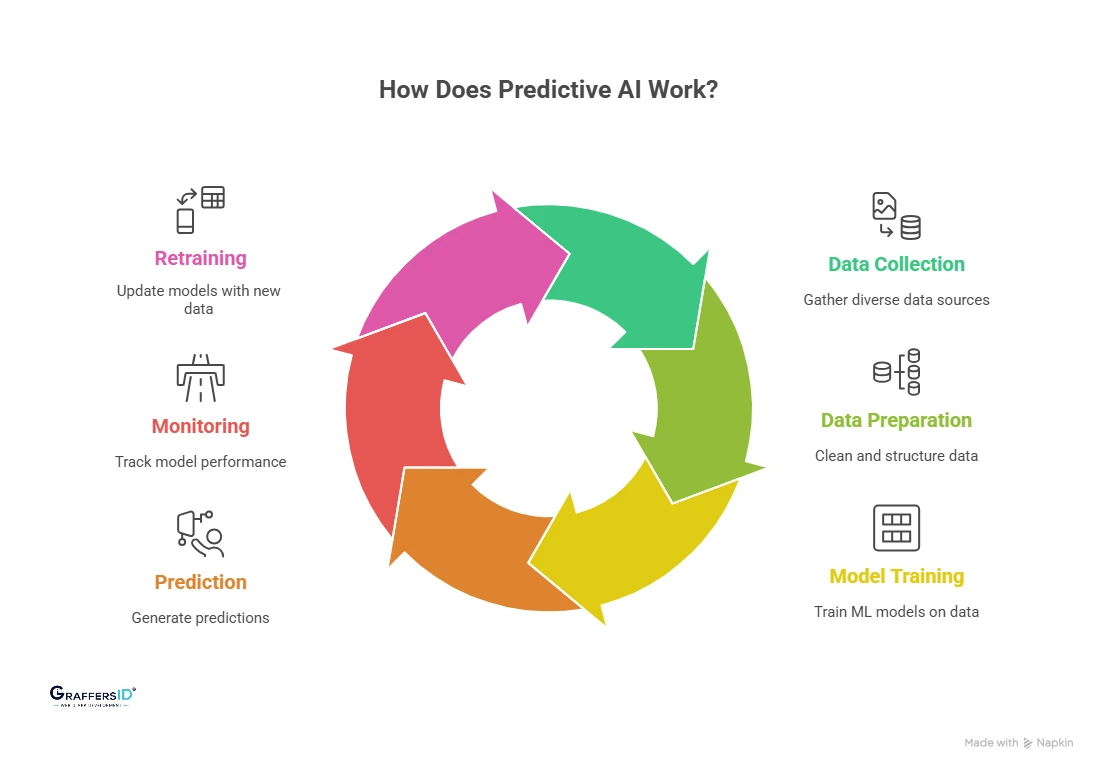
1. Data Collection and Preparation
Predictive AI starts with collecting large volumes of high-quality data from multiple sources, including:
-
Historical business data
-
Real-time user or system data
-
Structured data (databases, logs)
-
Unstructured data (text, images, behavior signals)
This data is cleaned, structured, and normalized to remove inconsistencies, reduce bias, and ensure reliable predictions.
2. Machine Learning Model Training
Once the data is prepared, machine learning models are trained to recognize patterns and trends within the data. Common models include:
-
Regression models
-
Decision trees and random forests
-
Neural networks
-
Time-series forecasting models
These models are trained to identify patterns and correlations that humans cannot easily detect.
3. Prediction, Monitoring, and Continuous Learning
Once deployed:
-
The model generates predictions in real time or batches
-
Performance is monitored continuously
-
Models are retrained as data changes
This ensures predictions remain relevant as business conditions evolve.
Key Components of a Predictive AI System in 2026
A modern predictive AI system is built on multiple interconnected components that work together to deliver accurate, real-time forecasts. In 2026, these components are designed to scale, adapt continuously, and integrate directly into business operations.
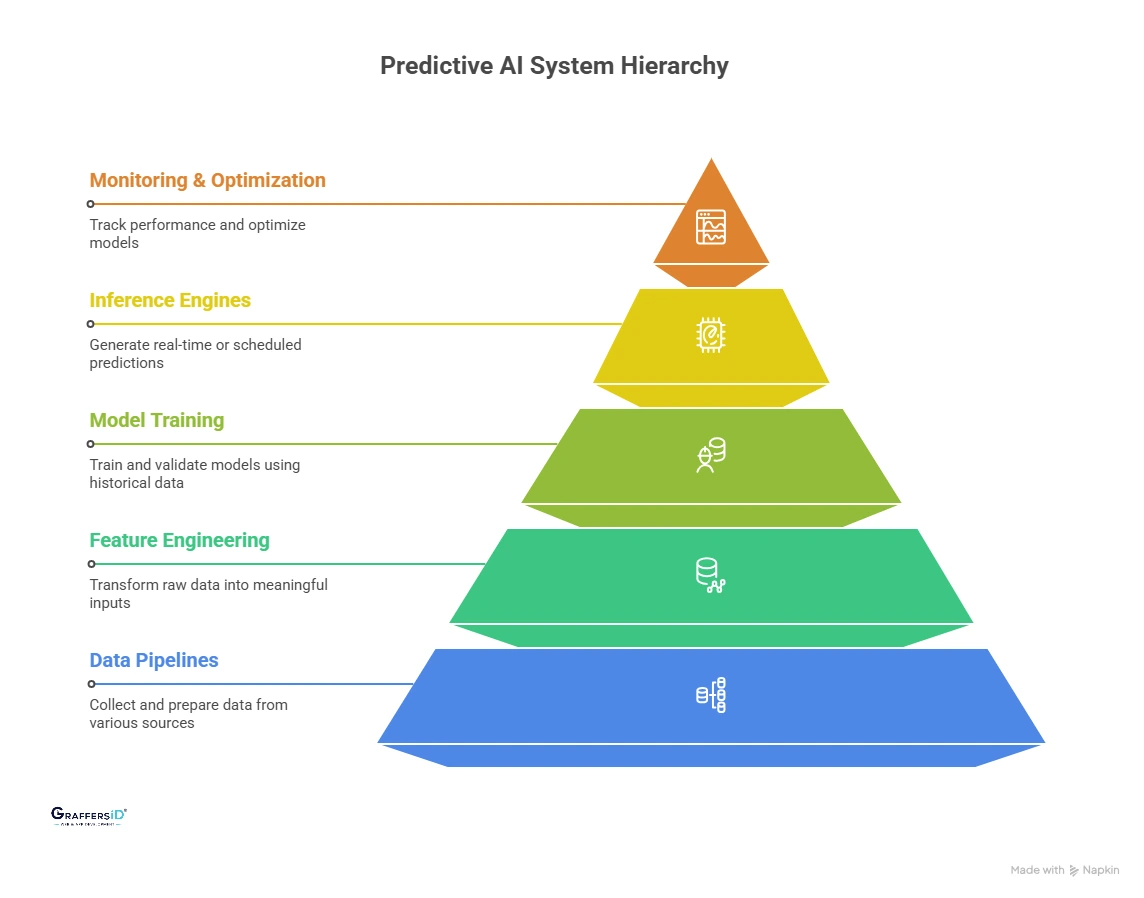
1. Data Ingestion and Preprocessing Pipelines
This layer collects data from multiple sources such as databases, APIs, applications, and IoT systems. The data is cleaned, standardized, and prepared to ensure consistency, accuracy, and reliability before it reaches the model.
2. Feature Engineering and Signal Extraction
Feature engineering transforms raw data into meaningful inputs for predictive models. This step identifies patterns, trends, and key variables that have the highest impact on prediction accuracy.
3. Model Training and Validation Frameworks
Predictive models are trained using historical data and tested against validation datasets to ensure accuracy and reliability. In 2026, continuous retraining helps models stay relevant as business conditions and data patterns change.
4. Prediction and Inference Engines
Inference engines generate predictions in real time or scheduled batches. These engines power use cases like demand forecasting, churn prediction, and risk detection directly within business applications.
5. Monitoring, Feedback, and Model Optimization
This component tracks model performance, detects accuracy drift, and feeds new data back into the system. Ongoing monitoring ensures predictions remain trustworthy, explainable, and aligned with business goals.
In 2026, predictive AI systems are no longer isolated tools; they are embedded into dashboards, products, and decision workflows, enabling teams to act on predictions instantly rather than interpret them later.
Predictive AI Use Cases in Real-World Business Applications in 2026
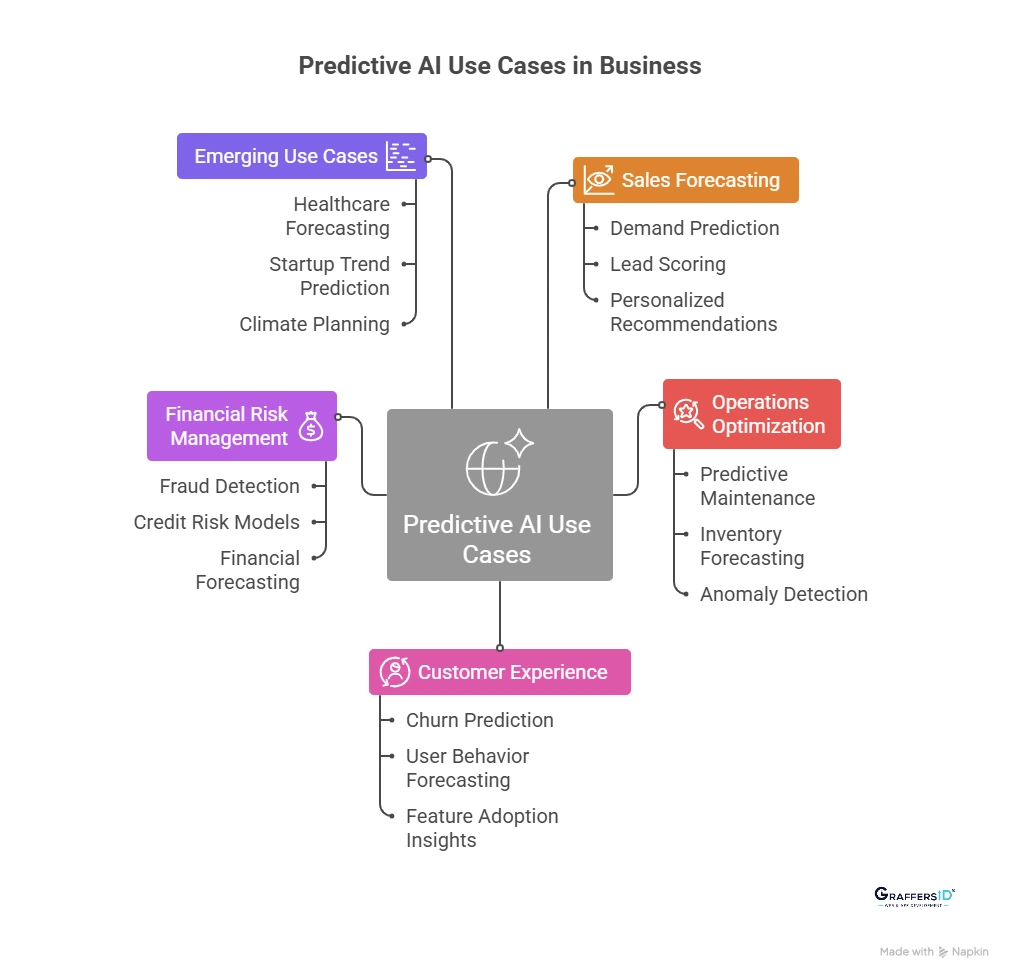
1. Sales Forecasting and Revenue Growth
-
Sales forecasting and demand prediction
-
Lead scoring and conversion probability modeling
-
Personalized product and pricing recommendations
Impact: Higher conversion rates, better pipeline visibility, and predictable revenue growth.
2. Operations Optimization and Risk Reduction
-
Predictive maintenance for manufacturing and logistics
-
Inventory forecasting and supply chain optimization
-
Anomaly detection in infrastructure and systems
Impact: Reduced downtime, lower operational costs, and improved reliability.
3. Customer Experience and Product Decisions
-
Customer churn prediction
-
User behavior and engagement forecasting
-
Feature adoption and product usage insights
Impact: Better retention, smarter product roadmaps, and improved user satisfaction.
4. Financial Risk and Compliance Management
-
Fraud detection and transaction risk scoring
-
Credit risk and underwriting models
-
Financial forecasting and budget planning
Impact: Reduced financial risk and improved compliance accuracy.
5. Emerging Predictive AI Use Cases Across Industries
-
Healthcare outcome and capacity forecasting
-
Startup and investment trend prediction
-
Climate, infrastructure, and public safety planning
Impact: Long-term planning with higher confidence and lower uncertainty.
Read More: Agentic AI vs. Generative AI: Key Differences CTOs Must Know in 2026
Benefits of Predictive AI for Business Growth in 2026
- Proactive and Data-Driven Decision-Making: Predictive AI enables leaders to anticipate outcomes and act early, replacing reactive decisions with forward-looking, data-backed strategies.
- Improved Operational Efficiency: By predicting demand, failures, and bottlenecks, Predictive AI helps automate workflows and optimize resources across operations.
- Reduced Business Risk and Uncertainty: Predictive models identify potential risks before they escalate, allowing businesses to mitigate issues related to finance, operations, and compliance.
- Personalization at Scale: Predictive AI allows companies to tailor experiences, recommendations, and pricing across products and services without increasing complexity.
- Faster and Smarter Strategic Planning: With accurate forecasts and scenario modeling, leadership teams can plan growth, investments, and product roadmaps with greater confidence.
Predictive AI Architecture: How Enterprise Systems Are Built in 2026?
A modern Predictive AI architecture is designed to handle large volumes of data, deliver accurate forecasts, and scale reliably across enterprise environments.
A scalable Predictive AI system typically includes the following core layers:
-
Data ingestion and preprocessing layer: Collects data from multiple sources such as databases, applications, IoT devices, and APIs, then cleans, normalizes, and prepares it for analysis.
-
Model training and evaluation pipelines: Uses machine learning frameworks to train predictive models, test their accuracy, reduce bias, and continuously improve performance as new data becomes available.
-
Real-time and batch prediction services: Delivers predictions either instantly (real time) or at scheduled intervals (batch), depending on business needs such as fraud detection, demand forecasting, or risk scoring.
-
Monitoring, governance, and optimization layer: Tracks model performance, ensures compliance, improves explainability, and retrains models to maintain accuracy and trust over time.
Together, these layers ensure that Predictive AI solutions remain reliable, transparent, and scalable, making them suitable for enterprise-wide decision-making in 2026.
How to Implement Predictive AI in Business? Step-by-Step 2026 Guide
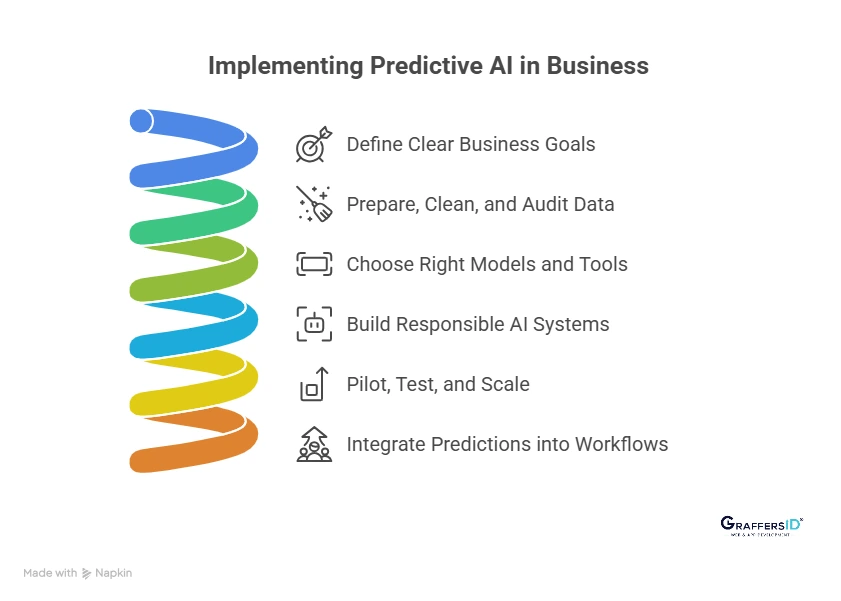
1. Define Clear Business Goals for Predictive AI
Start by identifying high-impact business decisions that benefit from prediction, such as demand forecasting, churn prevention, or risk detection. Predictive AI initiatives should always be driven by measurable business outcomes, not by technology experimentation alone.
2. Prepare, Clean, and Audit Your Data
Ensure your data is accurate, relevant, and well-governed before building models. This includes validating data sources, removing inconsistencies, addressing bias, and setting up data pipelines that support continuous updates.
Read More: 5 Best AI Frameworks and Libraries in 2026 Trusted by Leading Tech Companies
3. Choose the Right Predictive Models and Tools
Select algorithms, frameworks, and platforms based on your specific use case, data type, and scalability needs. In 2026, simplicity, interpretability, and maintainability often outperform overly complex models.
4. Build Responsible and Explainable AI Systems
Design Predictive AI pipelines with transparency, fairness, and compliance in mind from the start. Explainable models and audit-ready systems help build trust with stakeholders and meet evolving regulatory requirements.
5. Pilot, Test, and Scale Predictive AI Solutions
Deploy predictive models in controlled environments to validate accuracy and business impact. Use pilot results to fine-tune performance before scaling across teams, products, or regions.
6. Integrate Predictions into Daily Business Workflows
Embed predictive insights directly into dashboards, applications, and decision-making systems. The true value of Predictive AI comes when insights are accessible and actionable in real time.

Conclusion: Why Predictive AI is a Competitive Advantage in 2026
Predictive AI is no longer a future concept; it is a core capability for data-driven businesses in 2026. Organizations that use Predictive AI can anticipate outcomes, identify risks early, and make faster, more confident decisions in an increasingly complex and competitive environment.
By turning historical and real-time data into forward-looking insights, Predictive AI enables leaders to move beyond reactive decision-making. It helps businesses optimize operations, improve customer experiences, and plan growth with greater accuracy and resilience.
For CTOs, CEOs, and product leaders, the key question is no longer whether Predictive AI should be adopted, but how quickly it can be implemented responsibly, securely, and at scale to deliver measurable business impact.
At GraffersID, we help companies future-proof their products by delivering:
-
Custom web and app development tailored to AI-driven use cases
-
AI and automation solutions aligned with real business goals
-
Experienced AI developers and remote tech teams ready to scale with your vision
Looking to build or scale AI into your product or operations?
Contact GraffersID to hire AI developers and build intelligent, future-ready solutions that drive long-term growth.