Over the past decade, most companies experimented with automation tools, chatbots, and AI assistants. These systems helped teams save time, but they still required constant instructions from humans.
What’s changing in 2026 is something bigger. AI systems are evolving from tools that respond to prompts into agents that can plan, act, and complete tasks independently.
Instead of asking AI to generate a report or write code, companies are beginning to deploy AI that can:
- gather data from multiple systems
- analyze patterns
- decide what action to take
- execute workflows automatically
In other words, AI is shifting from task automation to workflow automation. For CTOs, product leaders, and founders, this shift opens a new category of technology: autonomous AI agents.
These systems are already appearing in areas like customer support, software development, analytics, and operations. Organizations that understand how they work and where they actually deliver value are gaining early operational advantages.
In this guide, we’ll break down what autonomous AI agents are, how they work, where businesses are using them, and how companies can start adopting them responsibly.
What are Autonomous AI Agents?
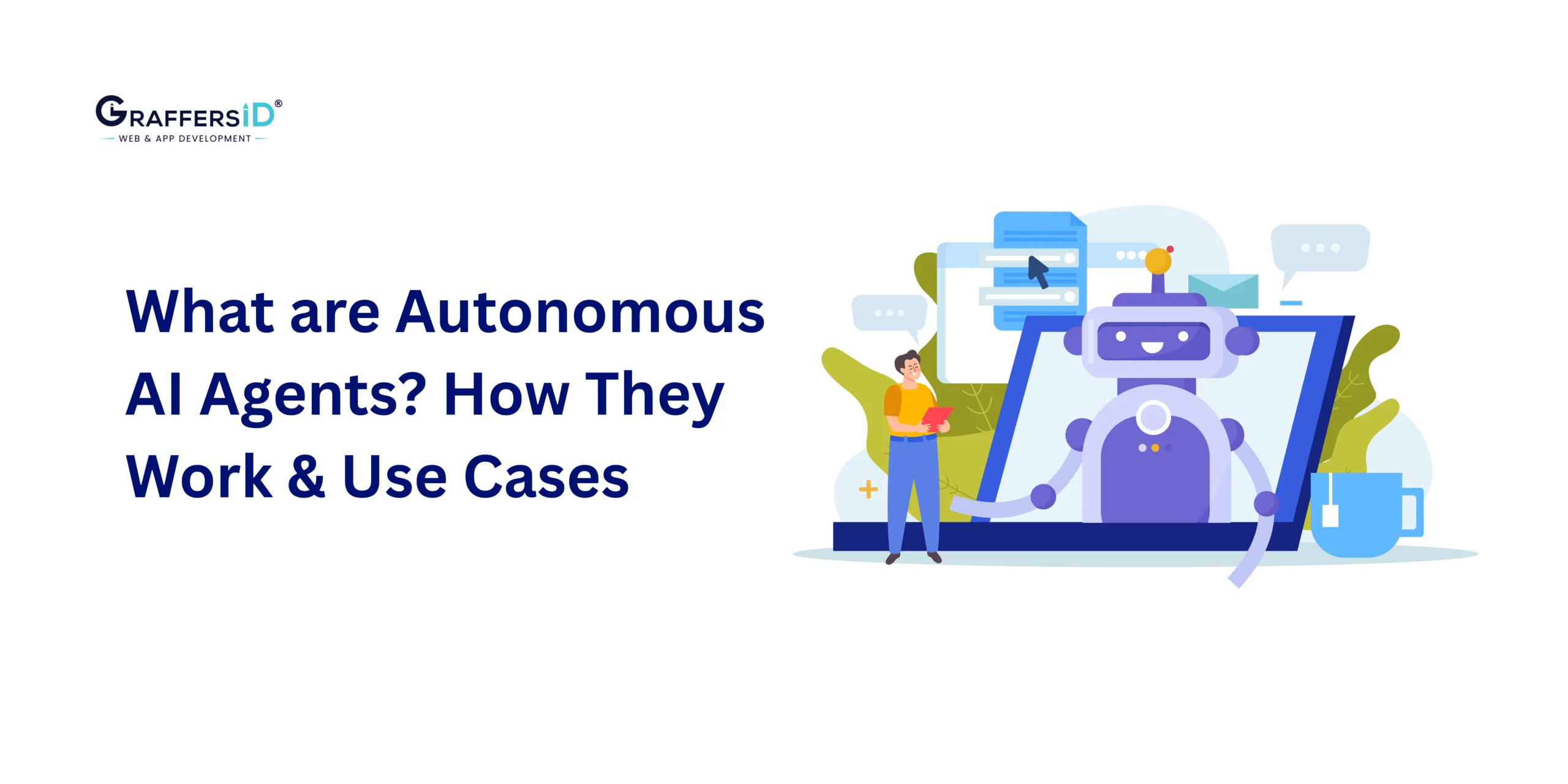
Autonomous AI agents are AI-powered software systems that can understand goals, make decisions, and complete tasks independently without needing constant human instructions.
Unlike traditional AI systems that only respond to prompts, autonomous agents are designed to plan, act, and execute workflows on their own. They can analyze situations, choose the next step, and interact with different systems to complete an objective.
In simple terms, these systems move AI from assisting with tasks to actually performing work across multiple steps of a process.
Key Characteristics of Autonomous AI Agents in 2026
Most enterprise-grade autonomous AI agents share a few core capabilities that allow them to operate independently and manage complex workflows. These capabilities distinguish them from traditional automation tools or basic AI assistants.
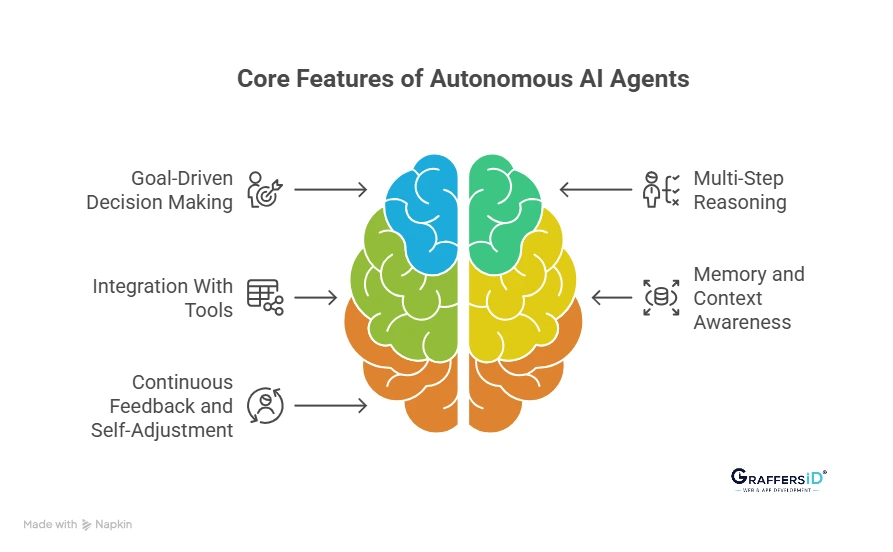
1. Goal-Driven Decision Making
Autonomous agents work toward a defined objective rather than reacting to isolated prompts. Once given a goal, the system determines the steps required to achieve it and continues working until the objective is completed or refined.
2. Multi-Step Reasoning
Instead of executing a single command, AI agents can break complex goals into smaller tasks and execute them in sequence. This allows them to handle processes that involve multiple steps, dependencies, or decisions.
3. Integration With Tools and Business Systems
Autonomous agents interact with external systems to perform real work. They typically connect with:
- APIs and external services
- internal databases and data warehouses
- SaaS platforms such as CRM or project tools
- enterprise software systems
These integrations enable the agent to gather data, trigger actions, and update systems automatically.
4. Memory and Context Awareness
Unlike simple AI assistants, autonomous agents can retain context across multiple tasks and workflows. This memory helps them track progress, recall previous interactions, and make better decisions over time.
5. Continuous Feedback and Self-Adjustment
Most autonomous agents operate within a feedback loop where they evaluate results after completing tasks. If the outcome is incomplete or incorrect, the agent adjusts its strategy and continues working toward the goal.
Read More: AI Assistants vs. AI Agents (2026): Key Differences, Features, and Use Cases Explained
Key Benefits of Autonomous AI Agents for Businesses in 2026
When implemented correctly, autonomous agents deliver several strategic advantages.
- End-to-End Workflow Automation: Instead of automating isolated tasks, companies can automate entire processes. This significantly reduces operational overhead.
- Faster Decision Making: Agents analyze large datasets quickly and deliver insights faster than manual workflows.
- Continuous Operations: AI agents operate 24/7 without interruptions, enabling faster response times and improved productivity.
- Scalability: Organizations can deploy multiple agents simultaneously across different departments. This allows teams to scale operations without increasing headcount.
- Cost Efficiency: Reducing repetitive tasks lowers operational costs while allowing employees to focus on strategic work.
How Do Autonomous AI Agents Work?
Autonomous AI agents operate through a continuous decision-making loop that allows them to understand goals, plan actions, execute tasks, and improve results over time.
This loop enables agents to function independently while adapting to new data, changing conditions, and evolving workflows. Below is the core process most autonomous AI agents follow.
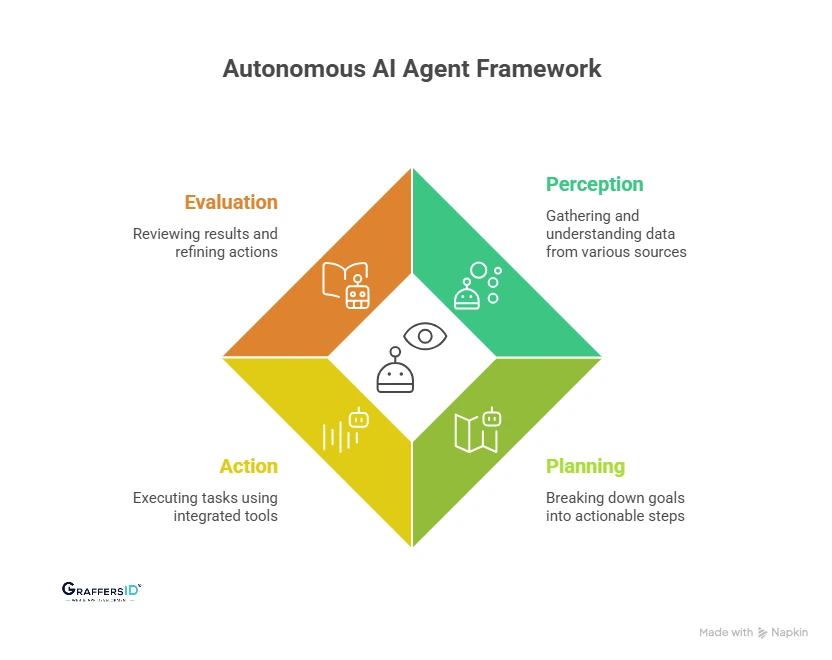
1. Perception: Gathering Data From Multiple Sources
The first step is collecting and understanding information from the environment. Agents gather data from different systems to build context before taking action. Common data sources include:
- internal databases and company tools
- APIs and third-party platforms
- documents and knowledge bases
- user instructions or prompts
This stage helps the agent understand what is happening and what goal needs to be achieved.
2. Planning: Breaking the Goal Into Actionable Steps
Once the agent understands the objective, it creates a structured plan to accomplish it. Instead of performing a single task, the agent divides the goal into smaller steps and determines the best sequence for completing them. Example workflow:
Goal: Generate a market research report. Possible plan:
- gather industry and competitor data
- analyze trends and performance metrics
- summarize key insights
- generate a structured report
This planning capability allows agents to handle complex workflows rather than isolated tasks.
3. Action: Executing Tasks Using Tools and Integrations
After creating a plan, the agent begins executing tasks using connected tools, software systems, and APIs. Typical actions may include:
- querying databases or retrieving information
- sending emails or notifications
- generating code or documents
- updating CRM records or dashboards
Because agents are integrated with multiple systems, they can perform real work across business applications.
4. Evaluation: Reviewing Results and Improving the Outcome
Once actions are completed, the agent evaluates the results to determine whether the goal has been achieved. If the outcome is incomplete or inaccurate, the agent can:
- revise the plan
- gather additional data
- repeat specific tasks
This evaluation stage ensures the system continuously refines its actions and improves results over time.
Read More: Agentic AI vs. AI Agents: Key Differences, Real-World Examples, and Business Use Cases (2026 Guide)
Continuous Agent Loop
The full process typically runs as a repeating cycle:
Perception → Planning → Action → Evaluation
This loop allows autonomous AI agents to operate with minimal human intervention while continuously adapting to new information and changing conditions.
Core Components of an Autonomous AI Agent in 2026
To operate reliably, autonomous AI agents are built on multiple technical layers that work together. Each component plays a specific role in helping the agent understand goals, make decisions, and execute tasks across systems.
Below are the core components that power most enterprise AI agents.
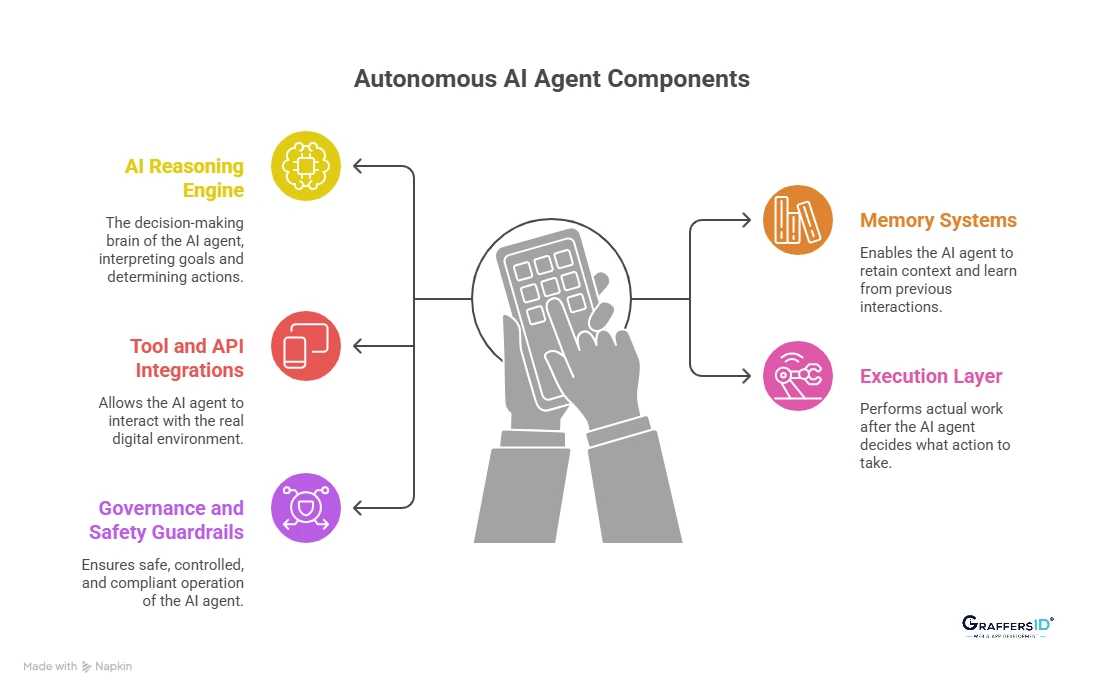
1. AI Reasoning Engine
The reasoning engine acts as the decision-making brain of the AI agent. It is usually powered by large language models (LLMs) or other AI decision systems. This component allows the agent to:
- interpret goals and instructions
- analyze context from available data
- determine the most appropriate next action
Without a reasoning engine, the system cannot independently plan or adapt its workflow.
2. Memory Systems
Memory enables an AI agent to retain context and learn from previous interactions. This allows the system to make better decisions over time. Most agents use two types of agent memory:
- Short-term memory: Maintains context during an active task or workflow.
- Long-term memory: Stores historical data, knowledge, and past results.
Together, these memory layers help agents maintain continuity across complex processes.
3. Tool and API Integrations
Autonomous agents rely on integrations to interact with the real digital environment. These connections allow them to retrieve data and perform actions across different systems. Common integrations include:
- CRM platforms
- internal databases
- communication tools
- analytics and reporting systems
Without access to external tools, an AI agent would only generate responses rather than execute meaningful tasks.
4. Execution Layer
The execution layer is where the AI agent performs actual work after deciding what action to take. Typical actions include:
- sending emails or notifications
- updating internal systems or databases
- generating reports or documents
- executing scripts or code
This layer transforms AI decisions into real operational outcomes.
5. Governance and Safety Guardrails
Enterprise-grade AI agents require governance mechanisms to ensure safe, controlled, and compliant operation. Common safeguards include:
- role-based permission controls
- human approval checkpoints for critical actions
- monitoring and logging systems
- security and compliance policies
These guardrails help organizations deploy autonomous agents responsibly while minimizing operational risks.
Types of Autonomous AI Agents Are Businesses Using in 2026
Not all autonomous AI agents work the same way. Businesses typically deploy different types of agents depending on the complexity of the task, level of autonomy required, and the systems they need to interact with.
Below are some of the most common types of autonomous agents organizations are using today.
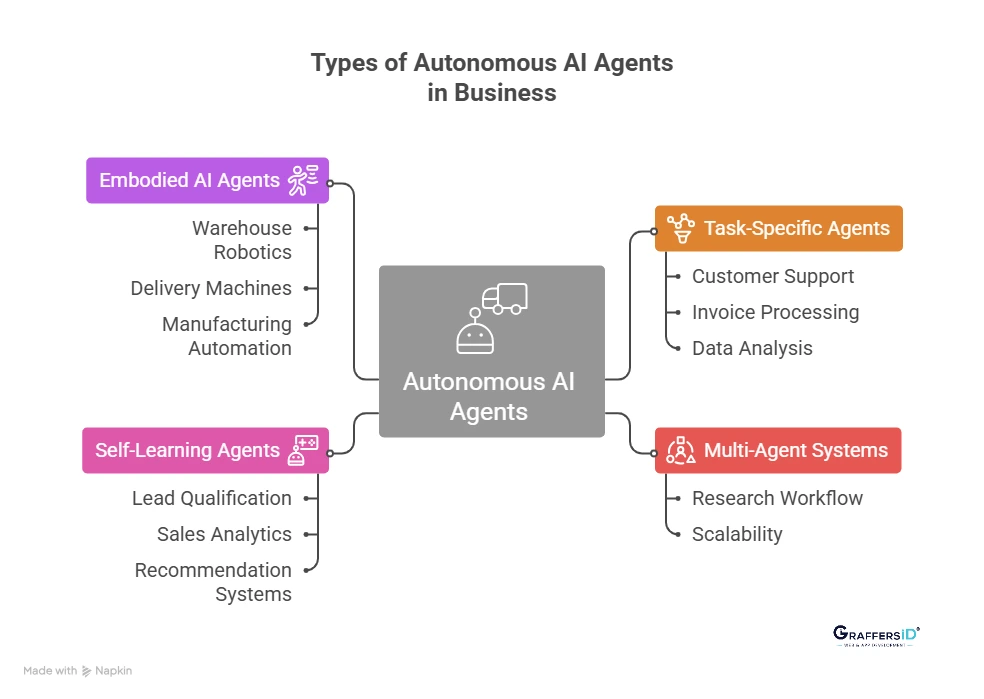
1. Task-Specific Autonomous Agents
Task-specific agents are designed to handle a single workflow or operational task independently. They are often the easiest entry point for companies experimenting with autonomous AI because they focus on a clearly defined process. Common examples include:
- customer support ticket resolution
- invoice and billing processing
- automated data analysis and reporting
Because these agents operate within a narrow scope, they are easier to implement, monitor, and scale within existing business systems.
2. Multi-Agent Systems
Multi-agent systems involve multiple specialized AI agents collaborating to complete complex workflows. Each agent performs a specific function, allowing the system to break large tasks into manageable components. For example, in a research workflow:
- A research agent gathers data from multiple sources
- An analysis agent interprets and processes the information
- A reporting agent generates summaries or presentations
This approach improves scalability and enables organizations to automate multi-step business processes more effectively.
3. Self-Learning Autonomous Agents
Self-learning agents improve their performance over time by learning from feedback, data patterns, and previous outcomes. Instead of following static rules, they adapt their decision-making as they process more information.
For instance, a lead qualification agent used by sales teams may gradually refine its scoring model as it analyzes more customer interactions and conversion data.
These agents are particularly useful in areas where patterns evolve and decisions must continuously improve, such as sales, marketing analytics, and recommendation systems.
4. Embodied AI Agents
Embodied agents operate in physical environments rather than purely digital systems. These agents combine AI decision-making with robotics or hardware systems to perform real-world tasks. Common examples include:
- warehouse robotics systems
- autonomous delivery machines
- manufacturing automation robots
While still evolving, embodied agents are becoming increasingly important in industries like logistics, manufacturing, and supply chain operations, where automation can significantly improve efficiency and safety.
Read More: Best Automation Software in 2026: Top Platforms to Streamline Workflows & Boost Efficiency
Use Cases of Autonomous AI Agents in 2026
Autonomous AI agents are moving beyond experimentation and are now being used to automate real business workflows. Companies across industries are deploying these systems to reduce manual work, improve decision speed, and operate more efficiently.
1. Customer Support Automation
Autonomous AI agents can manage a large portion of incoming support requests without human intervention. They retrieve customer history, resolve common issues, and escalate complex problems to human agents when needed.
- access customer records and past conversations
- answer frequently asked questions or troubleshoot issues
- route complex cases to the appropriate support team
This allows support teams to focus on complex customer interactions rather than repetitive queries.
2. Sales Research and Lead Qualification
Sales teams often spend significant time researching prospects before outreach. Autonomous agents can automate much of this process by gathering company insights and evaluating lead potential.
- collect company and industry data from multiple sources
- analyze prospects based on predefined sales criteria
- draft personalized outreach messages or summaries for sales teams
This reduces manual research time and helps sales teams focus on closing deals instead of data gathering.
3. Software Development and Engineering Workflows
AI agents are increasingly assisting engineering teams by automating parts of the development lifecycle. These agents can support developers by handling repetitive technical tasks and improving development speed.
- generate code snippets based on requirements
- run automated tests and identify potential bugs
- assist with debugging and technical documentation
For engineering teams, this leads to faster iteration cycles and reduced development overhead.
4. Data Analytics and Automated Reporting
Many organizations struggle with delayed insights because analysts must manually gather and process data from multiple systems. Autonomous agents can automate this entire process.
- collect data from internal databases, APIs, and dashboards
- analyze trends or performance metrics
- generate reports, dashboards, or summaries for stakeholders
This transforms analytics into a continuous and automated decision-support system.
5. Operations and Internal Workflow Automation
Operations teams are using autonomous AI agents to manage complex internal processes that involve multiple systems and approvals.
- track inventory levels and supply chain updates
- monitor operational metrics in real time
- automate workflow approvals and internal task coordination
These agents reduce manual coordination and help organizations run smoother, more efficient operations.
Difference Between AI Assistants, AI Agents, and Autonomous AI Agents
Understanding these differences helps businesses choose the right level of AI automation. The easiest way to think about it is how much independence the AI system has while completing tasks.
| AI Type | What It Does | Independence | Example |
|---|---|---|---|
| AI Assistants | Answers questions and helps with simple tasks when prompted | Low | Chatbots, writing assistants |
| AI Agents | Performs specific tasks using tools or integrations | Medium | Sending emails, retrieving data |
| Autonomous AI Agents | Plans and executes multi-step workflows on its own | High | Automated sales research or reporting agent |
| Agentic AI Systems | Multiple AI agents collaborate to complete complex goals | Very High | Multi-agent enterprise automation systems |
This progression shows how AI is evolving from basic assistance to fully automated, intelligent business operations.
How Can Businesses Start Using Autonomous AI Agents?
Adopting autonomous AI agents does not require a complete transformation of your organization. Most companies begin with small, practical implementations, test the impact, and gradually scale successful use cases across teams.
1. Identify Workflows That Are Easy to Automate
Start by identifying processes that are repetitive, data-driven, and consume significant manual effort. Common starting points include report generation, customer support triage, sales research, and internal operational tasks where AI agents can reduce routine workload.
2. Start With Small, Low-Risk Pilot Projects
Instead of deploying agents across the organization immediately, launch controlled pilot projects in a single workflow or department. This allows teams to evaluate accuracy, reliability, and operational impact before expanding the system further.
3. Connect AI Agents With Your Existing Tools
Autonomous agents become valuable when they can interact with the tools your teams already use. Integrating agents with systems such as CRM platforms, analytics tools, internal databases, and communication platforms enables them to perform meaningful actions rather than just generate outputs.
Read More: AI Agent vs. Chatbot: Key Differences, Use Cases & Future of Intelligent CX (2026)
4. Set Up Governance, Security, and Monitoring
Before scaling AI agents, businesses should establish clear guardrails. This typically includes access permissions, monitoring dashboards, human approval checkpoints, and security controls to ensure agents operate safely within company policies.
5. Expand to Multi-Agent Systems for Larger Workflows
Once early pilots prove successful, organizations can move toward multi-agent architectures, where specialized agents collaborate to complete complex workflows. This approach allows businesses to automate larger processes while maintaining reliability and scalability.

Conclusion: Why Autonomous AI Agents Are the Next Evolution of Business Automation
Autonomous AI agents represent a significant shift in how organizations approach automation and digital operations. For years, businesses relied on tools that could automate individual tasks or respond to prompts. Autonomous agents go a step further. They can understand goals, plan workflows, make decisions, and execute actions across multiple systems with minimal human input.
This shift moves organizations from task-level automation to workflow-level intelligence. For CTOs, founders, and product leaders, the real opportunity is not simply adopting AI, but identifying where autonomous agents can create measurable operational value.
However, successful adoption requires a balanced approach. Businesses that start with clear use cases, controlled pilots, and proper governance frameworks are far more likely to unlock sustainable benefits from AI agents.
At GraffersID, we help startups and growing companies build scalable digital products, from AI-powered applications and intelligent automation systems to modern web and mobile platforms.
Hire expert AI developers to build the right solution with experienced developers and AI engineers.