Quick Takeaways
- AI agents now handle sourcing, screening, and scheduling autonomously, cutting time-to-hire by up to 50% for startups using them correctly.
- 52% of talent leaders plan to deploy autonomous AI hiring agents in 2026, a sharp jump from experimental pilots just two years ago.
- AI sourcing tools expand candidate pools by an average of 340%, but human judgment remains essential for final fit decisions.
- Startups that pair AI-assisted screening with staff augmentation close critical developer roles weeks faster than those relying on traditional job boards alone.
The average time-to-fill a developer role sits at 44 days. For a startup running lean with a funding runway that has a hard stop, that is not a process inefficiency. It is a product roadblock.
AI agents are being positioned as the fix, and in some real, measurable ways, they are delivering. But the picture is messier than the vendor decks suggest. Most startups do not know which parts of the pipeline AI can actually own, which parts still need a human in the loop, and where the two approaches fit together.
Here is what is actually changing in how startups find and hire developers in 2026, and what it means for the decisions you are making this quarter.
What AI Agents Actually Do in the Hiring Pipeline Now
There is a meaningful difference between the AI tools most recruiters used two or three years ago and what is now being called an AI agent. Earlier tools were reactive. You uploaded a job description, they scored resumes, you reviewed the output. A human had to prompt every step.
AI agents in hiring operate differently. They monitor the pipeline, identify gaps, and act without waiting for a prompt at each stage. If a role is moving slower than expected, an agent can automatically re-engage strong candidates from a previous search, recommend new sourcing channels, and sequence follow-up messages without anyone clicking a button.
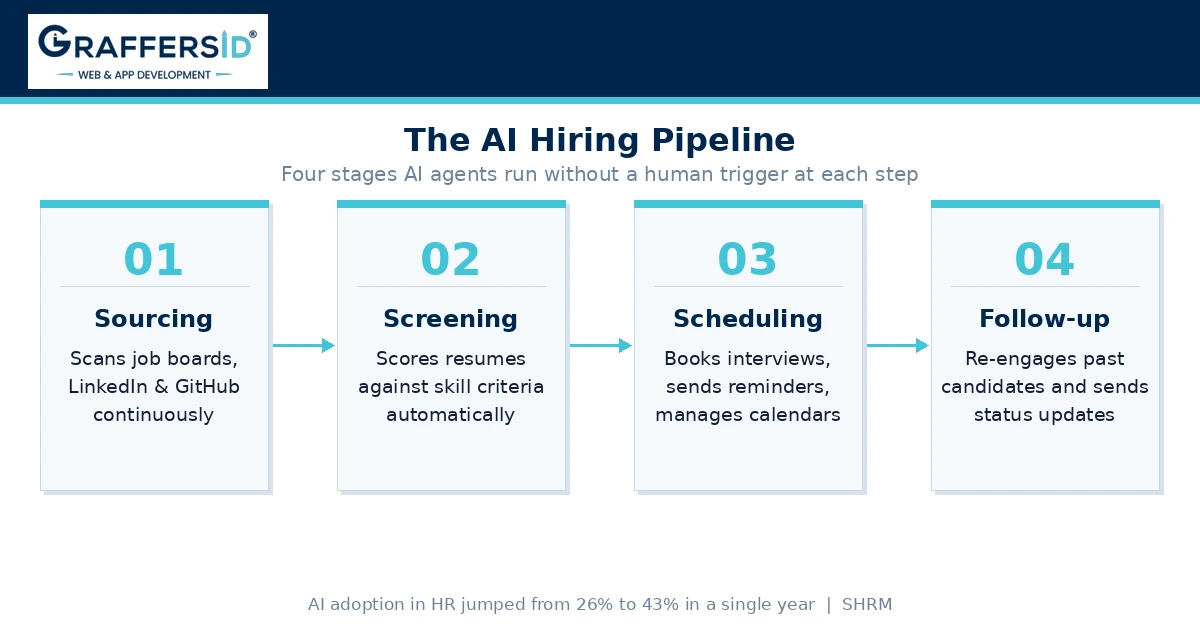
AI use across HR tasks jumped from 26% in 2024 to 43% in 2026, according to SHRM. That is not the kind of gradual adoption curve that takes years to compound. That is a step-change, and it happened in a single year.
The Four Pipeline Stages AI Agents Run Today
The four pipeline stages where AI agents are operating most visibly right now are sourcing, screening, interview scheduling, and candidate follow-up.
Sourcing agents run continuously rather than on demand. They scan job boards, GitHub activity, and professional networks in parallel, generating candidate lists that would take a recruiter several days to compile manually. Screening agents evaluate profiles against a defined criteria set and flag the top matches, often cutting resume review time from around ten days down to a matter of hours. Scheduling agents handle calendar coordination and reminders. Follow-up agents re-engage cold candidates and send status updates without recruiter involvement.
If you want a clear breakdown of how to find and work with pre-vetted developers who are already AI-workflow ready, the hire AI developers page covers what that process looks like in practice.
Read Also: Agentic AI vs. AI Agents: Key Differences, Real-World Examples, and Business Use Cases
What Does This Mean for Startups Hiring Developers?
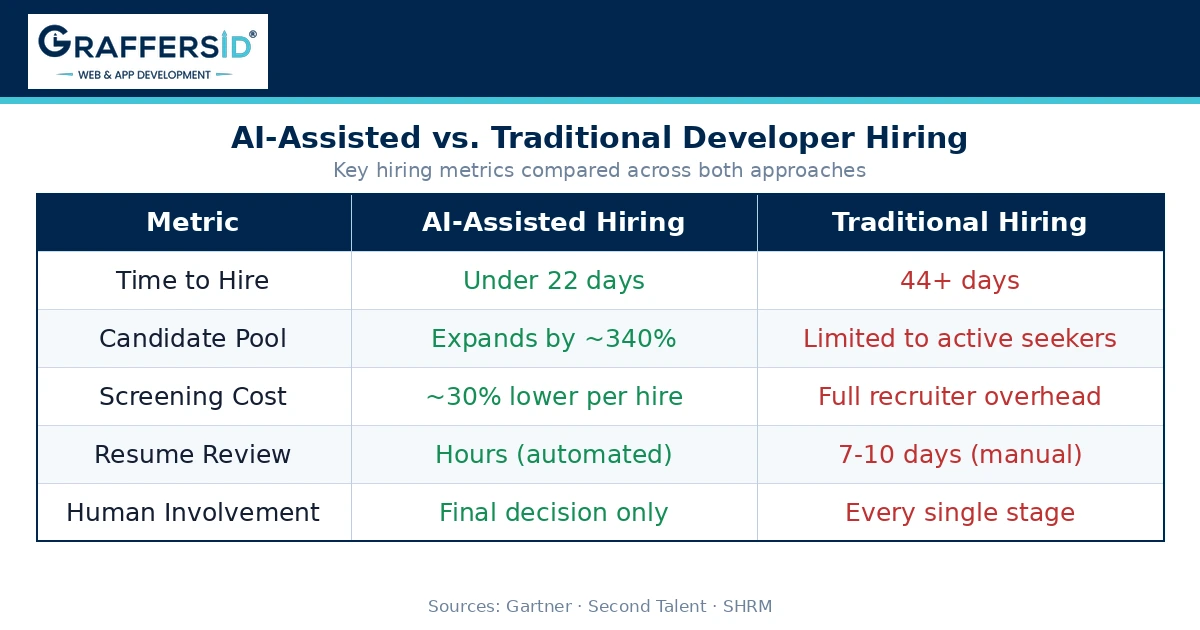
The numbers that matter most here are not the adoption percentages. They are the speed and cost figures, because those are what move the needle when you are trying to ship.
Speed and Candidate Pool Expansion
Companies using AI agents in sourcing and screening report 30 to 50% faster time-to-hire. At the sourcing stage specifically, AI tools are expanding candidate pools by an average of 340% while reducing sourcing time by 67%, based on data from Second Talent’s 2025 research. That is not a marginal improvement. It means a startup that was previously reviewing 40 candidates might now have 180 to work from, with the irrelevant ones already filtered out before a human looks at any of them.
On cost, the picture is similarly clear. The average cost-per-hire in the US reached approximately $4,700 in 2025 according to Gartner estimates. A 30% reduction from AI-assisted screening and scheduling, which is the conservative end of what teams are reporting, saves roughly $1,400 per hire. If you are hiring five developers this year, that alone pays for a significant portion of whatever tooling you put in place. You can look at the actual cost of hiring a developer broken down by location and engagement model for a more complete picture.
The Skills Filter Problem
But here is what most guides skip. AI sourcing has a structural blind spot with developer hiring specifically. The tools are trained to pattern-match against resumes and job titles. They do well with candidates who have conventional career paths, recognizable company names in their history, and skills listed in standardized ways. Developers who are strong but self-taught, or who have done substantial open-source work outside of traditional employment, are regularly filtered out at the sourcing stage before a human ever sees them.
Where AI Agents Fall Short
The candidate trust problem is real and it is getting worse.
The Trust Gap with Candidates
Only 26% of job seekers trust AI to evaluate them fairly, according to Korn Ferry’s 2026 talent acquisition report. Among technical candidates, who tend to be aware of how these systems work and skeptical about algorithmic bias, that number is probably lower. This creates a friction point that most startups are not accounting for: a strong developer who gets an automated rejection after an AI screening stage may never apply again, and they will tell their network.
Why Technical Depth Still Needs a Human
Beyond candidate trust, there is the question of what AI agents cannot actually assess. They can score a resume but cannot read a GitHub commit history with the contextual understanding of a senior engineer. They cannot gauge whether someone’s communication style will mesh with a distributed team operating across time zones. Alos they cannot catch the candidate whose resume is mediocre but whose technical problem-solving is exceptional.
The data reflects this. Among the organizations experimenting with AI agents in recruiting, only 23% have successfully scaled them across even one business function. The gap between “we’re running a pilot” and “this is how we actually hire now” is wide, and most teams land somewhere in the messy middle.
What this means practically: AI agents are production-ready for the top of the hiring funnel. They are not production-ready for the decisions that determine whether you are hiring the right person for a complex engineering role.
Read Also: Top Tech Trends for Scaling Startups
How Should Startups Actually Use This in 2026?
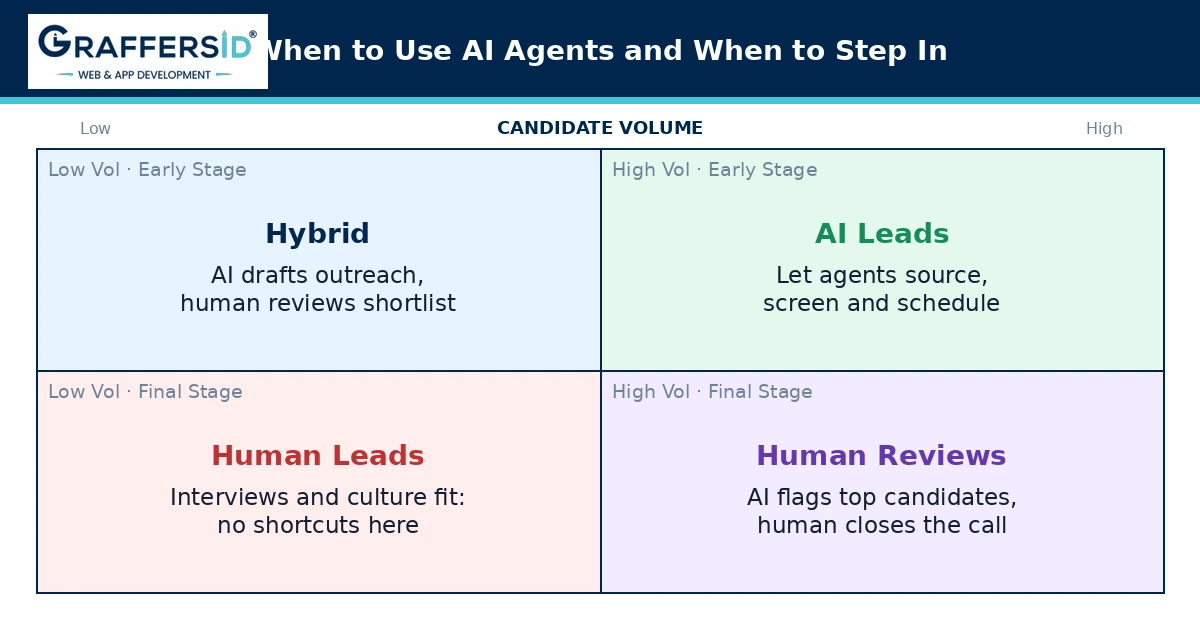
The question is not whether to use AI in your hiring process. At this point, not using it at the sourcing and initial screening stage is a competitive disadvantage. The question is where to draw the handoff line between the agent and the human.
A Practical Decision Framework
A useful way to think about it: AI earns its place in the high-volume, early-stage parts of the pipeline. When you are trying to identify 15 qualified candidates from a pool of 400 applications, an agent can do that in hours and do it consistently. When you are deciding which of those 15 developers to actually bring onto your team, that is where AI becomes a liability if you give it too much authority.
For startups specifically, the smarter move is to pair AI-assisted sourcing with a staff augmentation model rather than relying on either alone. AI broadens your candidate funnel faster than any recruiter could. Staff augmentation solves the vetting problem that AI cannot: you get developers who have already been technically assessed, who have demonstrated they can work in a distributed setup, and who can start within days rather than weeks.
That combination is why many growing startups have moved away from pure job-board hiring entirely. The emerging AI tools every tech leader should know covers some of the sourcing and workflow tools worth evaluating as part of that stack. On the staffing side, understanding how to build a high-performing remote team sets the right foundation before you scale.
There is also a model question worth thinking through. If you are augmenting an existing team rather than building from scratch, the differences between staff augmentation and managed services are worth understanding before you commit to an engagement structure.
The Bottom Line
AI agents have made the top of the developer hiring funnel genuinely faster and cheaper. That part is not hype. Where most startups go wrong is expecting those same agents to carry the full hiring decision, which they are not built to do.
The practical playbook is to use AI where it excels, which is sourcing volume and filtering at scale, and then rely on human-reviewed, pre-vetted talent for the final selection. That is where the real speed advantage comes from: not choosing between AI and human judgment, but running them in sequence.
At GraffersID, we give you the second half of that equation. Our staff augmentation model puts pre-vetted developers in front of you within 48 hours, already assessed for technical depth and remote-work fit. You handle the final conversation. We handle everything before it.
Ready to hire faster without giving up control over who joins your team? GraffersID has AI-ready, pre-vetted developers available to start in 48 hours, with no overhead and flexible monthly engagement.

FAQ
What are AI hiring agents and how do they work?
AI hiring agents are autonomous software systems that execute tasks across the recruiting pipeline without waiting for a human prompt at each step. In 2026, they handle sourcing candidates from job boards and professional networks, screening resumes against defined criteria, scheduling interviews, and following up with candidates. Unlike earlier AI recruitment tools that required manual triggering, agents run continuously and act on pipeline signals automatically.
Can AI agents replace human judgment in developer hiring?
Not for the decisions that matter most. AI agents perform well at high-volume, top-of-funnel tasks like sourcing and initial screening. However, assessing technical depth, evaluating communication fit for distributed teams, and making final hiring decisions still require human involvement. Only 26% of candidates trust AI to evaluate them fairly, which means over-relying on agents at the final stage creates both quality and trust risks.
How much faster is AI-assisted hiring compared to traditional methods?
Companies using AI agents in sourcing and screening consistently report 30 to 50% faster time-to-hire. Resume screening that previously took 7 to 10 days is reduced to a matter of hours. Interview scheduling, which often added 3 to 5 days of back-and-forth, is handled automatically. The overall time-to-fill for developer roles drops from an average of 44 days to under 22 days in well-structured AI-assisted pipelines.
What is the best hiring approach for a startup needing developers?
The most effective approach combines AI-assisted sourcing with a staff augmentation model. AI broadens your candidate funnel quickly. Staff augmentation provides developers who are already pre-vetted for technical skills and remote-work reliability, and who can start within days. This combination removes the two biggest delays in startup developer hiring: finding enough qualified candidates and verifying that they are actually right for your setup.