Quick Takeaways
- IT consulting typically costs $100 to $300 per hour. Staff augmentation runs $25 to $75 per hour, depending on region and seniority. That is a real difference of 4x or more on your developer spend.
- Staff augmentation keeps project ownership with you. IT consulting hands strategic control to the vendor.
- Over 50% of failed tech projects are linked to unclear scope. That is the one situation where consulting earns its cost. In every other situation, augmentation wins on speed, cost, and control.
- The smartest teams use both: consulting for initial discovery, augmentation for everything after.
Here is a situation most founders and CTOs have been in. You need external tech help. Your sprint is slipping, your in-house team is stretched, and every vendor you speak to sounds the same. Some call themselves consultants. Others offer staff augmentation. Both promise to solve your problem. But they are not the same thing, and choosing the wrong one will cost you more than the difference in their rates.
This post breaks down both models clearly, compares real costs, and gives you a simple framework to decide. If you have a working team, a defined product, and a delivery timeline that matters, you will almost certainly land on staff augmentation as the smarter choice.
What Is the Actual Difference?
1. Staff Augmentation Keeps Control With You
IT staff augmentation is a hiring model where an external developer joins your team and works under your direction. They use your tools, follow your processes, attend your standups, and report to your leads. You decide what they build, own the output and you manage the pace.
The vendor’s job is to find, vet, and place the right developer. Your job is to use them effectively.
This model works exceptionally well when you already know what needs to be built and just need more hands to build it. It is also the model that gives you the most budget predictability because you pay a fixed hourly or monthly rate for actual work done.
2. IT Consulting Hands Control to the Vendor
A consulting firm comes in to analyze your situation, define a solution, and often manage the delivery of that solution. They bring strategic expertise and take on accountability for outcomes.
The trade-off is cost and control. Consulting firms bill at a significantly higher rate, typically $100 to $300 per hour, because they are selling judgment and ownership, not just execution. They run scoping phases before any work begins. They manage their own team internally. And every time your requirements change, you renegotiate.
If you have a well-defined product and a team that knows how to execute, you are paying a very large premium for something you do not need.
The Real Cost Comparison
Let us put actual numbers on the table.
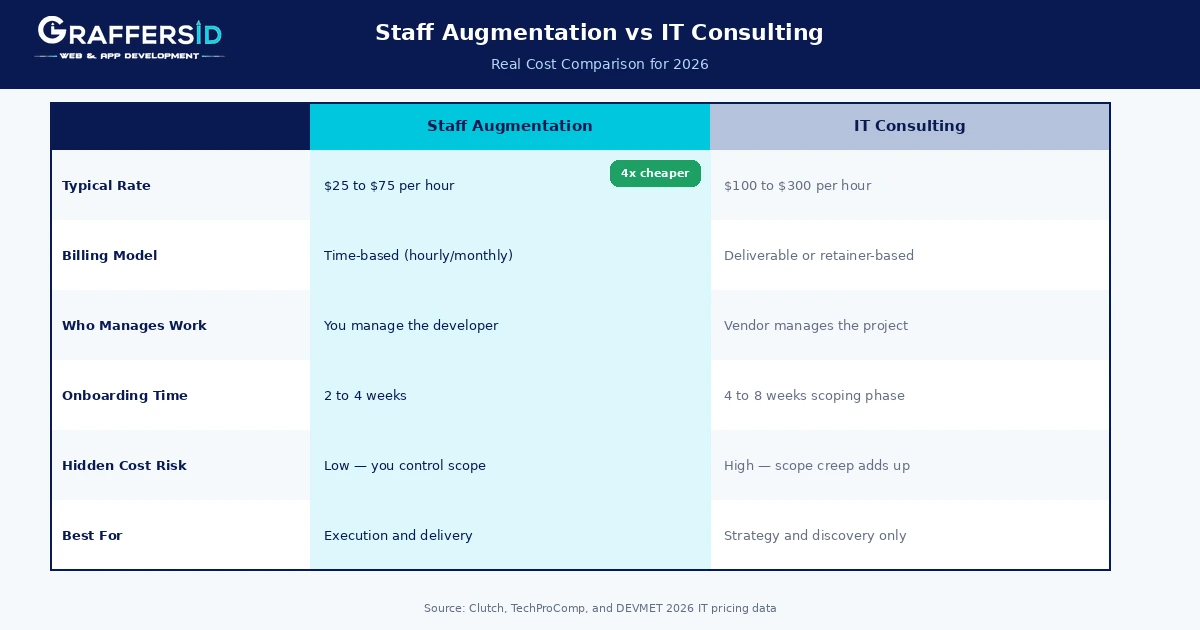
The rate difference is only part of the story. The bigger cost gap shows up in how the two models handle change. Staff augmentation lets you redirect a developer tomorrow morning. A consulting engagement requires a change order, a scoping revision, and often a new invoice. According to TechProComp’s 2026 IT Consulting vs Staffing analysis, consulting provides cost advantages only for short-term, clearly defined, one-time projects. For anything involving ongoing development or changing requirements, staffing wins on total cost.
Read Also: Staff Augmentation vs Outsourcing: Which Is Right for You?
When Staff Augmentation Is the Right Choice
For the majority of tech teams building products in 2026, staff augmentation is the model that delivers more value per rupee or dollar spent. Here is when it is clearly the right call.
- You have a defined scope. You know what features need to be built, which tech stack you are using, and roughly how long things should take. You do not need strategic guidance. You need engineers.
- Speed matters. Staff augmentation providers place pre-vetted developers in two to four weeks. A consulting engagement often takes four to eight weeks just to complete the scoping phase before a single line of code is written.
- You want budget predictability. A fixed hourly or monthly rate with no change order risk is far easier to forecast than consulting retainers with variable scope.
- Your team is already capable. If you have a technical lead who can direct work, there is no reason to pay consulting rates for oversight you can handle yourself.
- You need to scale up or down quickly. Staff augmentation lets you add capacity for a sprint, a quarter, or a year and then scale back without renegotiating a contract. That flexibility is impossible with most consulting engagements.
When IT Consulting Makes Sense
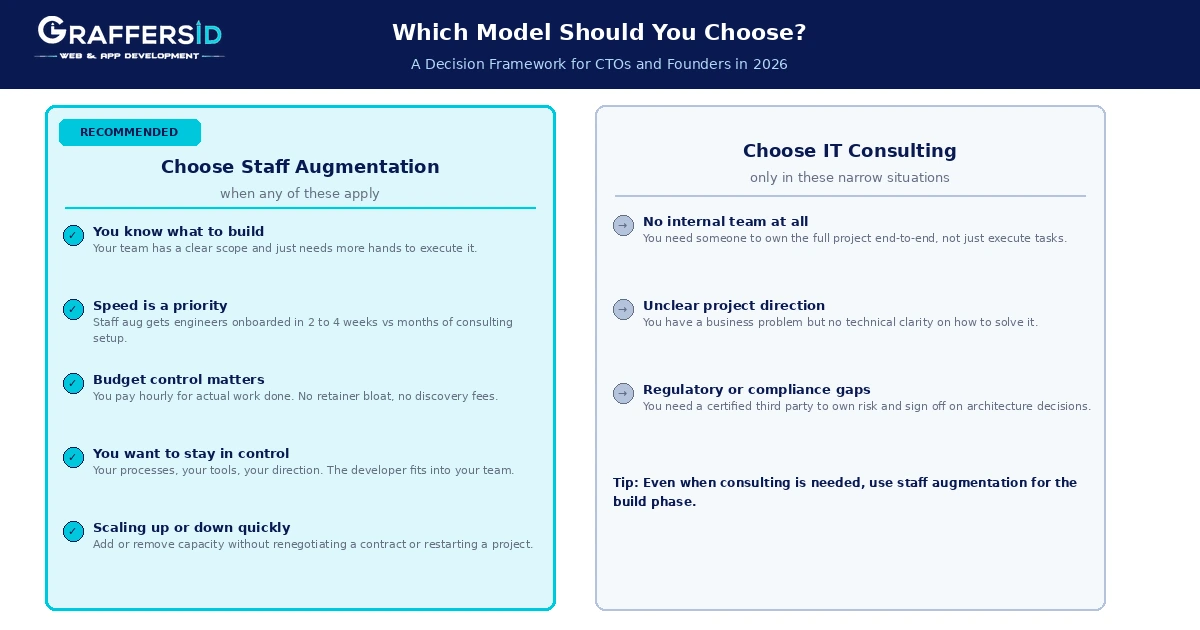
There are genuine situations where consulting earns its higher cost. Being honest about this matters, because the goal is to help you make the right call, not to oversell one model.
- You have no internal technical team at all. If you are a non-technical founder building your first product with zero engineering capacity, a consulting firm can own the entire process. Once the product is defined and built, you can transition to staff augmentation for ongoing development and feature work.
- You are completely unclear on the technical direction. If you have a business problem but no idea how to solve it technically, a short consulting engagement to define the architecture and approach can save months of misdirected effort. But once that clarity exists, switch to augmentation for execution.
- You face regulatory sign-off requirements. In industries like healthcare, fintech, or defence, certain compliance decisions require a certified third-party firm to own and sign off on architecture. That is a legitimate use of consulting. Everything else is not.
Can You Use Both? Yes, and It Often Makes Sense
The hybrid approach is what smart engineering leaders do in practice. A short consulting engagement of two to four weeks to define scope, architecture, and technical direction. Then a staff augmentation team to build it.
This way you get strategic clarity at consulting rates only for the time it takes to get that clarity, and then you switch to the far more cost-effective augmentation model for everything after. You are not paying $200 per hour for code that a $40 per hour augmented developer could write just as well under proper direction.
The key is to not let the consulting phase drag on. Once you have a clear technical brief, a defined stack, and a working architecture decision, the consultant’s job is done. Bring in your augmented team and get building.
The Hidden Costs Nobody Talks About
The hourly rate is the number vendors put in the subject line of their emails. It is rarely the number that ends up on your final invoice with a consulting firm. Here is what actually inflates the cost.
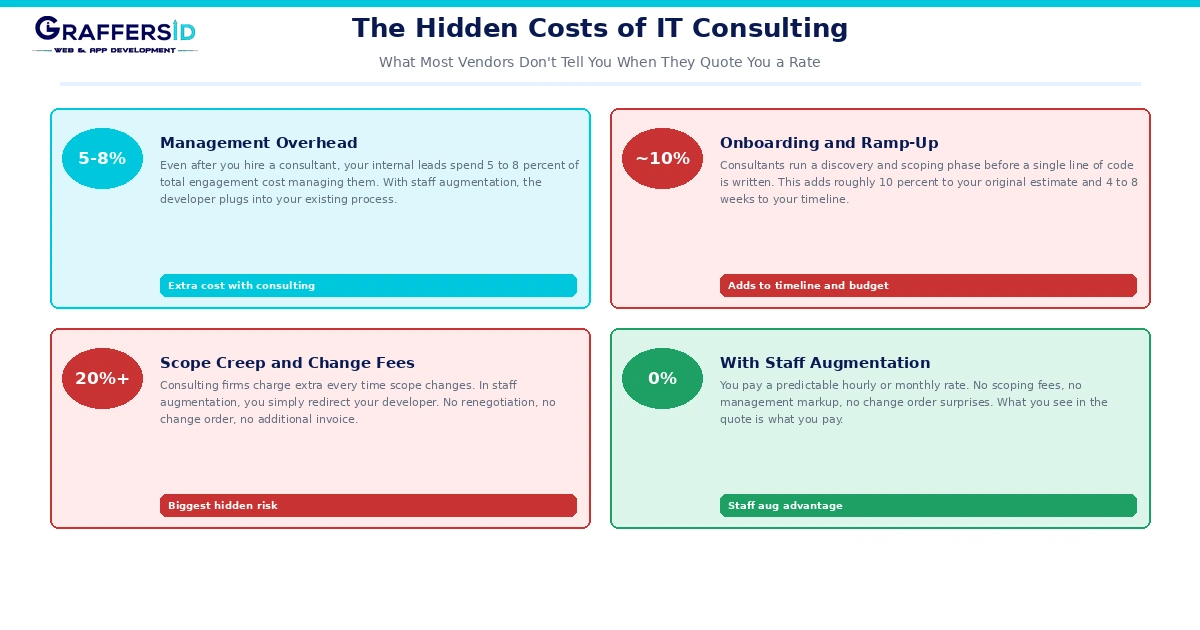
- Management overhead adds 5 to 8 percent. Even after hiring a consulting firm, your internal leads spend considerable time managing the relationship, reviewing outputs, attending steering meetings, and translating business context. That internal time has a cost that never shows up on the consulting invoice.
- Onboarding and discovery inflate budgets by around 10 percent. Most consulting firms run a paid discovery phase before work begins. This is four to eight weeks of billable hours at full rates before a single deliverable exists.
- Scope changes trigger new invoices. The most significant hidden cost in consulting is what happens when your requirements evolve, which they always do. With a staff augmentation model, you simply redirect your developer the next morning. With a consulting firm, every scope change requires renegotiation and often a separate change order at full rate.
- Rework from choosing the wrong model early. The single most expensive mistake is not picking the slightly wrong vendor. It is realising three months into a consulting engagement that all you needed was two strong augmented developers. The time and money spent unwinding that arrangement and starting over is a cost that never appears in any comparison guide.
Staff augmentation eliminates almost all of these risks. You pay a predictable rate and control the work. You redirect instantly when priorities shift. And if the developer is not working out, a good augmentation partner replaces them quickly.
What This Means for Your Next Hiring Decision
If your team already has technical direction and a defined roadmap, you do not need a consultant. What you need is the right developer, onboarded quickly, integrated into your team, and working under your direction at a fraction of consulting rates.
At GraffersID, we work with startups and scaling businesses to hire remote developers who are pre-vetted, technically strong, and ready to join your team within a week. Our model is built around giving you full control over your development process while we handle the sourcing, vetting, and ongoing support.
If you have a product to build and a timeline that matters, staff augmentation is almost always the model that saves you more money, gets you moving faster, and keeps the project exactly where it belongs in your hands.
Ready to add a strong developer to your team this week? GraffersID connects you with pre-vetted engineers across full-stack, AI, mobile, and more.