Businesses that deploy AI without governing it aren’t innovating; they’re gambling.
In 2026, AI governance has become the defining line between companies that scale AI confidently and those that quietly absorb its failures, biased hiring tools, hallucinating customer bots, regulatory fines, and reputational damage that doesn’t make the press release.
Most organizations have an AI strategy. Far fewer have an AI governance strategy. That gap is no longer a theoretical risk. It’s showing up in earnings calls, compliance audits, and customer trust scores.
So what exactly is AI governance, and why is it suddenly non-negotiable? This guide breaks it down completely:
- What AI governance means in practice (not just in principle)
- The regulatory landscape shaping compliance requirements in 2026
- How to build a governance framework that scales with your AI product
- The risks of getting it wrong and the competitive edge of getting it right
What is AI Governance?
AI governance is a structured framework of policies, processes, and accountability systems that ensures AI systems operate accurately, ethically, and transparently in compliance with regulations and in alignment with business goals.
It helps organizations control how AI models are built, deployed, and monitored, reducing risks while enabling scalable and responsible AI adoption. It includes policies, processes, and tools that manage AI across its lifecycle:
- Data: Ensuring quality, privacy, and bias checks
- Model: Validating performance, fairness, and explainability
- Deployment: Risk assessment and approval workflows
- Monitoring: Continuous tracking of performance, drift, and compliance
In simple terms, AI governance ensures your AI systems do what they’re supposed to do, without creating risk, compliance issues, or business uncertainty.
Read More: How to Build a Successful AI Adoption Strategy in 2026: A Proven Framework for CEOs and CTOs
Why AI Governance is Important for Businesses in 2026?
1. Reduces AI Risks and Legal Issues
AI systems can create serious risks if left unchecked, including biased decisions in hiring or finance, compliance violations, and reputational damage. AI governance helps businesses identify, monitor, and mitigate risks early through validation, testing, and continuous oversight.
2. Builds Customer Trust and Brand Credibility
Today’s users expect AI systems to be transparent, fair, and explainable. Lack of clarity in AI decisions can reduce trust and impact customer loyalty. With proper governance, companies can deliver reliable and unbiased AI experiences, strengthening brand reputation and trust.
3. Improves AI ROI and Enables Scalable Growth
Without governance, AI projects often fail due to poor planning, inconsistent processes, or repeated errors across teams. With governance frameworks in place, businesses achieve:
- Faster and more consistent deployments
- Standardized workflows across teams
- Higher ROI from AI investments
4. Ensures Compliance with AI Regulations and Standards
Global regulations like GDPR and the EU AI Act require businesses to manage AI responsibly and maintain accountability. AI governance ensures:
- Compliance with legal and industry standards
- Audit readiness and documentation
- Reduced risk of penalties and regulatory issues
Businesses that invest in AI governance early are better positioned to scale AI confidently while staying compliant.
Key Pillars of AI Governance in 2026
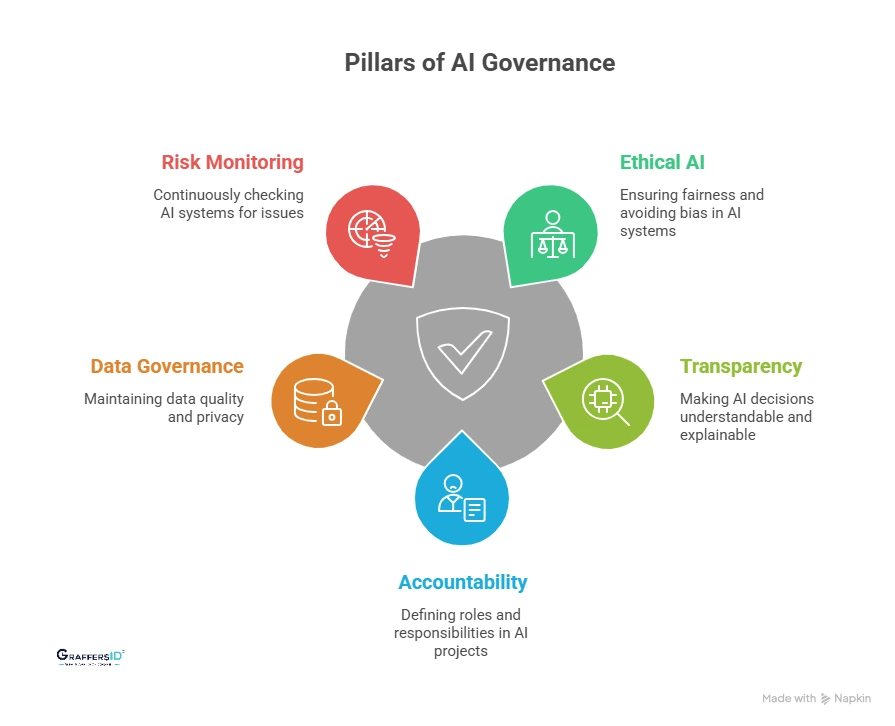
1. Ethical AI and Bias Prevention
- Ensure AI models are trained on diverse and unbiased datasets to avoid unfair outcomes.
- Regularly test for bias across different user groups using automated tools and validation frameworks.
- Implement fairness checks during development to ensure AI decisions are inclusive and responsible.
2. Transparency and Explainability in AI Systems
- Make AI systems easy to understand by clearly explaining how decisions are made.
- Use explainable AI (XAI) techniques to provide clear reasoning behind outputs, especially in critical industries like finance or healthcare.
- Transparency builds trust with users, stakeholders, and regulatory bodies.
3. Accountability and Ownership in AI Projects
- Clearly define roles and responsibilities across the AI lifecycle:
- Who develops the model
- Who tests and validates it
- Who is accountable for its outcomes
- Establish governance structures to ensure responsibility is assigned and tracked at every stage.
4. Data Governance and Privacy Protection
- Maintain high-quality, accurate, and well-structured data for better AI performance.
- Track data sources and lineage to ensure traceability and compliance.
- Protect user data by following privacy regulations and implementing strong data security practices.
5. AI Risk Monitoring and Continuous Control
- Continuously monitor AI systems to detect:
- Model drift (performance changes over time)
- Accuracy issues
- Security vulnerabilities
- Use automated monitoring tools to ensure AI systems remain reliable, secure, and aligned with business goals.
Key Elements of an AI Governance Framework in 2026
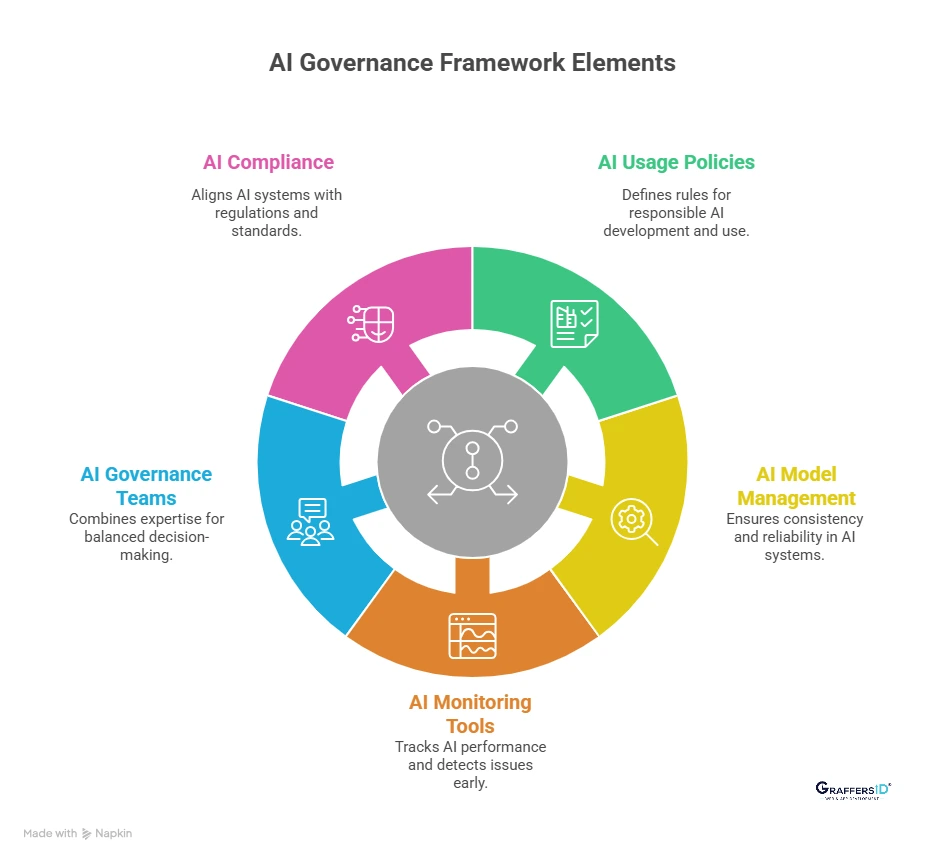
1. AI Usage Policies and Ethical Guidelines
Define clear rules for how AI should be developed and used within your organization. These policies ensure AI systems align with business goals, ethical standards, and user expectations.
- Set boundaries for responsible AI usage
- Align AI decisions with company values and compliance requirements
2. AI Model Management and Control Systems
Establish processes to manage the entire lifecycle of AI models, from development to deployment. This ensures consistency, reliability, and accountability in AI systems.
- Track model versions and updates over time
- Validate models before deployment to avoid errors or bias
- Maintain proper documentation for audits and transparency
3. AI Monitoring and Performance Auditing Tools
Use advanced tools to continuously track how AI systems perform in real-world scenarios. Monitoring helps detect issues early and maintain system reliability.
- Real-time performance tracking and reporting
- Bias detection and fairness analysis tools
- Automated alerts for anomalies, drift, or failures
4. Cross-Functional AI Governance Teams
Build a dedicated team that combines technical, legal, and business expertise to oversee AI systems. This ensures balanced decision-making and reduces organizational risk.
- Engineering teams handle development and implementation
- Legal and compliance teams ensure regulatory alignment
- Product teams align AI with business and user needs
5. AI Compliance with Regulations and Industry Standards
Ensure your AI systems follow global regulations and industry best practices to avoid legal risks and build trust. Compliance is critical for scaling AI across markets.
- Align with global frameworks like GDPR and AI regulations
- Follow industry-specific standards and security guidelines
How AI Governance Works at Each Stage of the AI Lifecycle in 2026?
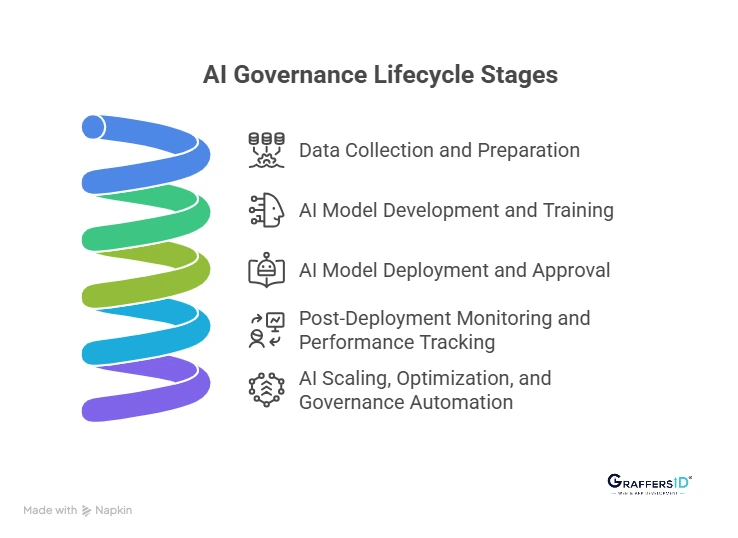
1. Data Collection and Preparation Stage
- Ensure high-quality, relevant, and unbiased data is used to train AI models, as poor data directly impacts outcomes.
- Maintain data privacy and compliance with regulations (like GDPR) by securing user consent and managing data access.
- Perform bias checks and data validation to prevent skewed or unfair model behavior later.
2. AI Model Development and Training Stage
- Apply fairness testing techniques to identify and reduce bias during model training.
- Use explainable AI (XAI) methods to make model decisions interpretable for stakeholders.
- Document model logic, datasets, and assumptions to ensure transparency and audit readiness.
3. AI Model Deployment and Approval Stage
- Conduct risk assessments to evaluate potential business, ethical, and operational risks before launch.
- Implement approval workflows and governance checks to ensure only validated models go live.
- Align deployment with business goals, compliance standards, and security requirements.
4. Post-Deployment Monitoring and Performance Tracking
- Continuously track model accuracy, performance, and real-world impact using monitoring tools.
- Detect issues like model drift, bias changes, or unexpected outputs in real time.
- Set up alerts and audit logs to ensure quick response and accountability.
5. AI Scaling, Optimization, and Governance Automation
- Standardize governance processes across teams to ensure consistent AI quality and compliance.
- Use automation tools for monitoring, reporting, and compliance checks to reduce manual effort.
- Continuously optimize models and governance frameworks to support scalable and reliable AI adoption.
AI Governance Best Practices for Businesses in 2026
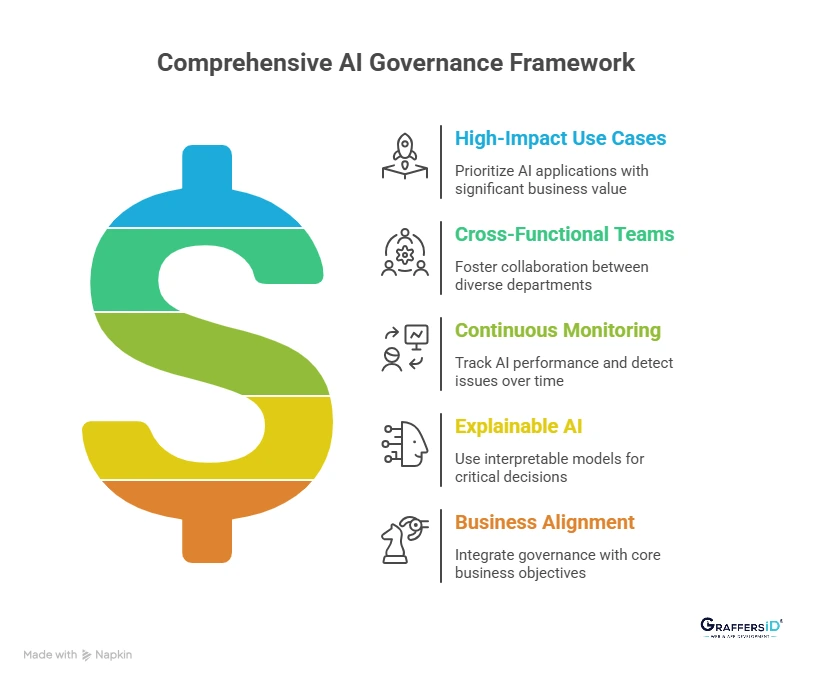
1. Focus on High-Impact AI Use Cases First
Start governance where AI decisions have the most business impact. Prioritize systems that directly influence revenue, customer experience, or critical operations to reduce risk early and show measurable ROI.
- Revenue-driven systems (pricing, recommendations)
- Customer-facing AI (chatbots, personalization engines)
2. Build Cross-Functional AI Governance Teams
AI governance is not just a technical responsibility; it requires collaboration across departments. Bringing together diverse expertise ensures better risk assessment, compliance, and decision-making.
- Tech teams: model development and performance
- Legal teams: compliance and regulations
- Business teams: strategic alignment and impact
3. Implement Continuous AI Monitoring and Auditing
AI systems evolve over time, so ongoing monitoring is essential. Businesses should track performance, detect bias, and identify model drift to ensure consistent and reliable outputs.
- Monitor accuracy and output quality
- Detect bias and fairness issues
- Track model performance and drift
Read More: AI in Cybersecurity in 2026: Emerging Threats, Global Trends & Cybersecurity Best Practices
4. Use Explainable AI Models for Critical Decisions
For high-stakes use cases, businesses should prioritize AI models that provide clear and interpretable outputs. This improves trust, supports compliance, and enables better decision-making.
- Essential for finance, healthcare, and HR systems
- Helps explain “why” behind AI decisions
- Supports audits and regulatory requirements
5. Align AI Governance with Business Goals and KPIs
AI governance should not operate in isolation; it must support core business objectives. Align governance frameworks with KPIs like growth, efficiency, and innovation to ensure long-term value.
- Connect governance to ROI and performance metrics
- Enable faster, safer AI scaling
- Support innovation without increasing risk
AI Governance Frameworks & Standards Every Business Should Know in 2026
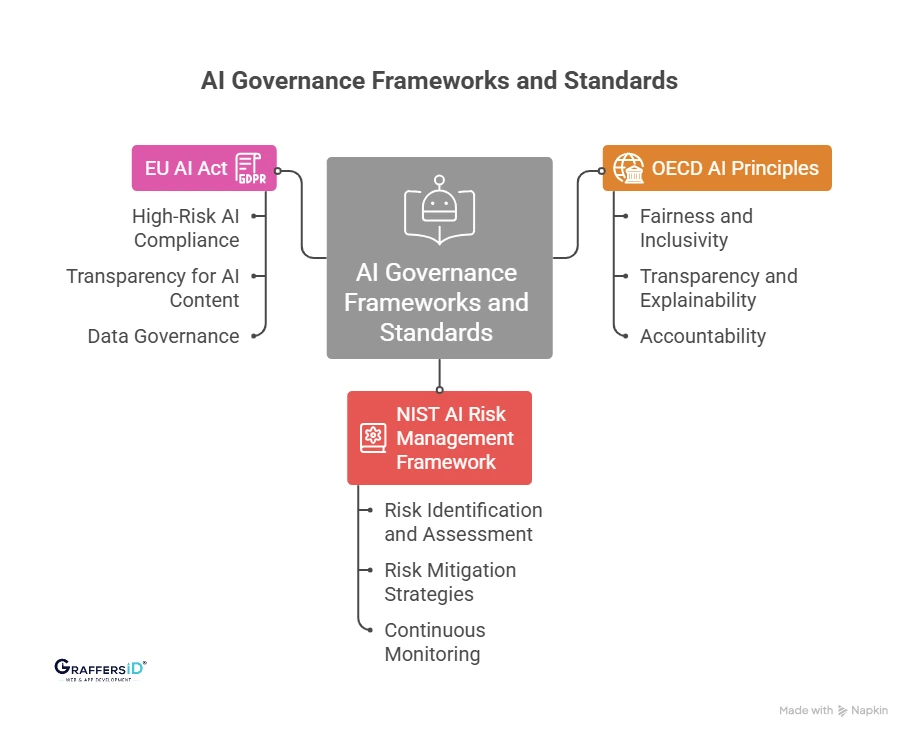
1. OECD AI Principles (Global Ethical AI Guidelines)
A globally recognized framework focused on responsible and human-centric AI development. Emphasizes:
- Fairness and inclusivity
- Transparency and explainability
- Accountability across AI systems
Best for organizations looking to align AI with ethical standards and long-term trust building.
2. NIST AI Risk Management Framework (AI Risk & Security Framework)
A practical framework by the National Institute of Standards and Technology (NIST) to manage AI risks effectively. Focuses on:
- Identifying and assessing AI risks
- Implementing risk mitigation strategies
- Continuous monitoring and improvement
Ideal for companies that want a structured, risk-first approach to AI governance.
3. EU AI Act (Risk-Based AI Regulation for Compliance)
One of the most comprehensive AI regulations categorizes AI systems based on risk levels (low to high risk). Key requirements:
- Strict compliance for high-risk AI systems
- Transparency for AI-generated content
- Strong data governance and documentation
Critical for businesses operating in or targeting the EU market.
There is no one-size-fits-all AI governance framework. The most effective approach is to combine global standards with your business goals, risk profile, and industry requirements.

Conclusion: Why AI Governance is a Business Advantage in 2026
AI governance is no longer just a compliance requirement; it’s a strategic advantage for businesses building with AI in 2026. As AI becomes central to decision-making, customer experience, and operations, companies that invest in governance are able to:
- Reduce operational, legal, and reputational risks
- Scale AI systems faster with better control and consistency
- Build long-term customer trust through transparency and reliability
The real competitive edge is not just adopting AI, but deploying AI systems that are reliable, explainable, and ready for scale from day one.
At GraffersID, we help businesses move beyond experimentation to build production-ready AI systems with governance built in from day one. Our approach focuses on:
- Developing AI-powered applications with governance-first architecture
- Ensuring transparent and structured development workflows
- Designing systems that are compliance-ready and scalable
Hire expert AI developers and build high-performance, compliance-ready AI systems designed for long-term success.