

In 2026, speed has become the biggest competitive advantage for modern businesses. CTOs, CEOs, and product leaders are under pressure to ship new applications, automate workflows, and improve customer experience, without expanding engineering budgets.
Traditional software development can take months. But low-code development platforms in 2026, powered by AI copilots, workflow agents, data automation, and no-code UI builders, allow teams to ship apps 3–5× faster with minimal coding.
From startups building MVPs to enterprises modernizing legacy systems, low-code tools have evolved into a core pillar of digital transformation and AI adoption.
This guide covers:
-
What do low-code platforms mean in 2026
-
Benefits, challenges & use cases
-
Top low-code tools for building intelligent apps
-
How to choose the right low-code platform
-
Expert strategic insights for decision-makers
What is a Low-Code Development Platform?
A low-code development platform is software that automates application creation with minimal coding effort. Instead of writing thousands of lines of code, teams use:
-
Drag-and-drop interfaces
-
AI-assisted app builders
-
Pre-built templates and APIs
In 2026, low-code tools are no longer limited to mobile apps; they integrate AI assistants, workflow automation, data modeling, and enterprise-grade security, enabling both technical and non-technical teams to collaborate smoothly.
Read More: Top 5 AI Coding Assistants in 2026 Every CTO Should Know About
How Low-Code Platforms Improve Productivity & Customer Experience in 2026?
Adopting a low-code strategy helps enterprises achieve measurable results:
-
Faster Time-to-Market: Low-code platforms help teams build screens, workflows, and app logic in minutes with AI copilots. This shortens development cycles and enables companies to release new features 3–5× faster than traditional coding.
-
Better Customer Experience (CX): With AI-driven personalization and rapid update cycles, businesses can deliver smoother, more intuitive user journeys. Faster iteration also ensures apps stay aligned with evolving customer expectations.
-
Stronger Collaboration Between Business & IT: Low-code tools empower non-technical teams to build internal apps and automate processes. This frees IT teams to focus on complex, high-impact development while improving alignment across departments.
-
Higher Operational Efficiency: Automate repetitive workflows, manual processes, and reduce human error. As a result, teams operate more efficiently, complete tasks faster, and maintain consistent execution across operations.
Key Benefits of Low-Code Development Platforms in 2026
Here are some of the important benefits of using a low-code platform in 2026 that you need to know:
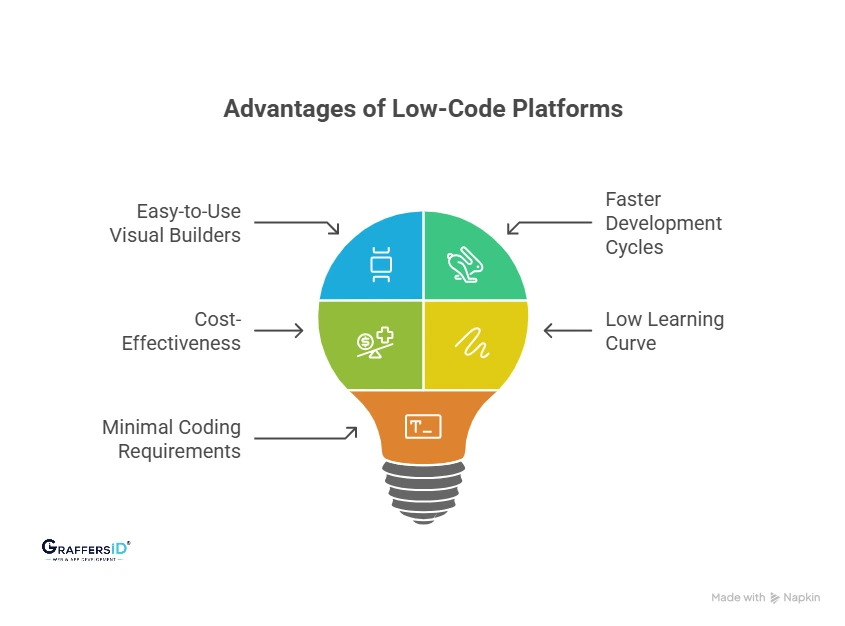
1. Faster Prototyping With Visual Builders
Low-code platforms let teams build prototypes instantly using drag-and-drop UI builders. AI automatically improves layouts, fixes UX inconsistencies, and helps convert ideas into functional screens in minutes.
2. Faster Development Cycles
AI copilots now handle much of the repetitive work, generating workflows, optimizing logic, refining performance, and suggesting best practices. This significantly reduces manual coding and speeds up release cycles.
3. Lower Development and Maintenance Costs
Businesses cut costs by reducing the need for large engineering teams, lengthy development timelines, and extensive maintenance efforts. Scalable, pay-as-you-grow pricing keeps budgets predictable as applications expand.
4. Easy for Non-Technical Teams to Use
Low-code tools offer templates, visual blocks, and guided AI flows, making it simple for non-developers to build functional apps. This empowers business teams to innovate without waiting for IT bandwidth.
5. Minimal Coding Requirements
Pre-built connectors and logic blocks replace traditional scripting. With AI generating APIs, workflows, and backend logic automatically, even complex systems can be built with very little manual code.
Who Should Use Low-Code Platforms in 2026?
- Developers: Professional developers use low-code platforms to speed up app delivery, automate repetitive coding tasks, and focus on high-value features like AI integrations and complex system design.
- Business Teams: Non-technical teams can create internal tools, dashboards, and automated workflows without relying heavily on IT. This speeds up operations and enables faster decision-making across departments.
- Enterprises: Large organizations adopt low-code platforms to modernize legacy systems, streamline operations, and scale digital transformation initiatives with AI-powered automation.
- Startups & SMBs: Startups and small businesses can build MVPs rapidly, reduce development costs, and scale products without hiring big engineering teams. Low-code tools make early-stage innovation faster and more affordable.
Read More: Best AI Code Generators to Use in 2026 for Faster and Smarter Development
Types of Low-Code Development Platforms in 2026
Low-code tools are software development tools that allow the user to build applications without writing code. There are three types of low-code tools:
1. Rapid Application Development (RAD) Tools
These tools enable ultra-fast prototyping and deployment using drag-and-drop components and built-in UI libraries. Perfect for startups or product teams pushing out an MVP to test market fit quickly in 2026’s competitive environment.
2. Visual Programming Platforms
Platforms inspired by tools like Scratch or Blockly that let non-developers build complex user interfaces and workflows through visual logic blocks. Ideal when your app needs rich UX design with minimal code.
3. API-Centric Low-Code Platforms
Tools focused on smooth integration with external systems, services, and databases via pre-built connectors and REST/GraphQL APIs. Best suited for enterprises building multi-platform, scalable applications where data flow and connectivity are key.
Common Challenges of Using Low-Code Development Platforms in 2026
-
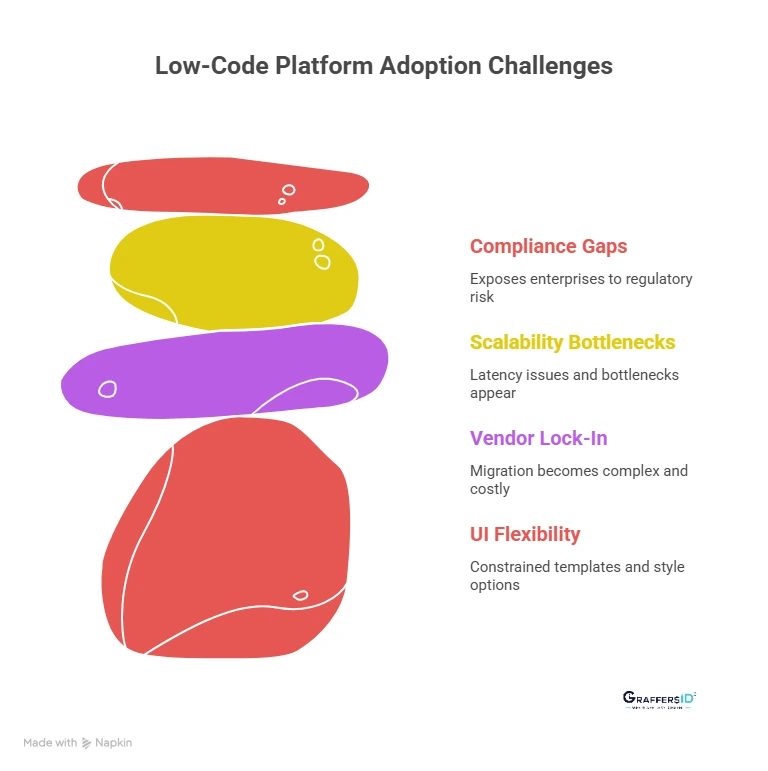
Limited UI & Design Flexibility: Low-code platforms often restrict highly custom UI/UX designs, which can be a challenge for brands that need unique interfaces. Developers may still need to write custom code to achieve advanced layouts or micro-interactions.
-
Risk of Vendor Lock-In: Many low-code tools rely on proprietary frameworks, making it difficult to migrate apps to another platform later. This can affect long-term flexibility, scaling plans, and cost control if teams are not careful.
-
Performance and Scalability Issues: Some low-code applications struggle with performance under heavy workloads or complex business logic. High-traffic enterprise systems may need additional optimization or custom code to scale efficiently.
-
Security and Compliance Gaps: Not all low-code tools fully comply with the latest regulations (e.g. GDPR, HIPAA, SOC 2). Weaknesses in role-based access control, audit trails, or data encryption can expose enterprises to risk in regulated industries.
Best 5 Low-Code Platforms for App Development in 2026
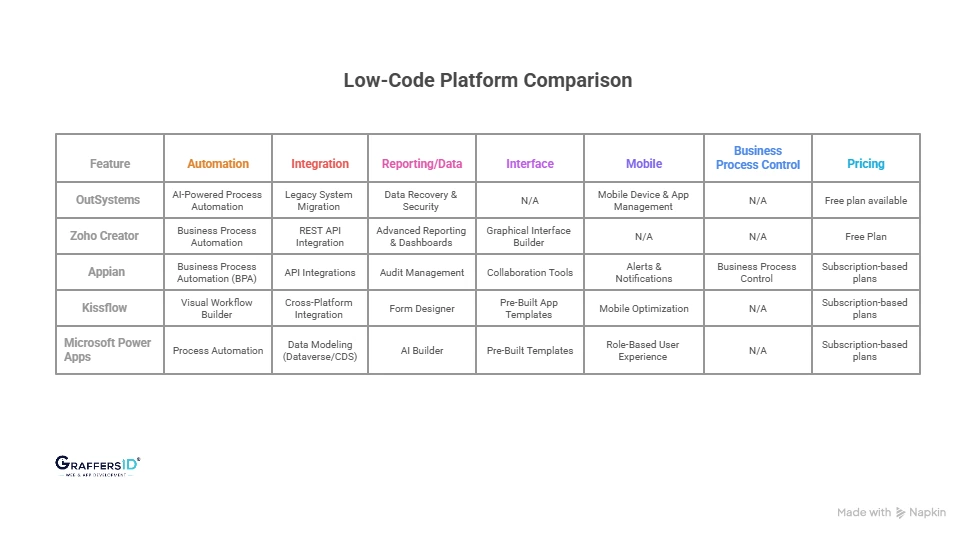
1. OutSystems: Best Enterprise Low-Code Platform for App Development in 2026
OutSystems is one of the most powerful low-code platforms for enterprises that need to build, modernize, and scale complex applications. With advanced AI copilots, strong automation, and enterprise-grade deployment capabilities, it’s built for large organizations with mission-critical needs.
Organizations across industries use OutSystems to modernize legacy systems, automate workflows, and launch customer-facing apps without long development cycles. With AI-driven tools, businesses can deploy production-ready applications in days instead of months, making it a go-to solution for CTOs and product leaders.
Key Features of OutSystems in 2026
1. AI-Powered Workflow & Process Automation: OutSystems uses built-in AI copilots to generate workflows, automate processes, and optimize logic, helping teams ship apps faster with fewer manual tasks.
2. Complete Mobile App Lifecycle Management: The platform supports end-to-end mobile development, including UI design, logic, testing, deployment, and updates, all inside one ecosystem.
3. Strong Governance, Compliance & Security Controls: Enterprises get role-based access, audit trails, secure cloud hosting, and compliance features that support large-scale, sensitive applications.
4. Pre-Built Connectors for Legacy System Integration: OutSystems offers ready-to-use connectors and integration tools to quickly connect with legacy ERPs, CRMs, and internal systems, reducing migration time.
5. Automated DevOps & CI/CD Pipeline: The platform includes built-in DevOps automation, allowing teams to deploy faster, maintain version control, and ensure stable releases.
Best For
Enterprises looking to modernize legacy systems, build mission-critical apps, and scale software across large teams with complex workflows.
Pricing of OutSystems
- Free plan available
- Flexible subscription tiers
- Free trial for enterprises
2. Zoho Creator: Best Low-Code Tool for Workflow Automation in 2026
Zoho Creator is one of the most user-friendly low-code platforms for building internal tools, automating workflows, and creating business apps quickly. Its AI-driven features and visual builders make it ideal for teams that want to streamline operations without heavy coding.
By enabling IT teams to offload repetitive development tasks, Zoho Creator empowers business units to innovate faster while reducing dependency on traditional coding.
Key Features of Zoho Creator in 2026
-
Drag-and-Drop App Builder: Zoho Creator offers an intuitive drag-and-drop interface that lets teams design forms, screens, and internal tools in minutes.
-
Business Process Automation: Users can automate repetitive tasks with visual workflows, logic builders, and triggers, and reduce manual effort, improve accuracy.
-
Pre-Built Templates & Modules: Speed up development with ready-made solutions.
-
REST API & Third-Party Integrations: Zoho Creator supports both REST APIs and ready-made connectors for CRMs, ERPs, databases, payments, and cloud apps.
-
Advanced Dashboards & Reporting Tools: Teams can create interactive dashboards with charts, KPIs, and real-time reports to track performance and operational metrics.
Best For
Zoho Creator is ideal for SMBs, operations teams, HR, finance, support, and multi-department workflows that need quick automation without relying on engineering teams.
Pricing of Zoho Creator
- Free Plan: Ideal for small projects or trials.
- Subscription Plans: Scalable pricing based on features and usage.
- Free Trial: Test before committing.
3. Appian: Best Low-Code Platform for Enterprise Automation in 2026
Appian is one of the leading low-code platforms for large enterprises, offering a powerful combination of low-code development, process mining, and end-to-end workflow automation. It’s designed to help organizations streamline complex processes, reduce operational bottlenecks, and build scalable applications faster.
Key Features of Appian in 2026
-
Unified Data Fabric: The platform connects data from multiple systems into a single unified layer without requiring data migration.
-
AI-Powered Process Automation: Uses advanced AI engines and automation workflows to eliminate manual tasks and speed up process execution.
-
Real-Time Workflow Monitoring: Provides visual dashboards and process insights to help teams track workflows, identify inefficiencies, and improve performance.
-
API Integrations: Integrates smoothly with legacy systems, CRMs, ERPs, AI services, and cloud apps through robust APIs.
-
Strong Compliance Controls: Enterprises benefit from built-in governance features and regulatory compliance frameworks suited for sensitive industries.
Read More: What Is Cursor AI? Features & Benefits for Tech Leaders in 2026
Best For
Appian is best suited for large enterprises, government bodies, BFSI sectors, healthcare, and any organization that manages complex or high-volume business processes.
Pricing of Appian
- Subscription-based plans
- Free trial available
4. Kissflow: Best Low-Code Platform for Web, Mobile Apps (2026)
Kissflow is a powerful low-code platform designed for teams that want to build web, mobile, and IoT applications quickly. It offers strong workflow automation, intuitive visual tools, and fast deployment capabilities, making it ideal for businesses trying to scale without heavy engineering effort.
Unlike traditional app builders, Kissflow offers end-to-end automation, enabling enterprises to streamline workflows, integrate with multiple platforms, and launch scalable apps faster. From simple websites to feature-rich mobile solutions with video, graphics, and dynamic content, Kissflow empowers teams to deliver apps at speed.
Key Features of Kissflow in 2026
-
Pre-Built Templates for Instant App Creation: Provides ready-made templates for forms, workflows, and applications.
-
Visual Workflow Automation: Its drag-and-drop workflow builder allows users to automate complex business processes without writing code.
-
No-Code Form Builder: Users can design smart, dynamic forms with conditional logic and validation rules.
-
API & Third-Party Integrations: Connects smoothly with CRMs, ERPs, databases, and AI tools through APIs and pre-built connectors.
-
Mobile-Ready App Development: Apps built on Kissflow automatically adapt to mobile devices, ensuring smooth performance across iOS and Android.
Best For
Teams looking for a fast, flexible, and scalable way to build internal tools, workflows, or customer-facing apps, without relying on large engineering teams.
Pricing of Kissflow
- Subscription-based plans
- Free trial available for testing
5. Microsoft Power Apps: Best Low-Code Platform for Microsoft Users (2026)
Microsoft Power Apps is one of the most popular low-code platforms in 2026, designed to help businesses build, deploy, and scale apps quickly without heavy coding. Integrated smoothly with Microsoft’s ecosystem (Office 365, Dynamics 365, and Azure), it empowers both technical and non-technical teams to automate processes and create enterprise-grade applications.
Key Features of Microsoft Power Apps in 2026
-
Ready-Made App Templates: Power Apps offers dozens of customizable templates for HR, sales, operations, field services, and more.
-
AI Builder: Add intelligence with pre-built AI models for predictions, form processing, and automation.
-
Role-Based User Experience: Power Apps lets organizations create apps with role-based permissions to ensure the right users access the right data.
-
Process Automation: With built-in Power Automate integration, businesses can automate repetitive tasks and system-to-system workflows effortlessly
-
Dataverse for Secure Data Storage: Microsoft Dataverse provides a scalable and secure data layer for storing and managing business data.
Best For
Ideal for companies already using Microsoft tools at scale. Power Apps helps them extend their existing ecosystem with custom apps, automated workflows, and AI-powered capabilities.
Pricing of Microsoft Power Apps
- Subscription-based pricing model (varies by user and app capacity)
How to Choose the Right Low-Code Development Platform in 2026?
When selecting a low-code solution, decision-makers should evaluate:
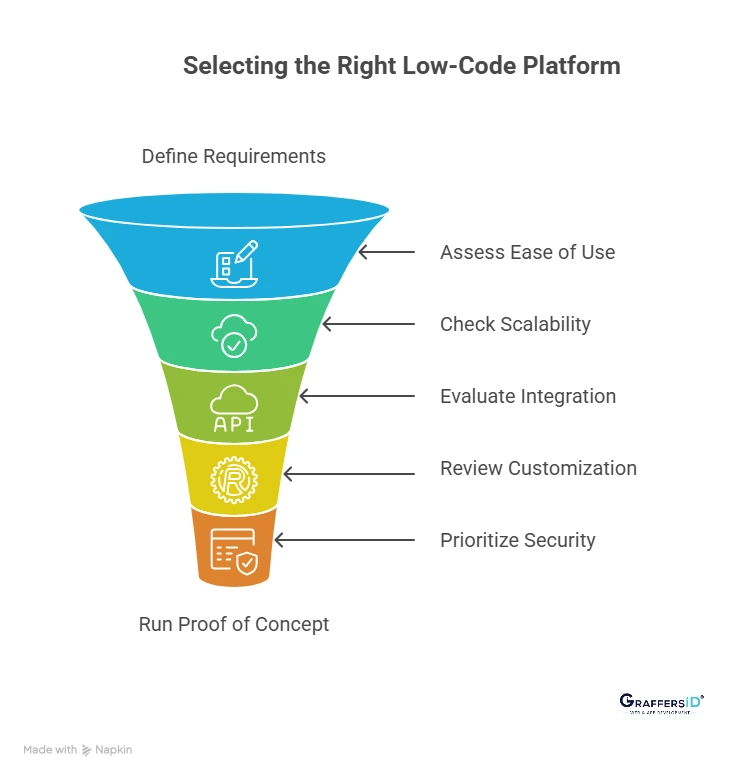
1. Define Your Business Needs
Start by identifying what kind of application you want to build. Whether it’s internal tools, customer-facing apps, automation workflows, or modernizing old systems, clarity at this stage ensures you choose the right platform.
2. Assess Ease of Use
Look for tools with intuitive drag-and-drop builders and AI copilots that simplify app creation. A platform that is easy to use reduces development time and supports faster rollouts.
3. Check Scalability
Choose a platform that can grow with your business and handle increasing users and data. Cloud-native infrastructure, auto-scaling, and high performance are essential for long-term reliability.
4. Evaluate Integration Capabilities
Select a platform that connects easily with your existing tools, APIs, CRMs, ERPs, and AI systems. Strong integration support ensures smooth data flow and better automation.
5. Look for Flexibility and Customization
Even low-code apps sometimes need custom logic or advanced features. Pick a platform that allows adding custom code when required without breaking the visual development experience.
6. Prioritize Security & Compliance
Security must be built in from day one. Choose platforms that offer strong governance, data protection, encryption, role-based access, and compliance with your industry’s standards.
7. Consider Vendor Support and Community Strength
Select a platform backed by strong vendor support, regular updates, and active documentation. A vibrant developer community also helps with faster troubleshooting and innovation.
8. Analyze Total Cost of Ownership (TCO)
Evaluate not just subscription fees but also integration efforts, scaling costs, and maintenance. A transparent pricing model helps you estimate ROI before committing.
9. Run a Proof of Concept (POC)
Before making a final decision, test the platform with a real use case. A short POC helps validate performance, usability, and whether the platform truly meets your goals.

Conclusion
In 2026, low-code platforms have become one of the fastest ways for businesses to launch applications, automate workflows, and modernize legacy systems, without long development cycles. With AI copilots, built-in integrations, and scalable cloud architectures, low-code is now a core strategy for companies aiming to reduce costs, speed up delivery, and stay competitive.
Organizations that adopt low-code early gain a clear advantage: quicker product releases, more efficient teams, and the ability to experiment and innovate without relying solely on heavy engineering bandwidth. As AI continues to shape how software is built, low-code will evolve into an essential layer of enterprise development.
Looking to build smarter, faster, and more cost-efficient in 2026?
At GraffersID, we specialize in helping companies hire AI developers, build scalable web and mobile applications, and integrate AI-powered low-code solutions to stay competitive in 2026 and beyond.
Looking to accelerate your development journey? Connect with GraffersID today and bring your next big idea to life with our expert AI developers and AI-driven solutions.