In 2026, AI is no longer a supporting technology; it has become the core operating layer for modern enterprises. From engineering automation and product development to customer service, decision-making, and large-scale workflow orchestration, AI models now sit at the center of every high-performing digital organization.
For CTOs, CEOs, and product leaders evaluating AI strategy, the biggest question they face in 2026 is:
“Which AI model should we build on, Claude or ChatGPT?”
With Anthropic’s Claude 3.2 series and OpenAI’s ChatGPT 5.1 leading the global LLM race, choosing the right model is no longer about features; it’s about scalability, automation power, multimodality, reasoning accuracy, and enterprise governance. Both models are exceptional, but each one shines in different areas that can directly impact performance, cost, and long-term AI strategy.
In this blog, we break down the real, practical, business-focused differences between Claude and ChatGPT in a way that helps decision-makers choose the right model for engineering, automation, product innovation, and enterprise AI adoption in 2026.
What is Claude? (Anthropic Claude 3.2 Overview)
Claude is a next-generation AI model from Anthropic, designed for safe reasoning, long-context understanding, and enterprise governance. Claude 3.2 is optimized for compliance-heavy industries such as finance, insurance, and legal.
Key Features of Claude 3.2
-
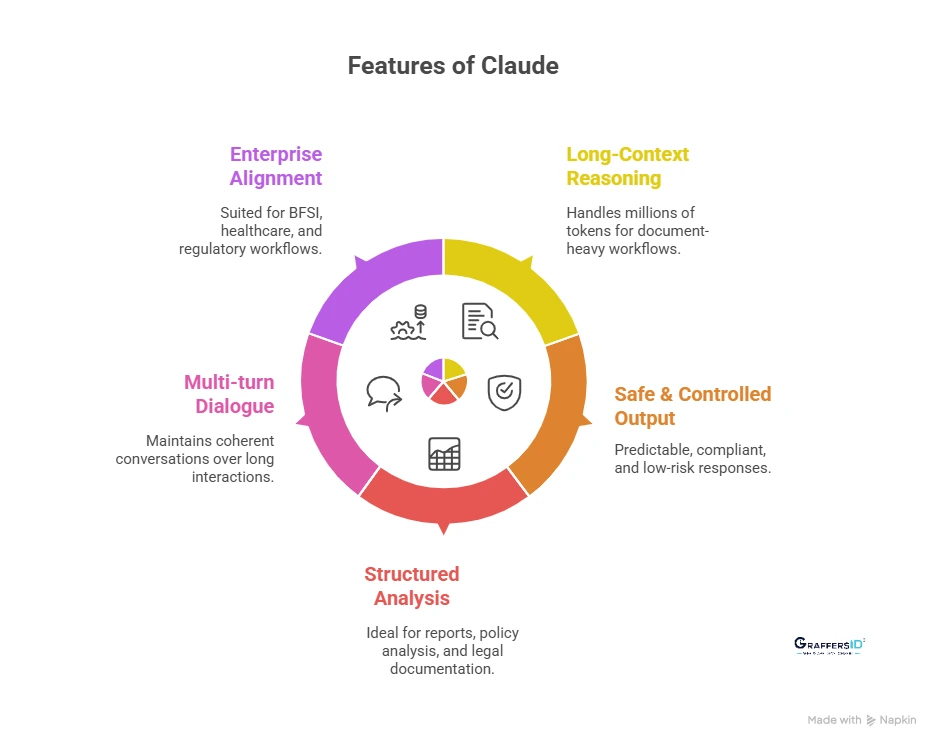
Long-Context Reasoning: Handles millions of tokens for document-heavy workflows.
-
Safe & Controlled Output: Predictable, compliant, and low-risk responses.
-
Structured Analysis: Ideal for reports, policy analysis, and legal documentation.
-
Multi-turn Dialogue: Maintains coherent conversations over long interactions.
-
Enterprise Alignment: Suited for BFSI, healthcare, and regulatory workflows.
Read More: What is Claude AI? Features, Use Cases, and Technical Benefits in 2026
Use Cases for Claude
-
Legal and insurance policy analysis
-
Financial reports and compliance automation
-
Research and knowledge management
-
Internal document summarization
What is ChatGPT? (OpenAI GPT 5.1 Overview)
ChatGPT is a next-generation language model developed by OpenAI, designed for coding, AI automation, and multimodal applications. In 2026, ChatGPT 5.1 powers AI agents, enterprise workflows, and in-app AI features for businesses globally.
Key Features of ChatGPT 5.1
-
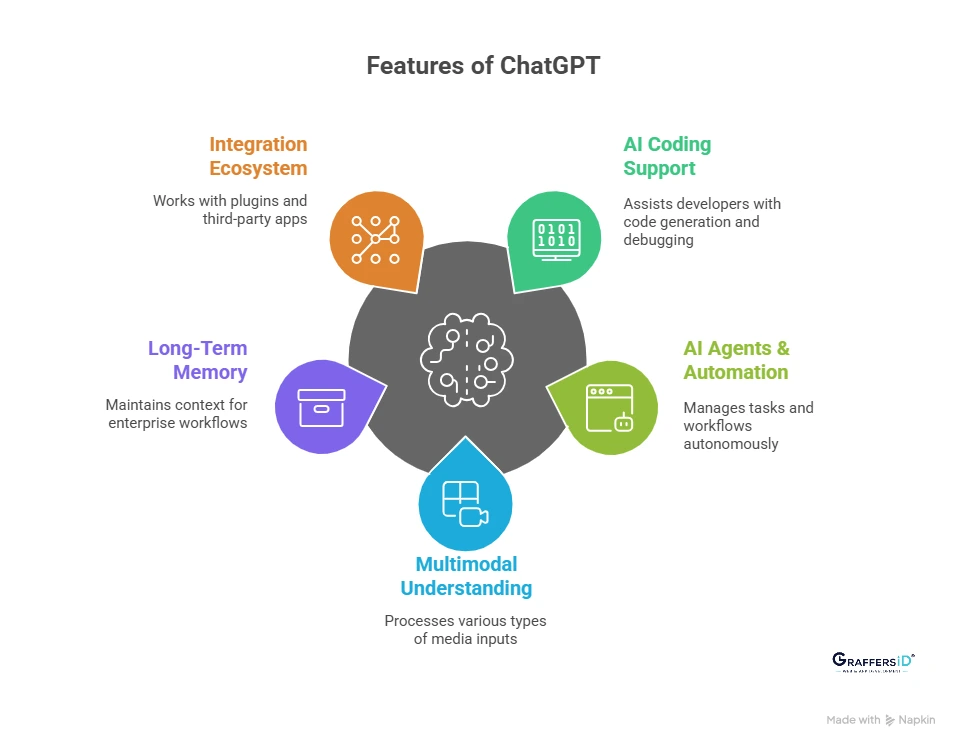
AI Coding & Developer Support: Multi-file code generation, debugging, testing, and refactoring.
-
AI Agents & Automation: Can call APIs, orchestrate workflows, and manage tasks autonomously.
-
Multimodal Understanding: Processes text, image, audio, and video inputs.
-
Long-Term Memory & Context: Maintains selective memory for enterprise workflows.
-
Integration Ecosystem: Works with GPT Store, plugins, and third-party apps.
Read More: Which OpenAI ChatGPT Version Should You Use in 2026? (Complete Business Guide)
Use Cases for ChatGPT
-
Building AI-powered apps and SaaS products
-
Automating business workflows
-
Engineering team productivity tools
Key Differences Between Claude and ChatGPT in 2026: Feature-by-Feature Comparison
1. Reasoning and Problem-Solving Abilities
Claude: Best for Structured Reasoning
-
Excels at understanding long-context documents, making it ideal for research-heavy workflows.
-
Performs analytical reasoning to summarize insights accurately.
-
Perfect for policy, compliance, and legal workflows where accuracy and structure matter.
ChatGPT: Best for Adaptive Reasoning
-
Handles multi-step reasoning across complex tasks dynamically.
-
Excels in planning and decision sequencing, suitable for AI-driven project workflows.
-
Supports code reasoning and test generation, integrating reasoning with execution.
Verdict:
-
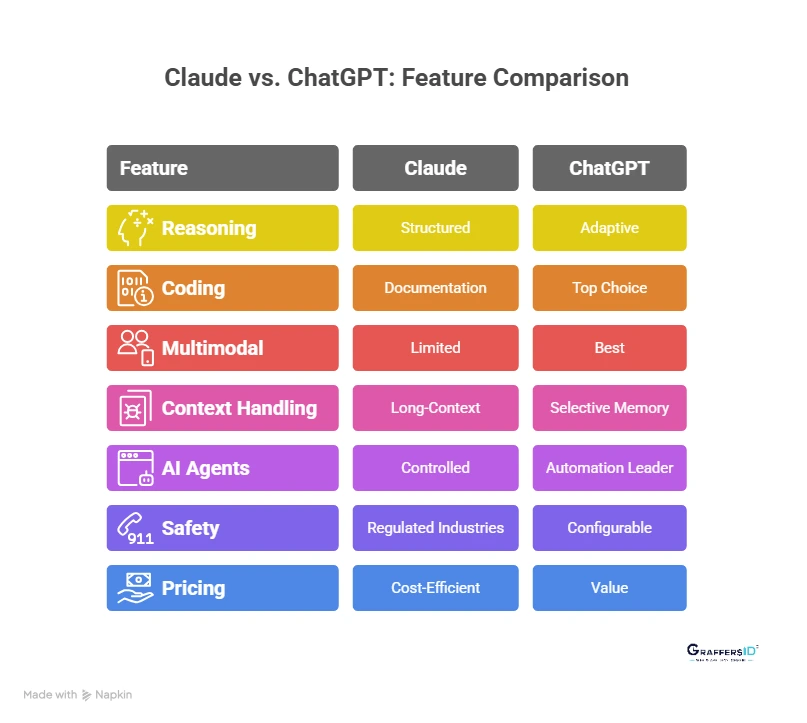
Claude for structured, research-driven reasoning.
-
ChatGPT for adaptive, task-oriented problem-solving.
2. Coding and Developer Support
ChatGPT: Top Choice for Developers
-
Generates multi-file code efficiently, reducing manual coding effort.
-
Provides real-time debugging and error correction for faster development cycles.
-
Supports full-stack engineering prompts, including API integration and dependency management.
-
Can create reusable components, unit tests, and testing frameworks, boosting team productivity.
Claude: Strong for Documentation
-
Great at explaining code logic and generating technical documentation.
-
Limited in real-time execution and complex code generation compared to ChatGPT.
Verdict: ChatGPT: the #1 coding assistant for engineering teams in 2026.
3. Multimodal AI Capabilities
ChatGPT: Best for Multimodal Workflows
-
Understands video content for analysis and insights.
-
Performs advanced image reasoning for product and design tasks.
-
Supports speech-to-text and text-to-speech, enhancing voice-driven applications.
-
Analyzes audio sentiment and interprets structured and unstructured inputs simultaneously.
Claude: Limited Multimodality
-
Handles text and images effectively.
-
Offers light multimodal capabilities, but no advanced video or audio interpretation.
Verdict: ChatGPT for enterprise applications requiring multimodal intelligence.
Read More: Claude vs. Gemini: Which LLM is Better for IT Workflows Like Coding and Automation in 2026?
4. Context Handling and Memory
Claude: Best for Long-Context Work
-
Supports massive context windows, suitable for documents with 1M+ tokens.
-
Maintains better long-context coherence, ensuring accurate summaries over large datasets.
-
Excels in memory recall for policy-heavy content, ideal for regulated sectors.
ChatGPT: Smart but Selective Memory
-
Uses a smart attention mechanism to prioritize important context.
-
Handles medium to long context well but may struggle with ultra-large documents.
Verdict: Claude for research-intensive and document-heavy workloads.
5. AI Agents and Automation
ChatGPT: Automation Leader
-
Calls APIs and triggers workflows automatically.
-
Can manage tools, run processes, and execute tasks autonomously.
-
Enables enterprise-grade AI agent deployment with supervision for critical systems.
Claude: Safer, Controlled Agents
-
Provides controlled AI agent functionality.
-
Best for environments where safety and predictability are prioritized.
Verdict: ChatGPT is ideal for automation and enterprise orchestration.
6. Safety, Compliance, and Guardrails
Claude: Preferred for Regulated Industries
-
Strong alignment with ethical and regulatory standards.
-
Generates predictable outputs with minimal risk of hallucination.
-
Safer for BFSI, healthcare, and legal workflows due to Constitutional AI guardrails.
ChatGPT: Configurable Safety
-
Offers safety features but is more flexible and less controlled, requiring supervision.
Verdict: Claude for governance-sensitive workflows.
7. Pricing and Scalability
Claude: Cost-Efficient for Long-Context Tasks
-
More economical for document-heavy workflows and long-context AI applications.
-
Scales effectively for research and compliance-heavy use cases.
ChatGPT: Value for Multimodal and Automation
-
Offers enterprise bundles with AI agents, reducing total operational costs.
-
Ideal for multimodal, coding, and automation-heavy workflows.
Verdict:
-
Claude for research, compliance, and long-context processing.
-
ChatGPT for engineering, automation, and multimodal tasks.
Read More: OpenAI’s GPT vs. Google Gemini: Which AI Model is Better for Workflow Automation in 2026?
How to Choose the Best AI Model for Your Business in 2026
1. Identify Your Main Use Case
- If your focus is on software development or engineering workflows, ChatGPT performs best.
- If you need deep research, reasoning, or long-form analysis, Claude delivers stronger results.
2. Evaluate Your Automation Requirements
- Choose ChatGPT if you need AI agents that can automate workflows, call APIs, or run tasks autonomously.
- Choose Claude if your priority is stable, safe, and controlled reasoning with minimal risk.
3. Understand Your Workload Size
- Claude is ideal for long-context work like reviewing large documents or processing big knowledge bases.
- ChatGPT works best for fast, repeated, short-to-medium tasks across teams.
4. Align with Your Tech Stack
- If you’re building AI-driven features inside your product or app, ChatGPT integrates more smoothly.
- If you handle compliance-heavy or policy-driven operations, Claude provides better governance.
Best AI Model for Your Business: When to Use Claude vs. ChatGPT in 2026
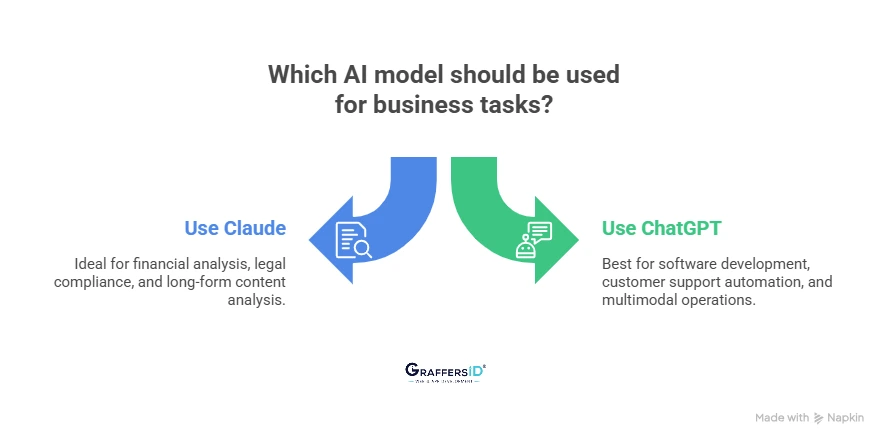
When to Use Claude?
- Financial Analysis: Claude excels at processing complex financial data and generating accurate reports.
- Insurance Workflows: Ideal for managing policy reviews, claims analysis, and regulatory compliance tasks.
- Legal Compliance Tasks: Helps enterprises interpret regulations and ensure risk-free documentation.
- Enterprise Documentation: Efficient at summarizing, organizing, and maintaining corporate knowledge.
- Reasoning-Heavy Reports: Delivers well-structured insights for strategic decision-making.
- Long-Form Content Analysis: Handles large documents and research materials with deep contextual understanding.
- Research and Policy Review: Perfect for evaluating policies, drafting reports, and analyzing extensive data sets.
When to Use ChatGPT?
- Software Development: Generates, refactors, and debugs code across multiple programming languages.
- Automated Workflows: Powers enterprise automation and orchestrates complex business processes.
- AI Agent Systems: Builds autonomous agents capable of calling APIs and executing tasks.
- Customer Support Automation: Handles conversational AI, queries, and multilingual support at scale.
- AI Features in Mobile/Web Apps: Integrates smoothly to add intelligent capabilities to digital products.
- Product Prototyping: Speeds up MVP development with code generation and idea validation.
- Multimodal Enterprise Operations: Processes text, image, video, and audio inputs for diverse business needs.
Conclusion: Claude vs. ChatGPT: Which AI Model Is Right for Your Business in 2026?
In 2026, there is no single “best” AI model, only the best fit for your business goals. Claude and ChatGPT both lead the market, but they excel in different areas that directly impact automation, engineering velocity, customer experience, and operational efficiency.
- Choose Claude if you need deep reasoning, compliance-safe outputs, and long-context document processing.
- Choose ChatGPT if you need powerful multimodal AI, full-stack engineering support, workflow automation, and enterprise-ready AI agents.
Ultimately, the real competitive advantage comes not from the model itself, but from how effectively you integrate, deploy, and scale AI across your organization.
If your business is planning to adopt AI for automation, engineering, product development, or digital transformation in 2026, the smartest move is partnering with experts who understand both models deeply.
GraffersID helps global enterprises develop AI-powered applications, custom AI agents, workflow automation systems, and scalable digital products.
Ready to build your AI solution?
Hire AI developers from GraffersID and accelerate your 2026 roadmap.