| Quick Takeaways
• LinkedIn ranked AI Engineer the fastest-growing job in the US for 2026, with postings up 143% year over year. • The fully loaded annual cost of a US-based senior AI engineer routinely exceeds $300,000 when salary, benefits, equity, and recruiting fees are factored in. • Staff augmentation gets you production-ready AI developers in 2 to 4 weeks, compared to the 4 to 6 months a full-time hire typically takes. • The skills that matter most are not credentials. They are hands-on production experience with LLM frameworks, RAG architecture, and agentic system design. |
Half the people calling themselves AI developers in 2026 are wrapping ChatGPT in an API call and billing at senior rates. They build a demo that works on a Tuesday afternoon. What they cannot do is ship AI systems that hold up in production.
That gap matters because the demand for genuine AI engineering talent has never been higher. LinkedIn’s 2026 Jobs on the Rise report ranked AI Engineer as the fastest-growing role in the US, with postings up 143% year over year. Supply has not kept up. Salaries are at record highs. The average time to fill a senior AI role through traditional hiring is now pushing five months.
This post gives you a practical framework covering what kind of AI developer your project actually needs, what skills to test, what it realistically costs, and which hiring model makes sense for your stage. If you are already clear on the hire and just want to move, you can hire AI developers from GraffersID directly.
What Kind of AI Developer Do You Actually Need?
Most companies lose weeks here. They write a job description for an AI developer without realising this term covers four genuinely different profiles. Hiring the wrong one often means rebuilding from scratch three months later.
The Four Profiles
The AI Agent Engineer is who you need if you are building autonomous workflows or multi-step systems that take action without constant human input. If you want to understand what building that actually involves, this guide on how to build an AI agent is a useful starting point. These engineers work primarily with LangChain, LangGraph, CrewAI, and AutoGen.
The LLM and RAG Engineer focuses on knowledge-grounded systems: document search, retrieval pipelines, and fine-tuned models. If your product needs to answer questions accurately from your own data, this is the profile you need.
The ML Engineer builds and trains machine learning models from scratch. Most product-stage startups do not need this profile yet, though many think they do.
The MLOps Engineer handles infrastructure: model serving, monitoring, and inference cost optimisation. You need them once models are live and reliability starts mattering.
Match the Profile to Your Use Case
Building a chatbot, an AI workflow, or an internal automation tool? That is profile 1 or 2. Training proprietary models on your own dataset? That is profile 3. Models already in production and reliability becoming a problem? That is profile 4. Getting this right before you write the job description saves at least a month of wasted sourcing.
The Skills That Separate Builders from Demo Artists
Credentials do not tell you much in this market. A strong degree from 2021 may come with zero experience in the tools that actually matter today. What you are evaluating is production experience with a specific, modern skill set.
Technical Skills That Actually Matter
Python is the baseline, non-negotiable. Beyond that, the skills that consistently separate candidates who can ship from those who cannot are: hands-on experience with LLM frameworks, a working understanding of what retrieval-augmented generation actually involves, familiarity with vector databases like Pinecone or Weaviate, and practical deployment experience on cloud platforms.
Understanding how LangChain fits into an AI development stack has become a near-universal requirement. It appears in roughly 34% of all agentic AI job postings in 2026. RAG architecture experience adds around 10 to 15% on top of base rates. MLOps and deployment capability adds another $15,000 to $30,000 versus a notebook-only candidate.
The Soft Skills Most Guides Skip
Can they translate a vague business problem into an ML approach? Can they tell you when AI is not the right solution? Can they explain model behaviour to a product manager who does not know what a transformer is? These things matter enormously in a cross-functional team. A developer who cannot communicate clearly creates expensive misalignments between what engineering builds and what the product actually needs.
The four core AI developer profiles and the production skills that distinguish each of them from demo-only candidates.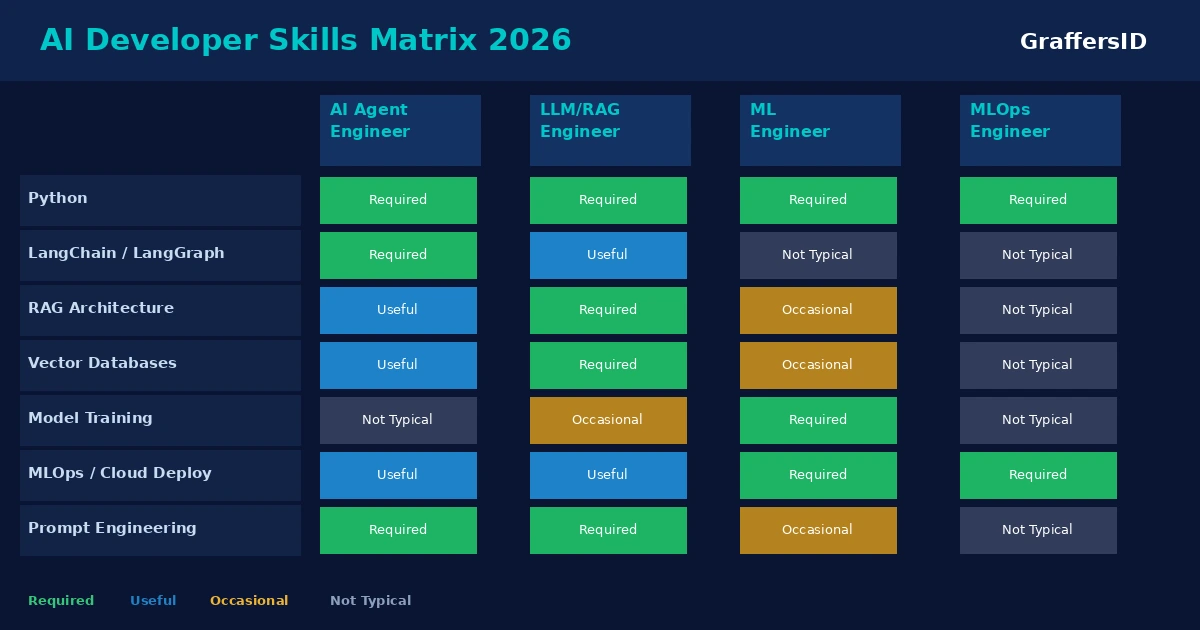
| Read Also: Agentic AI in Software Development: What CTOs Need to Know in 2026 |
What Does It Actually Cost to Hire an AI Developer in 2026?
Most salary guides understate the real number. They show the base salary. They leave out benefits, equity, recruiter fees of 15 to 25% of first-year salary, onboarding time, and management overhead.
The Real Cost of US Full-Time Hiring
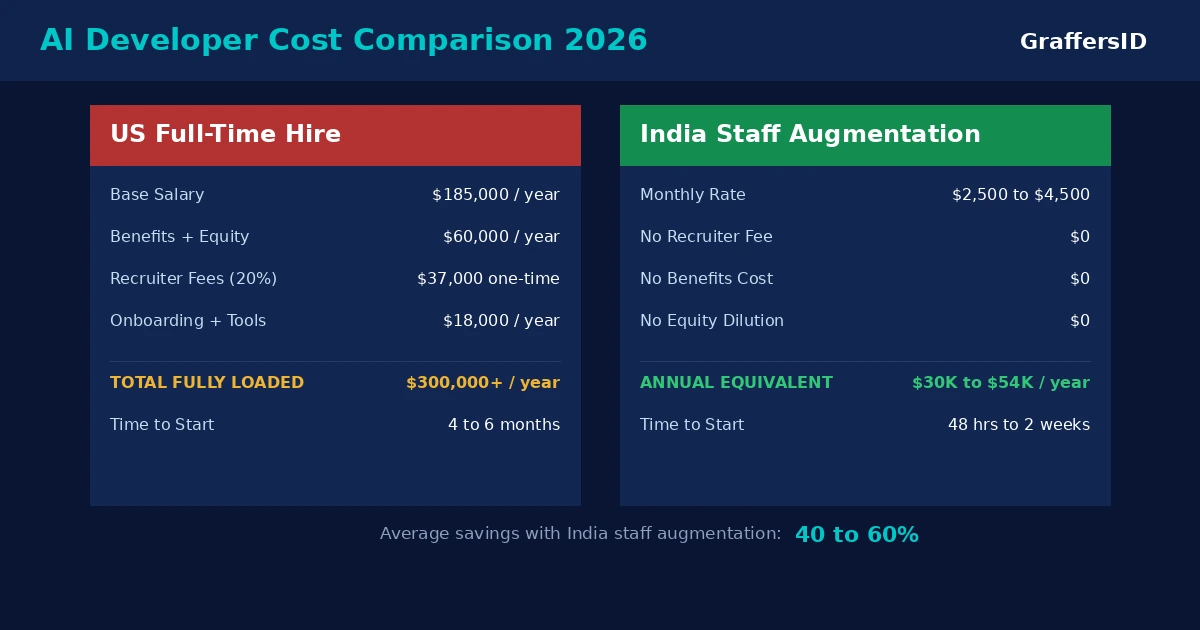
The median base salary for a senior AI engineer in the US hit $185,000 in 2026. The fully loaded annual cost, once everything is included, routinely exceeds $300,000. And the average time to fill that role is 4 to 6 months. That is not slow progress. That is zero progress on whatever the hire was supposed to own.
India vs Eastern Europe vs US: The Honest Comparison
The cost arbitrage in India is real and significant. A senior AI developer from India through a staff augmentation model typically costs $2,500 to $4,500 per month. The skill level at that price point is genuinely comparable to US-based senior talent when you are sourcing from a properly vetted pool.
Fully loaded annual cost for a US-based senior AI engineer vs monthly staff augmentation rates through GraffersID in 2026.
Full-Time Hire vs Staff Augmentation: Which Model Is Right for You?
For most companies in 2026, especially those at the startup or scale-up stage, staff augmentation is the faster and more capital-efficient path. But context matters.
When Full-Time Hiring Makes Sense
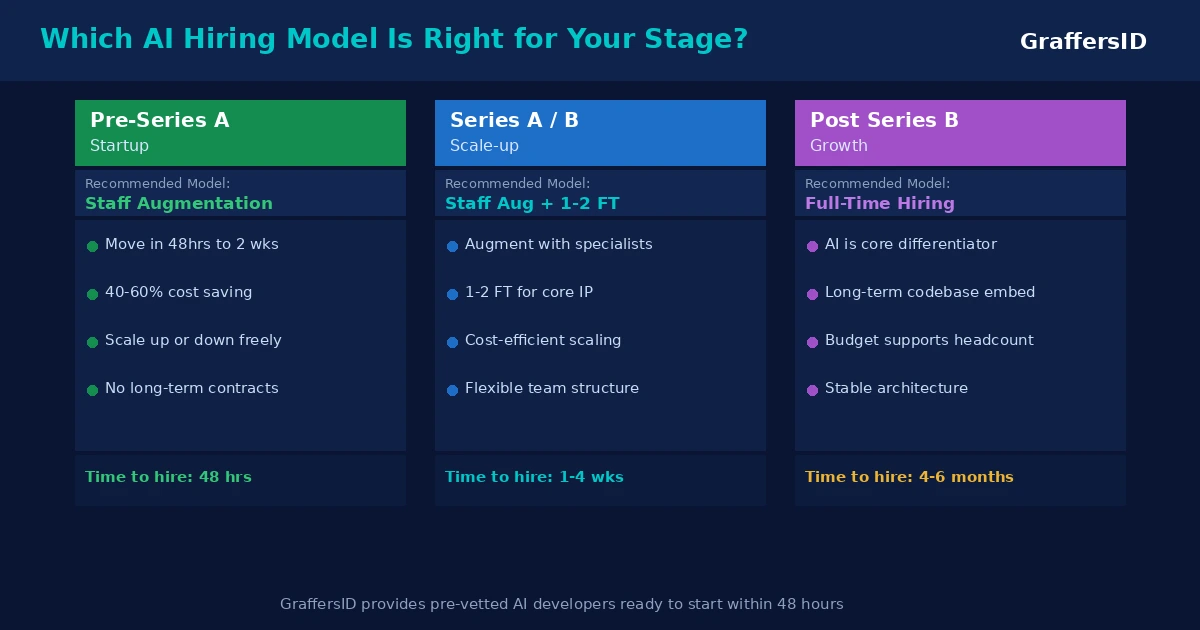
If AI is a core differentiator in your product, not just a feature, you eventually need engineers who are deeply embedded in your team, your codebase, and your roadmap. That is a full-time hire, and it generally makes sense post Series B when your architecture is stable and the work is long-term. Even then, understanding the difference between IT staff augmentation and traditional consulting or hiring is worth doing before you commit.
When Staff Augmentation Wins
If you need to move fast, if you are pre-Series B, or if you are experimenting with AI features before committing to a full team, staff augmentation is the right model. It gets you production-ready developers in 2 to 4 weeks at 40 to 60% less than equivalent US-based talent. For a fuller picture of the options available, the comparison between staff augmentation, dedicated teams, and full outsourcing covers those trade-offs in detail.
How to Interview AI Developers Without Getting Fooled
Standard algorithm tests do not work for AI hiring. Plenty of candidates pass a coding challenge and still deliver a system that hallucinates in production or collapses the moment a tool call returns an unexpected response.
Three Questions That Reveal Real Experience
- Ask them to walk you through a production AI system that broke. What broke, why did it break, what did they change? A developer who has shipped real systems will have a specific, detailed answer. Someone who has only built demos will give you generalities.
- Ask how they would design memory for an agent that needs context from conversations three weeks ago. This reveals whether they understand the actual architecture of stateful agents.
- Ask what happens when a tool call fails mid-task in an agentic workflow. Do they have a recovery strategy? The answer shows whether they understand reliability engineering for AI, which is a genuinely different discipline from writing the happy path.
Red Flags to Watch For
Be cautious of candidates who list LangChain as their only framework but cannot describe a project that required understanding what it does under the hood. Watch for anyone claiming more than three years of production AI agent experience. LangChain got meaningful adoption in late 2023. The most experienced practitioners have two to three years of real production time at most. Anyone claiming more is worth questioning closely.
The broader shift in how AI is changing hiring is also worth understanding. How AI agents are already changing the way startups hire developers covers this from a useful angle.
A practical decision framework for CTOs choosing between full-time hiring and staff augmentation for AI developers in 2026.
|
Final Thoughts
Hiring AI developers well in 2026 comes down to three things. Get specific about which profile you need before you start sourcing. Evaluate on production experience, not credentials. And choose the hiring model that fits your stage, not the one that sounds impressive in a board update.
For most companies right now, that third point means seriously considering staff augmentation over a full-time US-based hire. The time and cost savings are substantial. And when you are working with a properly vetted pool, the talent quality is genuinely comparable.
At GraffersID, we help startups and enterprises hire pre-vetted AI developers from India who are ready to work on production systems. Our developers are experienced with LLM frameworks, RAG pipelines, and agentic workflows, and can typically start within 48 hours.
| Ready to hire a production-ready AI developer without the six-month wait?
Tell us what you are building and we will match you with the right engineer in 48 hours. |