Quick Takeaways
- Staff augmentation puts external developers directly inside your team under your control, billed hourly, with no long-term lock-in, the most flexible model available in 2026
- A dedicated team is a vendor-managed squad working exclusively on your product at a fixed monthly fee, suited to long-horizon roadmaps where scope is relatively stable
- Project outsourcing transfers a defined deliverable to a vendor. It looks cheaper upfront, but scope drift makes it expensive fast
- Global staff augmentation spending is growing at 13.2% CAGR and is on track to hit $81.9 billion. This model is no longer a fallback; it is a primary engineering strategy for fast-moving companies
Picture a CTO, let’s call him Raj, who has 14 engineers, a Series A closing in six weeks, and two critical product features still unbuilt. He needs four more developers. Fast. He opens three tabs: one about staff augmentation, one about dedicated teams, and one about outsourcing. Every guide tells him the same recycled thing: “it depends on your needs.” That’s not an answer. That’s a shrug dressed up as advice.
This post is different. It breaks down all three models honestly, shows you where the real costs live, and gives you a clear framework for making the call. If you read to the end, you’ll know exactly which model fits your situation and why, for most scaling startups in 2026, staff augmentation is the model that keeps control in your hands while moving fast.
What Each Model Actually Means
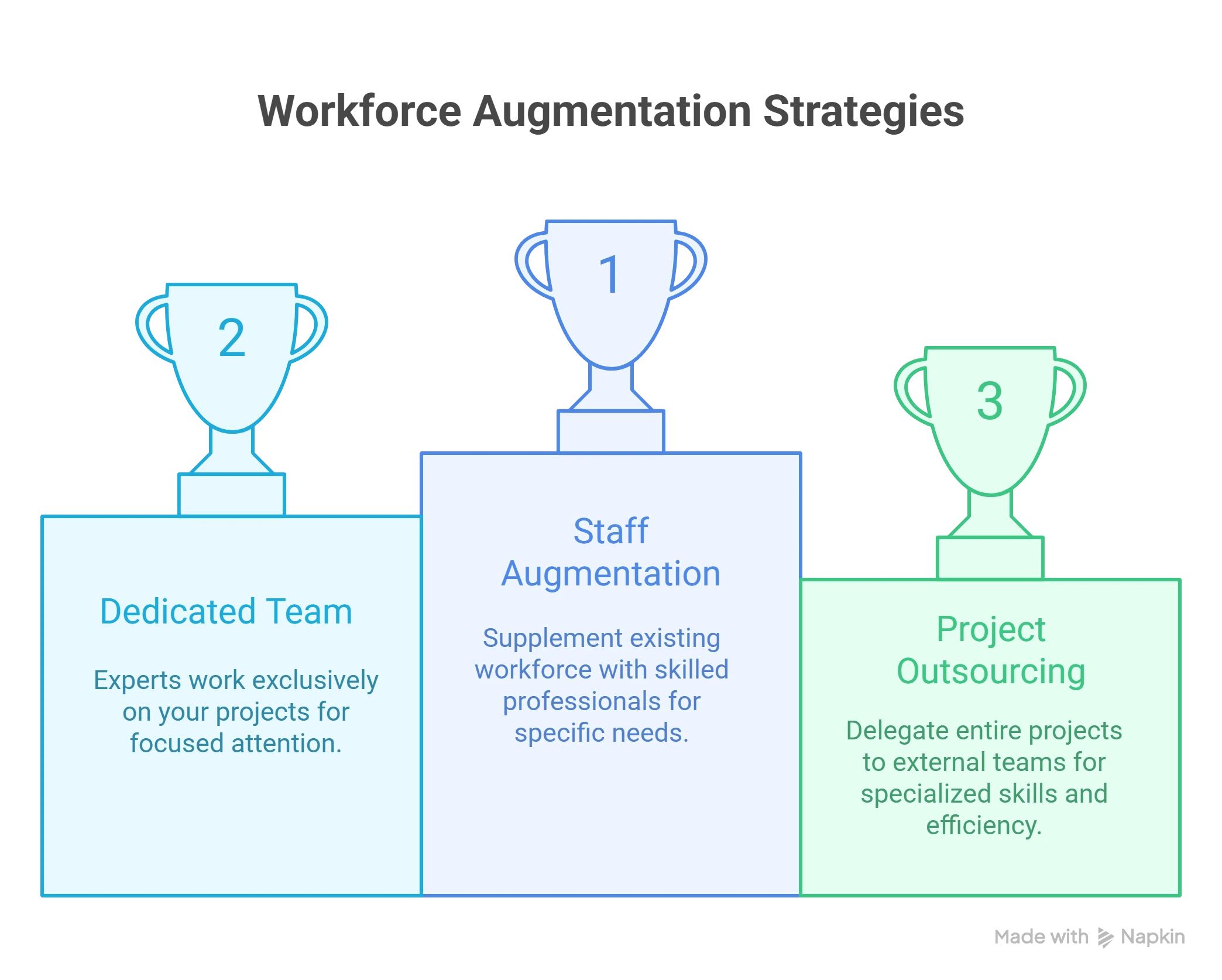
Before comparing, let’s make sure we’re working from the same definitions. These three terms get used interchangeably in vendor pitches, which causes a lot of confusion.
Staff Augmentation
Staff augmentation is a contracting model where external developers join your existing team. They work inside your Slack, attend your standups, use your Jira board, and report to your engineering lead. You direct the work day-to-day. You pay hourly or monthly per developer. The talent is external, but the control is entirely yours.
This is the model GraffersID operates on. When you bring in an augmented developer through us, they integrate into your workflow within a week, follow your processes, and operate like an extension of your in-house team, not like a vendor you hand specs to and wait on.
For a deeper look at how this compares to traditional outsourcing, the staff augmentation vs outsourcing guide covers the key distinctions in detail.
Dedicated Team
A dedicated team is a complete external squad of developers, QA engineers, and sometimes a project manager assembled by a vendor and working exclusively on your product. The vendor manages the team’s operations, HR, and infrastructure. You set the product direction. You pay a fixed monthly fee for the whole squad.
It involves more vendor ownership than augmentation, and it works well when you’re running a long-term product roadmap and don’t want to manage individual contractors. The tradeoff is less day-to-day control and a higher monthly cost floor.
Project Outsourcing
Outsourcing means handing a defined deliverable, a feature, a migration, or an entire product to a third-party vendor. They own the process, manage their own team, and hand you back the result. You pay per project, and you get minimal visibility into what happens in between.
This model looks attractive on a spreadsheet. But here’s what most guides won’t tell you: scope churn is the number one source of cost overrun in outsourced engagements. Research from Deloitte’s global outsourcing studies has consistently found that scope drift adds anywhere from 20 to 40 percent on top of the original quote. That’s not a vendor failure. It’s a structural feature of fixed-bid contracts colliding with software, where requirements always evolve.
The Real Cost Comparison
This is where the comparison gets honest.
What Each Model Costs Beyond the Sticker Price
The listed rate is rarely the full price. Here’s a more complete picture based on 2026 market data: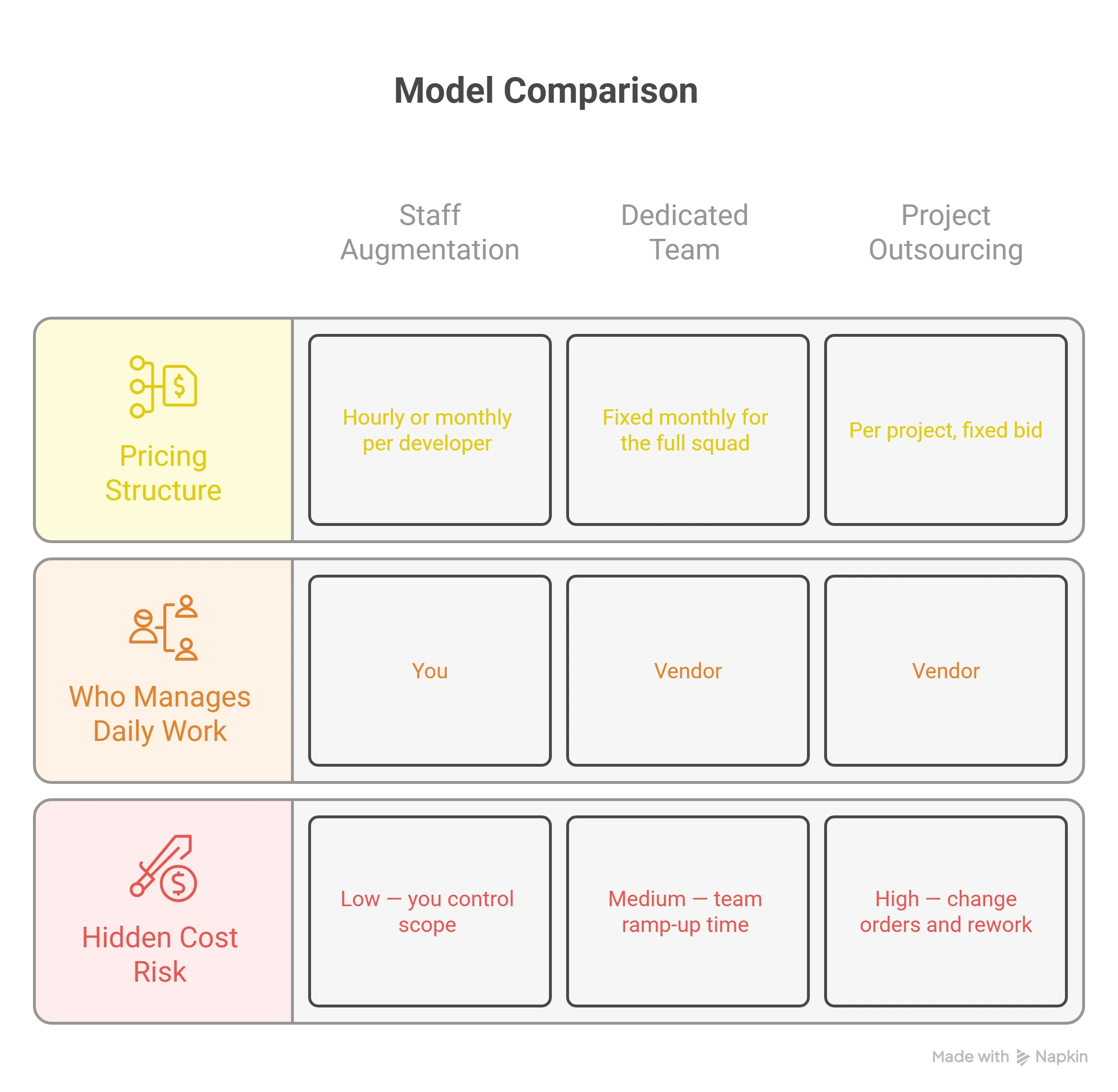
According to data from KORE1’s Q1 2026 placement report, outsourcing is only cheaper than staff augmentation when the project scope stays within 25 percent of the original spec. For most non-trivial software builds in 2026, the scope moves more than that. When it does, change-order costs on a fixed-bid engagement climb fast.
Staff augmentation has no change-order mechanism. When your product direction shifts, and it will, you simply redirect your developers.
- No renegotiation.
- No new statement of work.
- No surprise invoices.
For a broader look at how developer costs break down across hiring models, the cost to hire an app developer is worth reading before you commit to any engagement structure.
What Each Model Actually Costs You A side-by-side comparison of pricing structure, management ownership, and hidden cost risk across all three engagement models.
Read Also: Top Tech Trends for Scaling Startups
When Should You Choose Staff Augmentation?
Staff augmentation is the right model when you have internal technical leadership, a CTO, a lead engineer, a product manager who can direct developers, and you need to scale capacity without building permanent headcount.
Concretely, it fits when:
- You need developers integrated within days, not months
- Your product scope is evolving sprint-to-sprint and can’t be fixed-bid
- You want direct visibility into every commit, every pull request, every standup
- You’re not ready to hire full-time, but need the output of full-time engineers
- You want to scale up or down based on funding milestones rather than vendor contract terms
The pros and cons of IT staff augmentation post covers the model’s limitations honestly, too, because knowing when it doesn’t fit is just as useful as knowing when it does.
When Does a Dedicated Team Make Sense?
A dedicated team makes sense when you’re running a long product roadmap, typically 12 months or more, and you don’t have internal engineering leadership available to manage individual contractors day-to-day.
If you have the budget and want a stable squad that compounds domain knowledge over time, the dedicated model can outperform augmentation over a multi-year horizon. Research from Information Services Group found that companies switching from time-and-materials staffing to dedicated managed services save an average of 15 percent over that longer timeframe.
The catch is the ramp-up cost and the commitment floor. A dedicated team takes longer to assemble and carries a higher monthly baseline. For startups in active growth sprints with evolving roadmaps, that rigidity is often more pain than it’s worth.
When Is Project Outsourcing the Right Call?
Outsourcing works when three conditions are all true simultaneously: the scope is clearly defined, the requirements are unlikely to change, and you don’t need visibility into the day-to-day process.
That combination is rarer than most decision-makers expect. It tends to fit well for discrete, well-understood modules, such as a data migration, a standalone API integration, a legacy system audit, rather than core product development, where your users’ needs are still shaping the build.
If you’re building a product that users will live in and your team will iterate on for years, handing that off to a vendor and accepting a black-box delivery process is a risk most CTOs regret.
Read Also: Benefits of MVP Development Approach in Product Development
The 4-Question Model Selector A decision flowchart: Who manages daily work? Is scope stable? Do you need direct code visibility? What is your timeline? Each path leads to one of the three engagement models.
The Decision Framework: 4 Questions to Ask Before Signing Anything
Most guides give you a pros-and-cons table and leave you to figure out the rest. Here’s a faster way to land on the right answer.
Question 1: Who Will Manage the Developers Day-to-Day?
If you or someone on your team will manage directly, staff augmentation gives you the control to do that without friction. If no one internally has the bandwidth to manage a developer, a dedicated team with its own project manager might be worth the premium.
Question 2: How Stable Is Your Scope, Really?
Be honest here. Most founders say “fairly stable” and mean “we think we know what we’re building.” If you’re pre-product-market-fit, your scope will move. Staff augmentation handles that without penalty. Outsourcing does not.
Question 3: How Fast Do You Need to Move?
At GraffersID, the process from sharing requirements to developer onboarding takes under one week. That speed is a structural feature of staff augmentation, you’re not waiting for a vendor to assemble a team or run discovery sprints. You get developers inside your workflow fast, on your terms.
Question 4: What Happens to the Knowledge When the Engagement Ends?
With staff augmentation, every architectural decision, every edge case your developers discover, every context they build about your codebase that stays with your team. You’ve been in every conversation. With outsourcing, that knowledge often lives inside the vendor’s team, and knowledge transfer at handoff is notoriously incomplete.
For teams building complex, long-term products, product development services that keep your internal team in control throughout the build are almost always the better-compounding investment.
What Most Guides Get Wrong About These Models
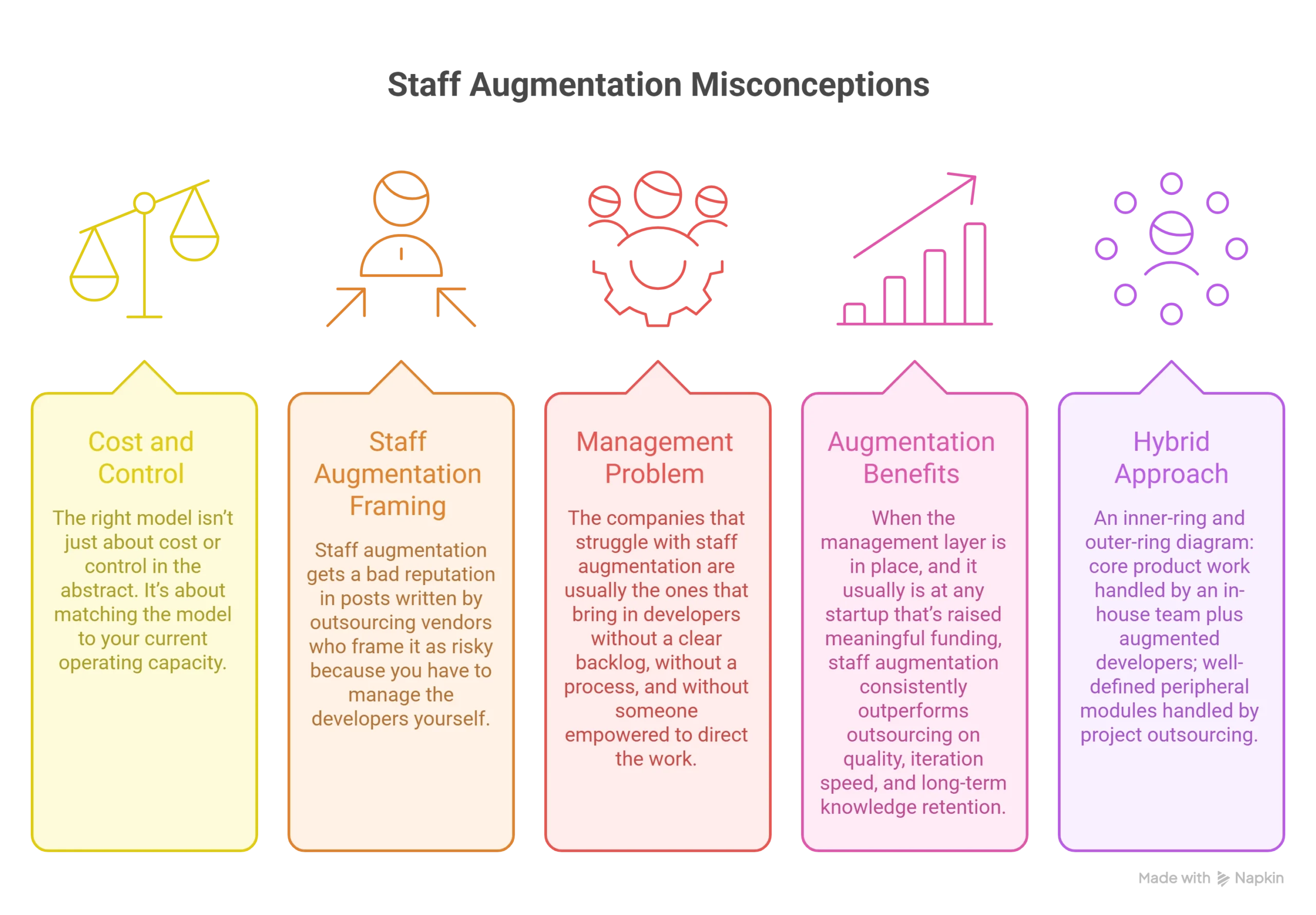
Here’s the honest admission most comparison posts skip over: the right model isn’t just about cost or control in the abstract. It’s about matching the model to your current operating capacity.
Staff augmentation gets a bad reputation in posts written by outsourcing vendors who frame it as risky because you have to manage the developers yourself. That framing has it backwards. If you’re a CTO who knows what you’re building and how you want it built, you don’t want a vendor making architectural decisions behind a closed door. You want developers you can direct, challenge, and course-correct in real time.
The companies that struggle with staff augmentation are usually the ones that bring in developers without a clear backlog, without a process, and without someone empowered to direct the work. That’s a management problem, not a model problem. And it’s fixable.
When the management layer is in place, and it usually is at any startup that’s raised meaningful funding, staff augmentation consistently outperforms outsourcing on quality, iteration speed, and long-term knowledge retention. The staff augmentation vs managed services comparison is also worth reviewing if you’re evaluating against enterprise-style managed IT arrangements.
The Hybrid Approach Most Scale-Ups Use: An inner-ring and outer-ring diagram: core product work handled by an in-house team plus augmented developers; well-defined peripheral modules handled by project outsourcing.
Conclusion
The global outsourcing market sits at over $730 billion and keeps growing. Staff augmentation alone is growing at 13.2% CAGR. These aren’t niche options anymore; they’re the primary way fast-moving technology companies build engineering capacity in 2026.
But the choice still matters. Outsourcing trades control for convenience, and that trade costs you in scope creep, rework, and knowledge loss. A dedicated team trades flexibility for stability, which works when your roadmap is long and your requirements are settled. Staff augmentation gives you speed, control, and the ability to pivot without penalty, which is exactly what most scaling startups actually need.
If your team has a clear backlog and an engineering leader who can direct developers, staff augmentation isn’t just one option among three. It’s the model built for how good product teams actually work.
Ready to scale your engineering team without losing control of your product? At GraffersID, we place pre-vetted developers inside your workflow in under one week no long contracts, no black-box delivery, no surprises.
FAQ
1. What is the main difference between staff augmentation and outsourcing?
Staff augmentation adds external developers to your existing team, working under your direct management and following your processes. Outsourcing hands an entire project or deliverable to a third-party vendor who manages execution independently. The core difference is who owns the day-to-day work and who carries the delivery risk in staff augmentation; that’s always you.
2. Is staff augmentation cheaper than outsourcing?
It depends on how stable your scope is. When project requirements stay within 25 percent of the original spec, outsourcing can appear cheaper on paper. When the scope shifts beyond that which happens on most software projects, staff augmentation avoids the change-order costs that make outsourcing significantly more expensive in practice.
3. When is a dedicated team better than staff augmentation?
A dedicated team makes more sense for long-term engagements of 12 months or more, where you want a stable, vendor-managed squad with its own internal coordination structure. For shorter timelines or rapidly evolving product roadmaps, staff augmentation offers better flexibility at a lower commitment threshold.
4. How quickly can I onboard augmented developers?
With GraffersID, the full process from requirement sharing to developer onboarding takes under one week. That includes vetting, interviewing, and integration into your tools and workflow.
5. Which model is best for startups?
For most Series A and B startups with active product development and internal engineering leadership, staff augmentation offers the best balance of speed, control, and cost efficiency. It scales with your funding milestones and doesn’t lock you into vendor-managed delivery when your roadmap is still evolving.