In 2026, mobile apps are no longer judged by design, speed, or UI polish alone; they are judged by how intelligent they are. The apps leading the market today don’t just respond to users; they predict, personalize, and act autonomously. From AI chatbots and real-time recommendations to on-device vision models and autonomous AI agents, the global shift is undeniable:
AI is no longer a feature; AI is the product. Across the US, Europe, and fast-growing digital markets, enterprises now expect mobile apps to:
-
Predict user intent before users tap
-
Personalize every screen, flow, and recommendation
-
Automate repetitive tasks inside the app
-
Understand voice, text, images, and gestures
-
Work offline using compact, on-device AI models
-
Continuously learn from behavior and context
If you’re planning to build a mobile app in 2026, or upgrade your existing product with AI, your competitive edge will depend on how effectively you integrate intelligence into the core experience, not just the interface.
This guide gives CTOs, CEOs, and product leaders a complete blueprint for building a high-performing AI-powered mobile app in 2026. You’ll learn the latest AI technologies, practical implementation strategies, development workflows, and enterprise best practices.
What is an AI-Powered Mobile App in 2026?
An AI-powered mobile app in 2026 is a smart application that can analyze data, learn from user behavior, make decisions on its own, and automate in-app workflows. Instead of waiting for user input, these apps adapt in real time, making experiences faster, more personalized, and more intuitive.
Core AI Capabilities Used in Modern Mobile Apps in 2026
Here are the core AI technologies used in modern intelligent mobile apps:

1. Machine Learning (ML) for Predictions and Personalization
Machine Learning helps the app recognize patterns, forecast user needs, and personalize content automatically. In 2026, ML models inside apps can predict actions, detect anomalies, and optimize user flows without manual configuration.
2. Generative AI for Content, Voice, and Image Creation
Generative AI enables apps to create text, images, voices, product descriptions, and summaries instantly. Mobile apps now embed GPT-class models or domain-specific LLMs to generate personalized content, recommendations, and conversational responses.
3. Natural Language Processing (NLP) for Conversations and Commands
NLP powers chatbots, voice assistants, search bars, and natural language interfaces. In 2026, NLP allows apps to understand human-like language, analyze sentiment, interpret queries, and execute tasks via voice or text with high accuracy.
4. Computer Vision for Image Recognition and AR Experiences
Computer Vision allows apps to detect objects, scan documents, understand surroundings, and enable AR-based interactions. With lightweight vision models, apps can now process images in real time, even offline, improving speed and privacy.
5. AI Agents for Autonomous Task Execution
AI agents in apps can perform tasks without user intervention, such as booking appointments, generating reports, or monitoring user activity. These agents follow multi-step reasoning and make decisions based on rules, goals, and context.
6. On-Device AI for Offline Intelligence and Speed
On-device AI models run directly on the smartphone, enabling fast, private, low-latency processing. This is essential for apps that require instant responses like OCR, voice recognition, or real-time translations.
Top AI Use Cases for Mobile Apps in 2026
Here are the most valuable and widely adopted AI use cases that modern enterprises implement in mobile apps today.
1. Hyper-Personalization in Mobile Apps
AI-powered personalization now adapts the entire mobile experience for each user. Apps can dynamically adjust home screens, generate personalized product recommendations, and show predictive suggestions based on real-time context. Even UI layouts change based on user patterns, creating an experience that feels custom-built for each individual.
2. AI Chatbots and Voice Assistants for Mobile
Mobile apps in 2026 rely heavily on multimodal AI assistants that understand text, voice, and images. These assistants are powered by fine-tuned LLMs and help users complete tasks instantly, from answering finance queries to booking healthcare appointments to resolving e-commerce issues. They reduce support load while improving engagement and retention.
3. Computer Vision Features for Mobile Apps
Computer vision models bring powerful real-time capabilities directly to smartphones. Apps now include advanced document scanning, secure face recognition, AR-based try-on experiences, and instant object detection for retail, travel, and industrial applications. On-device CV models also improve speed, reduce latency, and enhance privacy.
4. Predictive Analytics for Smarter User Decisions
Predictive AI helps businesses make more accurate decisions directly inside the app. Mobile systems use AI for demand forecasting, churn prediction, fraud and risk scoring, and behavior-based insights that guide product recommendations and alerts. Apps become more proactive, guiding users before issues or decisions arise.
5. Automation and AI Agents Inside Mobile Apps
In 2026, AI agents are the biggest disruption in mobile app development. These autonomous agents can perform actions on behalf of users: booking tickets, processing refunds, updating calendars, managing tasks, or completing workflows without human input. Instead of users tapping through menus, agents get things done autonomously inside the app.
How to Build an AI App in 2026? (Step-by-Step Guide)
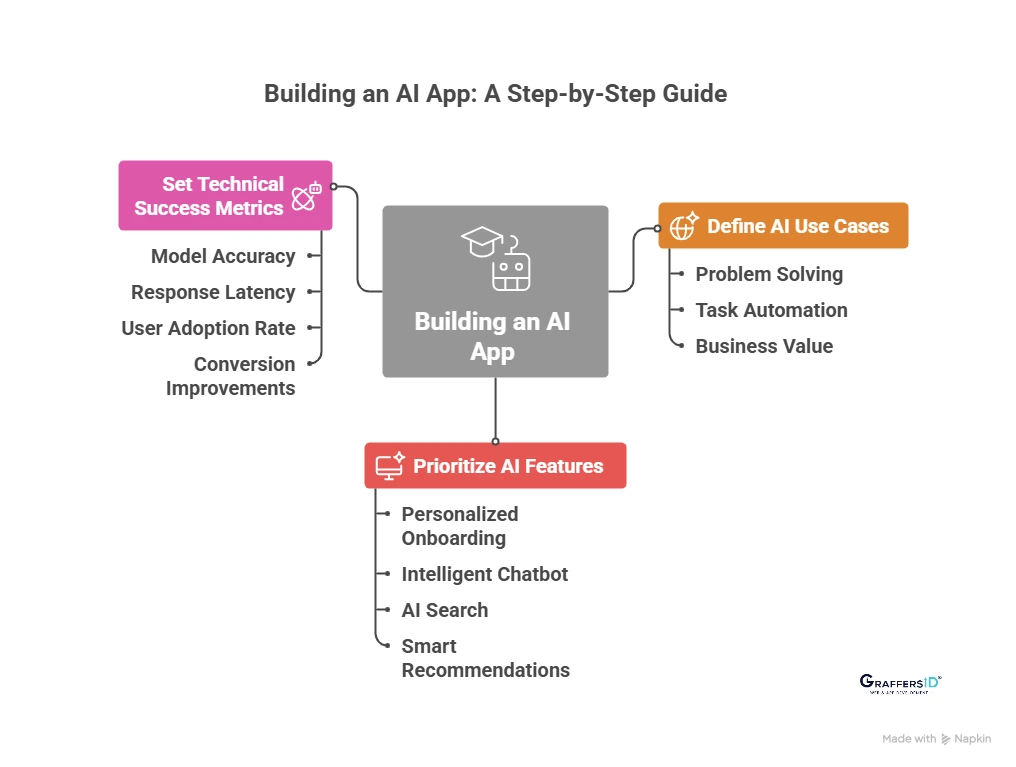
1. Define Your AI Use Cases
Before writing a single line of code, identify exactly why your app needs AI. Clarify the problems AI must solve, the tasks it must automate, and how it drives business value. Validate whether the use case is technically feasible with modern 2026 AI tooling and on-device models.
2. Prioritize AI Features for MVP
Start with a single high-impact AI feature instead of overloading the MVP. In 2026, the most successful apps launch with one core AI capability, such as personalized onboarding, an intelligent chatbot, AI search, or smart recommendations, and then scale gradually.
3. Set Technical Success Metrics for the AI System
Define measurable AI KPIs early to avoid unpredictable performance later. Metrics like model accuracy (80–95%), response latency (under 300 ms), user adoption rate, and conversion improvements will guide both engineering efforts and product decisions.
Choosing the Right AI Tech Stack for Mobile Apps in 2026
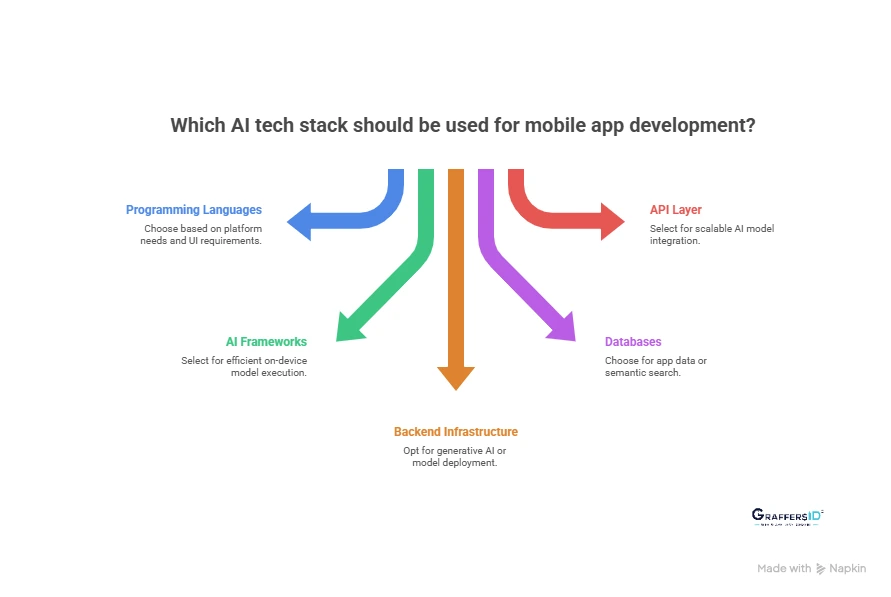
1. Programming Languages to Build AI Apps
-
React Native: the top choice for cross-platform, AI-integrated mobile development.
-
Flutter: ideal when you need smooth UI and fast iteration.
-
Swift / Kotlin: best for deep native integrations and on-device AI optimization.
2. AI & Machine Learning Frameworks
-
TensorFlow Lite and PyTorch Mobile for running efficient on-device models.
-
ONNX Runtime Mobile, the fastest option in 2026 for real-time inference.
-
Core ML and MediaPipe for iOS optimization and AI vision features.
3. Backend & AI Infrastructure
-
OpenAI GPT models, LLaMA-based models, and AWS Bedrock for generative AI tasks.
-
Google Vertex AI, HuggingFace models, and Replicate API for training, fine-tuning, or deploying vision/audio models.
4. Databases for AI Apps
-
MongoDB and PostgreSQL for app data.
-
Weaviate or Pinecone (vector databases) for storing embeddings and powering semantic search.
5. API Layer for AI Integration
-
Node.js, FastAPI (Python), or Golang for building scalable API layers that connect your app to AI models.
Data Strategy You Need for AI App Development in 2026
1. Build a Modern Data Pipeline:
A strong data pipeline improves model accuracy and reduces failure cases. Key steps include data collection, cleaning, labeling, versioning, generating embeddings, training (or fine-tuning), and deploying through a secure inference API.
2. Meet AI Data Privacy Requirements:
In 2026, data privacy laws demand strict compliance. Collect only essential data, obtain explicit user consent, and use edge AI models to process sensitive information directly on the device instead of the cloud.
How to Build and Integrate AI Models into Your App?
Option A: Use Pre-Trained Models (Fastest Method)
Pre-trained LLMs, LLaMA models, and vision models like YOLO or CLIP let you launch AI features quickly without needing to train anything. Ideal for startups and fast-moving teams.
Option B: Fine-Tune an Existing Model
Fine-tuning is best when you have domain-specific data or accuracy requirements. It enables custom workflows for sectors like finance, travel, or SaaS automation.
Option C: Build a Custom AI Model (For Enterprise Use Cases)
Only large enterprises with unique data (e.g., healthcare, cybersecurity) need custom models. These are resource-heavy but deliver maximum control and differentiation.
AI Integration Options
-
API-based for fast and cloud-driven inference
-
On-device for low latency and offline capability
-
Hybrid when you want both speed and scalability
How to Design User Experience for AI Apps (2026 Best Practices)
1. Design for Trust and Transparency
Users expect clarity on how AI makes decisions. Provide explanations, offer automation controls, and let users understand or adjust what the AI is doing.
2. Use Progressive, Predictive, and Adaptive UI
Use progressive disclosure to show complex AI features only when needed. Add “Why am I seeing this?” prompts and feedback loops to improve AI accuracy and build trust.
3. UX Inspirations
Netflix-style personalized recommendations, Google Photos-style visual search, and ChatGPT-style conversational interfaces remain industry standards in 2026.
How to Test AI Features in Your Mobile App?
1. Essential AI Test Types
Test AI accuracy, check for bias or fairness issues, validate latency and performance, run security scans, and perform usability tests with real users from different demographics.
2. Test AI Failure Scenarios
Evaluate how AI behaves when predictions are wrong, when data quality is poor, or when unexpected inputs like noisy audio or unclear images are provided.
How to Deploy and Scale an AI Mobile App?
1. Deployment Stages
Most teams deploy AI apps in four stages: Proof of Concept → Pilot launch → Staged rollout → Full-scale release. This reduces risk and ensures model reliability.
2. Scaling Requirements
Use cloud autoscaling, CI/CD for frequent model updates, and monitoring tools to track model drift, latency, and user adoption across real-world scenarios.
3. Model Maintenance
AI models must be retrained periodically as user behavior changes. Maintain strict version control, monitor drift, and schedule routine accuracy reviews.
Read More: Advancements in Natural Language Processing (NLP) in 2026: Tools, Trends, and AI Applications
Privacy and Compliance Requirements for AI Apps in 2026
1. GDPR Rules for AI-Powered Mobile Apps
GDPR in 2026 requires stricter data transparency, granular consent, and clear justification for collecting behavioral or biometric data. AI apps must implement privacy-by-design and ensure EU users can opt out without losing core functionality.
2. CCPA Compliance for AI Apps in the US
Under the 2026 CCPA updates, businesses must disclose how AI models use personal data, support “Do Not Sell/Share” requests, and provide explainable data logs. Mobile apps need user-friendly dashboards for data access and deletion.
3. Practicing Strong Data Minimization
AI apps must collect only essential data required to deliver the intended feature. With regulators enforcing “model traceability” in 2026, companies must document why each data point is collected and how it influences AI outputs.
4. New AI Transparency Regulations
AI transparency laws now mandate that apps clearly inform users when AI is making predictions, recommendations, or decisions. This includes labeling AI-generated content, automated actions, and model-driven personalization.
5. Secure and Clear User Consent Management
Apps must provide easy-to-understand consent screens with multi-layered permissions for location, biometrics, behavior tracking, and AI training. Real-time consent withdrawal and audit logs are now standard.
Common Challenges When Building AI Apps (And How to Fix Them)

1. High Computational Costs
Running AI workloads, especially multimodal models, can become expensive. Companies reduce costs using hybrid architectures, on-device inference, and optimized model compression.
2. Data Collection and Quality Issues
AI apps struggle when user data is inconsistent or limited. The solution is structured data pipelines, synthetic data generation, and automated validation to ensure cleaner training datasets.
3. Model Maintenance
Models degrade over time due to new user behaviors. Regular fine-tuning, scheduled retraining, A/B testing, and model versioning are essential for accuracy and reliability.
4. Multi-device Performance
Different devices have different computing capabilities. Progressive model loading, adaptive quantization, and fallback logic help deliver consistent performance across Android, iOS, and low-power devices.
5. Scaling AI and Engineering Teams
AI development requires ML engineers, data scientists, and mobile developers working together. Modern teams adopt MLOps pipelines, reusable model components, and cross-functional squads to scale efficiently.
6. Keeping AI Models Updated
With rapid advancements in small language models (SLMs) and on-device AI, outdated models can hurt app performance. Regular updates, monitoring drift, and integrating new edge models keep apps competitive.
7. Ensuring Accuracy Across User Segments
AI can behave differently across demographics or usage patterns. Continuous evaluation, diverse datasets, and segment-specific fine-tuning help maintain fairness and relevance.

Conclusion: Why AI-First Mobile Apps Will Lead the Market in 2026
In 2026, mobile apps are no longer defined by how they look; they are defined by how intelligently they understand, predict, and serve users. AI is now the core engine behind every high-performing app, powering real-time personalization, faster decisions, frictionless automation, and multimodal user experiences.
The companies that win the next decade will be the ones that build AI-first products, not just “AI-enhanced” features. That means choosing the right AI use case, designing a clean data pipeline, selecting the best models (on-device, cloud, or hybrid), and ensuring your app is compliant, transparent, and trustworthy.
GraffersID helps global startups, enterprises, and funded scale-ups build intelligent, production-ready AI apps using the latest technologies of 2026.
Whether you need AI developers, mobile app development teams, or end-to-end AI solutions, we deliver scalable products built for enterprise performance.
Hire expert AI developers from GraffersID and build your AI-first mobile app today.