Quick Takeaways
- The global SaaS market is valued at $908 billion in 2026. The most widely chosen stacks to build SaaS products with MERN are because of its speed, JavaScript-first ecosystem, and AI-ready architecture.
- A lean SaaS MVP built on MERN takes 8 to 14 weeks with a team of 2 to 3 developers and costs $15,000 to $60,000 at US rates, or 50 to 70% less with an India-based team.
- The biggest SaaS architecture decisions (multi-tenancy, auth, and billing) need to be made before a single line of code is written.
- Most founders overspend on features and underspend on architecture. MERN’s modular structure gives you the flexibility to scale, but only if the foundation is right from day one.
Here is the decision most first-time SaaS founders get wrong. They spend weeks picking a product name, designing a logo, and debating pricing before they have answered the question that actually determines whether their product ships on time and at budget: what stack are we building on?
MERN (MongoDB, Express.js, React.js, and Node.js) is the answer a significant portion of SaaS teams are landing on in 2026. Not because it is trendy, but because it is practical. It is fast to build on, easy to hire for, AI-ready by default, and modular enough to scale from 100 users to 100,000 without a complete rearchitecture.
This post walks you through exactly what building a SaaS product on MERN looks like in 2026: the architecture decisions, the real costs, and the team you need to pull it off.
Why MERN Works Well for SaaS in 2026
1. One Language Across the Entire Stack
The core advantage of MERN is deceptively simple. JavaScript runs on every layer: frontend, backend, and database interactions. Your React developer can read your Node.js API. Your backend engineer can review your frontend state management. There is no language boundary creating knowledge silos inside your team.
For a small SaaS team, this is not a minor convenience. It is a genuine speed advantage. Developers can move across layers when needed, onboarding is faster, code reviews cover the full stack, and debugging does not require switching mental models halfway through a trace.
If you want to understand what MERN stack is and how it works in 2026, the modern version looks different from even three years ago. It is now TypeScript-first, serverless-friendly, and built for AI integration from the ground up.
2. Real-Time, AI-Ready and Cloud-Native by Default
Modern SaaS products are expected to be fast, real-time, and increasingly intelligent. Node.js handles concurrent connections without blocking, making it ideal for SaaS dashboards with live data, notifications, and collaborative features. MongoDB’s document model maps cleanly to JSON API responses, which means less transformation overhead at every layer.
More importantly, MERN integrates cleanly with the AI tools that are becoming standard in SaaS products in 2026. LLM APIs, vector databases for semantic search, and LangChain-based agent workflows all connect naturally to a Node.js backend. If your SaaS product roadmap includes any AI feature in the next 12 months, MERN will not slow you down.
For a comparison of MERN against other stacks you might be considering, MERN vs Java Full Stack covers the trade-offs clearly for different product types.
Read Also: MEAN Stack vs MERN Stack: Which Is Better in 2026?
The Core SaaS Architecture Decisions You Must Make First
This is where most early-stage SaaS founders lose time and money. They jump into building features before resolving three foundational architecture questions. Getting these wrong early means expensive rework at the worst possible moment, right when your product is starting to grow.
1. Multi-Tenancy
A SaaS product serves multiple customers from a single application instance. Each customer’s data must be completely isolated from every other customer’s, even though they share the same infrastructure. This is called multi-tenancy, and how you design it in MongoDB determines how your product scales and how much your infrastructure costs.
The standard approach in a MERN SaaS is to include a tenantId field on every document and enforce tenant isolation at the API middleware layer. This is faster to implement than full database-per-tenant and scales well to thousands of customers without a dramatic jump in infrastructure cost.
2. Authentication and Authorization
Do not build your own auth system. Use Auth0, Clerk, or a similar service and save three to four weeks of development time on a problem that has already been solved. What you do need to build yourself is role-based access control, which covers the rules that determine what each user inside a customer account can see and do.
In MERN, this lives in your Express middleware. Every API request is intercepted, the user’s JWT is verified, and their role is checked before any business logic runs. Getting this layer right from the start means you can add enterprise features like SSO and fine-grained permissions later without rebuilding your security model.
3. Billing and Subscription Logic
Use Stripe. Integrate it early. Your billing logic will grow more complex than you expect: free trials, plan upgrades, seat-based pricing, annual vs monthly billing, and failed payment handling. Stripe handles the edge cases that would take months to build correctly and maintains the compliance certifications your enterprise customers will ask about.
The integration sits in your Node.js backend. Stripe webhooks update your MongoDB subscription records. Your React frontend reads subscription state and shows or hides features accordingly. This pattern is straightforward in MERN and well-documented.
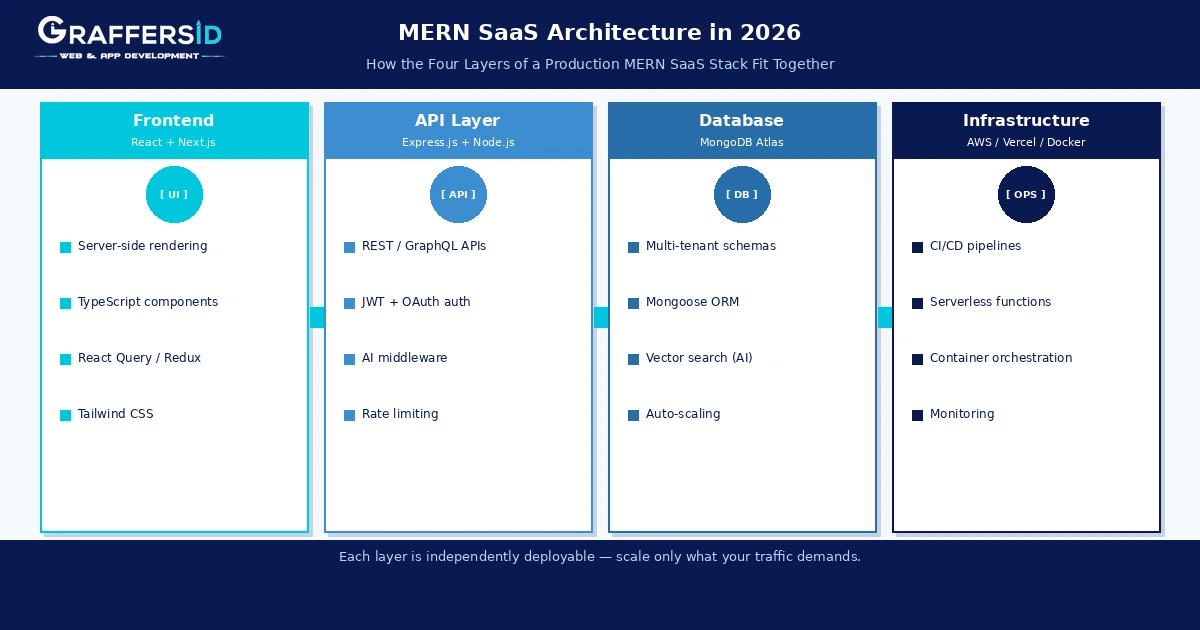
How the four layers of a production MERN SaaS stack fit together, from the React frontend through the Express API layer, MongoDB database, and cloud infrastructure.
Building Your SaaS on MERN: Phase by Phase
Phase 1: Discovery and Scope (Weeks 1 to 2)
Every week spent defining scope before writing code saves three to four weeks of mid-build rework. In this phase you define the single core workflow your MVP must nail, map out your data schema, design your API contracts, and make the three architecture decisions above.
Do not skip this phase to move faster. According to multiple SaaS build analyses, teams that run a proper two-week discovery sprint consistently deliver their MVPs on time. Teams that skip it spend those same two weeks doing rework six months later, at a cost of three to four times as much.
Phase 2: MVP Build (Weeks 3 to 14)
With a two to three person MERN team, a well-scoped MVP takes 8 to 12 weeks of active development. You are building one core user workflow end-to-end, not every feature on your roadmap. User authentication, a functional dashboard, Stripe billing, and a basic admin panel are the standard MVP components.
Work in two-week agile sprints. Ship a working build at the end of every sprint, even if it is not complete. This discipline forces scope decisions early and gives you real user feedback before you have spent your entire budget.
AI coding tools like GitHub Copilot and Cursor are now standard in production MERN teams in 2026, cutting boilerplate development time by 30 to 55% on routine tasks. This means an experienced MERN developer today delivers what used to require a two-person team on standard features. Hire experienced engineers who use AI well, not cheaper engineers because AI exists.
Phase 3: Post-Launch and Scale
Launching your MVP is not the finish line. Plan for 15 to 25% of your initial build cost per year in ongoing maintenance, covering bug fixes, security patches, dependency updates, and performance work. Cloud infrastructure starts at $100 to $200 per month for an MVP and grows with your user base. Third-party tools add $500 to $3,000 per month at mid-stage.
Scale your MERN architecture gradually. You do not need Kubernetes, microservices, or a distributed message queue for your first 1,000 users. A well-architected monolith is faster to run, cheaper to maintain, and easier to debug. Introduce complexity only when your traffic data tells you it is necessary.
Read Also: How to Build a Full-Stack E-Commerce Website with MERN Stack
What Does It Actually Cost to Build a MERN SaaS in 2026?
Cost depends on three variables: what you are building, where your developers are based, and how well your scope is defined before development starts. Here is what real 2026 numbers look like across the three standard product tiers.
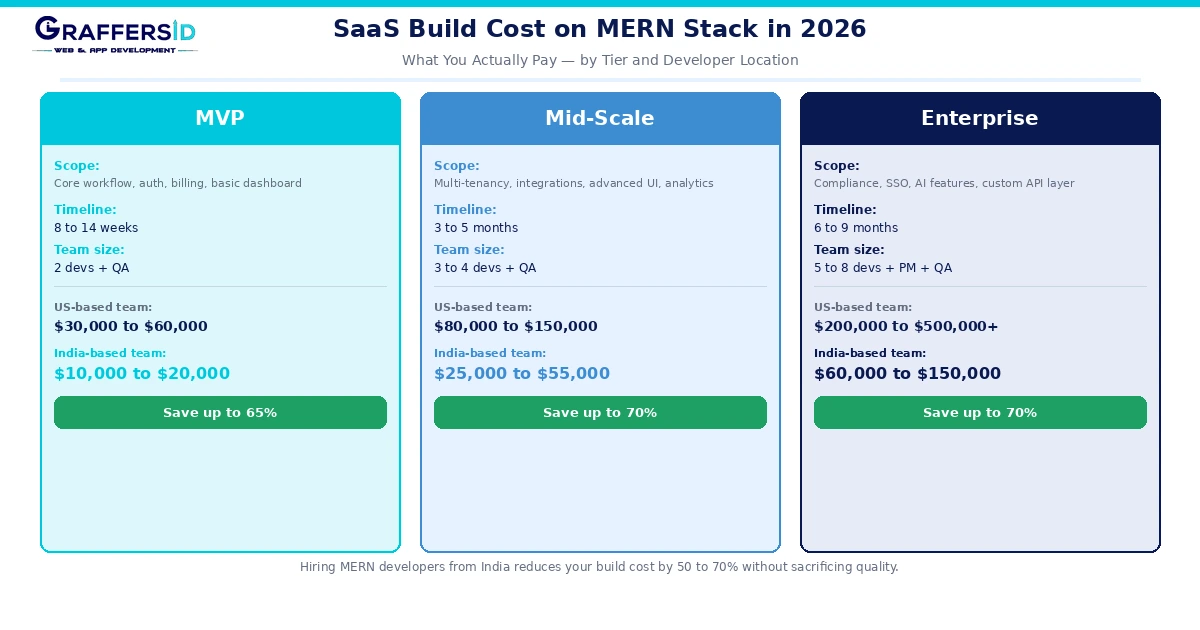
The most important number in that table is not the US rate. It is the India rate. Hiring MERN developers from India at $20 to $40 per hour delivers the same output as a US team at $100 to $150 per hour, provided you choose a structured partner with a proven SaaS delivery process and a pre-vetted developer pool.
That 50 to 70% cost reduction is not theoretical. It is the primary reason scaling startups and funded companies run their product development teams out of India while keeping their product and business leadership local.
If you want a detailed breakdown of what hiring actually costs, the cost to hire MERN stack developers covers rates by seniority level, region, and engagement model.
For a wider view of how MERN compares against other stacks for your SaaS build decision, the best tech stack for SaaS development is worth reading before you commit.
What Team Do You Need?
1. Minimum Viable Team for Your MVP
You do not need a large team to ship a MERN SaaS MVP. You need the right two to three people working on a tightly scoped problem.
A full-stack MERN developer who has built SaaS products before is your most important hire. They own the backend API, the database schema, and the core business logic. A dedicated frontend developer handles the React UI, dashboard components, and user-facing experience. A QA engineer, even part-time, catches the bugs that would otherwise reach your first paying customers.
That is it for MVP. Three people, eight to fourteen weeks, one core workflow done properly.
2. Growth Stage Team
Once your MVP has validated product-market fit and you are scaling from hundreds to thousands of users, you need to expand. At this stage, you typically need two backend developers splitting ownership of different services, two frontend developers working in parallel on different parts of the product, a dedicated DevOps engineer managing your cloud infrastructure and CI/CD pipelines, and a full-time QA engineer running automated test suites before every release.
A product manager becomes essential at this stage too. As your team grows beyond five engineers, someone needs to own the roadmap, write specifications, and keep feature development aligned with what your paying customers actually want.
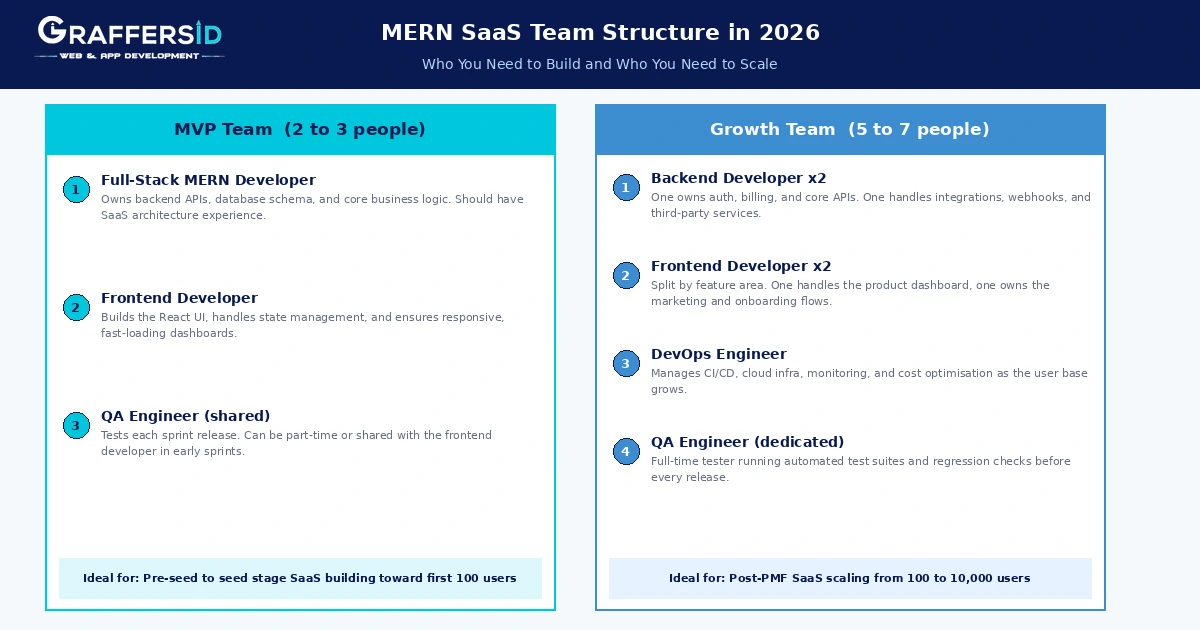
Who you need at MVP stage and who you need once the product is scaling, broken down by role and responsibility.
The Fastest Way to Build Your MERN SaaS Team
Building a SaaS product on MERN is a sound technical decision. Building the right team to execute it is where most founders either lose time or overspend.
Hiring full-time MERN developers locally takes three to four months and comes with salaries, benefits, equipment, and the risk that the hire does not work out. Freelancers are faster to find but introduce coordination risk and inconsistent availability. Neither model is ideal when you are trying to ship in 10 to 14 weeks.
Staff augmentation is the model that works best for SaaS builds. You get pre-vetted, experienced MERN developers who join your team within one to two weeks, work under your direction, follow your processes, and stay accountable to your timeline. You pay a predictable rate with no overhead, no benefits cost, and no long-term commitment beyond your project scope.
At GraffersID, we place dedicated MERN stack developers with SaaS-specific experience into product teams that need to move fast without burning budget. Our developers are onboarded within a week and have direct experience building the multi-tenant architectures, billing integrations, and real-time dashboards that SaaS products depend on.
Building a SaaS product on MERN in 2026 is one of the strongest technical decisions a founder or CTO can make. The stack is fast, AI-ready, and supported by one of the largest developer ecosystems in the world. What determines whether your build succeeds is not the stack itself. It is the architecture decisions you make in week one and the quality of the team you build around them.
If you are planning a MERN SaaS build and need experienced developers who can start quickly, talk to our team.