
| Quick Takeaways
● 68% of engineering teams report increased technical debt during rapid scaling phases. Growth creates the conditions that slow you down if you scale without structure. ● The average new engineer takes 3 to 9 months to reach full productivity. Structured onboarding cuts that in half and improves retention by 82%. ● Early-stage companies operate with manager-to-engineer ratios of 1:7.5 on average. Engineers whose managers had 10 or more direct reports stayed four months less than the baseline. ● Staff augmentation gets you production-ready developers in 48 hours to 2 weeks. Full-time US hiring takes 4 to 6 months on average, at more than 3x the cost. |
Most CTOs think scaling their engineering team means hiring more people. That instinct is right. The execution is usually wrong. They hire too fast, in the wrong sequence, without the systems to absorb new engineers. Six months later, velocity has dropped, senior developers are burned out from mentoring, and the codebase is carrying debt that will take quarters to clear.
Scaling well is not about headcount. It is about building the structures, processes, and hiring decisions that let your team grow without breaking what you have already built. If you want to understand how staff augmentation compares to dedicated teams and full outsourcing as you think through your scaling model, that breakdown is worth reading before you make any decisions.
This post gives you the practical framework. When to scale, who to hire first, what goes wrong when you rush it, and which model gets you there fastest at your current stage.
The Signs That You Are Scaling Wrong
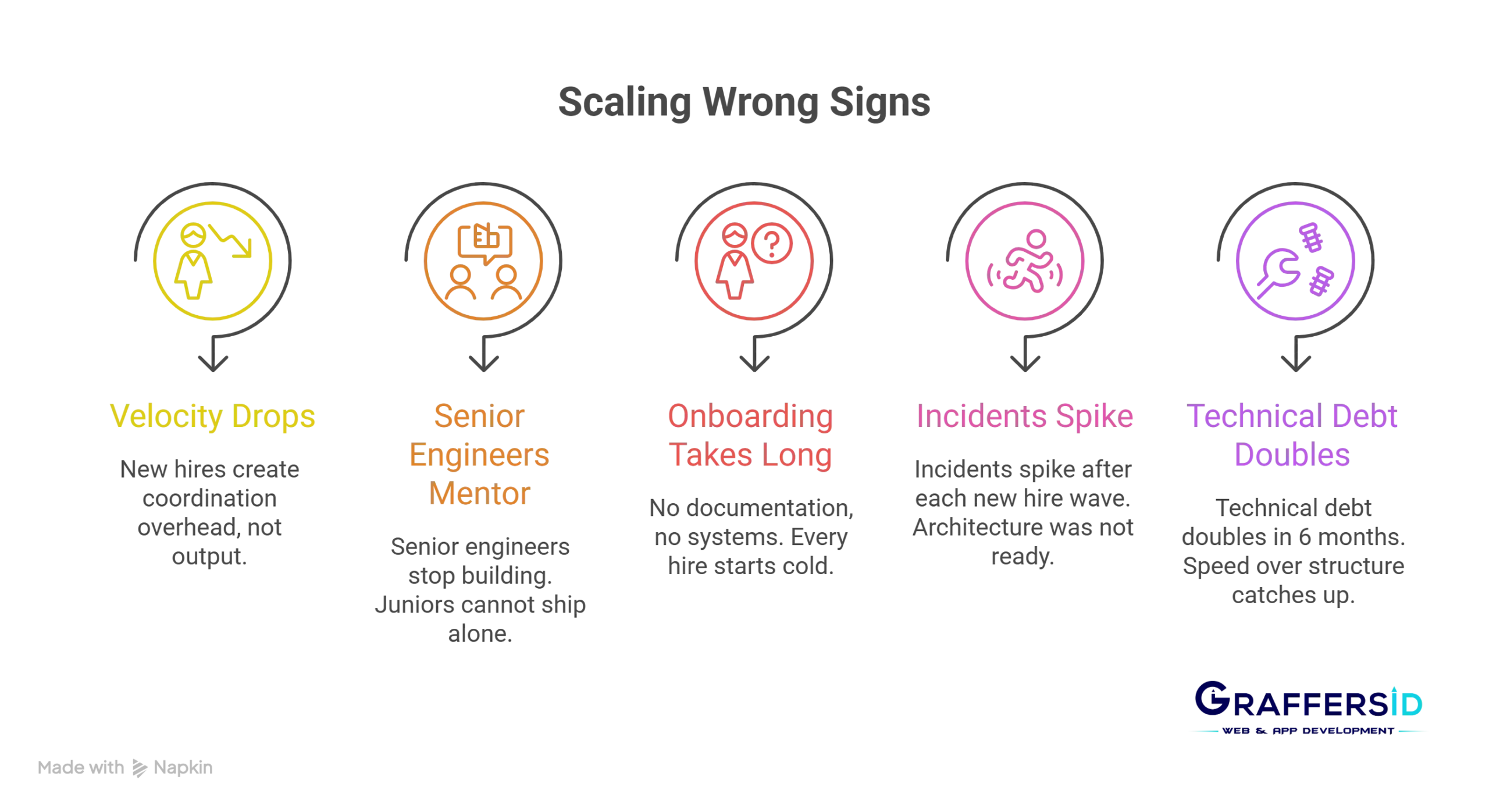
Before talking about how to do this well, it is worth naming what scaling wrong actually looks like. Most engineering leaders recognise these patterns only after they are already embedded.
Velocity drops as headcount rises. This one surprises people. Hiring ten engineers should make the team ten times faster. In practice, every engineer you add increases communication overhead, review cycles, and coordination complexity. If you have not structured the team before scaling, the new hires slow the people who were already there.
Senior engineers become full-time mentors. When junior hires cannot operate independently, your best people stop building and start explaining. The output of your senior engineers drops precisely when you need it most.
Onboarding takes more than two weeks. If a new engineer cannot be productive within two weeks, you do not have a hiring problem. You have a documentation and systems problem. No runbook, no architecture overview, no clear backlog. Every hire starts cold.
Technical debt doubles in six months. Speed-over-structure is a loan with interest. The code that ships fast during a growth sprint creates maintenance obligations that slow every sprint that follows.
The five most common signs that an engineering team is scaling without the structure to support it. Each one compounds the others.
Who to Hire First and In What Order
The sequence matters more than the speed. Hiring out of order is one of the most common and expensive mistakes CTOs make during a growth phase.
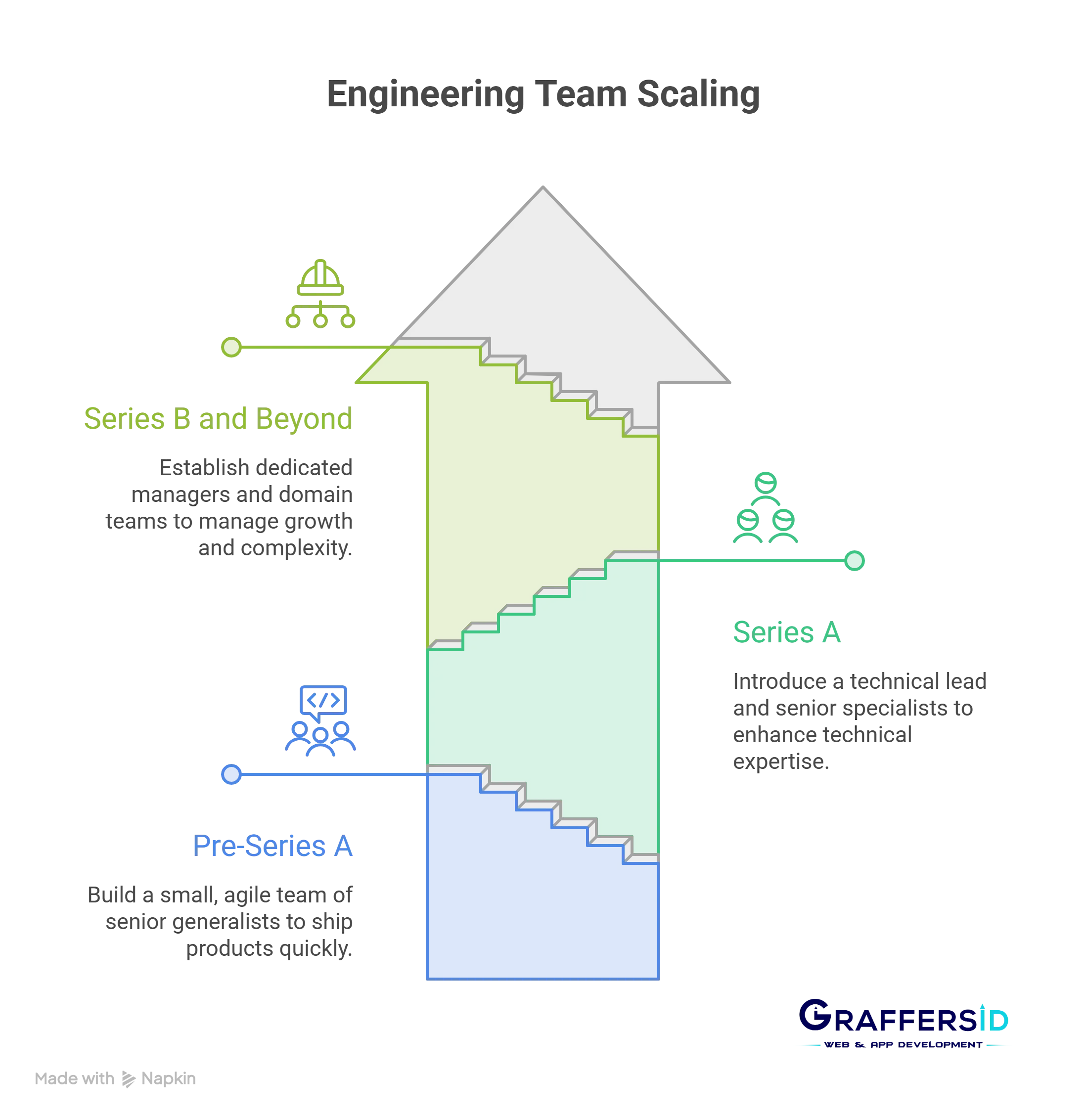
Pre-Series A: 1 to 5 Engineers
At this stage you need senior generalists who can build across the full stack, learn new domains quickly, and make architectural decisions without a playbook. You do not need specialists yet. You do not need an engineering manager. The CTO should handle everything that is not writing code.
The right profile here is the engineer who speaks product fluently, someone who uses what you are building, gives feedback without being asked, and thinks about how technical decisions land on real users. Experience at hiring remote developers cost-effectively matters at this stage because budget constraints are real and quality cannot drop.
Series A: 5 to 20 Engineers
Hire your technical lead first. Everything else waits. Without a technical lead in place, you are adding engineers without someone empowered to direct them. That creates overlap, confusion, and work that gets thrown away.
Senior specialists come next, aligned to your product’s core technical risks. Hold off on an engineering manager until you are at 12 to 15 people. Hiring a manager before then means paying for coordination overhead when what you really need is another pair of hands shipping code.
This is also where staff augmentation vs outsourcing decisions become strategically important. If you have gaps in specific skill areas, staff augmentation lets you fill them in weeks rather than months, without the hiring overhead of a permanent role.
Series B and Beyond: 20 to 50 Engineers
By now you need dedicated engineering managers, domain team leads, and platform engineers who are focused on developer experience and tooling. A 1 to 7 manager-to-engineer ratio is the target. Jellyfish data from 445 companies shows that engineers whose managers had ten or more direct reports stayed an average of four months less than the baseline. That is an attrition problem that compounds quickly at scale.
This is also the stage where you need a dedicated recruiter or Head of Talent. Recruiting cannot remain a side task for the CTO beyond 30 engineers.
The right hiring sequence at each stage of engineering growth. Hiring out of order is one of the most expensive mistakes a CTO can make during a scale phase.
| Read Also: Pros and Cons of IT Staff Augmentation: A Full Guide for CTOs |
What Breaks When You Scale Too Fast
1. Architecture That Was Never Built for This Team Size
The most expensive scaling mistake is not a hiring mistake. It is an architecture mistake. Systems that worked cleanly for a five-person team become bottlenecks for a twenty-person team. Monolithic codebases create merge conflicts and deployment dependencies that multiply with each hire. If your architecture cannot support parallel workstreams, adding engineers creates interference, not throughput.
McKinsey data shows that 66% of large IT projects run over budget and 70% deliver late. A significant driver of both is teams that scaled headcount without scaling their technical foundation. This is one of the reasons that AI-assisted development and agentic AI in software engineering are becoming important tools for scaling teams in 2026. They increase the throughput of each engineer, reducing the number of hires needed to achieve the same output.
2. Onboarding Without Documentation
Strong onboarding programs improve new hire productivity by over 70% and retention by 82%, yet 47% of companies still struggle with onboarding due to basic access and documentation failures. A new hire guide that covers environment setup, codebase architecture, team processes, and key contacts is not a nice-to-have. It is the difference between a developer who contributes in week two and one who is still asking basic questions in week eight.
3. The Senior Engineer Burnout Trap
When junior engineers cannot operate independently, senior engineers fill the gap. They review more code. They answer more questions. They join more calls. Within two to three months of a fast hiring wave, your most valuable engineers are producing at half their previous rate while spending the rest of their time keeping the new hires moving. The solution is not to stop hiring. It is to build the documentation, tooling, and onboarding systems before the hiring wave, not after.
Full-Time Hiring vs Staff Augmentation: The Honest Comparison for 2026
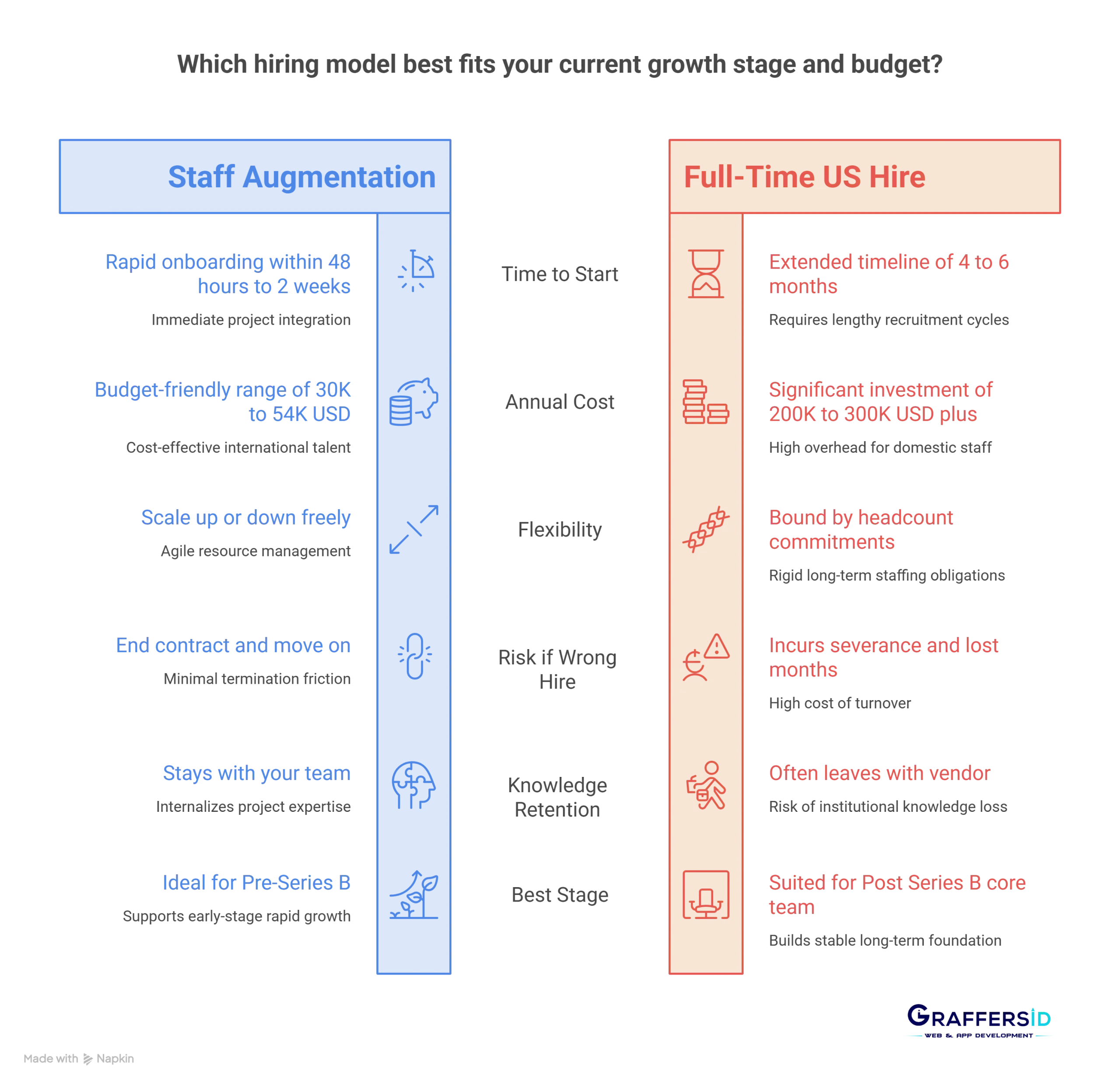
For most companies between Series A and Series B, staff augmentation is the faster and more capital-efficient path to scaling. Full-time US hiring makes sense for core long-term roles after Series B, when your architecture is stable and the work is genuinely permanent.
The numbers in 2026 are not close. A fully loaded senior US engineer costs $200,000 to $300,000 annually. A production-ready developer from India through staff augmentation costs $30,000 to $54,000 annually. The time-to-start difference is equally stark: 48 hours to two weeks versus four to six months. If you are carrying a gap in your engineering team right now, that gap costs you in missed delivery every day it is open. The comparison between remote hiring and in-house hiring models covers these trade-offs in detail.
The other advantage of staff augmentation that most guides understate is knowledge retention. With staff augmentation, every architectural decision, every context your developers build about your codebase, stays with your team. You have been in every conversation. With outsourcing, that knowledge often lives inside the vendor and knowledge transfer at handoff is notoriously incomplete.
Staff augmentation vs full-time US hiring across six dimensions that matter to CTOs scaling in 2026. The cost and time-to-start gaps are significant at every stage.
| Read Also: How to Hire AI Developers in 2026: Skills, Costs, and What Every CTO Should Know |
The Metrics That Tell You If Scaling Is Working
Scaling without measuring is guessing. Two frameworks are worth running in parallel. DORA metrics cover delivery speed: deployment frequency, lead time for changes, change failure rate, and time to restore. The SPACE framework from Microsoft and GitHub adds the human side: satisfaction, performance, activity, communication, and efficiency. Together they give you a complete picture of whether your team is actually absorbing growth or just absorbing headcount. According to Second Talent’s 2026 engineering leadership research, elite DORA performers are twice as likely to exceed organizational goals in profitability and productivity, but only 40.8% of engineering teams are currently using them.
Track time-to-productivity for new hires. If engineers are not contributing independently within two weeks, your onboarding process needs fixing before the next hire wave. Track manager-to-engineer ratios. If any manager is handling more than ten direct reports, split the team. Track technical debt accumulation alongside velocity. If debt is rising while velocity stays flat, you have a scaling structure problem, not a headcount problem.
Final Thoughts
Scaling an engineering team in 2026 is not a hiring challenge. It is a systems challenge. The companies that get this right are the ones who build the documentation, the onboarding processes, the architectural foundations, and the management structure before the headcount arrives, not after.
The hiring model that gets you there fastest matters too. For most companies between Series A and Series B, staff augmentation is the right answer. It is faster, significantly cheaper, and preserves the knowledge and control that outsourcing gives away. For core long-term roles at Series B and beyond, full-time hiring makes sense.
The mistake to avoid is treating scaling as a single decision. It is a sequence of decisions, made at the right stage, in the right order. Get the sequence right and growth compounds. Get it wrong and you spend the next two quarters undoing what you did in the last two months.
| Need to scale your engineering team fast without breaking delivery?
GraffersID provides pre-vetted developers from India who integrate into your team within 48 hours. No long hiring cycles, no overhead, no lock-in. Just production-ready engineers who start contributing from day one. |