Quick Takeaways
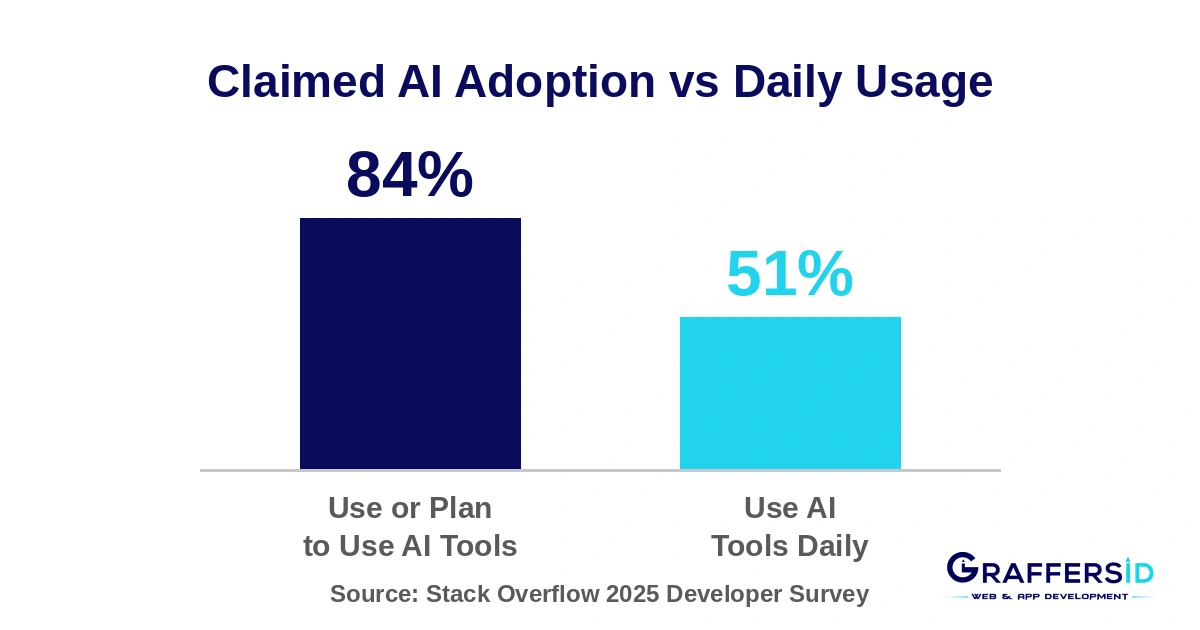
- Only 51% of professional developers use AI coding tools daily, and more developers distrust AI output than trust it, so a resume line claiming AI fluency proves very little on its own.
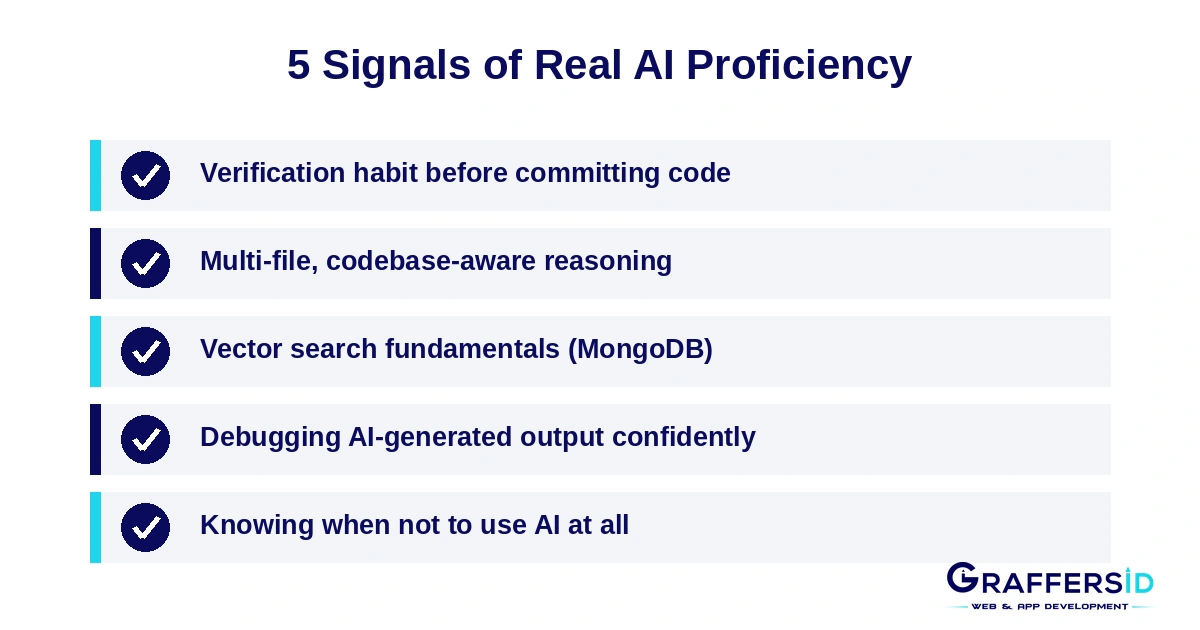
- MERN developer’s AI proficiency shows up in five testable signals: prompt to verify discipline, codebase-aware tool usage, AI-native MongoDB and vector search knowledge, debugging AI output, and knowing when not to use AI at all.
- A short live coding round using Cursor or Copilot on an actual MERN task reveals more in twenty minutes than a resume reveals in twenty lines.
- GraffersID developers are tested on AI tool fluency before they ever join a monthly contract, so you inherit a vetted signal instead of building the test yourself.
Every MERN developer you interview this year will tell you they are AI proficient. Most of them believe it too. The trouble is that “I use Copilot” and “I know how to direct an AI agent through a multi file refactor without breaking your auth flow” are two completely different skill levels, and almost nothing on a resume tells you which one you are looking at. Most hiring managers either take the claim at face value or ignore it entirely and fall back on the same generic technical screen they used in 2022. Neither approach works anymore.
This post gives you a concrete way to test AI proficiency in a MERN hire, what to actually ask, what a live round should look like, and what happens when you skip the step altogether. If you are still building out the team around this hire, our guide on how to hire MERN stack developers covers the broader process end to end.
Why “AI Proficient” on a Resume Doesn’t Mean Much Anymore
The phrase showed up on almost every developer resume somewhere around 2024, and by now it has lost most of its signal value. Everyone claims it. Job descriptions demand it. Recruiters filter for it. But claiming familiarity with a tool and being able to direct that tool through a real production task under time pressure are not the same competency, and the gap between them is exactly where bad hires happen.
The Claim Is Table Stakes Now, Not a Differentiator
Here’s what most guides won’t tell you: the data backs this up more than you’d expect. Stack Overflow’s 2025 Developer Survey of more than 49,000 developers found that AI tool adoption keeps climbing, with 84 percent of respondents using or planning to use AI tools. But daily, hands on reliance is a much smaller number. Only 51 percent of professional developers use AI tools every day. That’s roughly half your candidate pool claiming proficiency while actually reaching for the tool only occasionally.
What the Data Actually Shows About Daily Use Versus Claimed Use
The trust numbers matter even more for hiring. More developers actively distrust the accuracy of AI output, 46 percent, than trust it, 33 percent, and only a fraction, 3 percent, report highly trusting what the tool gives them. A developer who has internalized that distrust and built verification habits around it is a fundamentally safer hire than one who accepts whatever the model outputs. The claim on a resume tells you nothing about which type you’re getting. Building your screening process around AI-driven hiring approaches can help filter for this earlier, before a candidate ever reaches a live round.
What AI Proficiency Actually Looks Like in a MERN Developer
Forget the resume line for a moment. If you sat next to a genuinely AI proficient MERN developer for an afternoon, here’s roughly what you’d see.
1. Prompt to Verify Discipline, Not Blind Acceptance of Output
Prompt to verify discipline shows up first. They write a specific prompt, get output, and then read it line by line before it goes anywhere near a commit. They are not pasting generated code into a MongoDB schema and hoping. Given the trust numbers above, this habit alone separates a safe hire from a risky one.
2. Codebase Aware Tool Usage Across a Multi-File MERN Project
Codebase aware tool usage is the second signal, and it’s the one resumes hide best. There’s a real difference between a developer who uses Copilot for single function autocomplete and one who can point Cursor or Claude Code at an entire MERN repository and get it to reason across the Express routes, the React components, and the MongoDB models together. That’s the difference between a tool that fills in a line of code and an agent that works in your terminal, IDE, or editor to handle multi step tasks across an entire project. You want the second kind on a monthly contract. This is also where the fundamentals of hiring a MERN developer start to matter just as much as the AI layer on top of them.
3. Working Knowledge of AI-Native MERN Features Like MongoDB Atlas Vector Search
Third, look for working knowledge of what makes the MERN stack AI-ready in 2026. MongoDB now supports vector indexes, so a developer building AI features, product recommendations, semantic search, similarity matching, needs to understand embeddings inside the database layer, not just the model layer. If a candidate can’t explain how a vector index differs from a standard MongoDB index, that’s worth flagging.
The 5 Interview Signals That Separate Real Proficiency From Buzzwords
Here’s a table you can bring straight into your next interview loop.
| Signal | What to Ask | Red Flag Response |
|---|---|---|
| Verification habit | Walk me through the last time an AI tool gave you wrong code. How did you catch it. | Can’t recall a specific instance, or claims they never catch errors |
| Multi file reasoning | Describe a refactor where you used AI across more than one file. | Only describes single line autocomplete use |
| Vector search fundamentals | When would you use MongoDB Atlas Vector Search instead of a standard index. | Vague or unfamiliar with the concept entirely |
| Debugging AI output | Show me how you would debug a function an AI tool generated that fails silently. | Treats AI generated code differently from their own during debugging |
| Knowing when not to use AI | Tell me about a task where you deliberately avoided AI assistance. | Says AI is always the right tool for every task |
Should You Let Candidates Use AI During the Interview?
Yes, and this surprises a lot of hiring managers who still associate AI tools with cheating. Banning AI tools in a 2026 interview tests a skill your developer will rarely use on the job, writing algorithms from memory under a whiteboard. Letting candidates use Cursor or Copilot during a live round tests the actual job: directing a tool, catching its mistakes, and shipping something that works.
-
How to Structure a 30 to 45 Minute Live Round
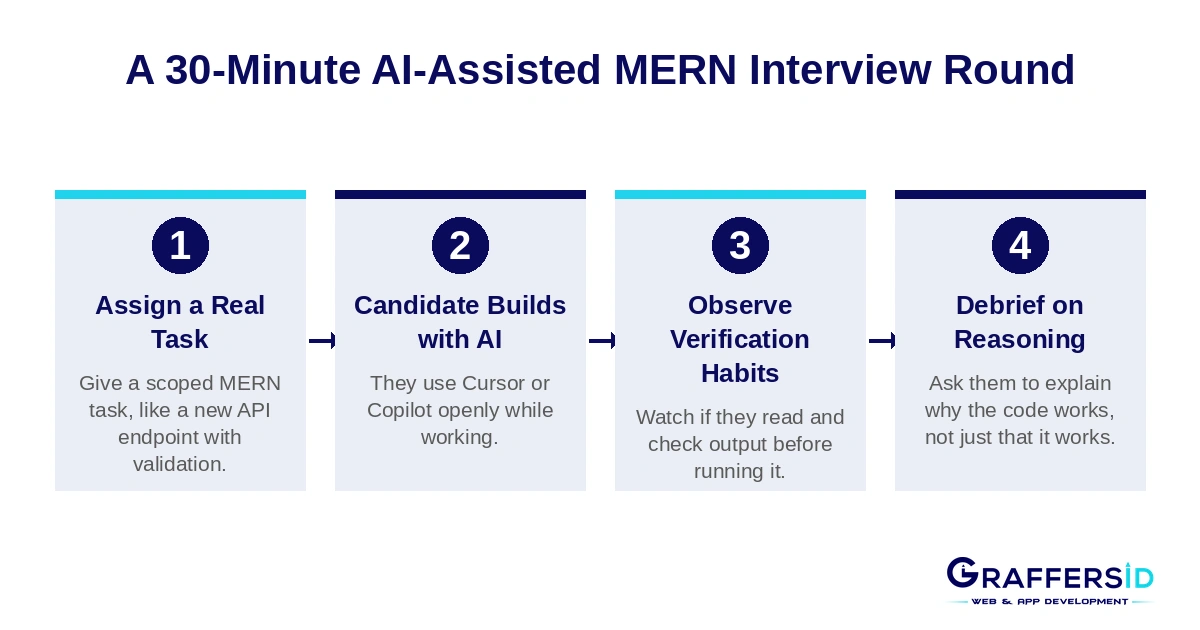
Structure the round around a real, scoped MERN task, something like adding a new API endpoint with validation and a corresponding React component, rather than an abstract algorithm question. Give them thirty to forty five minutes. Then step back and watch the process, not just the output.
-
What to Watch For While They Work
What you’re watching for is whether they read what the AI generates before running it, whether they catch the small MongoDB schema mismatch or the missing error handler the tool skipped, and whether they can explain their own code afterward without hesitation. A candidate who ships working code but can’t explain why it works learned nothing from the AI’s output, and that gap catches up with you three sprints in.
Read Also: MERN vs Java Full Stack in 2026
What’s the Real Risk of Skipping This Vetting Step?
The risk isn’t that you hire someone who can’t code. It’s that you hire someone whose AI generated output looks fine in review and breaks in production three weeks later, after they’ve already been billing you on a monthly contract the whole time. Debugging AI generated code that a developer didn’t fully understand in the first place takes longer than debugging code a developer wrote themselves, and someone still has to pay for that time.
There’s a compounding cost too, connected directly to what it actually costs to hire a MERN developer in the first place. If the hourly or monthly rate looked attractive but the developer’s AI verification habits were never tested, the real cost shows up later in rework, delayed releases, and the awkward conversation about why a feature that shipped two sprints ago just failed in production.
Conclusion
Testing AI proficiency in a MERN hire doesn’t require a complicated process. Run a real, scoped task through a live AI assisted round, ask the five questions in the table above, and pay closer attention to how a candidate verifies output than to how fast they produce it. That single shift catches most of the gap between resume claims and real capability.
At GraffersID, every MERN developer goes through exactly this kind of AI fluency testing before they’re placed on a monthly contract, so you’re not building this vetting process from scratch or hoping a resume line holds up. If you’d rather skip straight to developers who’ve already cleared this bar, or you’re still weighing choosing between staff augmentation, a dedicated team, or outsourcing for your next hire, we’re glad to walk you through it.
Ready to hire a MERN developer whose AI skills actually hold up under pressure? At GraffersID, every developer is tested on real AI-assisted workflows before they ever join your team on a monthly contract.