- Over 70% of modern SaaS vendors now use multi-tenancy. If you are still running one instance per customer, you are scaling costs linearly while competitors scale logarithmically.
- The database model you pick in week two can cost six to twelve months of re-architecture once you hit 500 customers. Most teams make this decision before they understand their isolation requirements.
- The hybrid model, shared pooled infrastructure for standard tiers and isolated environments for enterprise, is where most mature SaaS platforms land by Series B.
- Multi-tenancy determines what kind of engineers you need, how long the build takes, and what fails in production if the team does not have direct experience with it.
The first customer is easy. Everyone gets their own environment, their own database, their own deployment. Then customer fifty arrives and your engineering team is spending more time on deployment coordination than on building product.
This is the moment most founders discover their single-tenant setup was never a scalable architecture. It was just the fastest thing to ship. Multi-tenant SaaS architecture is what changes those economics permanently. If you are already thinking about your foundational SaaS build, how to build a SaaS product with MERN stack covers the layer this architecture sits on top of.
This post covers what multi-tenant SaaS architecture is, which database model fits your stage, what breaks in production, and what the build actually needs from your team.
What Is Multi-Tenant SaaS Architecture and Why Does It Matter?
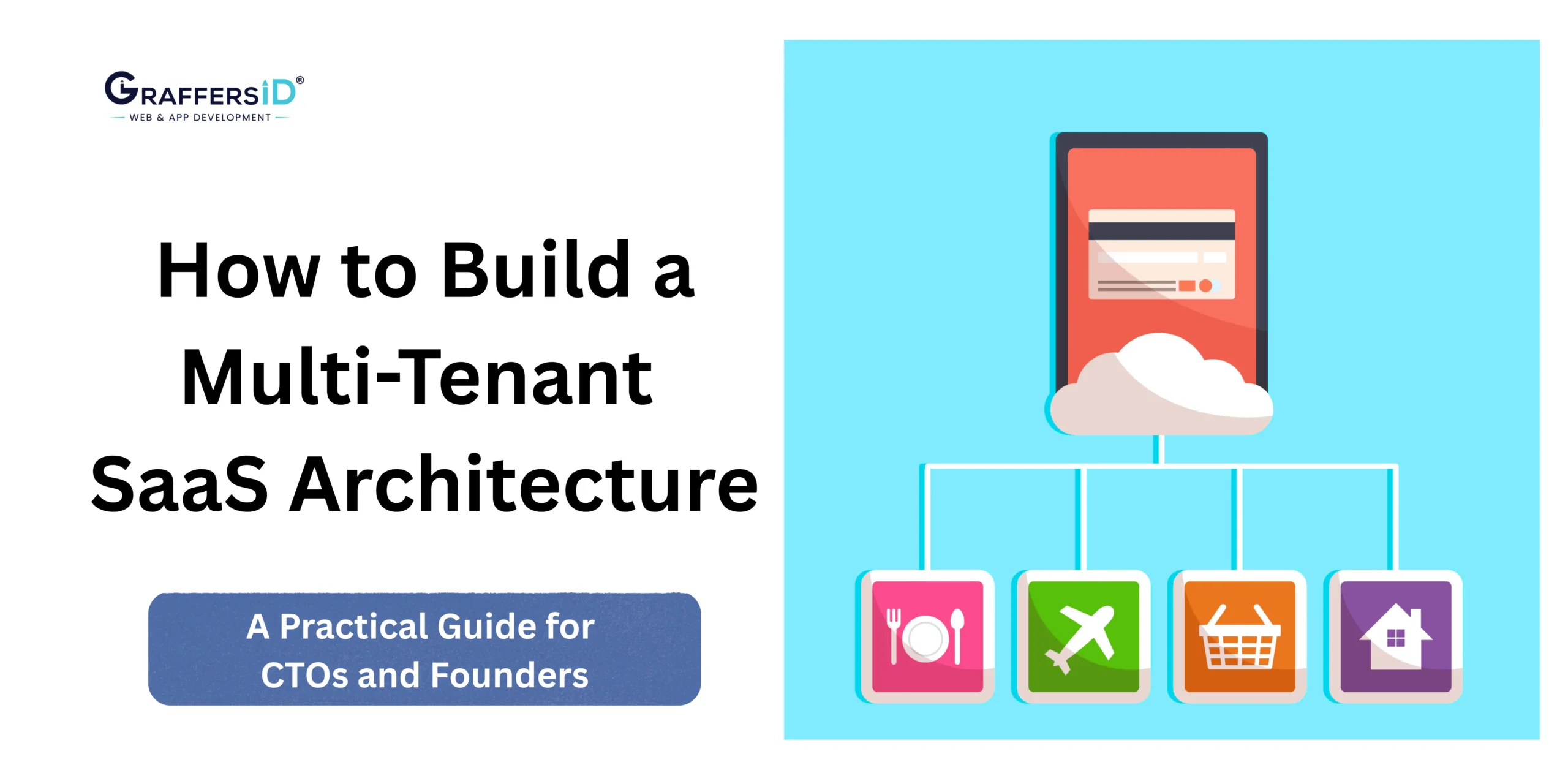
One application instance serves multiple customers from one shared codebase. Each tenant’s data stays logically separate. They share servers, application code, and often the same database, but they cannot see each other’s data.
The business case is simple. Infrastructure costs stay nearly flat as customers grow. Updates deploy once. Maintenance overhead does not multiply with each new sign-up. Adding customer 1,000 costs a fraction of what adding customer 10 cost when you were running single-tenant.
According to the Zylo 2026 SaaS Management Index, the average enterprise now manages 305 SaaS applications. Running single-tenant instances at that scale is financially unsustainable for any vendor.
Single-tenant still makes sense in specific situations: government contracts, regulated industries requiring physical data separation, or enterprise clients with strict compliance postures. These are the reason most mature SaaS platforms eventually build a hybrid model. Design for that from the beginning.
The Three Database Models: How to Choose the Right One
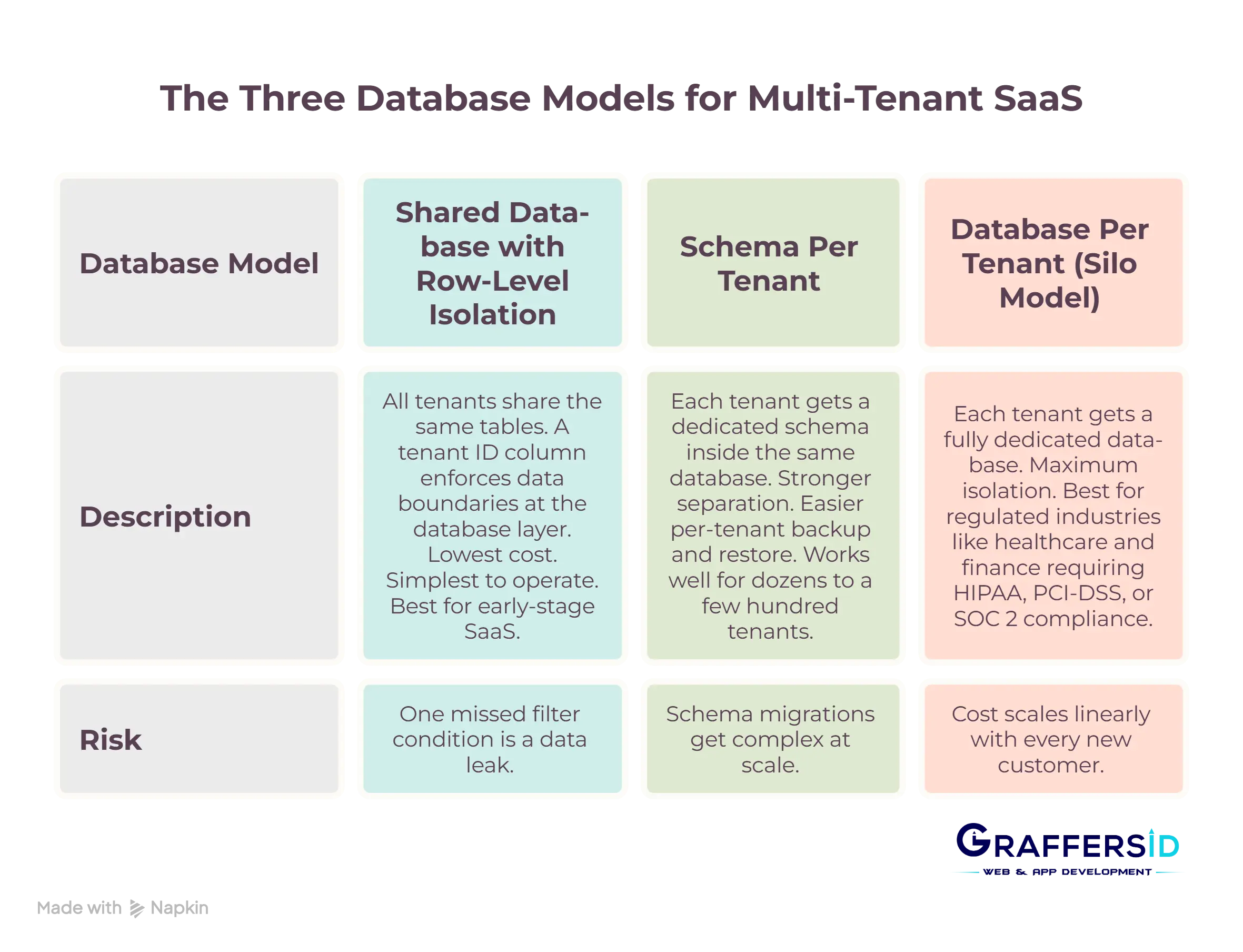
This is the decision most teams get wrong. Not because the options are unclear, but because they make the call before they understand their isolation requirements. A wrong choice does not reveal itself immediately. It shows up when you hit 500 customers and start paying for six months of re-architecture instead of shipping product.
1. Shared Database with Row-Level Isolation
All tenants share the same tables. A tenant identifier column on every table, paired with row-level security policies at the database layer, ensures queries return only the data belonging to the active tenant.
- Lowest cost. Simplest to operate. One connection pool, one migration path, one backup strategy.
- The risk is equally simple: one missed filter condition in a query is a data leak. Discipline must be enforced through the data access layer and automated tests that verify cross-tenant queries return empty results. Not developer memory.
Best for early-stage SaaS with cost constraints and low regulatory exposure.
2. Schema Per Tenant
Each tenant gets a dedicated schema within the same database instance. Stronger separation, easier per-tenant backup and restore.
The trade-off shows up at scale. Running schema migrations across hundreds of tenants becomes genuinely complex. This model works for dozens to a few hundred tenants, not tens of thousands.
Best for mid-stage products with moderate tenant counts and clients who have contractual audit requirements.
3. Database Per Tenant (The Silo Model)
Each tenant gets a fully dedicated database. Maximum isolation. Simplifies compliance with HIPAA, PCI-DSS, and SOC 2 because tenant data is physically separate, not just logically separate.
Cost scales linearly. Every new customer adds infrastructure and operational overhead. This is the right model for regulated industries and premium enterprise tiers. It is not a default starting point.
3. The Hybrid Model
Standard-tier customers on shared pooled infrastructure. Enterprise clients on isolated schemas or dedicated databases. This is where most mature SaaS platforms land.
Design for the hybrid from the beginning, even if you launch with shared infrastructure. If your architecture assumes every tenant lives in the same pool, adding a dedicated isolation path later means either rebuilding the data access layer or creating a permanent maintenance exception.
Understanding how AI features interact with your data layer matters here too. Adding AI features to a SaaS product brings its own tenant isolation requirements, particularly when those features involve retrieval from tenant-specific knowledge bases.
Read Also: Can Vibe Coding Replace Developers? The Honest Answer for CTOs in 2026
Tenant Isolation: What Actually Prevents Data Leaks
1. Authentication Is Not the Same as Isolation
Authentication confirms who a user is. Isolation ensures they can only access their own tenant’s data. A user can be fully authenticated and still access another tenant’s records if isolation is missing or incomplete at the database or application layer.
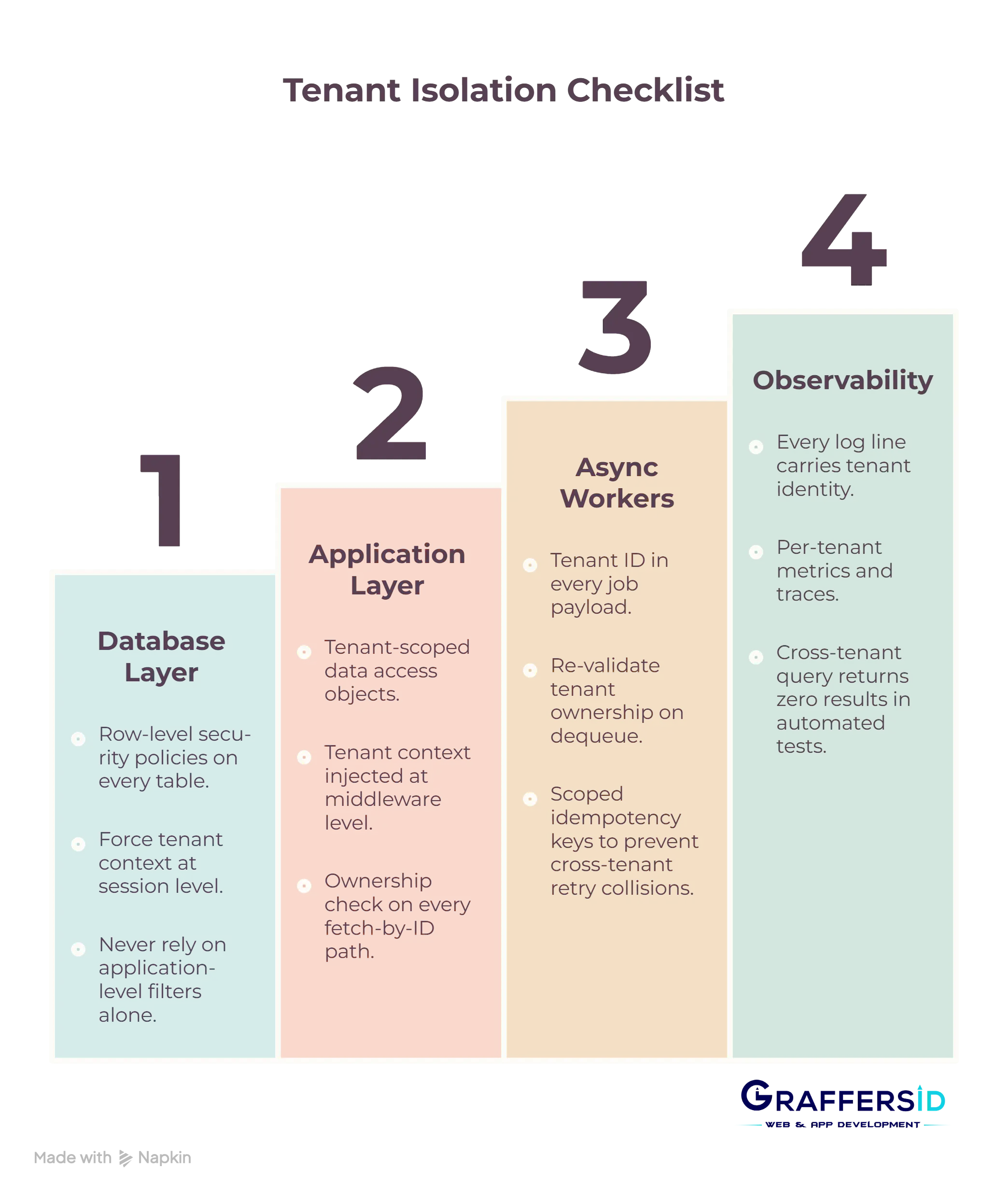
Enforcement needs to exist at multiple independent layers. Row-level security at the database. Middleware that validates tenant context at the start of every request. API gateway scoping. Automated integration tests that explicitly verify cross-tenant queries return zero results.
If any one layer is missing, the others become a single point of failure.
2. Isolation Beyond the Database
The service layer needs tenant-scoped data access objects and ownership checks on every fetch-by-identifier path. The common production failure: a developer loads a record by its primary key, assumes the identifier is enough, and forgets the tenant condition. It passes review. It passes testing and surfaces three weeks later in a support ticket.
Data access objects should require tenant context at construction time. Make the unsafe pattern hard to write, not just easy to avoid.
Agentic AI systems introduce a new dimension here. Agentic AI in software development creates autonomous systems that act across your data layer. Those agents need the same tenant-aware boundaries as every other part of the system.
3. The Noisy Neighbour Problem
One tenant runs a large import or batch job and consumes a disproportionate share of shared CPU or database I/O. Every other tenant experiences slower responses. They had no part in causing it.
The fixes are well understood. Per-tenant rate limiting at the API gateway layer. Resource quotas that prevent any single tenant from starving others. Usage-based tenant graduation that moves consistently heavy tenants to heavier isolation automatically.
Observability is equally important. If your metrics are aggregated across all tenants, you can have a healthy-looking dashboard while one enterprise client is experiencing three-second response times. Every log line and every metric needs to carry tenant identity.
What Breaking Your Architecture Actually Looks Like
The textbook failures are documented. The production failures are more mundane and more expensive. Here are the four that appear most often.
A developer adds a query path that passes review and testing. Three weeks later a support ticket arrives, traceable to that query returning records across tenants.
A background worker carries only a resource identifier in its payload. A retry fires, tenant context resolves from the payload rather than the session, and the result goes to the wrong tenant’s endpoint.
A schema migration that took three minutes at twenty tenants runs for four hours at five hundred tenants in a schema-per-tenant model and blocks deployments for a full day.
A shared infrastructure incident prompts an enterprise client to demand a dedicated database at renewal. Without a clean isolation path in the architecture, the choice is a six-month rebuild or losing the account.
Understanding retrieval-augmented generation and how data retrieval works in AI systems is increasingly relevant here because RAG pipelines that access tenant data without proper scoping create the same class of cross-tenant exposure risk as any other unscoped query.
Read Also: Agentic AI vs AI Agents: Key Differences, Real-World Examples, and Business Use Cases in 2026
What This Build Requires from Your Engineering Team
1. The Skills Most Guides Skip
Most senior developers have built applications. Fewer have built multi-tenant systems in production. The difference is whether isolation is a first-class concern or an afterthought.
A developer with real multi-tenant experience will design the data access layer so unscoped queries require explicit effort. They will add cross-tenant test assertions without being asked. They will think about async worker payload structure before writing the worker.
The interview question that separates these two groups: ask them to walk through how they would design a background job system that processes tenant data safely. Experienced developers immediately talk about payload structure, context resolution on dequeue, and retry behaviour. Developers without production experience talk about the database model.
2. Realistic Timelines
A basic shared-schema multi-tenant setup with row-level isolation, proper middleware, and automated cross-tenant tests takes two experienced developers four to eight weeks on a greenfield project.
A full hybrid architecture with a dedicated isolation path for enterprise clients, per-tenant rate limiting, and tenant-scoped observability takes three to five months with a team of three to four developers.
Teams learning multi-tenancy on the job typically add forty to sixty percent to these estimates. That is not a criticism. It is what skill acquisition costs in project time.
3. Why Staff Augmentation Fits This Build Well
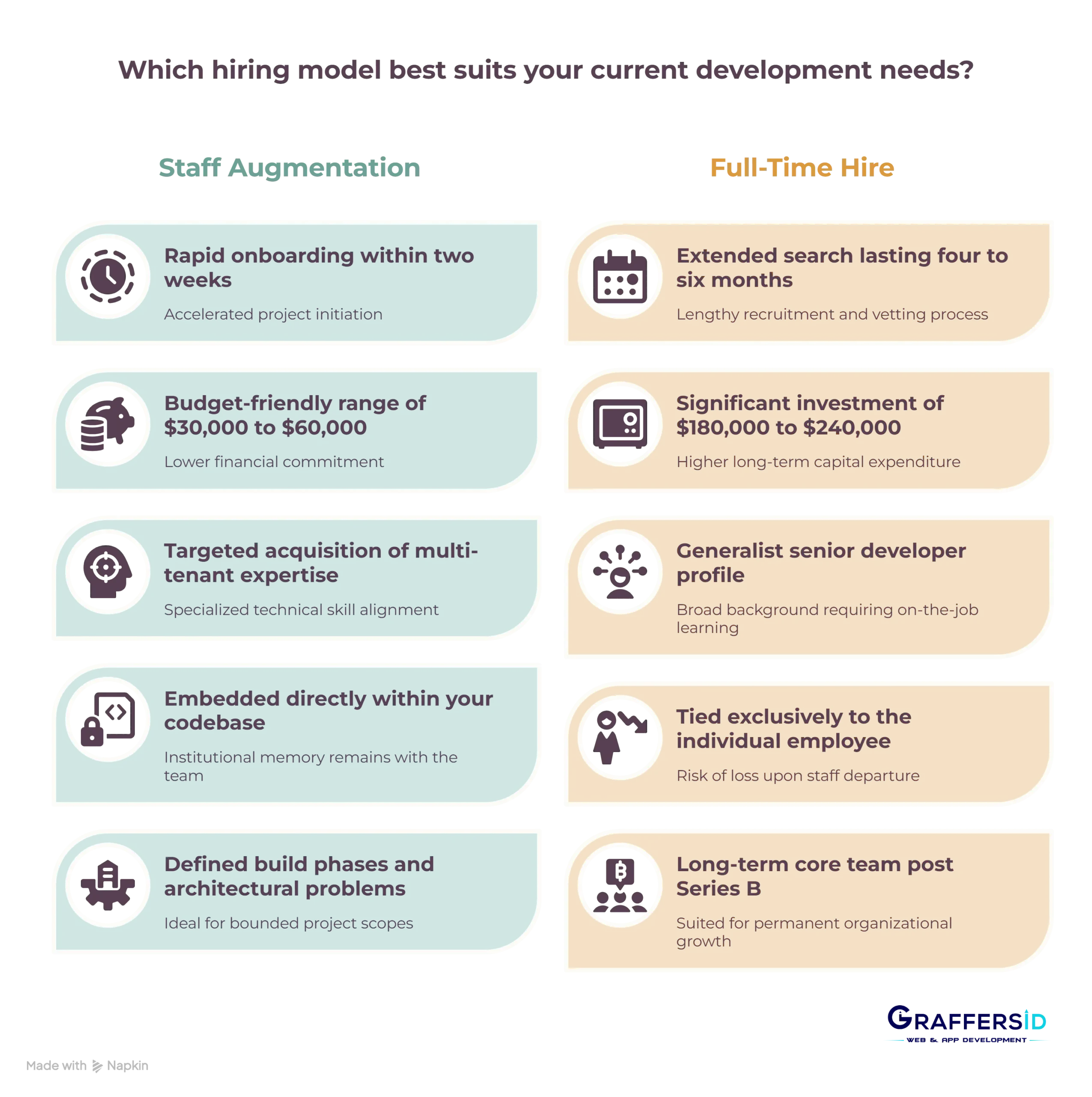
Multi-tenant architecture is a defined, bounded problem. You need developers with specific experience for a specific phase. That maps well to staff augmentation.
A full-time US-based senior developer with production multi-tenant experience costs $180,000 to $240,000 annually and takes four to six months to hire. The same profile through staff augmentation from India costs $2,500 to $5,000 per month and can start within two weeks. Knowledge stays with your team because developers are embedded in your codebase throughout the engagement.
For a clearer view of how the models compare, the breakdown of staff augmentation, dedicated teams, and full outsourcing is worth reading before you decide. And if you are growing the broader team around this build, how to scale an engineering team without breaking your product covers the sequencing decisions that determine whether that growth compounds or creates drag.
At GraffersID, our developers have built multi-tenant systems in production across SaaS, fintech, and B2B platforms. They treat isolation as a first-class concern, not a retrospective fix. Hire developers from GraffersID who have done exactly this work before.
Final Thoughts
The database model decision you make in week two stays with you at customer 500. Get it right early and every new customer adds revenue without adding proportional cost. Get it wrong and re-architecture becomes unavoidable at the worst possible time.
Start with shared-schema and strong row-level isolation. Design the hybrid path before you need it. Make tenant identity a first-class concept in your data model, middleware, background jobs, and observability. Then hire developers who have shipped this in production before.
Ready to build a multi-tenant SaaS architecture that scales without breaking? Talk to the GraffersID team and get production-ready developers embedded in your project within 48 hours.