| Quick Takeaways
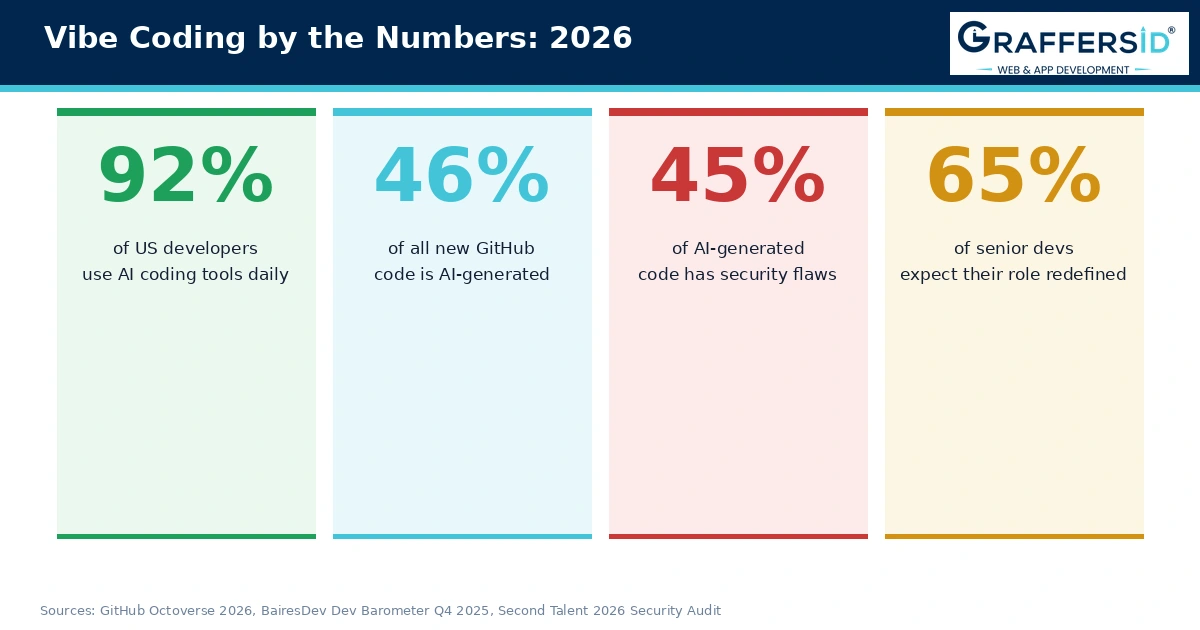
● 92% of US developers now use AI coding tools daily, and 46% of all new code on GitHub is AI-generated. Vibe coding is not coming. It is already the default. ● 25% of Y Combinator’s Winter 2025 cohort had codebases that were 95% AI-generated. For early-stage startups, the speed gains are real. ● 45% of AI-generated code contains high-risk security flaws according to a 2026 audit. The risks are just as real as the speed gains. ● 65% of senior developers expect their role to be redefined in 2026, not eliminated. The shift is from writing code to directing and validating it. |
Solo founders are shipping SaaS products with zero engineers. Y Combinator startups have codebases that are 95% AI-generated. The question every CTO is quietly asking is whether the developer headcount they are carrying is still justified. It is a fair question and it deserves a straight answer.
The short version: vibe coding will not replace skilled developers. But it is already replacing certain kinds of developer work, and the CTOs who understand that distinction will make better hiring and building decisions in 2026 than those who do not. If you want the full picture of how AI agents are already changing the way startups hire developers, that shift is already well underway.
This post gives you both sides of the vibe coding debate, backed by real 2026 data, and a clear framework for what to do about it.
What Vibe Coding Actually Is and Is Not
The term was coined by Andrej Karpathy in February 2025. Merriam-Webster listed it as a slang and trending expression the following month. Collins Dictionary named it Word of the Year for 2025. By 2026 the debate about whether it matters is over. Everyone is doing it.
In practice, vibe coding means describing what you want in plain language and letting an AI tool generate the code. You accept the output, test the result, and prompt your way through changes rather than writing every line manually. Tools like Cursor, Lovable, Bolt, and Replit Agent are the platforms most commonly associated with this approach.
Here is where the definition matters. Some definitions include thorough review and testing of AI-generated code. Others define vibe coding specifically as accepting output without understanding what it does. That distinction is not trivial. It is the line between a productivity tool and a liability.
To understand the underlying technology driving this, it helps to know what an LLM agent actually is and how it works, since most vibe coding tools are built on top of these systems.
The Case For Vibe Coding: Where It Genuinely Wins
-
Speed That Changes What Is Possible for Startups
The data on this side of the argument is hard to dismiss. Lovable reached $200 million in annual recurring revenue within 12 months of launch, built primarily by teams using AI-assisted development. Replit generated $240 million in 2025 revenue with a target of $1 billion ARR by end of 2026. According to FindSkill.ai’s 2026 vibe coding market analysis, the vibe coding tools market hit an estimated $4.7 billion in 2026, growing at 38% annually.
For early-stage startups in particular, the speed argument is compelling. Prototypes that used to take three weeks now take three hours. Non-developers are shipping products that previously required a full engineering team. 63% of non-developers report building products through vibe coding in 2026.
-
It Makes Experienced Developers Significantly More Productive
This is the part the debate often skips. Vibe coding is not just for people who cannot code. Senior developers using AI tools are reporting 3 to 5x productivity gains while retaining architectural judgment over what the AI produces. They read the code and test it. They know when to reject it.
A BairesDev survey of 501 developers in Q4 2025 found that 65% of senior developers expect their role to be redefined in 2026. Of those, 74% expect to shift from writing code to designing technical solutions, and 61% expect to integrate AI-generated code into their workflows as a core part of the job.
Vibe coding delivers real speed gains for prototyping and experienced developers, but security flaws and technical debt are consistent failure points without proper review.
The Case Against: Where Vibe Coding Breaks
-
The Security Numbers Are Not Theoretical
A 2026 security audit found that 45% of AI-generated code contains high-risk security flaws. AI fails to secure against cross-site scripting 86% of the time. AI-authored pull requests show 2.74 times more security vulnerabilities than human-written code. In March 2026 alone, 35 new CVEs were directly attributed to AI-generated code, up from 6 in January.
There is also the issue of package hallucination. AI suggests packages that do not exist. Attackers register those package names and deliver malicious code when developers install them. These are not edge cases. They are the default behaviour of vibe coding without governance and review layers in place.
-
Technical Debt Accumulates Faster Than Most Teams Realise
Vibe coding is the high-interest loan of software development. It delivers immediate output but buries unmaintainable, undocumented code in your repository. The bill comes due six months later in debugging sessions, missed deadlines, and failed production deployments.
63% of developers in 2026 report spending more time debugging AI-generated code than writing the original code themselves would have taken. The code works in a demo. It does not hold up when real users hit edge cases at scale.
| Read Also: IT Staff Augmentation vs IT Consulting: Which Model Actually Saves You More Money? |
So Can Vibe Coding Actually Replace Developers?
Here is the honest answer. It depends entirely on what you mean by developers and what you are building.
Vibe coding is already replacing certain kinds of developer work. Boilerplate CRUD applications, standard landing pages, basic dashboards, and simple integrations can now be built by non-developers in hours. Entry-level hiring has slowed significantly as a result. Companies that used to hire ten junior developers a year now hire three, and expect each of them to ship what a mid-level used to.
What it is not replacing, and will not replace, is the judgment layer. Reviewing AI output for security vulnerabilities. Designing architecture that holds up at scale. Owning production systems when they fail at 2am. Making the trade-off calls that no prompt can fully specify. These require experienced engineers, not faster code generation.
The World Economic Forum’s Future of Jobs Report projects that while 92 million jobs will be displaced by technology by 2030, 170 million new roles will emerge. A net gain of 78 million positions. Developer jobs are not disappearing. They are bifurcating into two groups: those who can work effectively with AI tools, and those who cannot.
Key 2026 data points on vibe coding adoption, AI code generation volume, security risks, and developer role shifts.
What This Means for How You Build and Hire in 2026
-
The Developer Profile That Matters Now
You no longer need someone who can write every line from scratch. You need someone who can direct AI tools, validate and review AI-generated output, catch security mistakes before they reach production, and own the architecture of what gets built. That profile is more valuable than a traditional developer, not less.
The risk for CTOs in 2026 is not that AI will take their engineering team. It is that they will mistake vibe-coded prototypes for production-ready software and ship accordingly. Building a strong AI adoption strategy that covers how your team uses, reviews, and governs AI tools is now a core operational priority, not a nice-to-have.
-
Why Staff Augmentation Makes Even More Sense Now
The cost of keeping a full-time senior developer who cannot work effectively with AI tools is higher than it used to be. Productivity gaps are wider. The cost of hiring an AI-proficient developer from India through staff augmentation is significantly lower than building a US-based full-time team while getting you the same production-ready capability.
The model also fits the vibe coding era better than traditional hiring. You need developers with specific skill profiles, often for defined build phases, and you need them fast. Staff augmentation gives you that flexibility in a way that a six-month hiring process for a full-time engineer does not. For a clear view of how the models compare, the breakdown of staff augmentation vs dedicated team vs full outsourcing is worth reading before you decide.
If you are building with AI tools and need developers who can bring proper engineering discipline to that process, hire AI developers from GraffersID and have someone on your team who understands both sides of this equation.
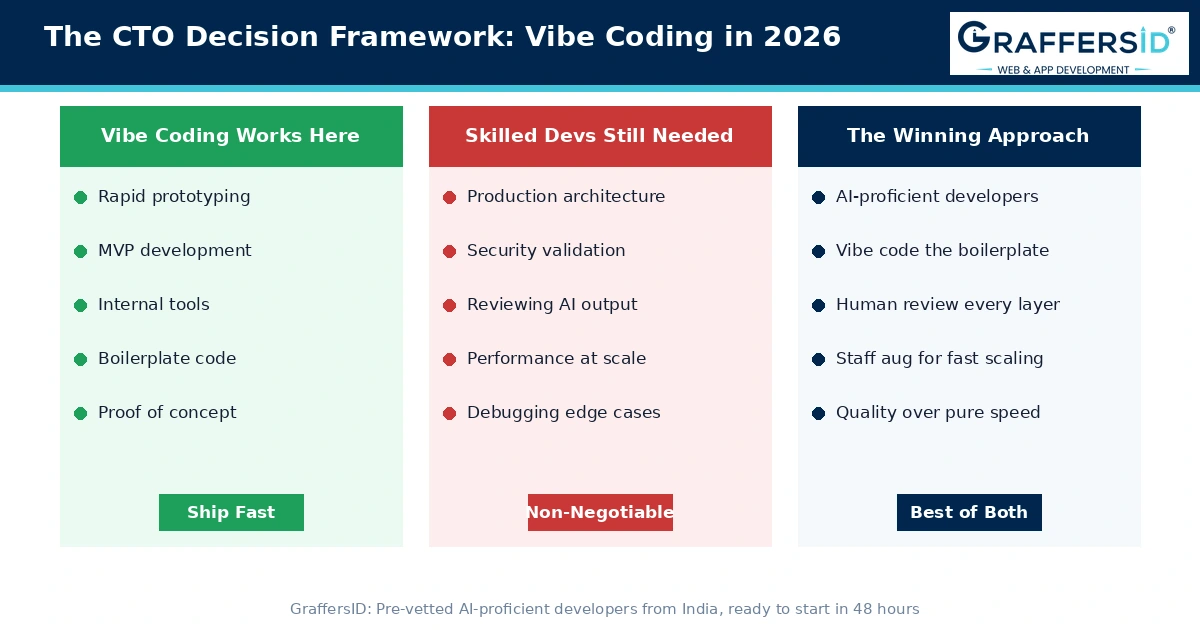
A practical framework for CTOs: where vibe coding delivers, where skilled developers remain essential, and what the winning approach looks like in 2026.
| Read Also: How to Hire AI Developers in 2026: Skills, Costs, and What Every CTO Should Know |
Final Thoughts
Vibe coding is a tool. A powerful one. But it is not a replacement for engineering judgment, and CTOs who treat it as one will find out the hard way when their AI-generated codebase meets real production pressure.
The companies that win in 2026 are not the ones who eliminate developers or the ones who ignore AI tools. They are the ones who hire developers who can use both: the speed of AI-assisted development and the discipline to validate, review, and own what gets shipped.
That combination is what separates a fast demo from a product that actually scales.
| Want developers who can direct AI tools and ship production-grade software?
GraffersID provides pre-vetted developers from India who are proficient in AI-assisted workflows, can review and validate AI-generated code, and are ready to start within 48 hours. Talk to our team: https://graffersid.com/contact-us/ |