
Retail and e-commerce in 2026 are no longer about simply launching an online store. They are about building intelligent, always-on digital commerce platforms that deliver personalized experiences, operate in real time, and scale seamlessly across channels.
With the global e-commerce market expected to surpass US$5.8 trillion by 2029, growth is being fueled by:
-
AI-driven personalization that adapts to every customer interaction
-
Headless and composable commerce architectures enabling faster innovation
-
Real-time payments and fintech integrations for seamless checkout experiences
-
Hyper-personalized journeys across web, mobile, voice, and in-store touchpoints
For CTOs, CEOs, and product leaders, the programming language behind an e-commerce platform is no longer a technical detail; it is a strategic business decision.
This guide explores the 7 best programming languages for retail & e-commerce in 2026, explaining where each language excels, real-world enterprise use cases, and which stacks work best for startups, mid-market brands, and large retailers.
How to Choose the Right Programming Language for E-Commerce? 2026 Criteria for Selection
Choosing the correct programming language for an e-commerce platform has a major impact on performance, security, scalability, and development costs. Here are some important factors to consider:
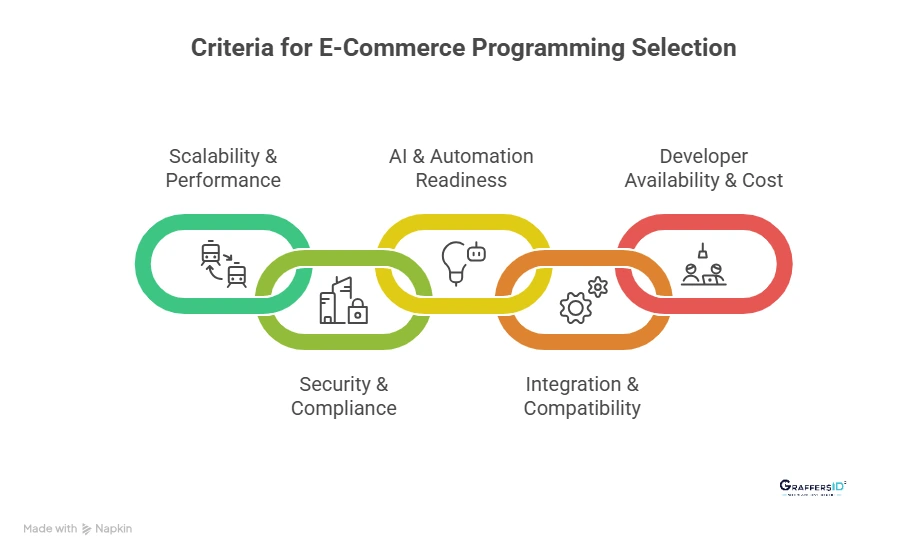
1. Scalability & Performance
An e-commerce programming language must support high traffic volumes without slowing down the user experience. It should handle flash sales, seasonal traffic spikes, and thousands of concurrent users smoothly. Strong performance is critical for real-time transactions, fast page loads, and microservices-based architectures. Platforms that fail to scale reliably often lose revenue during peak demand.
2. Security & Regulatory Compliance
E-commerce platforms process sensitive customer and payment data, making security non-negotiable. The chosen language should support PCI-DSS compliance, GDPR, and global data protection regulations. Built-in security features, secure authentication, and fraud prevention capabilities help reduce risks and protect customer trust. Security readiness also simplifies enterprise and international expansion.
3. AI & Automation Readiness
Modern e-commerce platforms rely heavily on AI-driven capabilities to stay competitive. The programming language should support AI-based product recommendations, intelligent search, and conversational chatbots. Automation features such as dynamic pricing, demand forecasting, and inventory optimization are essential for scalable growth. AI readiness ensures the platform remains future-proof beyond 2026.
4. Integration & Ecosystem Compatibility
A strong e-commerce tech stack must integrate seamlessly with third-party systems. This includes payment gateways, CRM and ERP platforms, analytics tools, and marketing automation software. Languages with rich libraries, APIs, and SDKs reduce integration time and improve system reliability. Smooth integrations enable faster innovation and better operational efficiency.
5. Developer Availability & Cost Efficiency
The availability of skilled developers directly impacts development speed and long-term maintenance. Popular programming languages offer a larger talent pool, making hiring faster and more cost-effective. Strong community support, documentation, and frameworks also reduce development risks. Choosing a widely adopted language ensures scalability without inflating operational costs.
7 Best Programming Languages for Retail & E-Commerce Website Development in 2026
Choosing the right programming language is critical to building scalable, secure, and AI-ready e-commerce platforms in 2026. Below are the seven most effective programming languages for retail and e-commerce development, explained with real-world use cases and clear business-fit guidance.

1. JavaScript: Best Programming Language for Modern E-Commerce & Headless Commerce
JavaScript continues to dominate e-commerce development in 2026 because it enables full-stack development, real-time performance, and seamless omnichannel experiences. With Node.js powering the backend and frameworks like React and Next.js on the frontend, businesses can build fast, SEO-friendly, and highly scalable platforms.
Why JavaScript Is Ideal for E-Commerce in 2026?
- One language for frontend and backend reduces development complexity
- Node.js handles high traffic with an event-driven, non-blocking architecture
- Next.js enables server-side rendering (SSR) for better SEO and Core Web Vitals
- Perfect fit for headless and composable commerce architectures
- Strong ecosystem of APIs, payment gateways, and third-party integrations
Enterprise Use Case
Amazon and Netflix use JavaScript extensively to power dynamic interfaces, personalization layers, and scalable frontend systems.
Best Fit For
- Startups, scale-ups, and enterprises
- Headless commerce platforms
- High-traffic and omnichannel e-commerce websites
GraffersID provides expert React developers to build scalable, AI-ready e-commerce platforms.
2. Python: Best Programming Language for AI-Driven E-Commerce & Automation
Python is the top choice for AI-powered retail platforms in 2026. It enables intelligent personalization, fraud detection, predictive analytics, and automated workflows, making it ideal for data-driven e-commerce businesses.
Why Python Works for Retail & E-Commerce?
-
AI-powered product recommendations and personalization engines
-
Advanced fraud detection and customer behavior analysis
-
Django offers strong security, authentication, and admin features
-
FastAPI enables high-performance APIs for modern commerce platforms
Enterprise Use Case
Shopify uses Python to support AI-driven fraud prevention and recommendation systems.
Best Fit For
-
AI-powered e-commerce platforms
-
Data-driven retail decision-making
-
Automation-heavy commerce workflows
3. Java: Best Programming Language for Enterprise E-Commerce Platforms
Java remains a gold standard for large-scale retail systems where stability, security, and performance are critical. It is widely used in enterprise marketplaces and global commerce platforms, handling millions of transactions.
Why Enterprises Choose Java?
-
Excellent scalability for high-volume transaction processing
-
Strong security and compliance support (PCI-DSS, GDPR)
-
Spring Boot simplifies microservices-based e-commerce architecture
-
Proven reliability for long-term, mission-critical platforms
Enterprise Use Case
Alibaba relies heavily on Java to manage massive transaction loads and global operations.
Best Fit For
-
Enterprise retail platforms
-
Global e-commerce marketplaces
-
High-volume and mission-critical systems
Read More: Best E-Commerce Development Companies in 2026 for Scalable, AI-Driven Online Stores
4. PHP: Best Programming Language for CMS-Based & Cost-Effective E-Commerce
PHP continues to be relevant in 2026, especially for content-heavy and CMS-driven e-commerce platforms. It powers some of the most widely used commerce systems globally.
Why PHP Still Matters for E-Commerce?
-
Foundation of Magento and WooCommerce ecosystems
-
Laravel provides modern security, routing, and caching features
-
Affordable hosting and development costs
-
Large global pool of experienced PHP developers
Best Fit For
-
Small and mid-sized e-commerce businesses
-
Content-focused online stores
-
Cost-conscious commerce projects
5. Ruby: Best Programming Language for E-Commerce MVPs & Startups
Ruby on Rails is known for speed of development and simplicity, making it a strong choice for startups launching MVPs or testing new e-commerce ideas.
Why Ruby Is Startup-Friendly?
-
Convention-over-configuration reduces development time
-
Faster MVP launches and rapid iterations
-
Built-in testing tools improve code quality
-
Clean, maintainable codebase
Enterprise Use Case
Shopify was originally built using Ruby on Rails, validating its effectiveness for e-commerce.
Best Fit For
-
MVPs and proof-of-concept platforms
-
Early-stage startups
-
Rapid prototyping and experimentation
6. C#: Best Programming Language for Microsoft-Based Enterprise Retail
C# is a powerful programming language created by Microsoft that provides enterprise-level security and a solid framework for e-commerce apps. It is commonly used in enterprise retail platforms that require strong security and performance.
Why C#?
- Its enterprise-level security makes it suitable for high-value transactions.
- The .NET Core microservices architecture allows for scalable solutions.
- Microsoft’s retail and AI advancements enhance e-commerce software.
Enterprise Use Case
Walmart uses .NET technologies for inventory management and large-scale retail operations.
7. Go: Best Programming Language for High-Performance & Fintech E-Commerce
Go is a new programming language created by Google that is famous for its speed and concurrency control. It is becoming increasingly popular in fintech-driven e-commerce applications that require high speed and real-time data processing.
Why Go?
- Excellent concurrency management enhances checkout speed and real-time transactions.
- High performance for backend services and fintech-based retail solutions.
- Increased use of cloud-based e-commerce platforms.
Enterprise Use Case
Uber uses Go for high-performance backend services, including real-time pricing and transaction processing.
Comparison Table: Best Programming Languages for E-Commerce (2026)
| Language | Best For | Scalability | AI Readiness | Cost |
|---|---|---|---|---|
| JavaScript | Full-stack & headless commerce | High | Medium | Low |
| Python | AI & automation | Medium | Very High | Medium |
| Java | Enterprise retail | Very High | Medium | High |
| PHP | CMS-based stores | Medium | Low | Low |
| Ruby | MVPs & startups | Medium | Low | Medium |
| C# | Enterprise security | High | Medium | High |
| Go | Real-time transactions | Very High | Medium | Medium |
Best Programming Languages by Business Size
Startups & SMBs:
-
React + Node.js
-
Ruby on Rails
Mid-Size E-Commerce:
-
JavaScript + Python
-
PHP (Magento)
Enterprise Retail:
-
Java
-
C# (.NET Core)
Fintech & Real-Time Commerce:
-
Go
-
Python
Read More: E-commerce Automation Trends 2026: How Retailers Are Using AI and Automation to Scale
Future Trends in Retail & E-Commerce Development: 2026 & Beyond
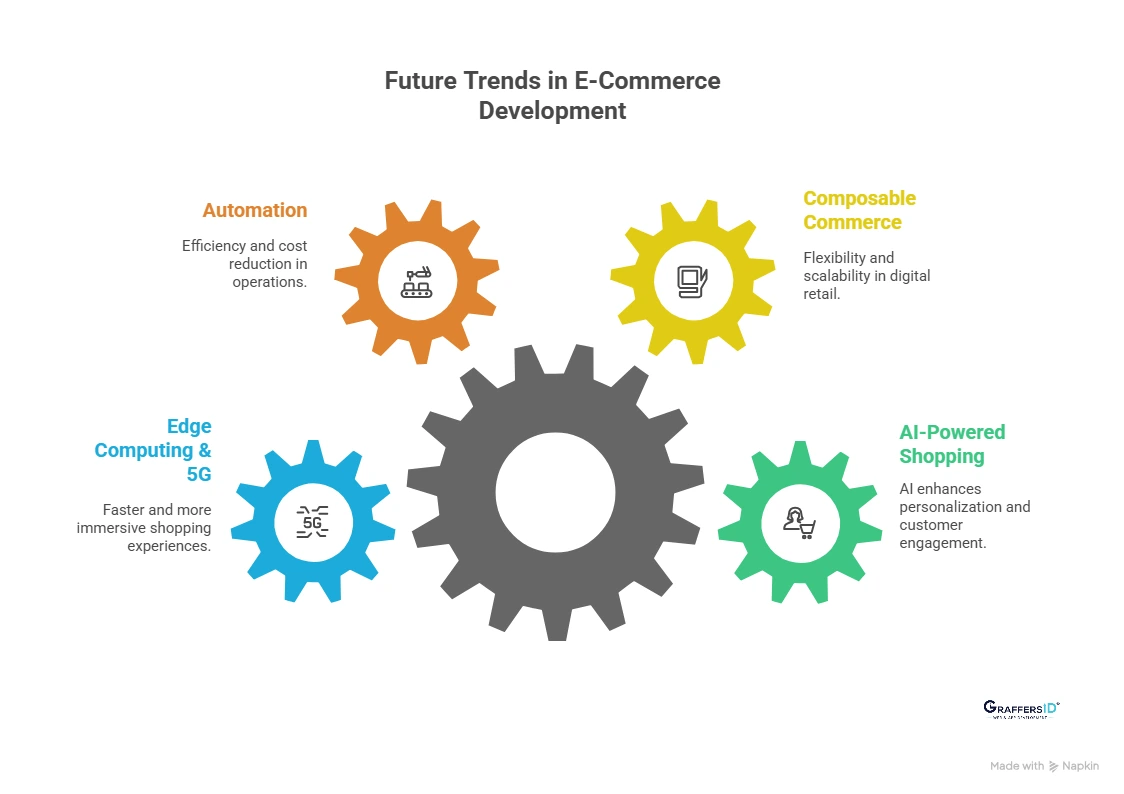
1. AI-Powered Shopping Experiences
AI is becoming the core engine of modern e-commerce platforms. In 2026, retailers use AI to deliver personalized product recommendations, power intelligent chatbots and virtual assistants, and enable voice-based shopping. These capabilities help brands increase conversions, improve customer engagement, and make faster data-driven decisions.
2. Composable & Headless Commerce Platforms
Headless and composable commerce allow businesses to separate the frontend from the backend for greater flexibility. This approach enables faster omnichannel launches, easier integrations with third-party tools, and the freedom to update user experiences without disrupting core commerce systems. In 2026, it is a key strategy for scalable digital retail.
3. Automation Across the E-Commerce Lifecycle
Automation is now embedded across inventory management, pricing, and customer support. Retailers rely on automated systems to forecast demand, adjust prices in real time, and handle customer queries at scale. In 2026, automation improves operational efficiency while reducing manual effort and costs.
4. Edge Computing & 5G in Retail
Edge computing and 5G are reshaping how fast and responsive e-commerce platforms feel. By processing data closer to users, businesses achieve faster mobile checkouts, real-time inventory visibility, and immersive AR and VR shopping experiences. This trend is especially important for mobile-first and global e-commerce brands.

Conclusion
There is no single “best” programming language for e-commerce in 2026. The right choice depends on business scale, performance expectations, AI readiness, security needs, and long-term growth strategy.
Modern e-commerce platforms increasingly rely on JavaScript frameworks such as Node.js, React, and Next.js to support headless commerce, fast user experiences, and scalable architectures. Python continues to play a critical role in AI-driven personalization, automation, and intelligent decision-making. For large enterprises, Java and C# remain trusted technologies for building secure, high-traffic retail systems, while Go is emerging as a strong option for real-time, fintech-heavy commerce environments.
Selecting the right programming language is not just a technical decision; it is a strategic investment that directly impacts time-to-market, platform reliability, operational efficiency, and future innovation. Aligning your technology stack with evolving trends such as AI-powered commerce, composable architectures, and automation ensures your platform remains competitive well beyond 2026.
GraffersID helps global businesses design and build scalable, AI-ready e-commerce platforms using modern technologies such as React, Node.js, Next.js, and Python. We specialize in custom web and mobile development, AI-powered automation solutions, and provide dedicated remote developers from India to support long-term growth.
Looking to hire remote developers for your e-commerce project?
Contact GraffersID to build secure, high-performance retail solutions that scale with your business and stay future-ready in 2026 and beyond.