| Quick Takeaways
● MCP (Model Context Protocol) was launched by Anthropic in November 2024 and donated to the Linux Foundation in December 2025. It is now vendor-neutral infrastructure backed by OpenAI, Google, Microsoft, and AWS. ● Monthly SDK downloads grew from 100,000 at launch to 97 million by March 2026, a 970x increase in 18 months. ● 41% of surveyed software organisations are already running MCP servers in limited or broad production as of 2026. ● Gartner predicts 40% of enterprise applications will include task-specific AI agents by end of 2026. Those agents need MCP to interact with your tools. |
Every engineering team building AI products in 2026 hits the same wall. You get the model working. It performs brilliantly in isolation. Then you spend three weeks building custom connectors to get it talking to your CRM, your internal database, your documentation, your cloud services. You do it once. Then you do it again for the next model. And again for the next tool.
MCP exists to end that problem. It is the open standard that lets any AI model connect to any external tool through a single, consistent interface. If you want to understand how agentic AI is already reshaping how software gets built, MCP is a core part of that shift. By the end of this post you will know exactly what MCP is, how it works, why it moved from niche developer protocol to mainstream enterprise infrastructure in under 18 months, and what a practical response looks like for your team.
What Is MCP, in Plain English?
The simplest way to understand MCP is the USB-C analogy. Before USB-C, every device manufacturer used a different connector. You needed a different cable for your laptop, your phone, your monitor, your hard drive. USB-C standardised the interface. One cable, every device.
MCP does the same thing for AI. Before MCP, every AI model needed a custom integration for every tool it wanted to access. If you wanted your AI assistant to read from your database, write to your CRM, and pull from your internal docs, you built three separate connectors, specific to that model, that tool, and that use case. Then you maintained them as both the model and the tools updated. The engineering cost was enormous. Understanding what an LLM agent actually does inside a production system makes it clear why this integration problem compounds so quickly at scale.
One developer writing for The New Stack captured the business case precisely: they spent two weeks building a custom plugin to connect an AI assistant to an internal CRM, then replaced it entirely with an MCP server that took four hours to implement and worked with every AI model in their stack. Two weeks versus four hours. One custom integration versus universal compatibility. That ratio is the entire business case for MCP.
How MCP Actually Works
1) The Three Components: Host, Client, and Server
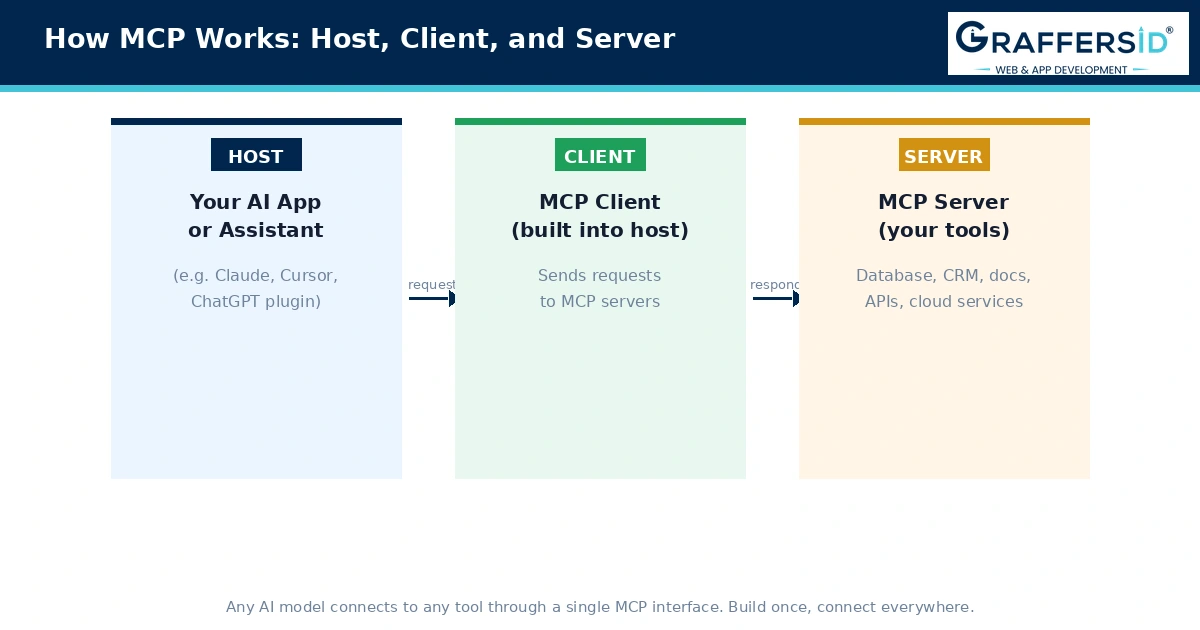
MCP has three parts and they are straightforward once you see how they fit together.
The Host is your AI application. That could be Claude, Cursor, a ChatGPT plugin, or a custom AI tool your team has built. The host is where the user or agent interacts with the AI model.
The Client is built into the host. It handles the communication layer, sending requests out to MCP servers and returning the results back to the model. You do not build the client yourself. It comes with the AI platform.
The Server is what you build or adopt. An MCP server wraps any external tool, database, API, or data source and exposes it through a standardised interface that any MCP-compatible AI model can call. This is where how LangChain fits into an AI development stack becomes relevant: MCP and LangChain are complementary layers. LangChain handles agent orchestration. MCP handles tool connectivity.
2) What It Looks Like in Practice
Pinterest published its MCP architecture in April 2026, one of the most detailed public case studies available. They run domain-specific MCP servers for their data platforms including Presto, Spark, and Airflow, with a central registry for server discovery and human-in-the-loop approval for high-risk operations.
Other common enterprise patterns include: internal tool aggregation where companies expose internal APIs, databases, and documentation as MCP servers behind a gateway; customer-facing agents that use MCP to access CRM data and support tickets; DevOps automation where MCP servers wrap infrastructure tools for AI-assisted operations; and data analysis pipelines where AI agents connect to data warehouses through MCP.
The three components of MCP: Host (your AI app), Client (built-in communication layer), and Server (your tools and data sources exposed through a standard interface).
Why MCP Became the Standard So Fast
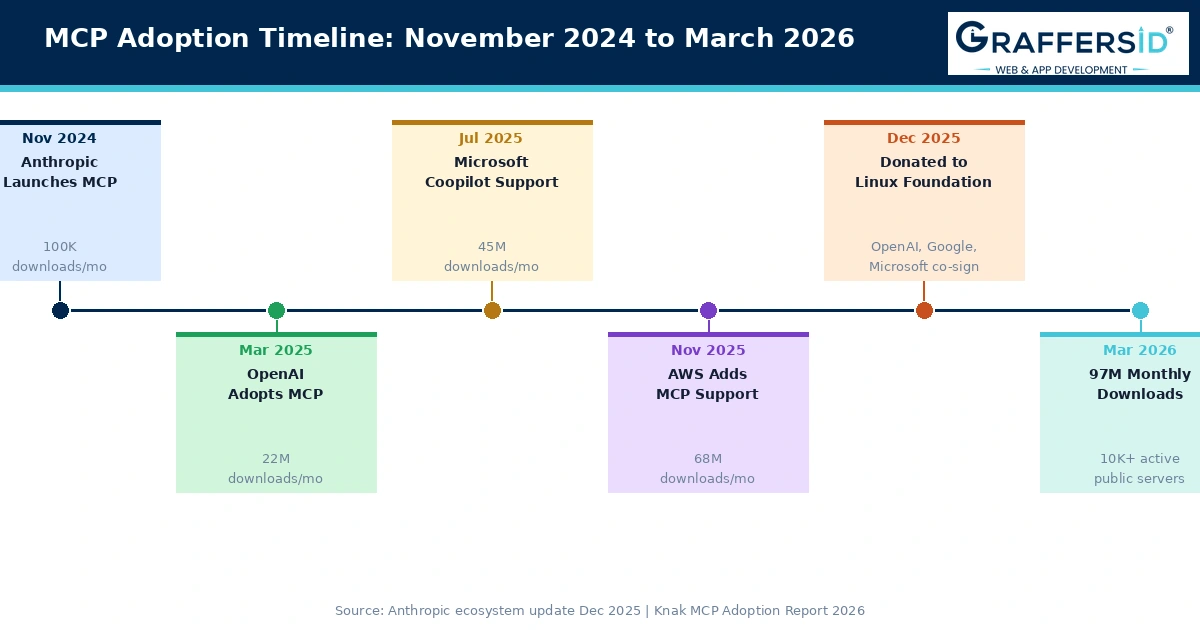
The adoption curve for MCP is one of the fastest in enterprise software history. When Anthropic launched it in November 2024, the SDK was downloaded roughly 100,000 times in the first month. By March 2026, that number had reached 97 million monthly downloads, a 970x increase in 18 months.
The inflection point came in December 2025 when Anthropic donated MCP to the newly formed Agentic AI Foundation under the Linux Foundation. OpenAI and Block were co-founders. AWS, Google, Microsoft, Cloudflare, and Bloomberg joined as platinum members. This is the same governance pattern that made Linux, Kubernetes, and OpenTelemetry successful. MCP stopped being one vendor’s side project and became industry infrastructure.
The practical result: every major AI platform now supports it. Claude, ChatGPT, Cursor, Windsurf, VS Code Copilot, Microsoft Copilot Studio, and Google DeepMind all have MCP integration. If you build an MCP server today, it works with every AI model your team or your customers might use tomorrow.
| Read Also: What Are Multi-Agent Systems? Architecture, Benefits, and Real-World Applications |
What MCP Means for Your Engineering Team
-
If You Are Building AI-Powered Products
If your product does not expose an MCP server, it is invisible to AI agents. That is not a metaphor. An AI agent working on behalf of your customer can only access tools that speak MCP. Forrester predicts that 30% of enterprise app vendors will launch their own MCP servers, and that vendors adopting this standard will have a meaningfully higher probability of early enterprise-wide adoption. The products that become agent-ready in 2026 will win the enterprise deals that require AI interoperability. Building a strong AI adoption strategy now means deciding where MCP sits in your product roadmap, not just which LLM to use.
-
If You Are Connecting AI Agents to Your Internal Stack
The integration economics change dramatically with MCP. Before MCP, connecting N AI models to M internal tools required N times M custom integrations. After MCP, you build one MCP server per tool and every AI model can reach it. The difference between AI agents and agentic AI systems becomes much more practical to deliver when the tool connectivity layer is standardised.
-
What the Security Risks Look Like
This is the part most MCP guides skip. Security researchers filed 30 plus CVEs against MCP implementations in January and February 2026. At RSA Conference 2026, a session demonstrated how an MCP vulnerability could enable remote code execution and full takeover of an Azure tenant. The risks are not abstract. According to a CIO.com analysis of enterprise MCP adoption, MCP tooling can be over-permissioned, untrusted MCP servers can enable data leakage or prompt injection, and malicious tool impersonation creates pathways for compromise.
The risk profile is manageable but it requires deliberate governance. Know which MCP servers are running in your environment. Define who has authority to create integrations. Implement tool-level permissions and audit logging before you roll out write access. These are not optional steps.
MCP adoption timeline from 100,000 monthly SDK downloads at launch in November 2024 to 97 million by March 2026, driven by cross-vendor adoption and Linux Foundation governance.
Should Your Team Be Building with MCP Right Now?
For most engineering teams in 2026, the answer is yes. The question is where to start and how fast to move.
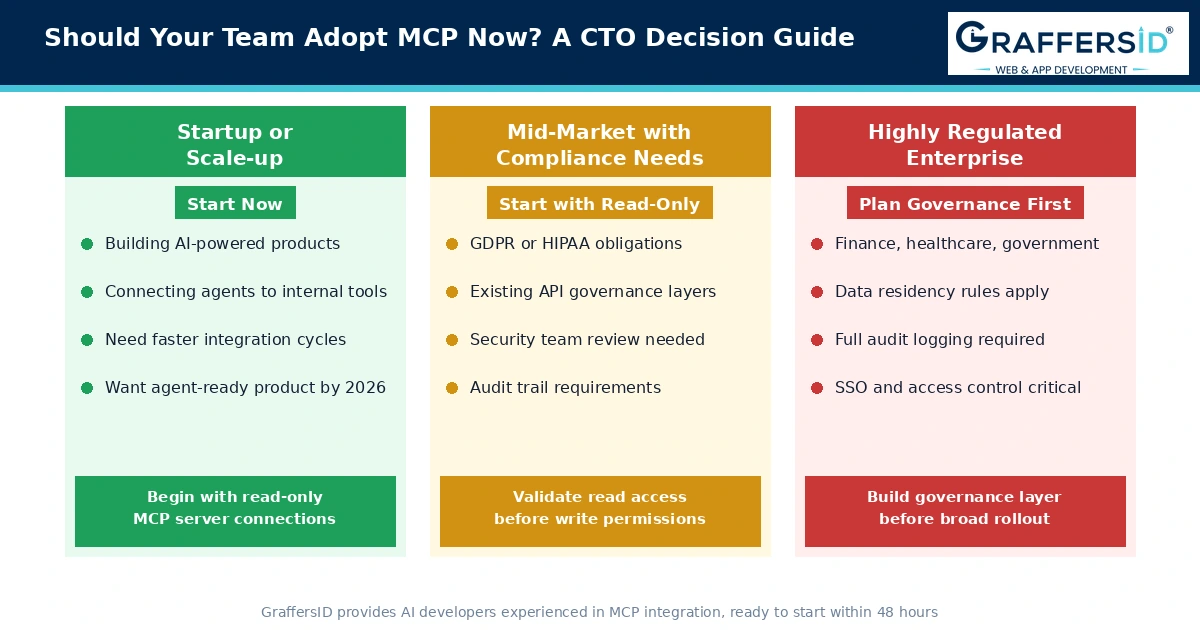
If you are a startup or scale-up building AI-powered products, start now with read-only MCP server connections. Connect your AI agent to your internal documentation, your customer data, your analytics. Validate the access patterns. Expand to write operations once you have tested the integration surface. The engineering lift for a basic MCP server is measured in days, not weeks.
If you are a mid-market company with compliance obligations, start with read-only access and involve your security team before granting write permissions. OAuth 2.1 with PKCE is available as an authentication framework but practical integration with your identity provider requires additional work. Plan for that before you ship.
If you are in a highly regulated environment, finance, healthcare, or government, your governance layer needs to come first. MCP does not natively address data residency rules, standardised audit logging, or SSO integration at the level most regulated enterprises require. Additional tooling is needed before broad rollout. That is not a reason to delay planning. It is a reason to start planning now. If you want a practical framework for how to structure this, the breakdown of staff augmentation vs dedicated team vs full outsourcing applies directly to how you resource the MCP build: whether you build in-house, augment your team with specialists, or partner with a development firm that has already built MCP integrations in production.
Whichever path fits your stage, the developers who will do this work well need to understand both the protocol and the agentic AI stack it connects to. If you need to move fast, hire AI developers from GraffersID who have hands-on experience with MCP, LangChain, and production agentic systems and are ready to start within 48 hours.
A practical MCP adoption decision guide for CTOs: startups should start now, mid-market teams start with read-only access, and highly regulated enterprises plan governance first.
| Read Also: Can Vibe Coding Replace Developers? The Honest Answer for CTOs in 2026 |
Final Thoughts
MCP is not optional to understand in 2026. It is becoming the connective tissue of enterprise AI: the standard layer that lets AI agents interact with the tools, data, and workflows that businesses already run on.
The CTOs who build an MCP strategy now will have a meaningful integration advantage as agent-driven workflows become the default. Those who wait will spend 2027 playing catch-up with teams that already have their tooling connected.
The protocol is mature enough to build on. The ecosystem is broad enough to justify the investment. And the engineering cost of starting, for most teams, is far lower than the cost of being invisible to AI agents when your customers start deploying them.
| Need developers who can build and integrate MCP into your AI stack?
GraffersID provides pre-vetted AI developers from India experienced in agentic AI, LLM frameworks, and MCP integration. They are ready to start within 48 hours. |