The real estate industry is no longer just about locations and listings; it’s about technology-driven speed, intelligence, and experience. In 2026, buyers, renters, investors, and property managers expect real-time property discovery, AI-powered pricing insights, seamless mobile experiences, and automated operations across every touchpoint.
Behind every high-performing real estate platform lies a critical decision that directly impacts growth, security, and scalability: the programming language powering it. Whether you’re building a property marketplace, tenant management system, mortgage automation platform, or AI-driven analytics engine, your technology stack determines how fast you can scale, how secure your data remains, and how future-ready your product is.
This guide breaks down the 7 best programming languages for real estate and property management in 2026, explaining where each language fits best, what problems it solves, and how leading PropTech platforms use them today.
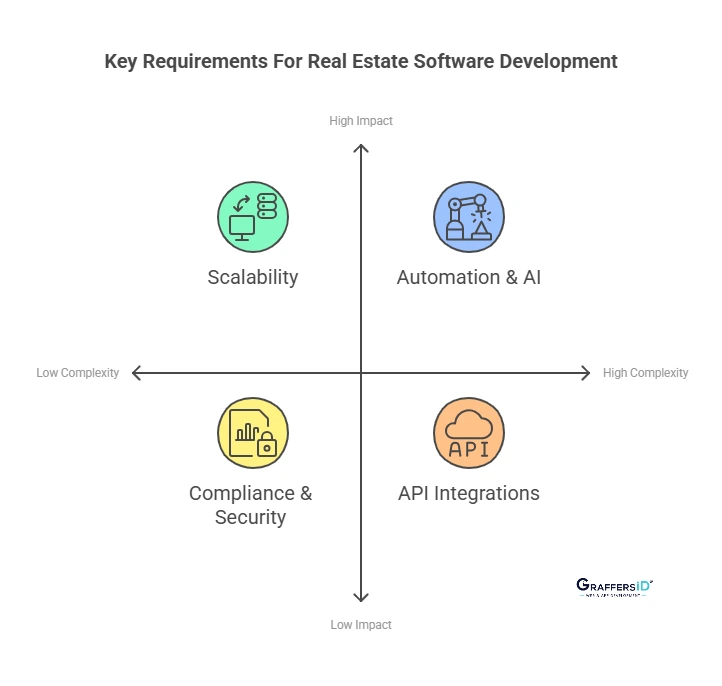
Key Requirements of the Right Programming Language for Real Estate Software (2026)
Before choosing a programming language for real estate or property management software, businesses must evaluate whether it can support scale, security, integrations, and intelligent automation. The right language should not only meet current needs but also remain future-ready as platforms grow.
1. Scalability & Cloud Readiness
A suitable programming language must handle high traffic, large property databases, and real-time user interactions without performance issues. It should support deployment on cloud platforms like AWS and Azure and enable modular or microservices-based architectures for easy scaling.
2. Security, Compliance & Data Privacy
Real estate platforms process sensitive user, financial, and legal data. The programming language should support strong encryption, secure authentication, and role-based access, while making it easier to comply with GDPR, CCPA, SOC 2, and local data protection regulations.
3. API Integrations & Platform Compatibility
Modern real estate software relies heavily on integrations. The language should allow smooth integration with MLS systems, CRM systems, ERPs, payment gateways, and third-party marketing or analytics tools, ensuring seamless data flow across the ecosystem.
4. AI, Automation & Real-Time Intelligence
To stay competitive in 2026, the programming language must support AI-driven pricing models, chatbots, and recommendation engines. It should also enable automation for tenant management, renewals, maintenance workflows, and support machine learning for market forecasting and investment insights.
Read More: AI in Real Estate: How PropTech Is Using AI for Pricing, Sales, and Property Management in 2026?
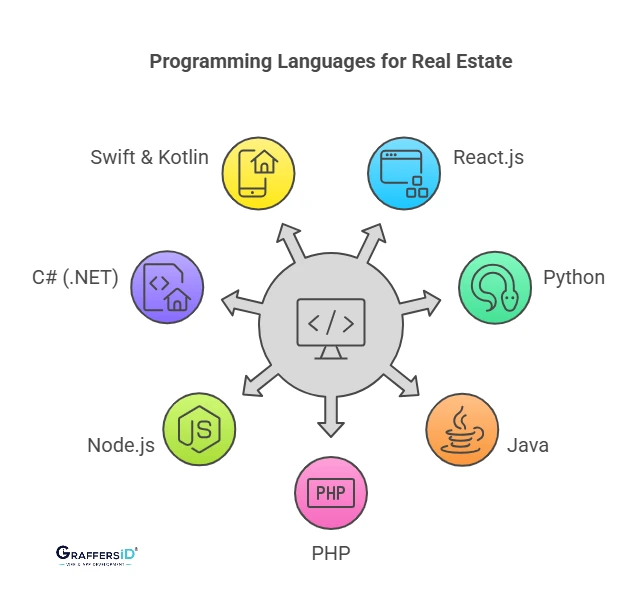
Top 7 Programming Languages for Real Estate & Property Management in 2026
Choosing the right programming language is critical for building scalable, secure, and future-ready real estate platforms. In 2026, real estate software must support real-time data, AI-driven insights, cloud scalability, and seamless user experiences across web and mobile platforms.
Below are the top 7 programming languages most widely used in real estate and PropTech applications, along with where each one fits best.
1. React.js: Best for Dynamic Real Estate Marketplaces
React.js continues to be the preferred choice for building fast, interactive, and conversion-focused real estate web applications. Its component-based architecture allows teams to roll out new features quickly without disrupting the entire platform.
Why is React.js ideal in 2026?
React enables real-time property filtering, interactive maps, and instant UI updates, features users now expect from modern property portals. When combined with Next.js, it delivers SEO-friendly server-side rendering (SSR) and improved page performance, which is critical for ranking and AI search visibility.
Best Use Cases:
-
Property listing and marketplace platforms
-
Buyer, seller, and renter dashboards
-
AI-powered recommendation and discovery interfaces
Industry Adoption: Zillow, Redfin, and large Realtor-style platforms rely heavily on React-based frontends.
Want to build a high-conversion real estate marketplace? GraffersID helps businesses hire remote React.js developers to build SEO-optimized, scalable real estate platforms.
2. Python: Best for AI-Driven Real Estate Analytics
Python is the foundation of AI, machine learning, and data intelligence in real estate software. It is widely used for analyzing large property datasets, predicting prices, and automating decision-making workflows.
Why Python stands out?
Python supports advanced AI models for property valuation, predictive pricing, and demand forecasting. Its rich ecosystem of libraries makes it the top choice for data-heavy real estate applications.
Key Libraries: Pandas, NumPy, TensorFlow, PyTorch, Django
Best Use Cases:
-
AI-powered pricing and valuation engines
-
Market trend and investment forecasting
-
Mortgage calculators and risk assessment tools
3. Java: Best for Enterprise Property Management Software
Java is an enterprise-friendly, object-oriented programming language that remains a trusted choice for large-scale, enterprise-level real estate software where stability and security are non-negotiable. It provides excellent security, scalability, and performance, and hence, can be applied in real estate CRMs and property management software.
Why Java still matters in 2026?
Java’s mature ecosystem, combined with Spring Boot, allows companies to build highly secure, scalable backend systems that comply with strict regulatory requirements.
Best Use Cases:
-
Enterprise real estate CRMs
-
Lease and tenant management systems
-
Mortgage processing and financial platforms
4. PHP (Laravel): Best for Cost-Effective Real Estate Websites
PHP is a server-side scripting language for developing websites, and Laravel is one of the top frameworks for budget-friendly and fast-to-market real estate solutions. It is usually used to design dynamic, database-based real estate websites.
Why Laravel works well?
Laravel offers rapid development, strong database management, built-in security features, and easy API integration, making it ideal for small to mid-sized real estate businesses.
Best Use Cases:
-
WordPress-based real estate portals
-
Broker and agency websites
-
Admin panels and internal dashboards
5. Node.js: Ideal for Real-Time &Scalable Backend Development
Node.js is a JavaScript runtime that enables developers to build high-performance, scalable, real-time real estate applications. It is especially suited for real estate websites that need quick property updates and interactive elements.
Why is Node.js powerful in 2026?
Its event-driven, non-blocking architecture allows real estate platforms to handle thousands of users simultaneously, making it ideal for live search, instant updates, and chat-based features.
Best Use Cases:
-
Real-time property search and filtering
-
Chat-based customer support systems
-
API-driven real estate ecosystems
Planning to scale a real-time real estate platform? GraffersID provides remote Node.js developers to build fast, scalable backend systems.
6. C# (.NET): Ideal for Real Estate Compliance & Accounting Software
C# is a modern object-oriented programming language developed by Microsoft. It is best suited for secure, compliance-based property management software, especially when combined with .NET Core and Azure Cloud.
Why is C# ideal?
It offers enterprise-grade security, smooth integration with Microsoft Azure, and strong support for financial and compliance-focused applications.
Best Use Cases:
-
Rental accounting and financial reporting systems
-
Compliance-driven property management software
-
Integrations with Microsoft Dynamics and enterprise tools
7. Swift & Kotlin: Ideal for Mobile Real Estate Apps
As mobile usage dominates property discovery in 2026, Swift (iOS) and Kotlin (Android) are essential for building mobile applications. They are widely used to develop high-performance, user-centric real estate mobile apps.
Why are Swift & Kotlin critical?
They deliver native performance, smooth user experiences, and support advanced features like AR/VR-based property tours and GPS-driven searches.
Best Use Cases:
-
Mobile property search and listing apps
-
GPS-based nearby property discovery
-
Virtual tours and mobile mortgage tools
Comparison Table: Top Programming Languages for Real Estate Development (2026)
Choosing the correct programming language is critical when developing efficient, scalable, secure real estate apps. Each language has its advantages, making it suitable for different aspects of real estate software development.
The following table shows a detailed comparison of the best programming languages:
| Language | Best For | Key Features | Use Cases |
| React.js | Dynamic real estate marketplaces | Component-based UI, fast rendering, SEO-friendly | Interactive property listing platforms |
| Python | AI-driven real estate analytics | Machine learning (TensorFlow), data processing (Pandas) | AI-powered property valuation, chatbots, investment analysis |
| Java | Enterprise-grade property management | High security, scalability, Spring Boot framework | Large-scale CRMs, mortgage processing, and lease management |
| PHP (Laravel) | Cost-effective real estate websites | MVC architecture, built-in security, and easy database integration | WordPress-based real estate platforms, small business websites |
| Node.js | Fast and scalable backend development | Event-driven architecture, real-time data handling | Real-time property search, chat-based customer support |
| C# (.NET) | Real estate compliance & accounting software | Secure, cloud-ready (Azure), integrates with Microsoft Dynamics | Large-scale rental management, compliance-driven applications |
| Swift & Kotlin | Mobile real estate apps | Native performance, supports AR/VR, seamless UI/UX | iOS and Android real estate apps, mortgage calculators, and GPS-based searches |
How to Choose the Best Programming Language for Your Real Estate Software (2026)
Selecting the right programming language for your real estate project depends on business goals, product type, scalability expectations, security requirements, and long-term maintenance needs.
In 2026, the decision is less about a single language and more about choosing the right technology stack that supports growth and automation.
Key Questions to Ask Before Choosing a Programming Language
Start by evaluating your project requirements clearly:
-
Is your product web-first, mobile-first, or AI-driven? Web platforms focus on performance and SEO, mobile apps require native speed, and AI-driven products demand strong data and ML capabilities.
-
Will your platform handle high traffic or real-time interactions? Property marketplaces, live search, and chat features require languages that support concurrency and fast data processing.
-
Are you operating in compliance-heavy regions? If your platform handles financial or personal data, the language must support GDPR, CCPA, and enterprise-grade security standards.
-
Do you need a fast MVP or a long-term enterprise solution? Startups often prioritize speed and cost, while enterprises focus on stability, scalability, and long-term support.
Practical Guidelines for Selecting the Right Technology Stack
Once your goals are clear, align them with the right programming language:
-
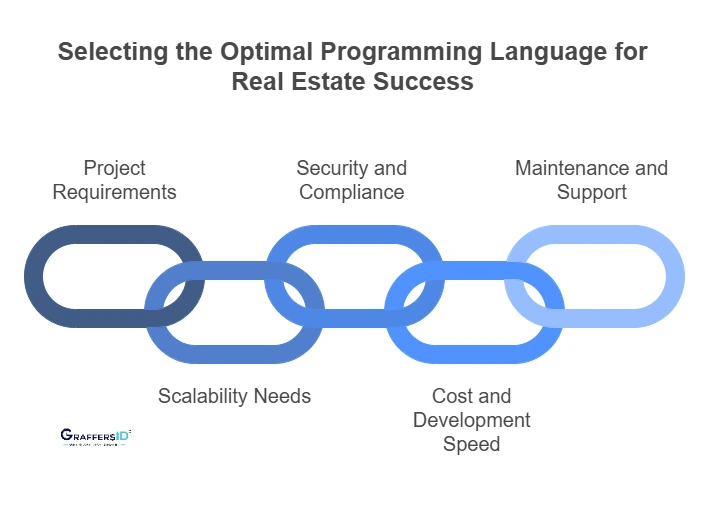
Define Your Project Scope: Decide whether you are building a property listing website, mobile application, AI-powered analytics system, or a full-scale enterprise platform.
-
Evaluate Scalability Requirements: For real-time updates and high user traffic, React.js combined with Node.js offers excellent performance and flexibility.
-
Prioritize Security & Compliance: For compliance-driven real estate software, Java and C# (.NET) provide robust security, access control, and regulatory support.
-
Balance Cost and Development Speed: PHP with Laravel is ideal for cost-effective and fast-to-market solutions, while Python is best suited for AI-driven functionality.
-
Plan for Long-Term Maintenance: Enterprise systems that require long-term stability and support benefit most from Java or C#, which have mature ecosystems and strong enterprise adoption.
Read More: Top 15 Real Estate Technology & PropTech Trends in 2026 | AI Innovations in Real Estate
Future Trends in Real Estate Software Development: 2026 and Beyond
Real estate software is rapidly evolving as emerging technologies redefine how properties are priced, marketed, managed, and transacted.
In 2026 and beyond, platforms that adopt AI, blockchain, IoT, and immersive technologies will gain a clear competitive edge.
1. Predictive Analytics and AI-Powered Property Valuation
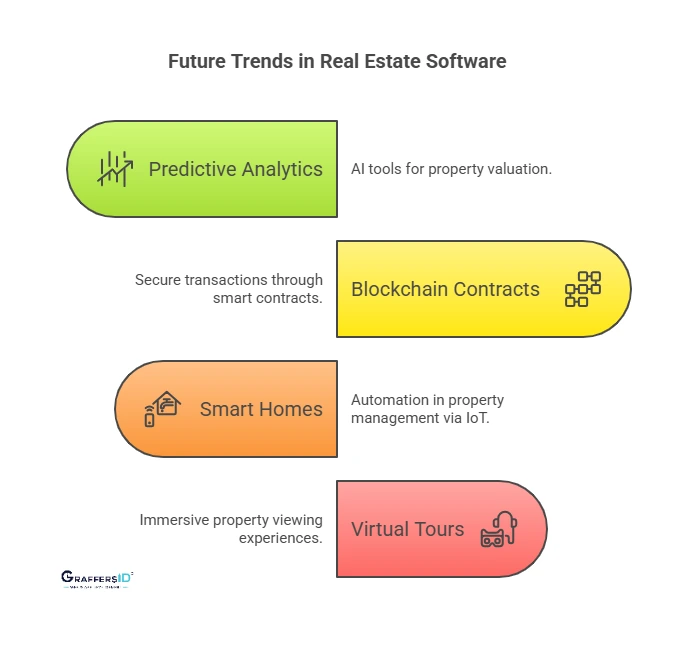
- Artificial intelligence is transforming real estate decision-making by enabling accurate property pricing, demand forecasting, and behavioral insights.
- AI models analyze historical data, market trends, and buyer activity to automate lead scoring, buyer-property matching, and investment recommendations.
2. Blockchain-based Smart Contracts
- Blockchain is improving trust and transparency in real estate transactions.
- Smart contracts automate leases, ownership transfers, and payments, reducing paperwork, fraud risks, and transaction timelines while ensuring secure, tamper-proof records.
3. IoT-powered Smart Homes and Automated Property Management
- Internet of Things (IoT) technology enables smart homes and automated property operations.
- Sensors and connected devices provide real-time insights into security, energy usage, occupancy, and maintenance needs, helping property managers reduce costs and prevent issues before they occur.
4. AR/VR-Powered Virtual Property Tours
- Augmented Reality (AR) and Virtual Reality (VR) are reshaping property discovery.
- Immersive virtual tours and 3D property walkthroughs allow buyers and renters to explore properties remotely, accelerating decision-making and expanding reach across global markets.

Conclusion: Choosing the Right Programming Language for Real Estate Software in 2026
There is no single “best” programming language for real estate software; there is only the right technology stack aligned with your business goals, scale, and future roadmap. In 2026, high-performing real estate platforms are built on flexible, cloud-ready architectures that support real-time interactions, AI-driven intelligence, and seamless user experiences.
Most successful PropTech solutions combine React.js for fast, SEO-friendly frontends, Node.js for scalable real-time backends, and Python for AI-powered analytics, pricing models, and automation. When used together, these technologies enable real estate platforms to deliver speed, security, and data-driven decision-making at scale.
At GraffersID, we specialize in building scalable, AI-ready, and future-proof real estate software solutions by matching the right technology stack with experienced remote developers.
Ready to build or scale your real estate software in 2026?
Partner with GraffersID to hire expert developers and accelerate your digital transformation today.