Healthcare software isn’t just another SaaS product. It operates in an environment where a minor technical flaw can impact patient safety, trigger regulatory penalties, or disrupt hospital operations. Unlike traditional e-commerce or business platforms, healthcare systems must be built with security, compliance, scalability, and interoperability at their core.
In 2026, the demand for intelligent and resilient healthcare systems is accelerating. From AI-assisted diagnosis and telemedicine platforms to remote patient monitoring, hospital ERP systems, and advanced healthcare automation solutions, organizations are rethinking their technology foundations. And at the center of that foundation lies one critical decision: the programming language.
The language you choose directly influences your system’s security architecture, compliance readiness, long-term maintainability, and ability to integrate with existing healthcare ecosystems.
In this guide, we’ll explore the five best programming languages for healthcare software development in 2026, along with real-world use cases, comparison insights, and emerging trends, so you can make a confident, future-ready decision for your healthcare product.
Types of Healthcare Software You Might Be Building in 2026
Before choosing a programming language, it’s important to understand what type of healthcare solution you’re building. Each category has different technical, compliance, and scalability requirements.
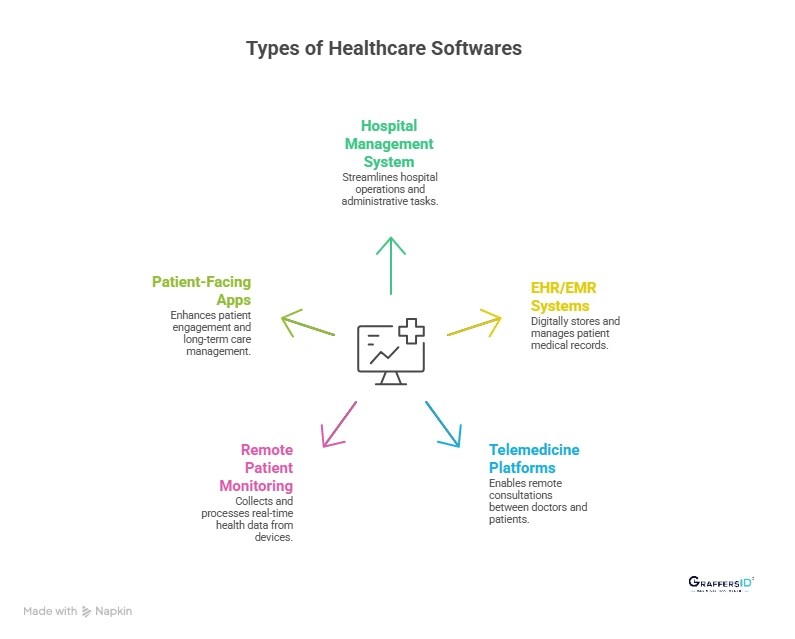
1. Hospital Management System (HMS)
A Hospital Management System helps healthcare facilities manage daily operations efficiently. It centralizes administrative, financial, and operational workflows into a single platform.
HMS platforms typically require strong role-based access control, secure data storage, and seamless integration with accounting and insurance systems.
2. Electronic Health Records (EHR) and EMR Systems
EHR and EMR systems are designed to digitally store and manage patient medical records. These systems must prioritize data accuracy, privacy, and interoperability.
Because they handle highly sensitive patient data, EHR/EMR platforms must comply with standards like HIPAA and support HL7/FHIR integrations.
3. Telemedicine Platforms
Telemedicine software enables remote consultations between doctors and patients. With digital healthcare adoption rising in 2026, telehealth platforms are becoming essential.
These platforms must ensure low-latency performance, encrypted communication, and scalable infrastructure to handle high user volumes.
4. Remote Patient Monitoring (RPM) and IoMT Solutions
Remote Patient Monitoring systems collect and process real-time health data from wearable devices and connected medical equipment. These solutions are part of the growing Internet of Medical Things (IoMT) ecosystem.
RPM systems demand high-performance backends, secure device communication, and reliable cloud integration.
5. Patient-Facing Healthcare Apps
Patient-centric healthcare apps focus on improving engagement, accessibility, and long-term care management. These apps are often mobile-first and designed for ease of use.
Such applications must balance user-friendly design with strong data privacy, authentication systems, and backend scalability.
Key Technical Requirements to Consider Before Choosing a Programming Language for Healthcare Software in 2026
Choosing the right programming language for healthcare software development goes beyond popularity or developer preference. In 2026, decision-makers must evaluate technical, regulatory, and long-term operational factors before finalizing their tech stack.
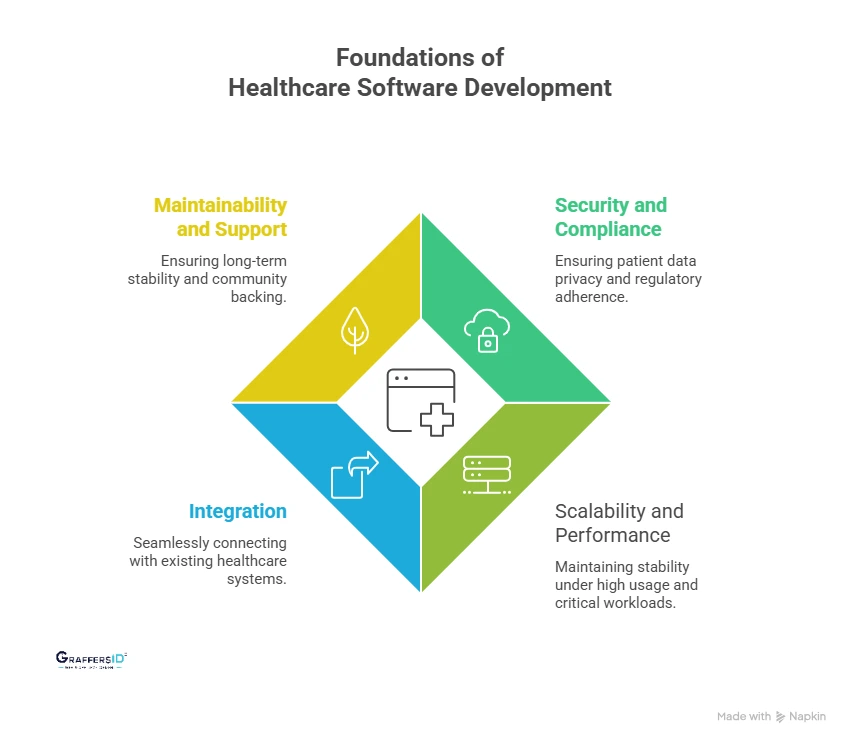
1. Security and Regulatory Compliance
Healthcare systems handle highly sensitive patient data, making security non-negotiable.
- HIPAA compliance: Your software must align with the Health Insurance Portability and Accountability Act to ensure patient data privacy and protection.
- HL7 standards: Protocols defined by HL7 International enable structured healthcare data exchange between systems.
- FHIR interoperability: Fast Healthcare Interoperability Resources ensure modern, API-based data sharing across hospitals, labs, and insurance systems.
- Audit logging and encryption: Strong encryption, access controls, and traceable audit trails are essential for compliance, breach prevention, and legal protection.
A programming language must support secure authentication, role-based access control, and compliance-ready architecture.
2. Scalability and Performance
Healthcare applications must remain stable under high usage and critical workloads.
- Handling concurrent users: Hospital systems may serve doctors, nurses, admins, and patients simultaneously without performance degradation.
- Real-time monitoring systems: Telemedicine and remote patient monitoring platforms require low latency and reliable data processing.
- Multi-location infrastructure: Large hospital networks need scalable backend systems that support multiple branches and centralized data management.
The chosen language should support high concurrency, microservices architecture, and cloud scalability.
3. Integration with Existing Healthcare Systems
Healthcare software rarely operates in isolation. It must connect seamlessly with multiple external systems.
- Laboratory systems
- Insurance APIs
- Legacy hospital software and EHR platforms
Strong API support, middleware compatibility, and standardized data handling capabilities are critical when selecting a language.
Read More: Healthcare Automation in 2026: How AI is Revolutionizing Patient Care and Operational Efficiency?
4. Long-Term Maintainability and Ecosystem Support
Healthcare software often runs for 10 years or more, making long-term stability a key consideration.
- Mature developer ecosystems ensure easier hiring and ongoing support.
- Strong community and enterprise backing reduce technical debt over time.
- Framework longevity and backward compatibility help future-proof your system.
Choosing a language with proven stability and long-term industry adoption minimizes risk and ensures sustainable growth.
Top 5 Programming Languages for Healthcare Software Development in 2026
Selecting the right programming language is one of the most important decisions when building healthcare software. Below are five widely adopted languages in 2026, explained with their strengths, ideal use cases, and where they fit best in the healthcare ecosystem.
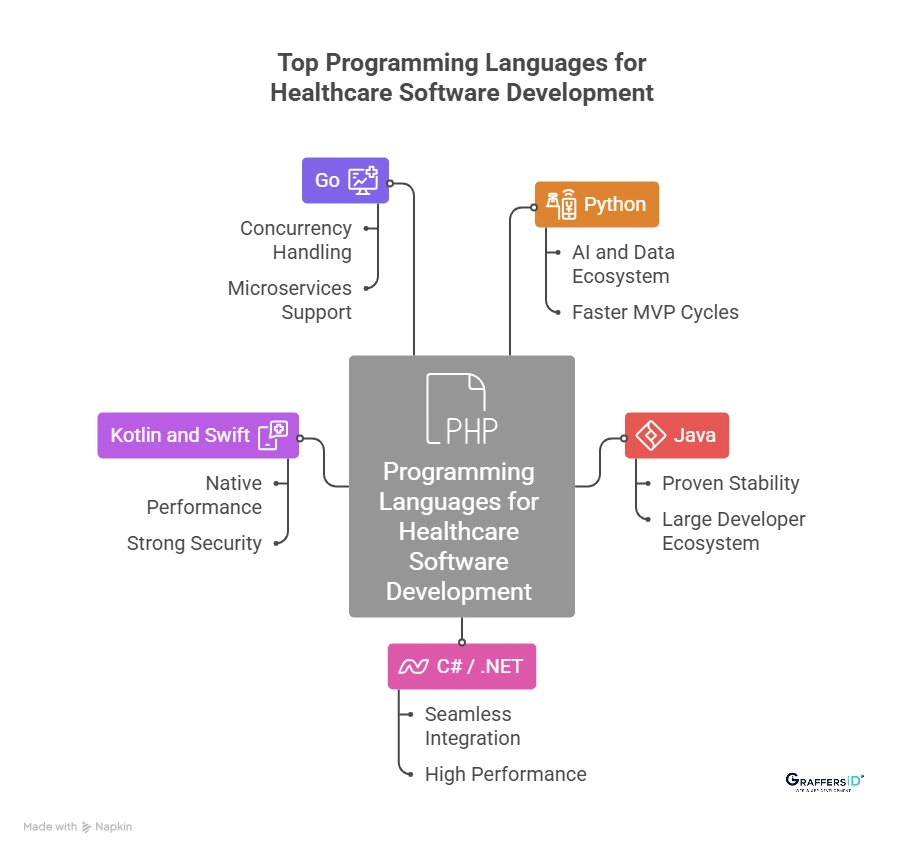
1. Python (AI-Driven Healthcare Applications)
Developed by Guido van Rossum, Python is a high-level, versatile programming language known for simplicity and rapid development. In healthcare, it is widely used for AI-enabled systems and modern backend applications.
Why Python stands out:
- Strong frameworks such as Django and FastAPI enable secure, scalable backend systems.
- An extensive AI and data ecosystem (e.g., TensorFlow, PyTorch) supports predictive healthcare solutions.
- Faster MVP cycles make it ideal for healthtech startups and innovation teams.
Ideal for:
- Predictive analytics and AI-assisted diagnosis
- Clinical dashboards and reporting systems
- Healthcare automation platforms
- Telemedicine backend infrastructure
Best fit: Startups and AI-enabled healthcare platforms looking for flexibility and speed.
2. Java (Enterprise-grade Hospital Management Systems)
Originally developed by Sun Microsystems (now owned by Oracle Corporation), Java has been the backbone of enterprise software for decades. It remains one of the most trusted languages for large-scale hospital systems.
Why Java stands out:
- Proven stability and strong security architecture for regulated environments.
- A large global developer ecosystem ensures long-term maintainability.
- Strong support for healthcare interoperability standards and integrations.
Ideal for:
- Hospital Management Systems (HMS)
- Electronic Health Record (EHR) platforms
- Insurance and third-party system integrations
- Multi-location hospital networks
Best fit: Enterprise hospital infrastructure requiring high scalability and compliance readiness.
3. C# / .NET (Microsoft-Based Healthcare IT Systems)
Created by Microsoft, C# runs on the .NET framework and is widely used in enterprise healthcare environments, especially those built on Microsoft technologies.
Why C# / .NET stands out:
- Seamless integration with Microsoft-based enterprise systems.
- High performance and strong backend capabilities.
- Mature security features suitable for compliance-heavy healthcare applications.
Ideal for:
- Internal hospital portals
- Billing and administrative systems
- Healthcare SaaS platforms
- Enterprise-grade backend services
Best fit: Private hospital chains and health IT systems operating within a Microsoft ecosystem.
4. Kotlin and Swift (Mobile Healthcare App Development)
Kotlin was developed by JetBrains and is officially supported by Google for Android development. Swift was created by Apple Inc. for iOS and macOS applications. Both are modern, secure languages for native mobile healthcare apps.
Why Kotlin and Swift stand out:
- Native performance ensures reliability for medical-grade mobile apps.
- Strong security architecture aligned with mobile data protection standards.
- Deep integration with device features and health sensors.
Ideal for:
- Telemedicine mobile apps
- Remote patient monitoring (RPM) applications
- Doctor-patient communication platforms
- Patient-facing healthcare apps
Best fit: Healthcare products requiring high-performance, secure mobile experiences.
5. Go (High-Performance Healthcare Backend Systems)
Also known as Golang, Go was developed by Google to build scalable and high-performance systems. It has become popular for cloud-native healthcare infrastructure.
Why Go stands out:
- Excellent concurrency handling for high-traffic systems.
- Strong support for microservices and distributed architectures.
- Efficient real-time data processing for healthcare workloads.
Ideal for:
- IoMT (Internet of Medical Things) data systems
- Large-scale healthcare APIs
- High-traffic telehealth platforms
- Real-time monitoring backends
Best fit: Performance-critical healthcare systems requiring scalability and reliability.
Programming Language Comparison for Healthcare Software Development in 2026
| Language | Best Use Case | Scalability | AI Use | EnterpriseUse | Mobile Use |
|---|---|---|---|---|---|
| Python | AI-driven healthcare & automation | High | Very High | Medium | Backend only |
| Java | Hospital management & EHR systems | VeryHigh | Medium | Very High | Android |
| C# / .NET | Hospital portals & admin systems | High | Medium | Very High | Limited |
| Kotlin | Android healthcare mobile apps | High | Medium | High | Yes |
| Swift | iOS healthcare mobile apps | High | Medium | High | Yes |
| Go | High-performance healthcare backends | VeryHigh | Medium | High | Backend only |
- Need AI or automation? Choose Python
- Building a large hospital system? Choose Java or C#
- Developing mobile healthcare apps? Choose Kotlin or Swift
- Handling real-time, high-load systems? Choose Go
Which Programming Language is Best for Your Healthcare Software Project in 2026?
The right programming language depends on the type of healthcare software you’re building, the features you plan to include, and your long-term scalability and compliance goals. Here’s a clear, feature-driven guide to help you decide.
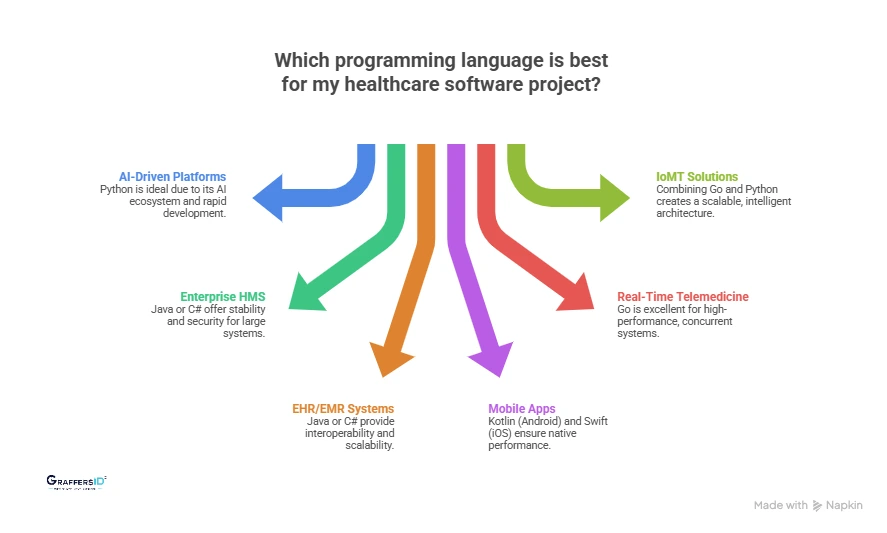
1. AI-Driven Healthcare Platforms
If your product includes AI-assisted diagnosis, predictive analytics, medical data processing, or healthcare automation workflows, Python is the most suitable choice due to its strong AI ecosystem, rapid development speed, and flexibility for data-intensive systems.
2. Enterprise Hospital Management Systems (HMS)
For large, multi-branch hospital systems that handle billing, insurance integrations, staff management, and complex role-based access control, Java or C# (.NET) offer enterprise-grade stability, security architecture, and long-term maintainability.
3. Electronic Health Records (EHR/EMR) Systems
If interoperability, compliance, and integration with lab systems and insurance APIs are critical, Java or C# provide strong support for scalable backend architecture and structured data handling.
4. Patient-Facing Mobile Healthcare Apps
For telemedicine apps, appointment booking platforms, medication tracking, or remote patient engagement tools, Kotlin (Android) and Swift (iOS) ensure native performance, stronger security, and better integration with device capabilities.
5. Real-Time Telemedicine & High-Traffic Systems
If your platform handles live video consultations, concurrent users, or real-time messaging at scale, Go is a strong choice for building high-performance, concurrent backend systems.
6. IoMT & Remote Patient Monitoring Solutions
For systems that process real-time health data from wearables or medical devices, combining Go (for performance) with Python (for analytics or automation layers) creates a scalable and intelligent architecture.
The ideal choice aligns with your product category, feature requirements, compliance needs, and growth roadmap. Selecting the right stack early ensures better security, scalability, and long-term operational stability.
Read More: Top 5 AI Tools in the Healthcare Industry in 2026: Healthcare Automation Trends & Future
Common Healthcare Software Development Mistakes to Avoid in 2026
- Choosing a Programming Language Based on Popularity Instead of Compliance: Many teams select languages because they are trending in the developer community. In healthcare, the priority should be regulatory readiness, security capabilities, and support for standards like HIPAA and FHIR, not popularity alone.
- Ignoring Integration with Existing Healthcare Systems: Healthcare platforms must seamlessly connect with EHR systems, lab software, insurance APIs, and legacy hospital infrastructure. Failing to prioritize interoperability early often leads to costly redevelopment later.
- Overlooking Long-Term Maintainability and Scalability: Healthcare software typically operates for a decade or more. Choosing a language without a strong ecosystem, long-term support, and scalable architecture can create technical debt and operational risks.
- Building Monolithic Systems Instead of Modular Architectures: Rigid, monolithic systems make it difficult to adapt to regulatory changes, feature expansions, or scaling demands. Modern healthcare platforms benefit from modular or microservices-based designs that allow controlled, secure growth.

Final Thoughts: Choosing the Right Programming Language for Healthcare Software in 2026
There is no universal “best” programming language for healthcare software development. The right choice depends on your specific use case, whether you’re building a hospital management system, telemedicine platform, EHR solution, remote patient monitoring app, or healthcare automation software.
The right decision depends on:
- The type of healthcare product you’re developing
- Regulatory and compliance requirements (such as HIPAA and interoperability standards)
- Scalability and performance expectations
- Your existing technology ecosystem and long-term roadmap
In healthcare IT, early architectural decisions directly impact security, compliance readiness, integration capabilities, system reliability, and long-term return on investment. A well-chosen tech stack reduces technical debt, accelerates approvals, and ensures your platform can evolve with changing regulations and patient needs.
If you’re planning to build or modernize a healthcare software solution in 2026, partnering with the right technical team is just as important as choosing the right language.
At GraffersID, our experienced healthtech developers help hospitals, startups, and enterprises design and build secure, scalable, and compliance-ready healthcare solutions tailored to their unique requirements.
Ready to build future-proof healthcare software? Contact GraffersID today and let’s architect the right solution for your vision.